
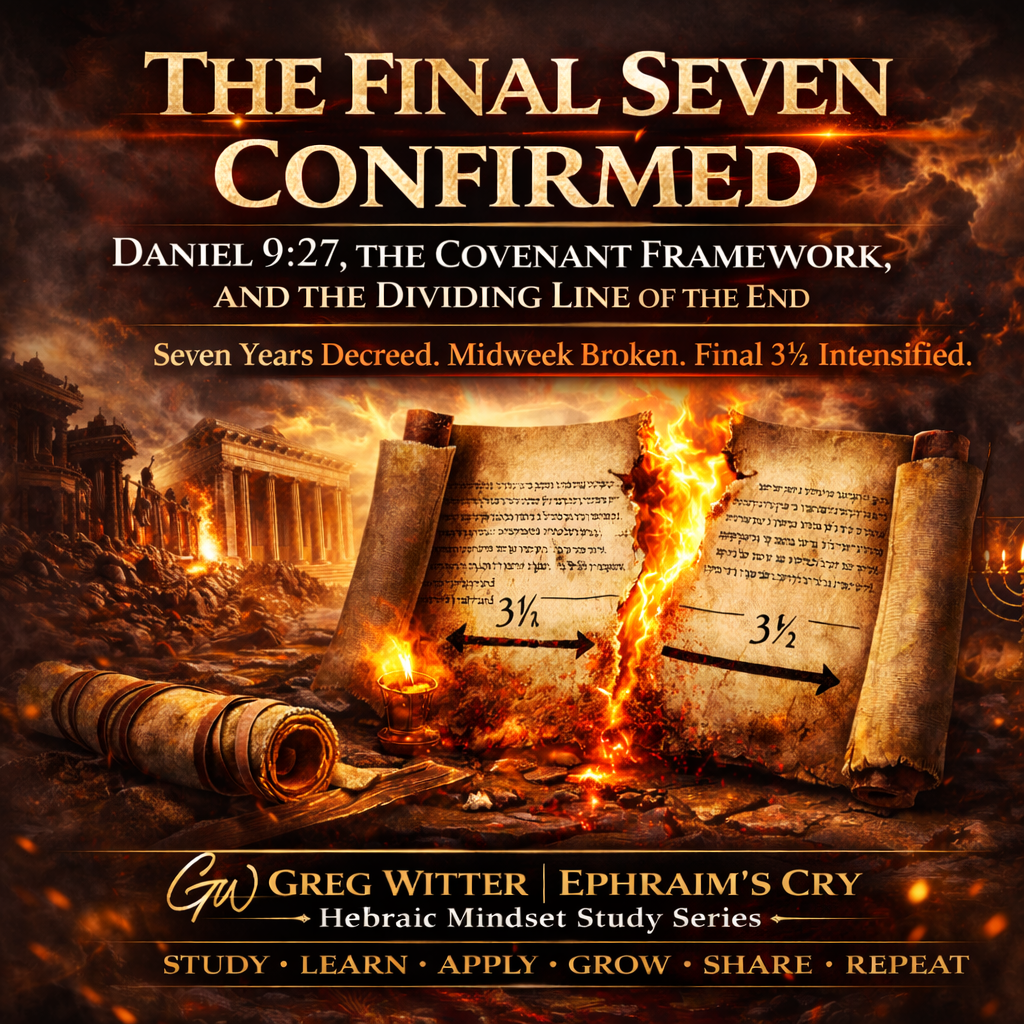
The Final Seven Confirmed
Daniel 9:27, the Covenant Framework, and the Dividing Line of the End
Seven Years Decreed. Midweek Broken. Final 3½ Intensified.
Greg Witter | Ephraim’s Cry
+Hebraic Mindset Study Series
Study Learn Apply Grow Share Repeat
Daniel 9:27 is not a side note. It is not symbolic fog. It is not a devotional metaphor. It is the structural hinge of the end-of-age covenant timeline. If you misplace it, you distort the prophetic framework of Daniel 7–12, the Olivet Discourse of Matthew 24, and the time markers of Revelation 11–13. If you force it into the 1st century, you collapse the internal logic of the text. If you reduce it to only 3½ years, you ignore the covenant week Daniel explicitly records. This teaching rebuilds the passage to maximum covenant clarity—text first, structure intact, no compression, no speculation.
Daniel 9 begins with Daniel praying about the desolations of Jerusalem (Daniel 9:2). Gabriel answers with a decree: “Seventy sevens are determined upon thy people and upon thy set-apart city” (Daniel 9:24). The scope is specific—Israel and Jerusalem. The purpose is covenantal—finish transgression, make an end of sins, make reconciliation for iniquity, bring in everlasting righteousness, seal vision and prophet, anoint the Most Set-Apart (Daniel 9:24). This is not vague spiritual symbolism; it is redemptive history measured in decreed time.
Gabriel then divides the seventy sevens into 7 + 62 + 1 (Daniel 9:25–27). After the sixty-two sevens, Messiah is cut off (Daniel 9:26). Then the city and sanctuary are destroyed by “the people of the prince that shall come” (Daniel 9:26). That phrase introduces a future ruler connected to the destroyer-people. The grammar does not return to Messiah in verse 27; it continues the narrative concerning the coming prince. Verse 27 begins: “And he shall confirm a covenant with many for one week…” The nearest legitimate antecedent is the “prince that shall come,” not Messiah who has already been cut off.
The text states two structural facts: (1) there is one week (seven years) remaining; (2) in the midst of the week sacrifice and offering cease (Daniel 9:27). Midst means middle. Seven divided in half is 3½. This is chronological language. The Hebrew verb for “confirm” is gābar—to make strong, to prevail, to enforce. It does not mean “inaugurate a New Covenant” in redemptive fulfillment. It conveys strengthening or enforcing an existing arrangement. The covenant is confirmed “with many,” suggesting broad participation. The text then ties that covenant to a midweek rupture and to abomination and desolation. Messiah does not enforce a seven-year covenant and then break it midstream with abominations. The structure points to a coming ruler who strengthens a covenant arrangement and then violates it.
The 70-week structure itself contains a visible break. Daniel 9:26 says “after” the sixty-two sevens Messiah is cut off and the city is destroyed; war and desolations continue to the end. Then verse 27 describes the final week. The separation between the sixty-ninth and seventieth week is not invented; it is observed in the text. Messiah’s cutting off and the destruction of Jerusalem occur after the sixty-nine, yet the covenant week of verse 27 still stands as a distinct final segment. That is the internal logic of the prophecy.
Yahusha confirms the forward orientation of Daniel’s abomination. In Matthew 24:15 He says, “When ye therefore shall see the abomination of desolation, spoken of by Daniel the prophet…” He speaks to His disciples about a future sign. He does not point backward to His death. He connects the abomination to unprecedented distress: “For then shall be great tribulation, such as was not since the beginning of the world…” (Matthew 24:21). He then places cosmic signs and His visible return after that tribulation (Matthew 24:29–31). If Daniel 9:27 were exhausted in the 1st century, Matthew 24 collapses, because Yahusha anchors the abomination and great tribulation to the end-of-age sequence culminating in His appearing.
Daniel’s own book reinforces this structure. Daniel 7:25 speaks of the little horn persecuting the set-apart ones for “a time, times, and the dividing of time” (3½ years). Daniel 12:7 repeats the same duration tied to the shattering of the power of the set-apart people. Revelation echoes this with 42 months and 1,260 days (Revelation 11:2–3; 12:6; 13:5). These are not random figures; they align with the latter half of Daniel’s week. Revelation magnifies the intensified 3½-year period of beast authority. Daniel provides the seven-year framework; Revelation zooms into the final half.
The common 70 AD fulfillment claim does not satisfy the text. Daniel 12:1–2 connects the end-time distress with resurrection. Matthew 24:29–31 connects the great tribulation with cosmic disturbance and the gathering at the appearing of the Son of Man. 70 AD does not include global unparalleled distress, cosmic signs, or the visible return. Nor does it resolve the covenant-confirmation language of Daniel 9:27. The text demands more than a localized Roman campaign; it anticipates a covenant-linked midpoint rupture followed by unprecedented persecution and final judgment upon the desolator (Daniel 9:27 end clause).
The covenant-confirmation language also aligns with Daniel 8 and 11. Daniel 8:25 describes a ruler who prospers by peace and destroys many. Daniel 11:23 speaks of a league made with him, after which he works deceitfully. 1 Thessalonians 5:3 warns of “peace and safety” preceding sudden destruction. The pattern is consistent: covenant-like alignment, deceptive stability, midcourse betrayal, intensified persecution, and ultimate judgment.
Daniel 9:27 implies a functioning sacrificial system at the midpoint. Sacrifice and offering must be active to be stopped. Whether that involves a rebuilt temple, an altar, or another authorized structure is debated, but the text assumes operational worship interrupted midweek. This further confirms the forward-looking nature of the prophecy.
The structure, therefore, is covenantal and chronological:
Prophetic Sequence (Structural Overview)
• One week (seven years) confirmed with many (Daniel 9:27)
• Midweek cessation of sacrifice (Daniel 9:27)
• Abomination causing desolation (Daniel 9:27; Matthew 24:15)
• Final 3½ years of beast authority (Daniel 7:25; Revelation 13:5)
• Unmatched tribulation (Matthew 24:21)
• Judgment poured upon the desolator (Daniel 9:27)
• Resurrection and deliverance context (Daniel 12:1–2)
The birth pains Yahusha describes (Matthew 24:4–8) correspond to escalating instability before the midpoint. The great tribulation corresponds to the latter half. The whole period is seven; the intensified final segment is 3½. Precision matters.
This is not about date-setting. It is about covenant discernment. Daniel 9:27 does not merely give a number; it gives a pattern—covenant strengthened, covenant broken, abomination installed, persecution intensified, judgment executed. The remnant is warned to watch for covenant alignment and the abomination marker, not merely for chaos.
Key Clarifications
• Scripture explicitly gives one week (seven years) — Daniel 9:27.
• Scripture repeatedly emphasizes the final 3½ years — Daniel 7:25; Revelation 13:5.
• The abomination is future from Yahusha’s vantage point — Matthew 24:15.
• The 70 AD model does not satisfy the global, cosmic, and resurrection elements.
• The covenant confirmer of verse 27 is the coming prince, not Messiah.
The text stands on its own structure. Daniel gives the framework. Yahusha gives the dividing sign. Revelation gives the intensity window. The final seven is future, covenant-confirmed, midweek-broken, and climaxes in a 3½-year great tribulation before judgment and deliverance.
If we are going to speak prophetically, we must speak textually. Seven total. Midpoint rupture. Final 3½ intensified. That is not tradition; that is structure.
#EphraimsCry, #GregWitter, #Daniel927, #SeventyWeeks, #CovenantConfirmed, #AbominationOfDesolation, #GreatTribulation, #Matthew24, #Revelation13, #Daniel7, #Daniel12, #PropheticStructure, #WatchmanWarning, #TorahAndTestimony, #WholeCounselOfElohim, #EndTimeFramework
