
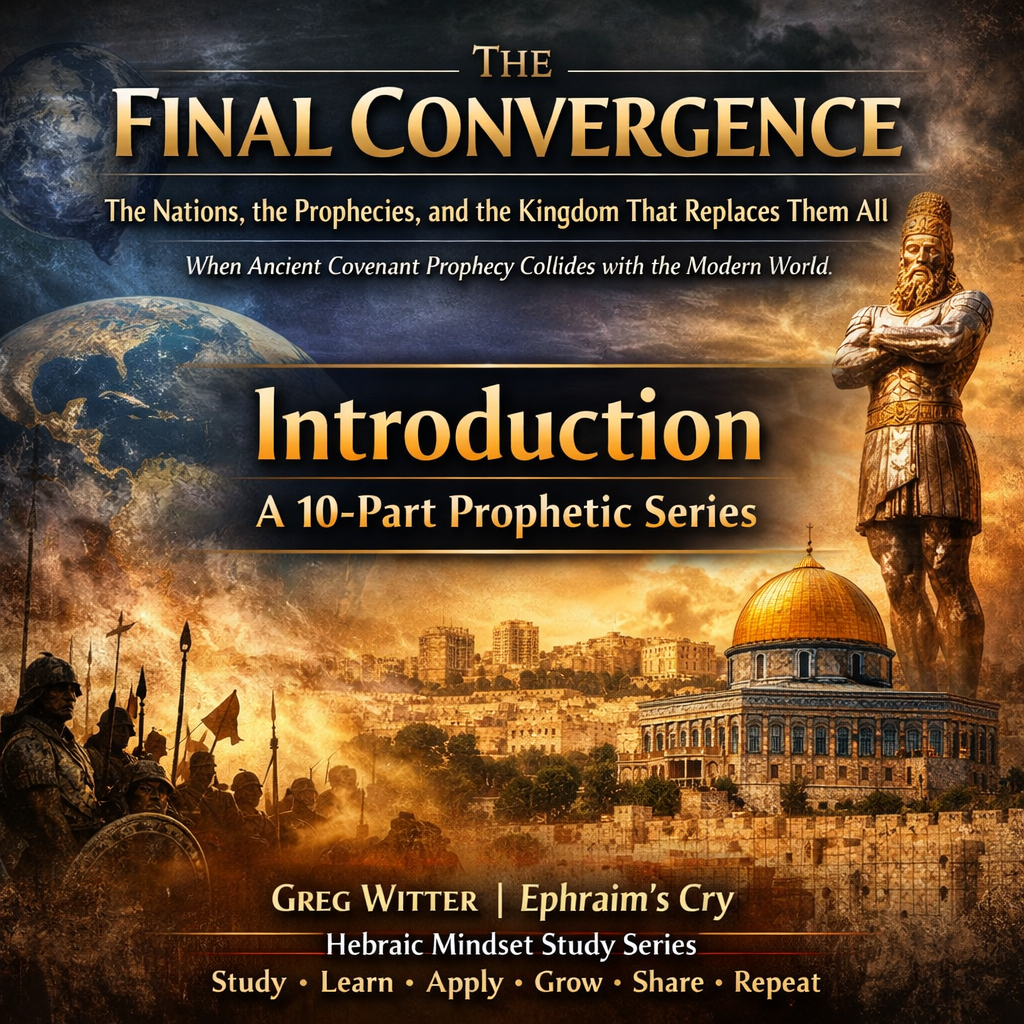
The Final Convergence
The Nations, the Prophecies, and the Kingdom That Replaces Them All
When Ancient Covenant Prophecy Collides with the Modern World
Introduction — A 10-Part Prophetic Series
Greg Witter | Ephraim’s Cry
Hebraic Mindset Study Series
Study Learn Apply Grow Share Repeat
Most people approach prophecy the wrong way.
They begin with the headlines.
A war breaks out. Nations shift alliances. Something happens in the Middle East, and suddenly people begin searching Scripture trying to match verses to the news. Ancient prophecies are forced into modern political maps, assumptions are made about nations the text never names, and speculation quickly replaces careful study.
That method creates more confusion than clarity.
Prophecy was never intended to be interpreted by starting with the newspaper. The prophets did not speak to a future audience reading modern headlines. They spoke within a covenant framework already established in the Torah, the Prophets, and the writings that came before them.
If we want to understand the end of the story, we must begin where the Bible itself begins to establish the structure of the nations.
Genesis.
The Bible lays out the architecture of the world in Genesis 10 through what is commonly called the Table of Nations. After the flood of Noah’s day, the descendants of Shem, Ham, and Japheth spread across the earth and established the early civilizations that would later become the nations known throughout Scripture.
These were not random migrations. They established the geographic and ethnic framework of the ancient world. The names listed there later reappear throughout the prophets when Scripture describes conflicts between nations and the final movements of history.
Magog.
Meshech.
Tubal.
Gomer.
Togarmah.
When Ezekiel later describes a northern coalition rising against Israel in Ezekiel 38–39, those names are not mysterious inventions. They are rooted in the ancient geography established in Genesis.
This is where prophecy must begin.
The prophets speak from within the world defined by Genesis, not the political boundaries drawn by modern governments.
When that foundation is ignored, prophecy becomes speculation. When that foundation is restored, prophecy becomes understandable.
But Genesis does not only establish the map of the nations. It also establishes the conflict that will define history.
The seed war.
From the moment of the fall in Genesis 3, the Scriptures reveal that two lines would move through history in opposition to one another. One line aligned with the covenant promises of Yahuah, and the other aligned with rebellion against His authority.
This conflict appears repeatedly throughout the Scriptures.
It appears in the rebellion of Babel.
It appears in the rise of empires that dominate and persecute the covenant people.
It appears in the destruction of Jerusalem by Rome.
It appears in the emergence of later religious and political systems that reshape the world around the land of Israel.
And ultimately it appears again in the prophetic visions describing the final alignment of nations before the intervention of Yahuah Himself.
This is where the prophecy of Ezekiel 38–39 enters the discussion.
Ezekiel describes a massive coalition of nations gathering from the north and surrounding regions to invade the land of Israel. Many modern interpreters rush to assign modern national names to these ancient peoples, but the text itself focuses on something much more important than modern geopolitics.
The intervention of Yahuah.
The prophecy climaxes not with military victory by any nation, but with divine judgment.
Ezekiel 38:16 declares that Yahuah Himself brings Gog against the land so that the nations will know His authority.
Ezekiel 38:22 describes catastrophic judgment falling upon the invading forces.
Ezekiel 38:23 explains the purpose of the entire event: that Yahuah will magnify Himself before the nations.
In other words, the prophecy is not primarily about who wins a geopolitical conflict.
It is about the moment when the authority of Yahuah is revealed before the nations of the earth.
To understand how that moment develops, we must trace the prophetic architecture that leads up to it.
That is the purpose of this series.
Rather than forcing modern events into isolated verses, this study will walk through the biblical structure step by step, allowing Scripture to interpret Scripture. By doing so, we can begin to see how the prophets describe the movement of history toward a final convergence.
This series will unfold across ten parts, each examining a critical piece of the prophetic structure.
Part 1 will return to Genesis and examine the Table of Nations in detail. Understanding how the descendants of Noah spread across the earth establishes the geographic framework for nearly every prophetic reference to nations that appears later in Scripture.
Part 2 will focus on the covenant land itself. Israel sits at the intersection of three continents, making it one of the most contested regions in history. We will explore why this small territory repeatedly becomes the center of global conflict and how its covenant significance drives the prophetic narrative.
Part 3 will examine the development of the seed war through history, tracing the rise of the major empires described in Scripture and how each of them interacted with the covenant people.
Part 4 will examine the Roman destruction of Jerusalem in 70 AD and the deeper biblical context surrounding that event. This includes examining the role of Edom, the long historical tension between Jacob and Esau, and how that conflict echoes through later prophetic passages.
Part 5 will examine the rise of Islam and the transformation of the Middle Eastern world after the collapse of the Roman order. This shift dramatically altered the political and religious landscape surrounding Israel and continues to influence the region today.
Part 6 will examine the prophecy of Gog and Magog in Ezekiel 38–39 in detail, exploring the nations listed in the text and the pattern of coalition warfare described by the prophet.
Part 7 will examine the legacy of Rome and the development of the modern Western world. The prophetic imagery of Daniel’s statue and the two legs of iron point to a divided continuation of the Roman system that continues to influence global politics.
Part 8 will examine the growing alignment of nations and power structures that appear to be moving toward the type of coalition described by the prophets.
Part 9 will focus on the divine intervention described in Ezekiel, Zechariah, and Revelation, where Yahuah Himself confronts the rebellion of the nations.
Part 10 will conclude the series by examining the ultimate outcome of these events: the establishment of the Kingdom of Elohim and the restoration of covenant order on the earth.
When viewed together, these passages reveal that history is not random.
Empires rise and fall.
Nations form alliances and break them.
Wars reshape the world.
But through it all, the prophets reveal a pattern that moves steadily toward a final convergence.
A moment when the kingdoms of men reach their limits.
And the Kingdom of Yahuah replaces them all.
#GregWitter, #EphraimsCry, #HebraicMindset, #HebraicMindsetStudySeries, #StudyLearnApplyGrowShareRepeat,
#BibleProphecy, #EndTimes, GogAndMagog, #Ezekiel38, #PropheticTimeline, #KingdomOfYahuah
