
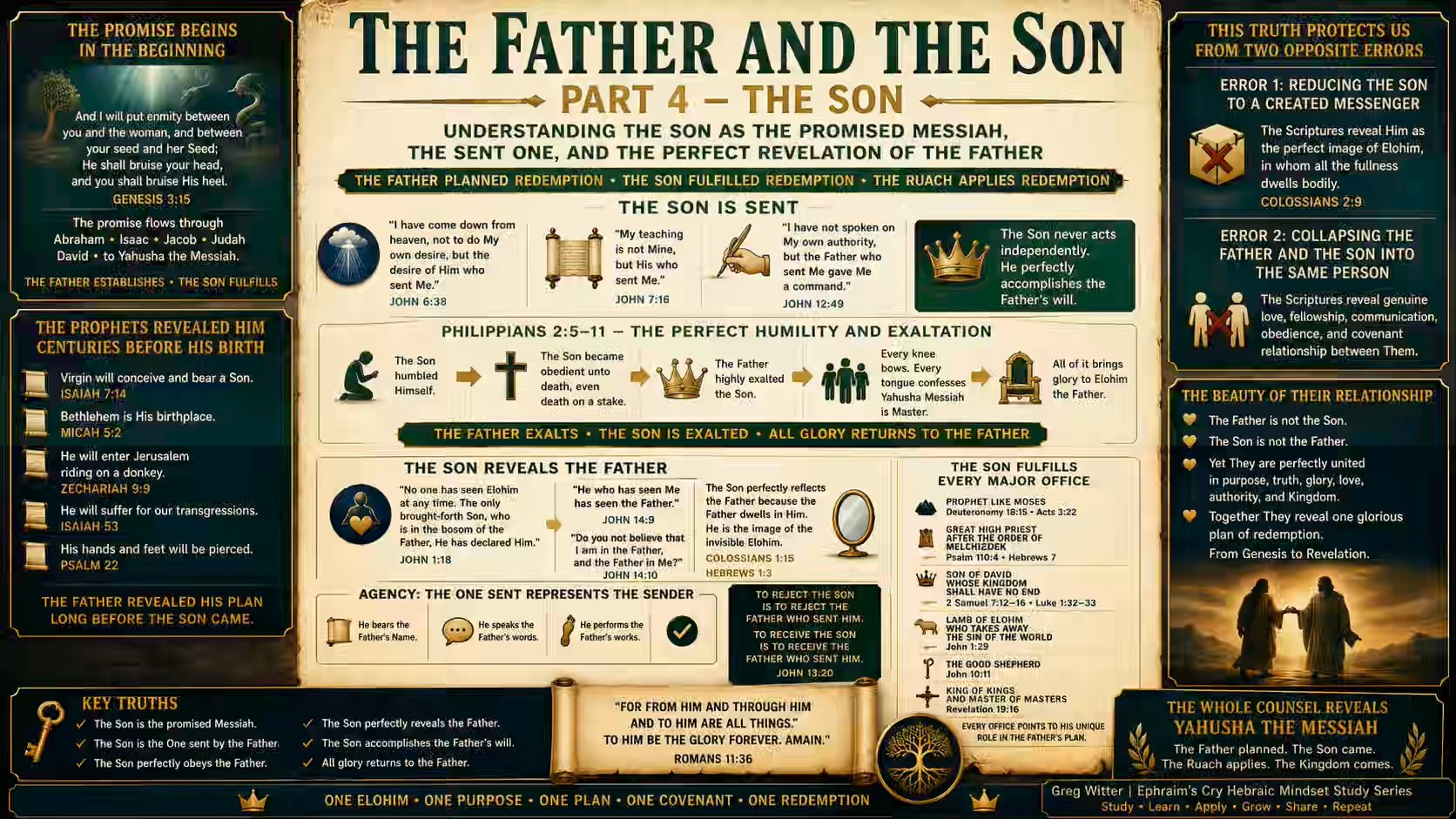
THE FATHER AND THE SON
PART 4 — THE SON
Understanding the Son as the Promised Messiah, the Sent One, and the Perfect Revelation of the Father
From the moment sin entered the world, the Scriptures began revealing the coming of the Son. His appearance in Bethlehem was not the beginning of His account. It was the fulfillment of a plan established before the foundation of the world. From Genesis through Revelation, the Scriptures progressively reveal the identity, mission, authority, and purpose of Yahusha the Messiah. He is the promised Seed, the Kinsman-Redeemer, the Prophet like Moses, the suffering Servant, the great High Priest, the righteous King, and the coming Judge. Every one of these offices reveals another aspect of His mission, yet none of them ever identify Him as the Father. Rather, they consistently reveal Him as the One sent by the Father to accomplish the Father’s redemptive plan.
The first promise of Messiah appears immediately after the fall. In Bereshith (Genesis) 3:15, Yahuah declared that the Seed of the woman would crush the serpent’s head while the serpent would bruise His heel. From that moment forward, all of Scripture begins tracing the covenant line through which the Messiah would come. The promise passes through Abraham, Isaac, Jacob, Judah, David, and ultimately to Yahusha. The Father establishes the covenant. The Son fulfills the covenant.
The Prophets continued to reveal the coming Messiah in remarkable detail. Isaiah spoke of the virgin conceiving and bearing a Son (Isaiah 7:14). Micah identified Bethlehem as His birthplace (Micah 5:2). Zechariah foretold His entry into Jerusalem riding upon a donkey (Zechariah 9:9). Isaiah 53 described His suffering centuries before the crucifixion. David wrote of His hands and feet being pierced (Psalm 22). None of these prophecies appeared by accident. The Father revealed His plan long before the Son entered history to fulfill it.
Yahusha repeatedly identified Himself as the One sent by the Father. This becomes one of the defining characteristics of His ministry. He never claimed independence from the Father. Instead, He continually pointed people back to the One who sent Him.
“I have come down from heaven, not to do My own desire, but the desire of Him who sent Me.” (John 6:38)
“My teaching is not Mine, but His who sent Me.” (John 7:16)
“I have not spoken on My own authority, but the Father who sent Me gave Me a command, what I should say and what I should speak.” (John 12:49)
These statements do not diminish Yahusha. They magnify His perfect obedience. They reveal the absolute harmony that exists between the Father and the Son. The Son is never acting independently because Their purposes are perfectly united.
One of the greatest misunderstandings in this discussion concerns the Son’s submission to the Father. Some conclude that because the Son obeys the Father, He must therefore be less than the Father in nature. That conclusion simply does not follow. Submission within a covenant relationship does not establish inferiority. Throughout Scripture, authority and submission exist without implying inequality of worth or value. Yahusha’sobedience demonstrates His perfection, not His inferiority.
Philippians 2 presents one of the clearest pictures of this humility. Although existing in the form of Elohim, Yahusha humbled Himself, took upon Himself the form of a servant, and became obedient unto death—even death on the stake. Therefore Elohim highly exalted Him and gave Him the Name above every name, that at the Name of Yahusha every knee should bow and every tongue confess that Yahusha Messiah is Master, to the glory of Elohim the Father (Philippians 2:5–11).
Notice the beautiful order revealed in this passage.
The Son humbles Himself.
The Father exalts the Son.
Every knee bows before the Son.
Every tongue confesses the Son.
All of it brings glory to the Father.
Nothing in this passage creates competition between the Father and the Son. Everything reveals perfect unity and perfect covenant order.
The Scriptures also reveal Yahusha as the perfect revelation of the Father.
John writes,
“No one has seen Elohim at any time. The only brought-forth Son, who is in the bosom of the Father, He has declared Him.” (John 1:18)
Later Yahusha tells Philip,
“He who has seen Me has seen the Father.” (John 14:9)
Many stop reading at that statement and conclude that Yahusha is saying He is the Father Himself. But Yahusha immediately continues,
“Do you not believe that I am in the Father, and the Father in Me?” (John 14:10)
The context explains the statement. Yahusha perfectly reveals the Father because the Father dwells in Him and works through Him. He is the visible image of the invisible Elohim (Colossians 1:15). He is the exact representation of His being (Hebrews 1:3). He reveals the Father’s character perfectly because He perfectly reflects the Father’s nature. Representation does not eliminate relationship.
This is where the Hebraic principle of agency begins to emerge. The one sent fully represents the sender. The Son bears the Father’s Name, speaks the Father’s words, performs the Father’s works, and accomplishes the Father’s will. To reject the Son is to reject the Father who sent Him. To receive the Son is to receive the Father who sent Him (John 13:20). This is not confusion of persons. It is perfect representation through covenant agency.
Yahusha also fulfills every major office revealed in the Scriptures.
He is the Prophet like Moses (Deuteronomy 18:15; Acts 3:22).
He is the Great High Priest after the order of Melchizedek (Psalm 110:4; Hebrews 7).
He is the Son of David whose Kingdom shall have no end (2 Samuel 7:12–16; Luke 1:32–33).
He is the Lamb of Elohim who takes away the sin of the world (John 1:29).
He is the Good Shepherd (John 10:11).
He is the coming King of kings and Master of masters (Revelation 19:16).
Every office points to His unique role in the Father’s plan of redemption.
The Son did not come to replace the Father.
The Son came to reveal the Father.
The Son did not come to glorify Himself.
The Son came to glorify the Father.
The Father did not send the Son because They were divided.
The Father sent the Son because They were perfectly united in one eternal purpose before the foundation of the world.
This truth protects us from two opposite errors.
It prevents us from reducing Yahusha to a mere created messenger, for the Scriptures reveal Him as the perfect image of the invisible Elohim, the One in whom all the fullness dwells bodily (Colossians 2:9).
It also prevents us from collapsing the Father and the Son into the same person, for the Scriptures consistently reveal genuine love, genuine fellowship, genuine communication, genuine obedience, and genuine covenant relationship between Them.
The Son is exactly who the Father revealed Him to be.
The promised Messiah.
The Kinsman-Redeemer.
The perfect Servant.
The perfect Son.
The perfect revelation of the Father.
The One through whom the Father is making all things new.
The Father is not the Son.
The Son is not the Father.
Yet together They reveal one glorious plan of redemption that has been unfolding from Genesis to Revelation through the wisdom, love, and faithfulness of Elohim.
Greg Witter | Ephraim’s Cry Hebraic Mindset Study Series
Study • Learn • Apply • Grow • Share • Repeat
#EphraimsCry #GregWitter #HebraicMindset #HebraicMindsetStudySeries #FatherAndSon #Yahusha #Messiah #KinsmanRedeemer
#Prophet #HighPriest #KingOfKings #LambOfElohim #WholeCounselOfElohim #Torah #Prophets #Writings #ApostolicWitness
#John14 #John1 #Philippians2 #Hebrews1 #Colossians1 #Colossians2 #KingdomOfElohim #GospelOfTheKingdom
#ScriptureInterpretsScripture #TruthMatters #StudyLearnApplyGrowShareRepeat
