
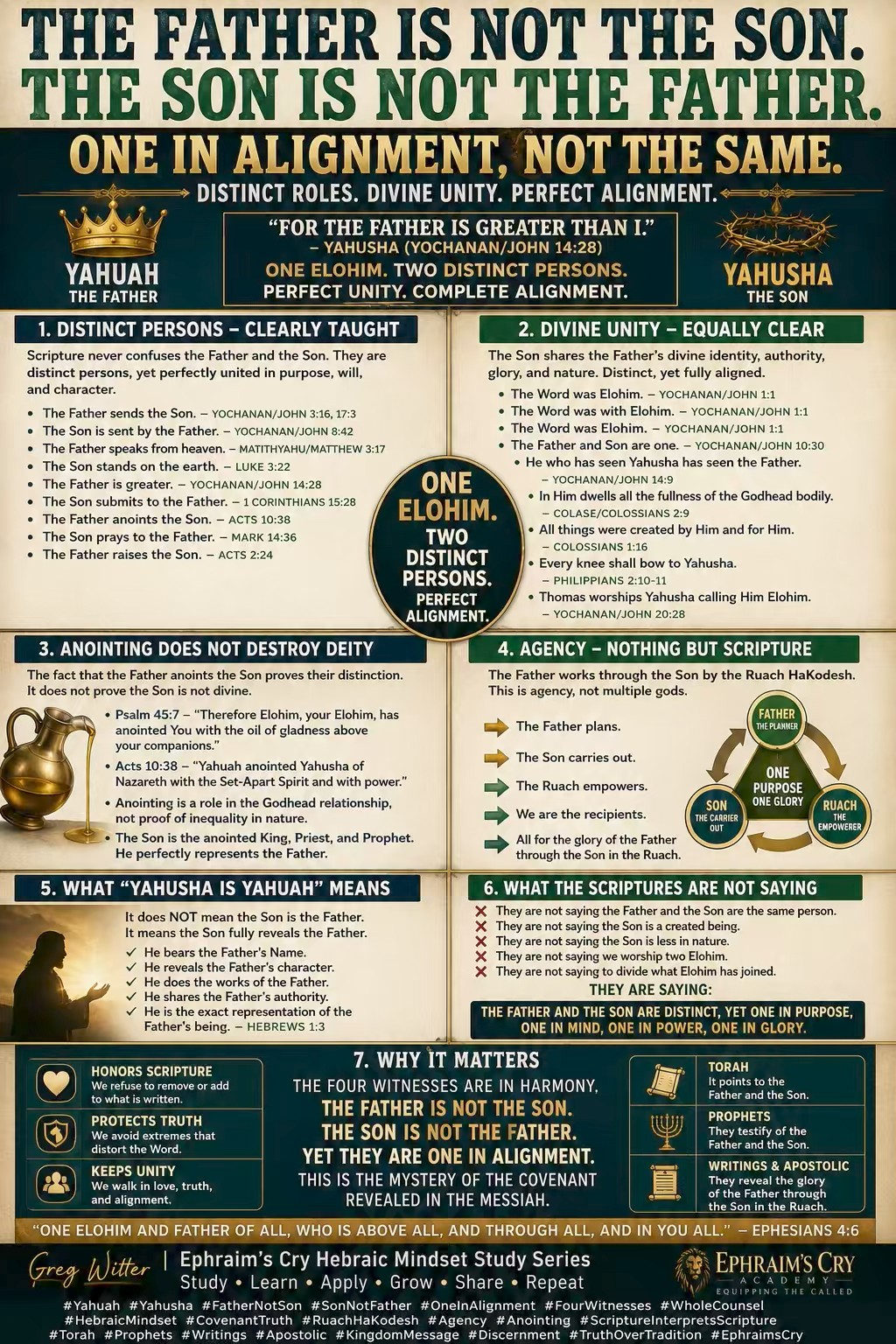
THE FATHER AND THE SON
PART 15 — THE DIVINE COUNCIL OF ELOHIM
Restoring the Biblical Relationship Through the Whole Counsel of Elohim
Understanding the Heavenly Government of the Kingdom
One Supreme King. One Heavenly Council. One Kingdom Administered According to His Will.
Scripture Reading
Torah: Genesis 1:26–27; Genesis 3:22; Genesis 11:7
Prophets: 1 Kings 22:19–23; Isaiah 6:1–8; Isaiah 43:10–13; Isaiah 44:24; Isaiah 45:5–7; Daniel 7:9–14
Writings: Job 1:6–12; Job 2:1–7; Psalm 82; Psalm 89:5–8; Psalm 103:19–21
Apostolic Witness: John 5:19–30; John 7:16; John 8:28–29; John 12:49–50; Colossians 1:15–20; Revelation 4–5
Introduction
Throughout this study we have restored the biblical relationship between the Father and the Son by allowing the Torah, the Prophets, the Writings, and the Apostolic Witness to interpret one another. We have seen that the Father is the Supreme Elohim, that Yahusha is the Son whom the Father sent, and that the principle of agency explains many passages that have often been misunderstood.
As we conclude this series, one final subject helps bring these truths together—the Divine Council of Elohim.
This lesson is intentionally an introduction rather than a complete study. The subject is too broad to exhaust in a single chapter and deserves an entire Hebraic Mindset Study Series of its own. Nevertheless, understanding the Divine Council provides an important framework for interpreting many passages concerning the Father and the Son while preserving the absolute supremacy of the Father and the unique mission of His Son.
The Divine Council Reveals the Government of the Kingdom
Scripture consistently reveals Yahuah as the Supreme King seated upon His heavenly throne. He alone is the Creator, the Most High, and the Sovereign over heaven and earth. Yet the Scriptures also reveal that He governs His Kingdom through an ordered heavenly administration.
Genesis introduces this pattern with statements such as, “Let Us make man in Our image” (Genesis 1:26), “The man has become like one of Us” (Genesis 3:22), and “Come, let Us go down” (Genesis 11:7). Isaiah records Yahuah saying, “Whom shall I send, and who will go for Us?” (Isaiah 6:8).
Rather than forcing these passages into later theological systems, the whole counsel of Elohim reveals that Yahuah is speaking within the context of His heavenly government while remaining the only Creator (Isaiah 44:24).
The Heavenly Throne Room Bears a Consistent Witness
Scripture repeatedly allows us to see the heavenly throne room.
Micaiah saw Yahuah seated upon His throne with the host of heaven standing before Him (1 Kings 22:19–23).
Job records the sons of Elohim presenting themselves before Yahuah (Job 1–2).
Isaiah saw Yahuah high and lifted up while the seraphim proclaimed His holiness (Isaiah 6:1–8).
Daniel saw the Ancient of Days seated in judgment while thousands upon thousands ministered before Him (Daniel 7:9–10).
John saw the heavenly throne surrounded by living creatures, elders, and innumerable heavenly beings worshiping the One seated upon the throne and the Lamb (Revelation 4–5).
These passages are not isolated events. Together they reveal the orderly government of the Kingdom of Elohim.
The Divine Council Supports the Principle of Agency
Throughout this series we have repeatedly seen the biblical principle of agency.
Yahuah sends representatives who act with delegated authority while always remaining subject to the One who sent them.
This pattern is seen in prophets, judges, priests, kings, messengers, and ultimately in Yahusha Himself.
Yahusha repeatedly declared that He came not to do His own will but the will of the Father who sent Him (John 5:19–30; John 6:38).
He spoke the Father’s words (John 7:16).
He did the Father’s works (John 14:10).
He received authority from the Father (Matthew 28:18).
The Divine Council illustrates this same Kingdom pattern of delegated authority, faithful service, and perfect submission to the Supreme King.
One Supreme Elohim
The Divine Council never diminishes biblical monotheism.
Scripture never presents the members of the heavenly council as equal to Yahuah.
They are created heavenly beings who worship Him, obey Him, serve Him, and remain accountable to Him.
Yahuah alone is the Most High.
Yahuah alone is the Creator.
Yahuah alone is worthy of absolute worship.
The Father alone is the source of all authority.
Everything else derives its authority from Him.
Bringing the Four Witnesses Together
The Torah introduces the heavenly government.
The Prophets reveal its operation.
The Writings celebrate it.
The Apostolic Witness confirms it.
Understanding the Divine Council strengthens everything we have learned throughout this study concerning the Father and the Son. It provides biblical context for passages that have often been misunderstood, reinforces the principle of agency, demonstrates the perfect order of the Kingdom, and preserves the consistent testimony that the Father alone is the Supreme Elohim while Yahusha is His Anointed Son and Messiah.
Conclusion
The Divine Council is not a separate doctrine disconnected from the Father and the Son. It provides another witness to the order of the Kingdom of Elohim and helps explain many passages that have puzzled students of Scripture for centuries.
As we conclude this study, we recognize that this chapter serves only as an introduction. The subject is too extensive to be treated fully here.
Our next major Hebraic Mindset Study Series will examine the Divine Council in depth, tracing this theme from Genesis through Revelation and allowing the whole counsel of Elohim to reveal the heavenly government of His eternal Kingdom.
Until then, let us continue to test every doctrine, every tradition, and every theological system against the testimony of the Torah, the Prophets, the Writings, and the Apostolic Witness, allowing Scripture to interpret Scripture and giving all glory to the Father through His Son, Yahusha the Messiah.
Greg Witter | Ephraim’s Cry Hebraic Mindset Study Series | Study • Learn • Apply • Grow • Share • Repeat
#EphraimsCry #HebraicMindset #WholeCounselOfElohim #TheFatherAndTheSon #GospelOfTheKingdom
#ReturnToCovenant #KingdomOfElohim #Torah #Prophets #Writings #ApostolicWitness #ScriptureInterpretsScripture
#BibleStudy #Discipleship #TruthSeekers #Watchman #DivineCouncil #HeavenlyCouncil #KingdomGovernment
