
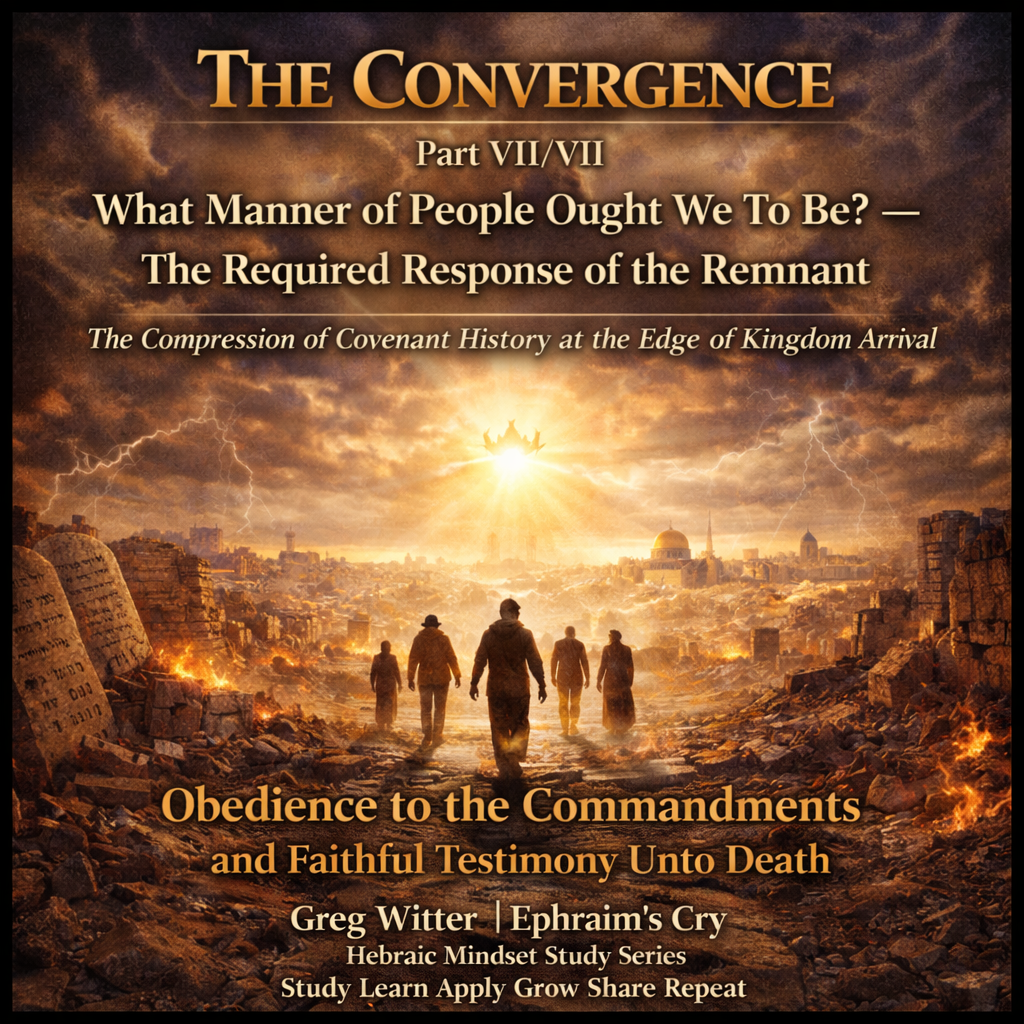
THE CONVERGENCE
Part VII/VII — What Ma of People Ought We To Be?
The Required Response of the Remnant
The Compression of Covenant History at the Edge of Kingdom Arrival
Obedience to the Commandments and Faithful Testimony Unto Death
Greg Witter | Ephraim’s Cry
Hebraic Mindset Study Series
Study Learn Apply Grow Share Repeat
INTRODUCTION — WHEN PROPHECY TURNS FROM EVENTS TO PEOPLE
We have walked the structure.
We have traced the alignment.
We have watched the systems compress.
We have seen counterfeit authority rise.
We have seen shaking expose instability.
We have seen separation clarify allegiance.
Now revelation turns and looks at us.
“What manner of people ought we to be?” (2 Peter 3:11)
Peter did not ask that question in a moment of comfort. He asked it while describing the collapse of the present order. In the verses immediately before this question, Peter speaks of the heavens passing away with a roar and the elements melting with fervent heat. The world as it currently operates will not endure forever.
Peter’s conclusion was not speculation about timelines. It was transformation of life.
Knowing what is coming demands becoming something different.
The purpose of prophetic revelation is not curiosity. It is formation. When Scripture reveals where history is moving, it also demands that the covenant people align their lives accordingly.
The Convergence we have traced through this series is therefore not merely informational. It is confrontational. It presses upon every reader the same unavoidable question: If the age is compressing toward visible allegiance, then what kind of people must we become?
THE CONVERGENCE IS A SUMMONS
The Convergence is not information.
It is summons.
Throughout this series we have traced the structural alignment of the age. Economic systems move toward centralized control. Cultural narratives redefine truth. Lawlessness becomes normalized. Counterfeit authority rises and demands loyalty.
These developments are not random. They are the culmination of long-standing trajectories in rebellion against the authority of Elohim.
But prophecy never reveals these things merely to satisfy curiosity. Prophecy exposes them so the covenant people will recognize the moment and respond accordingly.
If the age is compressing toward visible allegiance, then hidden compromise will not survive.
If counterfeit authority will demand worship, then diluted obedience will collapse.
If endurance defines the saints, then emotional enthusiasm will not carry you.
Covenant loyalty will.
This is where the series lands: not in prediction, but in formation.
THE DIAGNOSTIC MARK OF THE REMNANT
Revelation 14:12 gives the diagnostic clarity of the remnant:
“Here is the endurance of the saints: those who keep the commandments of Elohim and the testimony of Yahusha.”
That phrase is not ornamental theology. It is legal identity.
Keep — guard, preserve, protect, obey.
Commandments — instruction rooted in covenant.
Testimony — witness to Messiah’s authority and kingship.
The remnant are not defined by the intensity of their opinions. They are defined by covenant continuity under pressure.
The commandments of Elohim represent the covenant constitution given through Torah. The testimony of Yahusha represents the authority of the Messiah who fulfills and embodies that covenant.
The two cannot be separated. Torah without Messiah becomes legalism. Messiah without Torah becomes lawlessness.
The remnant hold both.
They obey the commandments of Elohim.
They bear witness to Yahusha as King.
This combination is precisely why they are opposed by the systems of the world.
THE REMNANT PATTERN THROUGHOUT SCRIPTURE
The concept of a remnant did not originate in the book of Revelation. It is a pattern that appears repeatedly throughout Scripture.
In the days of Noah, the entire world had turned toward corruption. Violence filled the earth, and humanity’s rebellion had reached such intensity that judgment became inevitable.
Yet even in that moment, a remnant remained.
“Noah found favor in the eyes of Yahuah.” (Genesis 6:8)
Eight people entered the ark. The rest of the world continued its rebellion until judgment arrived.
The pattern appears again in the days of Elijah. When the prophet believed he stood alone against the corruption of Israel, Yahuah revealed that seven thousand had not bowed the knee to Baal.
The pattern appears again in the Babylonian exile. While the nation was scattered and Jerusalem lay in ruins, a remnant returned to rebuild the covenant community.
The pattern appears again in the early ekklesia. While the religious establishment rejected the Messiah, a faithful remnant recognized Him and proclaimed His authority.
The existence of a remnant is therefore not an anomaly of the end times. It is the consistent method by which Yahuah preserves covenant faithfulness in every generation.
The end of the age does not invent the remnant.
It reveals it.
COVENANT WALKING — THE HEBREW CONCEPT OF HALAK
The Hebrew concept of walking — halak — is critical here.
Covenant obedience was never abstract. It was patterned life.
When Scripture describes walking with Elohim, it does not refer merely to intellectual agreement. It refers to a way of life shaped by covenant instruction.
Enoch walked with Elohim.
Abraham walked before Elohim.
Israel was commanded to walk in His statutes.
This concept appears repeatedly throughout Torah and the Prophets.
Deuteronomy 6 commands that covenant instruction be spoken continually.
“You shall teach them diligently to your children, and speak of them when you sit in your house, when you walk along the way, when you lie down, and when you rise up.”
Covenant identity is daily rhythm, not crisis performance.
This is why the remnant endure. Their obedience is not situational. It is habitual. Their lives are already aligned with covenant instruction before pressure arrives.
Endurance in crisis is built through daily obedience in ordinary moments.
LOVE OF TRUTH VERSUS STRONG DELUSION
The falling away described in 2 Thessalonians is not simply about deception. It is about affection.
Paul explains that strong delusion comes upon those who “did not love the truth.”
Not those who lacked access to it.
Those who did not love it.
Love of truth is revealed when truth costs you something.
When truth threatens reputation.
When truth threatens security.
When truth threatens comfort.
At that moment, affection is exposed. People do not abandon truth merely because they misunderstand it. They abandon it because they prefer something else more.
The remnant, however, love the truth more than the comforts that compromise might provide.
That love anchors their endurance.
THE REFUSAL OF NEUTRALITY
The age ahead will not primarily test knowledge.
It will test allegiance.
Scripture consistently rejects the illusion of neutrality.
Yahusha said plainly:
“He who is not with Me is against Me.” (Matthew 12:30)
As convergence intensifies, the middle ground disappears. Cultural neutrality collapses. Institutions demand loyalty. Systems require participation.
In such an environment, silence itself becomes a form of allegiance.
The remnant cannot remain neutral because the covenant does not permit neutrality.
Covenant identity demands loyalty.
THE BRIDE PREPARED
Scripture also describes the covenant people as a bride.
Throughout the prophets, Israel is portrayed as the bride of Yahuah. In the Apostolic writings, the ekklesia is described as the bride of Messiah.
The culmination of history includes a wedding.
“The marriage of the Lamb has come, and His bride has made herself ready.” (Revelation 19:7)
Notice the wording.
The bride makes herself ready.
Preparation precedes celebration.
Refinement precedes union.
The endurance of the remnant is therefore not merely survival. It is preparation. Through obedience, faithfulness, and perseverance, the bride is made ready for the return of the King.
FAITHFUL UNTO DEATH — THE CROWN OF LIFE
Scripture does not hide the cost of covenant loyalty.
The endurance of the remnant is not romanticized courage. It is the willingness to remain faithful even when obedience carries consequences.
Yahusha spoke plainly to the ekklesia in Smyrna.
“Do not fear any of those things which you are about to suffer… Be faithful unto death, and I will give you the crown of life.” (Revelation 2:10)
Faithfulness unto death is not a call to reckless martyrdom. It is a declaration that covenant allegiance cannot be negotiated.
The crown of life represents vindication. It represents the public recognition of those who refused to surrender their loyalty even when pressure intensified.
James echoes the same promise.
“Blessed is the man who endures temptation; for when he has been approved, he will receive the crown of life which Yahuah has promised to those who love Him.” (James 1:12)
Notice again the connection between endurance and love.
Those who love Elohim remain loyal when testing comes. Their obedience does not depend upon comfort or security. It flows from covenant devotion.
The remnant therefore understand that endurance is not optional. It is the pathway through which faithfulness is proven.
KINGDOM CITIZENSHIP — LOYALTY TO A DIFFERENT AUTHORITY
One of the reasons the remnant cannot fully integrate into the systems of the world is that their ultimate citizenship lies elsewhere.
Paul explained this reality clearly.
“Our citizenship is in heaven, from which we also eagerly wait for the Savior, the Master Yahusha Messiah.” (Philippians 3:20)
Citizenship determines allegiance. It determines which authority ultimately governs a person’s loyalty.
The kingdoms of the earth demand submission to their authority structures. They expect participation in their economic systems, their moral frameworks, and their political loyalties.
But the remnant recognize that their highest allegiance belongs to the Kingdom of Elohim.
This does not make them anarchists or rebels against legitimate authority. Scripture consistently calls believers to live honorably and peaceably within society whenever possible.
However, when earthly authority demands allegiance that contradicts the covenant, the remnant follow the example of the apostles.
“We must obey Elohim rather than men.” (Acts 5:29)
The distinction between earthly citizenship and heavenly citizenship becomes increasingly visible as convergence intensifies.
THE KINGDOM TRANSFER — DANIEL’S VISION FULFILLED
Prophecy does not end with persecution. It ends with kingdom transfer.
Daniel was shown a vision of four beastly empires rising from the sea. These empires represent the successive systems of human power that dominate history.
But Daniel also saw something else.
He saw the courtroom of heaven.
“I watched till thrones were put in place, and the Ancient of Days was seated.” (Daniel 7:9)
The scene is unmistakably judicial. Thrones are set. The court is seated. The books are opened.
After judgment is pronounced, authority shifts.
“The court shall sit in judgment, and his dominion shall be taken away.” (Daniel 7:26)
Then comes the astonishing declaration.
“Then the kingdom and dominion, and the greatness of the kingdoms under the whole heaven, shall be given to the people of the saints of the Most High.” (Daniel 7:27)
The kingdoms of the world do not endure indefinitely. Their authority is temporary. Their power is borrowed.
The kingdom of Elohim, however, is permanent.
The remnant endure the furnace not merely to survive it, but to inherit what comes afterward.
THE KINGDOM THAT CANNOT BE SHAKEN
Throughout this series we have examined the shaking of the nations.
Political systems fracture.
Economic structures shift.
Cultural narratives collapse.
These developments can produce fear if they are viewed merely as instability. But Scripture provides a different interpretation.
Hebrews explains that the shaking has purpose.
“Yet once more I shake not only the earth, but also heaven.” (Hebrews 12:26)
The purpose of the shaking is to remove what cannot endure.
“Now this phrase, ‘Yet once more,’ indicates the removal of those things that are being shaken… that the things which cannot be shaken may remain.” (Hebrews 12:27)
The shaking of the age therefore reveals foundations.
Anything built upon deception, exploitation, or rebellion will ultimately collapse.
But the Kingdom of Elohim stands beyond the reach of that shaking.
Hebrews concludes with a powerful declaration.
“Therefore, since we are receiving a kingdom which cannot be shaken, let us have grace.” (Hebrews 12:28)
The remnant are not anchored to temporary structures. They are anchored to an unshakable kingdom.
THE FINAL QUESTION
All of this leads back to Peter’s question.
“What manner of people ought we to be?” (2 Peter 3:11)
The question is not rhetorical. It is practical.
If the world is moving toward visible allegiance, then the lives of the covenant people must reflect visible loyalty.
If deception will intensify, then discernment must deepen.
If pressure will increase, then endurance must strengthen.
If counterfeit authority will demand submission, then covenant loyalty must already be settled.
The remnant do not improvise faithfulness in crisis. They cultivate it long before the crisis arrives.
THE CHARACTER OF THE REMNANT
So what kind of people must we become?
People whose obedience is not conditional on comfort.
People whose testimony does not retreat under accusation.
People who refuse to rename evil good because culture demands it.
People who refuse to redefine righteousness because authority pressures it.
People who love truth enough to endure its cost.
People who recognize the authority of Yahusha not merely with words, but with their lives.
These characteristics are not extraordinary heroism. They are covenant faithfulness.
THE FINAL CHARGE
The Convergence series therefore does not end with a dramatic prediction.
It ends with a sober charge.
We must walk what we proclaim.
We must guard what we confess.
We must endure without bitterness.
We must refuse to trade covenant loyalty for cultural approval.
If we know these things — if we see the convergence — then our lives must align accordingly.
The age will not be navigated by emotional intensity.
It will be navigated by covenant clarity.
Only one Kingdom cannot be shaken.
Only one Name carries eternal authority.
Only one Head remains when counterfeit crowns fall.
So the question stands, not to frighten, but to refine.
What manner of people ought we to be?
People who keep the commandments of Elohim.
People who hold the testimony of Yahusha.
People who endure to the end.
That is not extremism.
It is covenant faithfulness at the edge of Kingdom arrival.
#TheConvergence, #PartVII, #WhatMannerOfPeople, #CovenantResponse, #Endurance, #TorahAndTestimony, #Revelation1412, #Revelation1211, #2Peter3, #Micah68, #Psalm15, #Emunah, #KingdomAllegiance, #FaithfulUntoDeath, #RemnantIdentity, #WalkInObedience, #NoNeutralGround, #UnshakableKingdom, #HebraicMindset, #EphraimsCry, #GregWitter
