
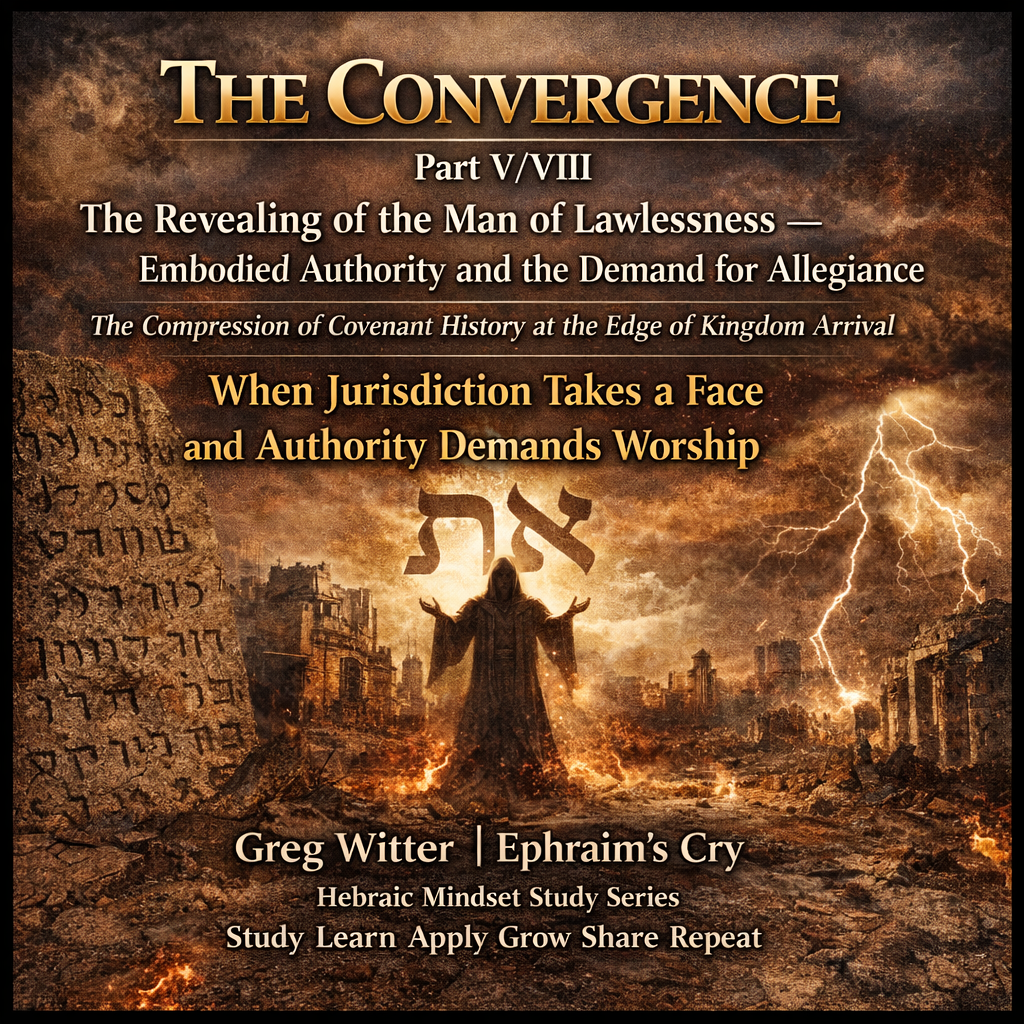
The Convergence
Part V/VII The Revealing of the Man of Lawlessness — Embodied Authority and the Demand for Allegiance
The Compression of Covenant History at the Edge of Kingdom Arrival
When Jurisdiction Takes a Face and Authority Demands Worship
Greg Witter | Ephraim’s Cry
Hebraic Mindset Study Series
Study Learn Apply Grow Share Repeat
Part I established structural alignment.
Part II exposed economic allegiance.
Part III revealed shaking as covenant litigation.
Part IV demonstrated lawlessness maturing as atmosphere.
Part V now brings the unavoidable development into view: when lawlessness, having matured institutionally and culturally, becomes embodied in authority.
Scripture does not end the age with abstract chaos. It ends it with jurisdiction. It ends it with headship. It ends it with a visible authority demanding visible allegiance.
The apostle Paul writes in 2 Thessalonians 2:3–4 that the falling away must come first, and then the man of lawlessness is revealed, the son of destruction, who opposes and exalts himself above all that is called Elohim or that is worshiped, so that he sits as Elohim in the temple, displaying himself as if he were Elohim.
This is not mythology. It is covenant continuity.
From Genesis forward, rebellion has always sought embodied authority. The serpent did not merely whisper ideas; he offered jurisdiction — “you shall be like Elohim.” The Tower of Babel did not merely construct bricks; it constructed centralized defiance. Pharaoh did not merely enslave; he declared himself ultimate authority. Nebuchadnezzar did not merely rule; he erected an image and demanded worship.
The pattern is consistent: rebellion eventually demands visible allegiance.
The revealing Paul speaks of is apokalyptō — to uncover, to unveil. That means the structure already exists before it is recognized. The ideology already exists. The alignment already exists. The economic framework already exists. The cultural redefinitions already exist. The falling away prepares the soil. The revealing harvests it.
The atmosphere must mature before the embodiment emerges.
This is why Part IV matters. Lawlessness must normalize before lawlessness can legislate. Truth must erode before counterfeit authority can dominate. When Isaiah 24 declares that the earth is defiled because they have transgressed laws, changed ordinances, and broken the everlasting covenant, it is describing structural redefinition. When boundaries are redefined, authority becomes destabilized. When authority destabilizes, populations crave centralized certainty.
That craving prepares the throne.
Headship in Scripture is covenantal, not merely administrative. The Hebrew word rosh (ראש) means head, chief, beginning. Paleo-Hebrew Resh (𐤓) depicts the head of a man — authority, leadership, direction. Headship defines law, time, and worship. Adam functioned as federal head in Genesis 1–3. His obedience or rebellion affected all under his jurisdiction. Kings in Israel were covenant representatives; their righteousness or corruption shaped national fate. High priests bore the names of tribes upon their shoulders and breastpiece, representing the people before Yahuah.
Federal headship is covenant structure.
So when Paul speaks of the man of lawlessness, he is describing rival federal headship. He is describing embodied jurisdiction representing a lawless covenant system.
The Greek term he uses is anomia — lawlessness. Not mere immorality. Not simple crime. Anomia is rejection of law. In covenant language, that means rejection of Torah — instruction. Torah is not arbitrary regulation; it is covenant constitution. The Hebrew word Torah (תורה) derives from the root yarah, to instruct, to point, to shoot straight. Torah establishes direction. Anomia rejects direction.
The revealing, then, is the manifestation of institutionalized anomia embodied in a head.
Daniel foresaw this development. Daniel 7 presents four beasts representing successive empires. The fourth beast is distinct — terrifying, iron-toothed, devouring the whole earth. It is systemic, not merely territorial. From within this structure arises a horn speaking arrogant words and persecuting the set-apart ones. This horn wages war against the saints and prevails for a season.
Daniel’s language is covenantal courtroom language. Authority is granted. Time is appointed. Judgment eventually sits.
The fourth beast corresponds with Revelation 13. A beast rises from the sea — sea often symbolizing nations in agitation. Authority is given to him. A second beast arises and causes the earth to worship the first. An image is constructed and given breath.
The breath imagery is deliberate. Genesis 2 describes Yahuah breathing into Adam the breath of life. Revelation 13 describes breath given to the image of the beast. Counterfeit creation. Counterfeit animation. Counterfeit authority.
The image demands worship. Worship is not optional. It is mandated. Allegiance becomes measurable.
This is where Part II’s economic layer and Part IV’s lawlessness converge. Revelation 13:16–17 states that no one may buy or sell except one who has the mark, the name of the beast, or the number of his name. Commerce becomes confession. Economic participation becomes covenant allegiance.
The mark is placed on forehead and hand. This is not arbitrary placement. Deuteronomy 6:6–8 commands that the words of covenant instruction be bound as a sign upon the hand and as frontlets between the eyes. The forehead represents thought, worldview, identity. The hand represents action, labor, participation.
The counterfeit mirrors the covenant.
The beast demands what Torah reserved for Yahuah.
The Hebrew word for name, shem (שם), means more than label. It means character, authority, reputation. Paleo-Hebrew Shin (𐤔) represents teeth — consuming, pressing. Mem (𐤌) represents waters — chaos, flow. Shem represents defining authority that shapes reality. To bear someone’s name is to operate under their jurisdiction.
Revelation’s conflict is therefore about name-bearing.
Whose shem governs you?
Whose authority defines you?
Revelation 14 contrasts those who bear the beast’s mark with those who have the name of the Father written on their foreheads. This is covenant polarity.
Paul also warns that the revealing is accompanied by strong delusion because people refuse the love of the truth (2 Thessalonians 2:10–11). The Hebrew concept of truth is emet (אמת). Aleph (𐤀) — strength, source. Mem (𐤌) — waters, chaos. Tav (𐤕) — covenant mark. Emet spans beginning to end — Aleph to Tav. Truth is covenantal consistency from origin to completion.
When emet is rejected, delusion becomes judgment.
This connects directly to the rib — covenant lawsuit — framework seen in Deuteronomy 28, Hosea 4, and Micah 6. Yahuah calls heaven and earth as witnesses. He charges His people with breach. He lists evidence. He announces consequence. Hosea 4 declares there is no truth, no mercy, no knowledge of Elohim in the land; therefore the land mourns and everyone who dwells in it languishes. Creation responds to covenant breach.
Micah 6 opens with Yahuah calling the mountains to hear His controversy — His rib — against His people. Covenant litigation precedes removal.
Revelation’s judgments function in that same rib structure. Seals, trumpets, bowls escalate. Earthquakes intensify. Babylon collapses. The kings of the earth lament. The merchants mourn. The system unravels because its foundation was anomia.
The revealing of the man of lawlessness is not an isolated prophecy. It is the culmination of covenant drift.
Lawlessness matures culturally.
Alignment consolidates structurally.
Commerce confesses economically.
Shaking destabilizes foundations.
Apostasy erodes discernment.
Then jurisdiction takes a face.
The revealing does not create the war. It exposes it.
The war is over headship.
Revelation 13 presents authority given for forty-two months. Revelation 17 presents ten kings giving their power and authority to the beast. This is voluntary consolidation. Political alignment surrenders sovereignty. The system becomes integrated.
The Hebrew word mishpat (משפט) means judgment, justice, verdict. Paleo-Hebrew Mem (𐤌) waters, Shin (𐤔) teeth, Pe (𐤐) mouth, Tav (𐤕) covenant sign. Mishpat depicts waters pressed and spoken under covenant mark — judgment rendered by authority. Revelation is mishpat on a global scale.
The beast’s authority is temporary. Daniel 7:26 states that the court will sit, and his dominion will be taken away, annihilated and destroyed forever. Federal headship will transfer.
This returns us to the beginning. Genesis 1:1 contains the Aleph-Tav (את) within the opening verse. The Aleph (𐤀) represents strength, leader. Tav (𐤕) represents covenant mark. From Aleph to Tav, Yahuah establishes legitimate authority. The serpent attempted counterfeit authority in Genesis 3. The man of lawlessness represents the final manifestation of that counterfeit headship.
But the end was declared from the beginning.
Revelation 19 reveals the Rider called Faithful and True — emet embodied — wearing many crowns. The counterfeit head is replaced by legitimate King. Federal headship is restored under righteous jurisdiction.
Part V therefore functions as exposure, not speculation.
The man of lawlessness is not fantasy villainy. He is covenant counterfeit embodied. He is rival headship demanding worship, enforcing allegiance, leveraging economic control, operating within a lawless culture that has redefined truth.
And he is temporary.
The revealing clarifies lines.
Not partisan lines.
Not ideological lines.
Covenant lines.
Who bears which name?
Who submits to which head?
Who obeys which instruction?
Revelation 14 describes the endurance of the set-apart ones — those who keep the commandments of Elohim and hold the testimony of Yahusha. That is covenant polarity under pressure.
Part V therefore intensifies the convergence.
Structural alignment.
Economic allegiance.
Shaking correction.
Lawlessness maturation.
Embodied counterfeit headship.
The compression accelerates toward verdict.
Only one Kingdom cannot be shaken.
Only one Name carries eternal authority.
Only one Head reigns from Aleph to Tav.
And when jurisdiction demands worship, allegiance will no longer be theoretical.
It will be visible.
I. GENESIS HEADSHIP FROM THE BEGINNING — DOMINION, INSTRUCTION, AND THE FIRST COUNTERFEIT
The revealing of the man of lawlessness is only understandable if Genesis is treated as constitutional foundation, not as children’s story. Genesis 1:26–28 establishes a dominion grant. Dominion is not “power fantasy.” It is delegated jurisdiction under Yahuah. Humanity is given authority, but not autonomy. Dominion is always bounded by instruction.
This is why the first real attack in Genesis is not merely temptation; it is a rival word. The serpent offers an alternative instruction stream. He does not only entice desire. He challenges Yahuah’s word, reframes boundaries, and then offers the prize of rival headship: “you shall be like Elohim” (Genesis 3:5). That is jurisdictional warfare.
So the first counterfeit is not “sinful behavior.” The first counterfeit is a rival authority claim that changes the meaning of obedience. The serpent is the earliest picture of anomia before the term exists. He is the first voice of lawlessness: redefining what Yahuah said, implying Yahuah’s boundaries are oppressive, and promising exaltation through disobedience.
Genesis 3 also reveals the mechanism: once instruction is rejected, shame enters, covering becomes man-made, blame becomes instinctual, and order fractures. When headship fractures at the top, everything beneath it fractures with it. That is federal headship reality.
Adam’s failure becomes the first great covenant catastrophe: authority divorced from instruction. Dominion divorced from Torah-pattern boundaries.
And because Genesis is the beginning of covenant history, the end of covenant history must mirror this conflict. The final counterfeit headship will also claim authority divorced from instruction, and it will also promise “security” and “life” through disobedience.
That is why the man of lawlessness is not random. He is Adamic rebellion matured into a final headship structure.
II. THE TORAH OF YAHUAH VERSUS ANOMIA — THE CROSS-LANGUAGE LEGAL CASE
The reason the end-time conflict becomes so confusing is because people treat Torah as “old” and treat lawlessness as “freedom.” Scripture refuses that framing. Torah is instruction. Torah is covenant constitution. Torah is the revealed will of Yahuah, the boundaries of life, and the definition of righteousness.
The apostolic writings make this explicit. 1 John 3:4 defines sin as lawlessness. That means sin is not merely “mistakes.” Sin is covenant refusal. Sin is a posture against instruction. Yahusha Himself warns in Matthew 7:23 that He will say to some, “Depart from Me, you workers of lawlessness.” That is anomia. He is not rejecting them because they lacked religion. He is rejecting them because they practiced a lawless version of faith while claiming His name.
Matthew 24:12 says lawlessness will abound and the love of many will grow cold. That means anomia is not simply individual immorality; it becomes atmosphere. It becomes culture. It becomes institutional normal.
So the man of lawlessness is the embodiment of a culture that has already decided Torah is oppression, that instruction is bondage, that boundaries are evil, and that obedience is legalism. That redefinition is not harmless theology. It is the spirit of the serpent repackaged.
Torah (תורה) in Paleo-Hebrew illustrates a covenant structure: Tav (𐤕) as covenant mark, Vav (𐤅) as connection, Resh (𐤓) as head, He (𐤄) as breath/revelation. Torah is covenant-marked revelation that connects headship to breath of instruction. It is how Yahuah connects authority to righteousness.
Anomia is the severing of that connection. It is headship without instruction. It is authority without covenant mark. It is jurisdiction without truth.
This is why Part V cannot remain merely prophetic. It must remain legal. The man of lawlessness is the final legal contradiction: he claims authority while rejecting the source of authority. He demands allegiance while opposing the covenant that defines allegiance.
III. THE RIB FRAMEWORK — THE COVENANT LAWSUIT SEQUENCE THAT REVELATION FULFILLS
If we are going to say “covenant litigation” we must show the courtroom sequence clearly, because Scripture is not vague.
The rib pattern is consistent across Torah and Prophets. Deuteronomy invokes witnesses. Heaven and earth are called to testify (Deuteronomy 30:19; Deuteronomy 31:28). Covenant blessings and curses are announced (Deuteronomy 28). Evidence is described in lived consequence. The Prophets then prosecute: Yahuah lists charges, exposes false worship, condemns injustice, and announces judgment.
Micah 6 is explicit: Yahuah calls the mountains and enduring foundations of the earth to hear His rib. That means creation witnesses covenant case. Hosea 4 is explicit: because there is no truth, no covenant faithfulness, no knowledge of Elohim, the land mourns and the living languish. That means covenant breach is not private; it is territorial and creational.
The rib sequence can be stated plainly:
- Covenant established (Torah).
- Witnesses invoked (heaven and earth).
- Charges issued (Prophets).
- Evidence exposed (national and creational consequence).
- Escalation enacted (discipline intensifies).
- Verdict announced (Day of Yahuah, removal, collapse).
- Separation executed (remnant preserved, rebels removed).
Now place Revelation into that sequence and the book becomes legible. Seals expose instability. Trumpets intensify warning. Bowls execute final wrath. Earthquakes function as covenant signs of removal. Babylon collapses as corrupt system under verdict. Kings and merchants mourn because the legal case has reached sentence.
The man of lawlessness is revealed inside that lawsuit context. He is not merely a villain. He is evidence of covenant breach made visible. He is the embodiment of the lawsuit’s central claim: the world rejected Yahuah’s instruction and crowned counterfeit authority.
So when the final headship rises, the lawsuit is already underway.
IV. ISAIAH 24 — THE EVERLASTING COVENANT BROKEN AND ORDINANCES CHANGED
Isaiah 24 is not optional for this part. Isaiah 24 is one of the clearest “global covenant collapse” texts in Scripture. It states the earth is defiled because its inhabitants have transgressed laws, changed ordinances, and broken the everlasting covenant. That is not vague. It is structural.
“Changed ordinances” is not merely “people sinned.” It is covenant redefinition. It is the deliberate alteration of order. It is what our world does when it renames evil good and calls order oppression. It is the legal mechanism by which anomia becomes normal.
Isaiah then describes the earth mourning, the world languishing, the haughty humbled, the city of confusion broken, and few men left. The earth staggering “like a drunkard” is not entertainment imagery; it is collapse language. The weight of rebellion becomes structural instability.
Now connect Isaiah 24 to Paul: the man of lawlessness emerges from a world that has already “changed ordinances.” That is why he is plausible. That is why he is received. That is why delusion works. If a people has already agreed to redefinition, then a ruler of redefinition is not strange — he is natural.
Isaiah 24 makes Part V heavier, because it proves the revealing is not merely future; it is the fruit of a process already described: ordinance-changing produces covenant collapse, and covenant collapse produces centralized authority demands.
V. TEMPLE THEOLOGY — EDEN, TABERNACLE, COSMIC ORDER, AND “SITTING IN THE TEMPLE”
Paul’s temple language cannot be handled lightly. In Scripture, temple is not merely a building. It is the seat of worship jurisdiction and the sign of who rules. Eden itself has sanctuary markers: sacred space, boundary, priestly assignment (guarding), and access linked to obedience. The tabernacle then formalizes this reality: sacred space is governed by instruction, and access is covenant-defined.
Genesis 1 also carries cosmic temple patterns: order from chaos, separation, lights as signs, culminating in Sabbath. Sabbath functions as enthronement sign — the Creator reigning over His ordered world. When Sabbath is rejected, enthronement is contested.
So when Paul says the man of lawlessness sits in the temple displaying himself as Elohim, he is describing a rival enthronement claim. It is not merely “he sits somewhere.” It is “he claims to be the seat of ultimate authority.” He claims worship jurisdiction. He claims the right to define good and evil. He claims the right to set law, time, and identity.
That is the serpent’s offer made governmental.
The end-time counterfeit therefore is a counterfeit temple system: authority demanding worship while severed from Torah.
VI. DANIEL 8 AND 11 — SELF-EXALTATION, DECEIT, AND WAR AGAINST THE SET-APART
Daniel 7 gives the beast structure. Daniel 8 and Daniel 11 give inner mechanics: self-exaltation, deceit, and persecution.
Daniel 8 describes a power that magnifies itself, casts truth to the ground, prospers by deceit, and destroys mighty ones and the set-apart people. That phrase “casts truth to the ground” is not mere poetry. It is emet inversion. It is truth inversion becoming policy.
Daniel 11 describes a figure who exalts himself above every mighty one, speaks marvelous things, and prospers until indignation is accomplished. That is the same skeleton Paul uses: self-exaltation above what is worshiped.
Daniel is showing the same reality from multiple angles: political consolidation produces a self-exalting authority that wages war against covenant fidelity, not merely against “religion.”
That is why “the revealing” matters. The man of lawlessness is not merely an alternative ruler; he is an authority who wages war against truth itself and against those who refuse ordinance-changing.
VII. REVELATION 13 HEADSHIP CHAIN — DELEGATED AUTHORITY AS COUNTERFEIT KINGDOM
Revelation 13 must be read as delegated headship. The dragon gives authority to the beast. The beast receives worship. The second beast enforces worship and constructs the image. This is counterfeit kingdom architecture: a trinity-like delegation structure that imitates legitimate authority while operating in rebellion.
This is why Revelation repeatedly says “authority was given.” The beast is not sovereign. He is permitted. He is granted a window. That means the system is under Yahuah’s timeline even while it rebels against Yahuah’s law.
Revelation 13 also contains blasphemy language against the tabernacle, which confirms temple-jurisdiction warfare. It is not merely politics. It is sacred jurisdiction conflict.
The mark enforcement is the visible hinge of the entire system. It ties economics, identity, and worship into one measurable compliance mechanism. It is the end-time maturation of the serpent’s strategy: redefine truth, promise security, demand compromise, then enforce allegiance.
VIII. THE MARK VERSUS THE OT — COVENANT SIGN COUNTERFEIT
The Torah concept of sign is critical. The Hebrew word ot (אות) means sign, mark, signal. Paleo-Hebrew illustrates Aleph (𐤀) strength/leader, Vav (𐤅) connection, Tav (𐤕) covenant mark. Ot is covenant connection to the Leader through the mark. Torah teaches covenant signs: Sabbath as sign (Exodus 31:13), covenant words as sign on hand and frontlets (Deuteronomy 6).
The counterfeit mark is therefore a counterfeit ot. It connects people to counterfeit headship through counterfeit covenant.
This is why the mark is more than “tech.” It is covenant allegiance made measurable. It is the visible proof of who bears whose authority.
IX. STRONG DELUSION AS JUDICIAL HARDENING — PHARAOH, ROMANS 1, AND THE END OF PATIENCE
Strong delusion is not random. Scripture contains a consistent pattern: repeated refusal produces judicial hardening.
Pharaoh hardens his heart; then Yahuah confirms hardening as judgment. Isaiah 6 describes hearing but not understanding, seeing but not perceiving — a judicial veil. Romans 1 describes being “given over” when people suppress truth, exchange truth for a lie, and worship creation rather than the Creator.
Paul’s strong delusion fits this same covenant logic. It is the consequence of refusing the love of truth. It is what happens when a culture becomes committed to ordinance-changing and then demands that everyone else celebrate the change.
Delusion then becomes a tool of separation. It reveals who loves truth and who loves comfort.
X. ROMANS 5 — FEDERAL HEADSHIP IN THE APOSTOLIC WITNESS
Federal headship is not a side doctrine. Romans 5 explicitly frames Adam and Messiah as representative heads: through one man sin entered, through one Man righteousness is offered. That means headship is the covenant mechanism by which a single representative affects many.
This matters because the man of lawlessness is counterfeit federal headship. He offers a rival “new humanity” under rival authority. He demands allegiance in thought and deed. He defines righteousness as compliance with his system. He criminalizes covenant faithfulness. He becomes the visible head of a lawless order.
That is why Scripture emphasizes endurance. Endurance is refusal to switch heads. Endurance is refusal to change covenant jurisdictions.
XI. PSALM 2 AND GENESIS 49 — ENTHRONEMENT, SCEPTER, AND THE REAL KING
Psalm 2 describes the nations raging and rulers taking counsel against Yahuah and His Anointed. It then describes Yahuah laughing and establishing His King on Zion. That is enthronement conflict. That is jurisdiction warfare.
Genesis 49 speaks of the scepter not departing from Judah until Shiloh comes. That is covenant authority prophecy. It signals legitimate rule, legitimate throne, legitimate King.
So Part V must not only expose counterfeit headship; it must remind the hearer that legitimate headship is already decreed. The counterfeit rises as final rebellion, but the King of the Kingdom is not reacting. He is fulfilling.
This makes the revealing both terrifying and clarifying. It is terrifying because deception is deep. It is clarifying because allegiance becomes visible.
XII. BABEL RETURNING — GLOBAL UNITY WITHOUT TRUTH, PEACE WITHOUT COVENANT
Babel is one of the clearest patterns in Scripture for end-time consolidation. Babel represents unified rebellion under a shared system. It is humanity attempting to build security and identity apart from Yahuah. The response is not only judgment; it is mercy through disruption. Language fracture prevents totalitarian unity.
End-time convergence looks like Babel repaired: global unity narratives, enforced morality, centralized control, technological and economic integration, and “peace” framed as compliance.
This is why “peace and safety” matters. Peace without covenant is anesthetic. Safety without Torah is delusion.
And when Babel returns in mature form, it requires a head. That head is the man of lawlessness.
XIII. THE CORE LINE — THE REVEALING AS THE END OF PLAUSIBLE DENIABILITY
The revealing ends the era of religious ambiguity. It ends the era of “I didn’t know.” It ends the era of hidden allegiance.
When jurisdiction takes a face, everyone must decide:
Do you submit to instruction, or to convenience?
Do you bear Yahuah’s name, or the beast’s authority?
Do you receive the Kingdom that cannot be shaken, or do you cling to a system that is being removed?
This is why Part V must be weighty. This is why it must be uncompromising.
The man of lawlessness is not simply future content. He is the climax of a process: ordinance-changing, truth inversion, lawlessness normalization, economic confession, and finally embodied headship demanding worship.
And he is temporary.
The beast’s authority is temporary. The system’s dominance is temporary. The delusion is temporary. The King is not.
Only one Kingdom cannot be shaken.
Only one Name carries eternal authority.
Only one Head reigns from Aleph to Tav.
And when jurisdiction demands worship, allegiance will no longer be theoretical.
It will be visible.
#TheConvergence, #PartV, #ManOfLawlessness, #FallingAway, #Anomia, #Torah, #TorahVsLawlessness, #CovenantHeadship, #FederalHeadship, #RibFramework, #CovenantLawsuit, #Isaiah24, #ChangedOrdinances, #EverlastingCovenant, #Revelation13, #Revelation17, #Daniel7, #Daniel8, #Daniel11, #MarkOfTheBeast, #NameBearing, #Shem, #Emet, #Mishpat, #AlephTav, #OtSign, #StrongDelusion, #Psalm2, #BabelPattern, #KingdomThatCannotBeShaken, #TorahAndTestimony, #TestimonyOfYahusha, #RemnantEndurance, #WatchmanCall, #HebraicMindset, #EphraimsCry, #GregWitter
