
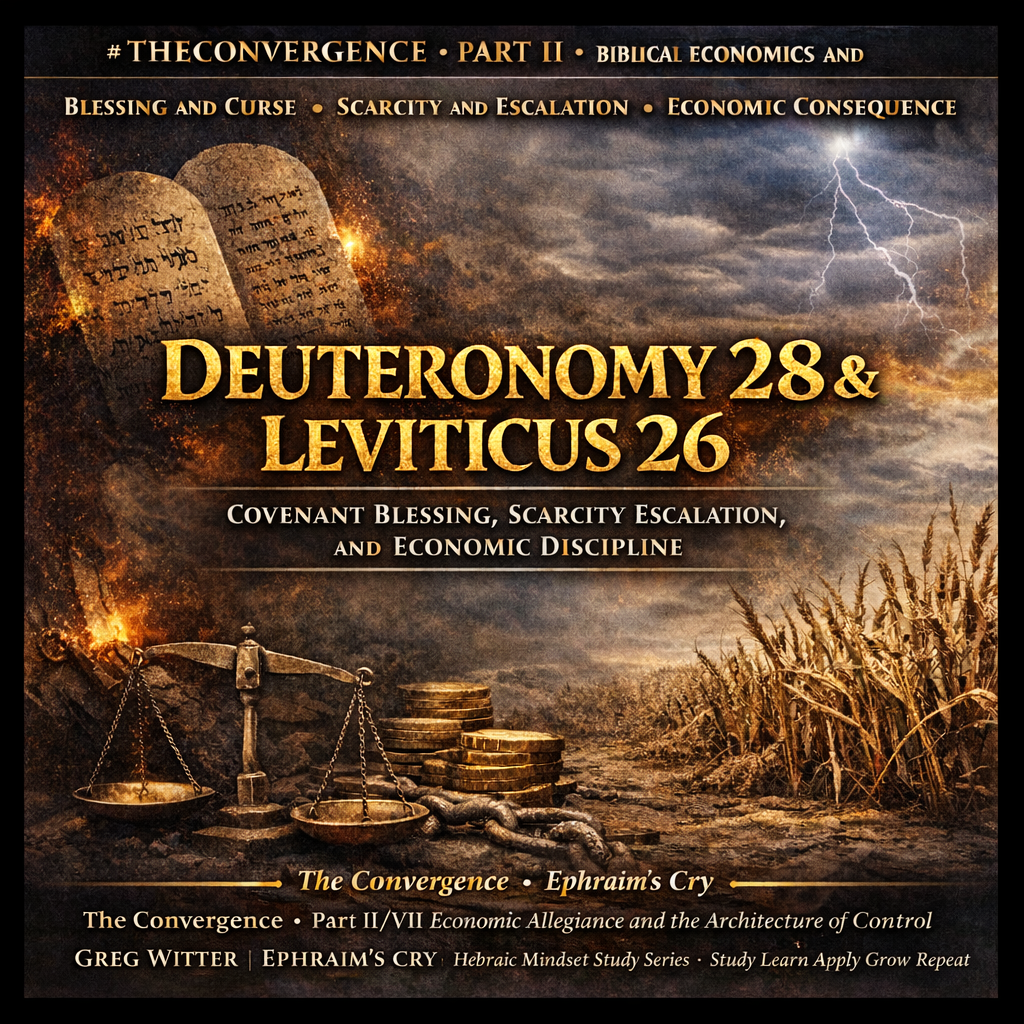
The Convergence
Part II/VII Economic Allegiance and the Architecture of Control
The Compression of Covenant History at the Edge of Kingdom Arrival
The Economy of Worship — When Commerce Becomes Confession
Greg Witter | Ephraim’s Cry
Hebraic Mindset Study Series
Study Learn Apply Grow Share Repeat

Part I established the frame: dominion is delegated, rebellion centralizes, systems align, and alignment precedes accountability. Part II moves into the bloodstream of that alignment. If dominion is the throne, economy is the lever. If authority is the claim, commerce becomes the test. And if worship reveals allegiance, economy is where allegiance becomes measurable—because economy governs access, and access governs survival.
In a converging age, the question is no longer theoretical. It is no longer simply “what do you believe?” It becomes “what will you bow to when daily life is conditional?” That is why Scripture never treats economics as neutral. It treats provision, debt, ownership, labor, weights, measures, trade, scarcity, and accumulation as covenant territory. Money is not merely currency; it is trust made visible. Commerce is not merely exchange; it is participation. And participation, under pressure, becomes confession.

I. PROVISION BEFORE CURRENCY — ECONOMY IN EDEN AND THE FRACTURE OF TRUST
Before there was coin, before there were markets, before there were kings, there was provision. Genesis 2 shows Yahuah as direct Provider in a world where source is unmistakable. The garden is planted by His hand, ordered by His wisdom, and bounded by His instruction. Man receives and stewards. That is economy in its original form: not anxiety, not accumulation, not control—but trust, stewardship, and covenant order. Dominion functions under dependence, not autonomy.
Genesis 3 fractures that simplicity at the root. The serpent’s offer is not merely moral temptation—it is sovereignty temptation: autonomy, self-definition, independence from Yahuah’s word. Once rebellion enters, toil enters. The ground resists. Sweat becomes necessary. Scarcity becomes experiential. Fear of “not enough” enters the human condition. Economy becomes complicated because trust becomes contested. The curse does not create provision; it corrupts the relationship to provision. From this point forward, mankind will be tempted to build systems that replace dependence with control, and safety with submission.
That is the seed of end-time economic convergence: the replacement of covenant trust with system trust, and the replacement of Yahuah as Source with structure as source.

II. MANNA AND DAILY DEPENDENCE — YAHUAH’S TRAINING AGAINST FEAR-BASED ACCUMULATION
Exodus 16 is not a wilderness anecdote. It is covenant economics in action. Yahuah provides manna daily, and the instruction is direct: gather what you need for today. Do not hoard. Do not store beyond what He commands. Those who attempt to secure tomorrow by disobedient accumulation discover decay—rot and worms. That isn’t random. It is a surgical exposure of the heart.
Manna teaches that fear-driven accumulation is mistrust disguised as wisdom. It teaches that provision is not meant to be idolized. It teaches that storage is not meant to replace obedience. Daily bread requires daily dependence, because covenant relationship is maintained daily. The wilderness is where Yahuah dismantles Egypt out of the people, and Egypt includes the economic mindset of survival by control. Manna trains Israel away from panic economics and into covenant economics: obedience first, trust first, source first.
This matters because end-time pressure will weaponize scarcity. And the person trained by manna does not panic the way the world panics. The person trained by manna recognizes that the deeper battle is not food—it is allegiance.

III. SABBATH, SHEMITTAH, AND JUBILEE — COVENANT RESTRAINT AGAINST PERMANENT ECONOMIC TYRANNY
Torah does not merely teach generosity. It builds structural restraints to prevent oppression from becoming permanent. Leviticus 25 establishes the Sabbatical year and Jubilee: land rests, debts release, servants go free, and inheritance returns. That is not idealism; it is covenant engineering. Yahuah refuses to allow the marketplace to become a machine that permanently devours the vulnerable.
Jubilee declares ownership limits. It declares that land is not ultimately possessed—it is stewarded. It declares that human beings are not commodities. It declares that debt cannot become generational slavery. It declares that wealth cannot consolidate into irreversible dominance. It is an anti-empire mechanism written into covenant law, becauseempires are built by permanent consolidation—permanent land capture, permanent debt, permanent class separation, permanent dependence.
Deuteronomy 15 expands the same principle through commanded debt release and commanded openhandedness. It forbids hardness of heart and forbids shutting the hand. Why? Because covenant economics is not only personal ethics—it is national identity. A covenant people cannot mirror Pharaoh’s system and still claim to be Yahuah’s people. If the community’s economy becomes coercion, then the community has already begun aligning with Babylon.
This is one reason Babylon is so dangerous in Revelation: it functions as a counterfeit kingdom with a counterfeit economy that produces permanent bondage. Jubilee is covenant reset; Babylon is anti-reset. Jubilee releases; Babylon captures. Jubilee restores inheritance; Babylon commodifies inheritance.

IV. HONEST WEIGHTS AND FALSE SCALES — MEASUREMENT AS MORAL WARFARE
Scripture repeatedly condemns dishonest weights and measures. That is not a minor issue. Measurement is power. Whoever controls measurement controls what is considered “fair,” what is considered “true,” what is considered “value,” and what is considered “legitimate.” False scales allow oppression without visible violence. They allow theft without calling it theft. They allow extraction while claiming neutrality.
Proverbs treats false balances as an abomination because dishonesty in commerce is dishonesty embedded into daily life. A society can lie in religion and still pretend it is righteous; but when it lies in measurement, the lie becomes systemic. In converging times, this becomes even more potent because modern systems can alter definitions at scale—definitions of value, definitions of identity, definitions of compliance. When the system controls definitions, it can redefine righteousness as dangerous and lawlessness as virtuous, then punish obedience economically while calling it “public safety.”
That is not hypothetical. That is how control systems work: they moralize participation and weaponize measurement.

V. PROPHETIC INDICTMENT — WHEN COMMERCE BECOMES OPPRESSION AND OPPRESSION BECOMES NORMAL
The Prophets do not treat economic injustice as “lesser sin.” They treat it as covenant breach. Amos condemns those who sell the righteous for silver, who trample the poor, and who cannot wait for Sabbath to end so they can resume predatory trade. That detail matters: impatience with covenant rest is a sign of slavery to profit. When a people cannot endure rest, they are already enslaved.
Micah condemns leaders who build with blood and prophets who speak for hire, revealing how economy corrupts governance and religion simultaneously. Habakkuk pronounces woe upon those who gather unjust gain to establish their house, showing that economic structures built on exploitation carry judgment inside their walls. Isaiah warns of moral inversion—calling evil good and good evil—and that inversion consistently becomes economic: obedience becomes punishable, righteousness becomes costly, and compromise becomes rewarded.
Ezekiel exposes Tyre as a merchant empire intoxicated by trade, swollen with wealth, and lifted up in pride. “By thy great wisdom and by thy traffick hast thou increased thy riches.” Trade becomes identity. Wealth becomes deification. Commerce becomes worship. Tyre is a prophetic preview of Babylon’s merchant system: luxury, maritime networks, economic supremacy, and pride. Scripture does not admire that system; it judges it.
This matters because Revelation’s Babylon is not merely a political entity. It is a merchant kingdom—a global commercial organism that binds nations through trade, then turns trade into control.

VI. SCARCITY, CRISIS, AND CENTRALIZATION — THE JOSEPH PATTERN AND THE PHARAOH OUTCOME
Genesis 47 reveals a sobering mechanism: under famine, people exchange livestock, then land, then themselves for survival. Pharaoh acquires ownership. Crisis accelerates consolidation. Scarcity creates leverage. Fear produces compliance. The people accept structures they would not accept in normal times because survival becomes the justification.
This is not accusation; it is pattern. History repeats this again and again. When abundance exists, people resist control. When scarcity hits, people trade freedom for access. Convergence leverages crisis because crisis reveals what people will surrender. Scarcity becomes the pressure point that transforms commerce into confession.
This is why end-time economics is not merely “money.” It is crisis-driven architecture that converts daily need into daily surrender.

VII. EMPIRE COMMERCE IN DANIEL — TAXATION, PLUNDER, AND MANIPULATED PARTICIPATION
Daniel reveals beasts, but beasts rule through systems, not merely through swords. Empires require taxation, regulation, standardization, and enforced participation. Nebuchadnezzar’s pride is tied to what he built—economic magnificence that becomes spiritual arrogance. The king worships the work of his hands, and the people are pressured into the same.
Daniel 11 adds the manipulation layer: rulers using tribute, taxation, deceit, and plunder to secure dominance. Political authority and economic extraction intertwine. The throne and the treasury become one machine. That machine does not only demand obedience; it produces dependence. Dependence becomes loyalty. Loyalty becomes worship.
This is how empire sustains itself: by making participation feel necessary, then redefining refusal as rebellion.

VIII. MAMMON AND MASTER — YAHUSHA’S WAR AGAINST SYSTEM TRUST
Yahusha does not speak softly about money because He knows the heart. “Ye cannot serve Elohim and mammon.” Mammon is not simply wealth; it is the spiritual claim that security comes from structure rather than from Yahuah. It is trust relocated. It is dependence transferred.
This is why end-time enforcement targets buying and selling. Money is where trust becomes practical. In a converging world, the question becomes: will you obey when obedience costs access? Will you hold fast when holding fast produces restriction? Will you remain faithful when the system claims the right to define who is “allowed” to function?
Yahusha also warns against anxiety-driven living and teaches reliance on the Father’s provision. That does not mean passivity. It means allegiance. The covenant heart works faithfully while refusing to worship the system that claims to sustain life.

IX. REVELATION 6, 13, 17, 18 — FAMINE, ENFORCEMENT, AND THE MERCHANT KINGDOM
Revelation 6 introduces scarcity as part of judgment sequence—economic destabilization that shakes nations and exposes hearts. Scarcity is not merely hardship; it is a revealing. It presses populations toward consolidation and control, and it presses the remnant toward endurance.
Revelation 13 reveals enforcement architecture: no buying or selling without alignment. This is not trivial. It is the conversion of commerce into confession. Daily life becomes a litmus test. Participation becomes allegiance. The system claims the right to grant or deny access, making worship measurable and refusal costly.
Revelation 17 reveals a global influence structure intertwining political power with spiritual deception. Revelation 18 reveals the merchant collapse: kings mourn, merchants weep, shipmasters cry out, luxury trade collapses, and the system falls in one hour. The list of goods is not decorative—it reveals the nature of the kingdom: luxury, indulgence, domination, and commodification. And then the line that should sober every reader: “and souls of men.” Human beings treated as cargo. Dignity reduced to inventory. Life reduced to commodity.
This is Babylon: a counterfeit kingdom with a counterfeit economy that captures rather than releases, enslaves rather than restores, and demands allegiance through access.

X. CAPACITY AND INFRASTRUCTURE — ARCHITECTURE BEFORE ACTIVATION
Technology is not prophecy. But infrastructure enables enforcement. Digital identity centralizes verification. Programmable currency enables transaction control. Biometric systems reduce anonymity. Algorithmic governance shapes participation. Narrative control moralizes compliance.
Capacity does not equal activation. But capacity accelerates implementation. Architecture precedes activation. And convergence is what happens when architecture becomes interoperable—when systems can speak to each other, enforce together, and punish together. When identity, access, money, permission, and compliance can be linked, commerce can become confession at scale.
That is why this is called the architecture of control. It is not one thing. It is many systems aligning into one enforcement capability.

XI. THE REMNANT ECONOMY — OBEDIENCE AND TESTIMONY UNDER ECONOMIC PRESSURE
Revelation identifies the remnant by covenant markers: they keep the commandments of Elohim and hold the testimony of Yahusha. That is not abstract spirituality. That is lived allegiance. It means obedience remains obedience when it is costly. It means testimony remains testimony when it triggers restriction. It means endurance is not optional. It is identity.
Acts 2–4 shows a covenant contrast: a community that refuses fear-based accumulation, that shares provision, and that breaks the spell of scarcity through covenant fellowship. Ananias and Sapphira show that economic deception inside covenant community is deadly because it corrupts witness. James 5 shows that end-time wealth-hoarding is not merely unkind; it is condemnable, and the withheld wages cry out to Yahuah.
The remnant does not worship mammon. The remnant does not bow for access. The remnant does not trade inheritance for appetite. The remnant does not surrender covenant for convenience. The remnant is trained by manna, guarded by Jubilee, warned by the Prophets, instructed by Yahusha, and described by Revelation.

XII. CONCLUSION — WHEN COMMERCE BECOMES CONFESSION, THE AGE HAS MATURED
Put the witnesses together. Eden shows provision as relational trust. Manna shows daily dependence as obedience training. Jubilee shows economic reset as covenant restraint against tyranny. Honest weights show measurement as moral integrity. The Prophets show commerce becoming oppression and oppression becoming judgment. Daniel shows empire sustained through economic manipulation. Yahusha shows mammon as rival master. Revelation shows scarcity and enforcement leading to buying-and-selling allegiance tests and a merchant kingdom collapsing under divine judgment.
The conclusion is unavoidable: economy is one of the primary instruments by which covenant allegiance is exposed in the time of the end. When access becomes conditional, neutrality collapses. When buying and selling become tied to confession, worship becomes measurable. And when worship becomes measurable, accountability is near—because alignment precedes judgment.
This is not fear. This is discernment. This is the covenant reading of the marketplace. This is seeing that the economy is not merely money; it is a lever. And in a converging age, that lever will be pulled.
XIII. DEUTERONOMY 28 AND LEVITICUS 26 — COVENANT BLESSING, SCARCITY ESCALATION, AND ECONOMIC DISCIPLINE
Deuteronomy 28 cannot be ignored in any serious treatment of covenant economics. It establishes that obedience and disobedience have material consequences—not in simplistic formula, but in covenant structure. Blessing includes abundance in storehouses, increase in flocks, security in labor, and stability in land. Curse includes drought, blight, loss of harvest, financial vulnerability, dependence upon foreign powers, and eventually economic captivity.
The covenant logic is clear: economy is never detached from obedience. When a people walk in covenant alignment, provision stabilizes. When a people break covenant, scarcity intensifies—not randomly, but progressively. Leviticus 26 makes this escalation explicit. If disobedience persists, discipline increases “seven times more.” Scarcity is not merely misfortune; it is corrective exposure.
This escalation model matters because convergence accelerates escalation. When covenant boundaries are abandoned collectively, economic instability becomes systemic. Inflation, debt bondage, dependence upon external systems, and foreign dominance are not merely geopolitical developments; they are covenant indicators when read throughTorah architecture.
The convergence of end-time systems does not negate covenant logic; it amplifies it. If obedience is tested under scarcity, and scarcity intensifies under rebellion, then economic convergence becomes both a pressure and a revealing.

XIV. SHEMITTAH AND YOVEL — HEBREW DEPTH OF RELEASE AND RESET
The Hebrew word שמיטה (Shemitah) carries the idea of release—letting fall, relinquishing grip. It is not merely a calendar event; it is a spiritual discipline against control. Every seventh year, the land rests and debts are released. This interrupts accumulation cycles and prevents permanent stratification.
The word יובל (Yovel), Jubilee, is connected to the ram’s horn blast announcing restoration. It signals return, restoration, reversion to original inheritance. Jubilee is not incremental reform; it is structural reset.
Now contrast that with Babylon.
Babylon never resets.
Babylon accumulates.
Babylon consolidates.
Babylon centralizes.
Babylon captures.
Jubilee restores inheritance.
Babylon absorbs inheritance.
Jubilee releases debt.
Babylon multiplies debt.
Jubilee returns land.
Babylon concentrates land.
Revelation’s Babylon functions as a counterfeit Jubilee—offering false reset language while tightening control. Modern “reset” rhetoric must be measured against covenant reset. One restores covenant boundaries. The other strengthens centralized dependency.
The difference is not economic policy.
It is covenant allegiance.

XV. SOLOMON, GOLD, AND THE DRIFT OF PROSPERITY
1 Kings 10–11 records Solomon’s wealth in staggering detail. Gold accumulates in extraordinary volume. Trade alliances expand. Horses are imported. Silver becomes common. And yet immediately following the description of wealth comes the record of spiritual compromise.
Prosperity did not begin the drift—but it accelerated insulation from dependence. Wealth reduces visible vulnerability. Visible vulnerability reminds man of his need. Remove the reminder, and autonomy grows quietly.
Ecclesiastes, traditionally associated with Solomon, reflects the futility of accumulation. Wealth does not satisfy. Abundance does not secure permanence. Riches do not prevent death. The Preacher concludes that reverence and obedience are the whole duty of man, not accumulation.
The lesson is not anti-wealth.
It is anti-deification of wealth.
When abundance becomes insulation from covenant humility, convergence toward Babylon increases.

XVI. NEHEMIAH 5 — ECONOMIC REPENTANCE AS COVENANT RESTORATION
Nehemiah 5 provides a rarely cited but powerful example of covenant economic reform. The people cry out because their children are being enslaved to repay debt. Fields and vineyards are mortgaged. The nobles are exploiting the vulnerable.
Nehemiah does not respond with sentiment. He rebukes the leaders and demands restoration. Land is returned. Interest is canceled. Economic injustice is reversed publicly.
This is covenant repentance expressed economically.
It demonstrates that economic oppression within covenant community is intolerable. It also demonstrates that reform is possible when leadership fears Yahuah more than profit.
This stands in stark contrast to Revelation 18, where no reform occurs—only collapse. Babylon does not repent; it falls.

XVII. PROVERBS, SURETY, AND DEBT ENSLAVEMENT
Proverbs repeatedly warns against surety—becoming collateral for another’s debt. It warns that the borrower becomes servant to the lender. These are not merely personal financial tips; they are covenant anthropology. Debt is a form of subordination. Excessive debt creates structural vulnerability.
In a converging age, systemic debt becomes a lever of control. Nations indebted to larger financial powers lose autonomy. Individuals overleveraged become compliant. The Proverbs wisdom tradition is a preventative guard against becoming economically maneuverable by external authority.
When Revelation speaks of buying and selling being restricted, it assumes participation in a structured economic order. The more entangled one is in that order, the greater the pressure. Covenant wisdom teaches measured participation, not naïve immersion.

XVIII. ZECHARIAH 5 — THE FLYING SCROLL AND ECONOMIC CURSE
Zechariah 5 presents a flying scroll that enters houses built on theft and false oath. It consumes the timber and stones. This imagery is economic and judicial. Structures built on deception carry internal judgment.
This anticipates Revelation 18’s collapse. Babylon’s luxury houses fall not merely because of external attack, but because judgment is embedded in injustice. When systems are built upon theft—material or moral—the curse is architectural.
Convergence does not remove justice.
It magnifies exposure.

XIX. REVELATION 6 — THE FAMINE HORSE AND SCARCITY MECHANICS
Revelation 6 describes a black horse with scales in hand and measured grain sold at inflated ratios. Wheat and barley become scarce. Oil and wine are protected. This indicates stratified scarcity—staple goods restricted, luxury preserved.
Scarcity becomes uneven.
Access becomes unequal.
Pressure becomes strategic.
This famine imagery foreshadows Revelation 13 enforcement. Scarcity destabilizes. Destabilization produces compliance. Compliance produces control.
The sequence matters.

XX. SEAL OF ELOHIM VS MARK OF THE BEAST — OWNERSHIP AND ALLEGIANCE
Revelation 7 speaks of the servants of Elohim being sealed. The Greek term sphragis indicates ownership mark, authentication, authority. Revelation 13 uses charagma for mark—imprinted allegiance, inscription of authority.
Seal precedes mark.
Yahuah marks His own before the beast demands marking.
The question is not whether people will be marked.
The question is who marks them.
Ownership precedes enforcement.
Those sealed by Elohim cannot be owned by Babylon.
That is covenant identity in the face of economic coercion.

XXI. ACTS 2–4 — COVENANT ECONOMY AS ANTIDOTE TO BABYLON
Acts describes believers sharing possessions voluntarily, ensuring no one lacked. This is not communism; it is covenant generosity breaking fear cycles. The early community demonstrates a Jubilee spirit—release, restoration, provision, without coercion.
Contrast this with Revelation 18.
One community shares freely.
The other consumes compulsively.
One builds witness.
The other builds luxury.
One fears Elohim.
The other worships wealth.
Ananias and Sapphira reveal that economic deception inside covenant community is spiritual rebellion. Integrity in economy is inseparable from integrity in testimony.

XXII. JAMES 5 — LAST-DAYS WEALTH INDICTMENT
James warns that in the last days riches will rot and corrode, testifying against their owners. Withheld wages cry out. Oppression of laborers becomes judicial evidence.
This is explicitly last-days language.
Economic injustice becomes courtroom evidence.
Convergence therefore carries legal weight.

XXIII. JERUSALEM — ECONOMIC AND COVENANT CENTER
Jerusalem is not merely religious center; it is covenant center. Control over Jerusalem has always involved economic dimensions—tribute, taxation, temple economy, trade routes.
Luke 21 speaks of Jerusalem trampled until the times of the nations are fulfilled. Control of the city is tied to larger dominion shifts. Economic pressure surrounding Jerusalem often signals geopolitical convergence.
The city becomes a focal point of spiritual and economic contention.

XXIV. MERCHANT–PRIEST–KING ALLIANCE — STRUCTURAL TRIAD
Throughout Scripture, corruption deepens when merchant (commerce), priest (religion), and king (political authority) align in rebellion. Jeremiah condemns priests and prophets who speak falsely for gain. Revelation 17–18 shows kings and merchants intertwined with spiritual deception.
When economy, religion, and governance align outside covenant, control becomes comprehensive.
That is convergence.

XXV. SYSTEM DENSITY AND FRAGILITY
Highly integrated systems appear strong. Yet Revelation 18 shows collapse in one hour. Convergence increases density—and density increases fragility. When supply chains, financial systems, identity systems, and regulatory systems interlock, a single fracture can cascade.
Babylon appears invincible—until it falls instantly.
Convergence magnifies both control and vulnerability.

XXVI. FINAL INTEGRATION — ECONOMY AS THE MEASURE OF WORSHIP
Eden shows provision as trust.
Manna trains daily dependence.
Shemitah and Jubilee prevent tyranny.
Prophets expose economic oppression.
Daniel shows empire sustained through extraction.
Yahusha identifies mammon as rival master.
Revelation shows buying and selling tied to allegiance.
James shows last-days wealth condemned.
Acts shows covenant economy as contrast.
The witnesses are unified.
Economy is not peripheral.
It is central.
When commerce becomes confession, the age has matured.
And maturity precedes judgment.
#TheConvergence, #PartII, #EconomicAllegiance, #EconomyOfWorship, #WhenCommerceBecomesConfession, #Shemitah, #Yovel, #CovenantEconomics, #MannaAndTrust, #JubileeJustice, #FalseScales, #PropheticIndictment, #TyreAndBabylon, #Daniel11, #Revelation6, #Revelation13, #SealOfElohim, #MarkOfTheBeast, #BuyingAndSelling, #Acts2Economy, #James5Warning, #MerchantPriestKing, #JerusalemConvergence, #ArchitectureOfControl, #ObedienceAndTestimony, #EndTimesDiscernment, #WatchmanCall, #HebraicMindset, #EphraimsCry, #GregWitter
