
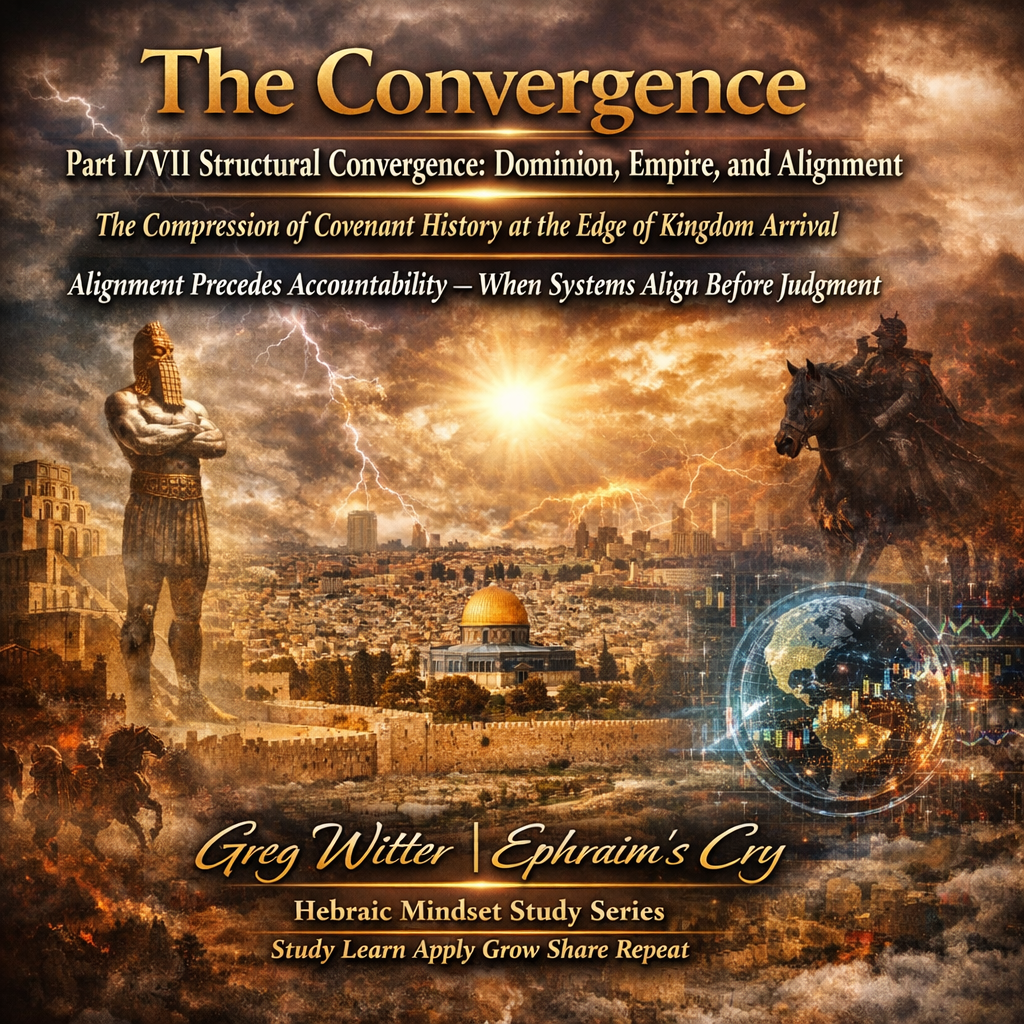
The Convergence
Part I/VII Structural Convergence: Dominion, Empire, and Alignment
The Compression of Covenant History at the Edge of Kingdom Arrival
Alignment Precedes Accountability — When Systems Align Before Judgment
Greg Witter | Ephraim’s Cry
Hebraic Mindset Study Series
Study Learn Apply Grow Share Repeat
We are not living in accidental times. We are living in converging times.
History is not spiraling out of control; it is tightening toward culmination. What looks like disconnected crises is actually coordinated compression. Systems that once operated with friction, delay, and separation are increasingly synchronizing. Political authority is consolidating. Economic participation is becoming conditional. Technology is normalizing surveillance and identity control. Moral lawlessness is being reframed as virtue. Religious language is being weaponized to bless compromise. Nations are being pushed into “solutions” that require submission. This is not random. It is structural.
This is what I mean by Convergence: the visible alignment of multiple covenant “witness streams” into a single, measurable architecture that removes excuses, clarifies allegiances, and accelerates accountability.
Yahuah does not leave humanity without witness. He multiplies witness. He stacks witness. He repeats patterns. He validates His warnings through the Torah, the Prophets, the Writings, and the Apostolic testimony. This is His method. And when those witnesses begin aligning at the same time—structurally, repeatedly, measurably—what once could be dismissed becomes undeniable.
That is Convergence.
And to understand Convergence correctly, we do not start with headlines. We start with dominion.
I. DOMINION: DELEGATED AUTHORITY UNDER COVENANT ORDER
Genesis 1:26–28 establishes the dominion mandate:
“Let us make man in Our image, after Our likeness: and let them have dominion…”
“Be fruitful, and multiply, and replenish the earth, and subdue it…”
Dominion is delegated authority. It is not autonomy. It is not self-rule. It is stewardship under a higher throne. The earth was entrusted to mankind, but the authority over mankind remained with Yahuah. Dominion is therefore never merely political—it is covenantal. It is moral. It is accountable.
Genesis 2 immediately reinforces that dominion operates inside boundaries. There is a garden. There is instruction. There is a defined prohibition. That is not “legalism.” That is reality: authority exists inside the word of the One who gives it. Dominion without instruction becomes tyranny. Freedom without boundaries becomes lawlessness. Stewardship without obedience becomes abuse.
Genesis 3 reveals the first and deepest lie of history: authority can be possessed apart from submission. The serpent does not merely tempt appetite; he tempts sovereignty:
“Ye shall be as Elohim, knowing good and evil.” (Genesis 3:5)
That is the offering of independent authority—self-definition—moral autonomy. The rebellion is governmental before it is behavioral. The fall is a shift in allegiance: from Yahuah’s word to self-rule.
Then Genesis 3:15 establishes the war that explains everything that follows:
“I will put enmity between thee and the woman, and between thy seed and her seed…”
This is not a poetic flourish. This is structural. It means history is not neutral. History is divided. There is a seed-line of covenant fidelity and a seed-line of rebellion. Every ideological system, every empire, every “world order,” every forced unity project, every attempt to centralize authority apart from Yahuah belongs to one seed or the other. The end of the age will not be defined by one isolated evil act. It will be defined by the maturation of seed conflict into final alignment.
That is why Convergence matters: it is seed conflict becoming visible at system scale.
Genesis 4 then shows the immediate fruit of this: Cain and Abel. Two worship approaches. Two hearts. Two outcomes. Cain’s issue is not merely anger; it is refusal of correction. His offering is not accepted, and instead of repenting, he hardens. Dominion begins turning into violence. The seed conflict does not stay theological—it becomes societal.
By Genesis 6, the corruption of dominion fills the earth: violence, perversion, structural decay. Whatever all the debates are about the details of Genesis 6, Scripture’s conclusion is not debatable: the earth became corrupt, and violence filled it (Genesis 6:11–13). Dominion was not stewarded—it was weaponized.
So Yahuah judges. The flood is not mythology. It is covenant witness: when dominion becomes fully corrupted, Heaven intervenes.
After judgment, Genesis 9 reaffirms that human governance exists, but now under explicit accountability. Bloodshed is judged. Authority is restrained. Life is sacred. Dominion is not a license. It is a trust.
This matters because Convergence is not the first time systems have aligned toward judgment. Scripture shows the pattern: corruption → escalation → exposure → intervention. That pattern is repeating.
II. DISPERSION, NATIONS, AND BOUNDARIES: THE STRUCTURE OF ACCOUNTABILITY
Genesis 10 is not filler. It is blueprint. The Table of Nations maps humanity spread into distinct peoples with territories and boundaries. This is not a failure of unity; it is a design of accountability. Bounded nations prevent totalizing control. Dispersion restrains centralized rebellion. Multiple peoples make singular empire harder.
Then Deuteronomy 32:8–9 reveals the theological reality behind that structure:
“When the Most High divided to the nations their inheritance, when He separated the sons of Adam, He set the bounds of the people…”
“For Yahuah’s portion is His people; Jacob is the lot of His inheritance.”
Nations were allotted. Boundaries were set. There is order. There is jurisdiction. There is accountability. This is why centralized global authority is never neutral. It is always a threat to covenant boundaries, because it aims to dissolve what Yahuah set.
Psalm 82 then adds judicial gravity:
“Elohim standeth in the congregation of the mighty; He judgeth among the elohim.”
“How long will ye judge unjustly…?”
“I have said, Ye are elohim… but ye shall die like men…”
Whatever anyone does with the language debates here, the conclusion is clear: delegated rulers are judged. Authority is measured. Injustice is not “politics.” It is rebellion. And rebellion is accountable.
This is a major reason Convergence is not fear-based. It is court-based. It is judicial. When authority consolidates into unjust hands, Psalm 82 tells you what happens: Yahuah judges rulers.
So when you see systems aligning toward control, you are not merely watching “bad leadership.” You are watching delegated authority reaching judgment.
III. BABEL: CENTRALIZATION AS REBELLION AND THE BLUEPRINT OF EMPIRE
Genesis 11 is the archetype of end-time consolidation:
“Let us build us a city and a tower… lest we be scattered…”
“Let us make us a name…”
This is the Babel impulse: centralized identity, centralized language, centralized control—defying dispersion. The core sin is not bricks. The core sin is rejecting boundaries and pursuing unity apart from Yahuah.
Yahuah disperses them. Why? Because unified rebellion becomes global tyranny. Dispersion is mercy. Dispersion restrains the growth of a single anti-covenant system.
Convergence is Babel returning—but not through one city. Through digital unification. Through economic integration. Through identity systems. Through narrative control. Through transnational governance structures. Through “safety” frameworks that require submission.
Babel is not dead. Babel is maturing.
IV. EMPIRE SUCCESSION: THE TIMES OF THE NATIONS AND THE ARCHITECTURE OF TRANSFERRED DOMINION
Daniel 2 reveals a statue—an empire succession model. Daniel 7 reveals beasts—an empire character model. Different symbols, same truth: dominion transfers through successive empires until the appointed end.
Babylon.
Medo-Persia.
Greece.
Rome.
Each empire centralizes authority. Each empire standardizes law. Each empire pressures worship. Each empire integrates commerce and loyalty. Each empire demands compliance. The form changes. The architecture remains.
Yahusha names this era in Luke 21:24:
“Jerusalem shall be trodden down of the nations, until the times of the nations be fulfilled.”
This is not vague. It means there is a period of permitted dominion over Jerusalem. It has an end. It is measurable by the tightening of focus on that city and on covenant claims.
Daniel 9 then adds a critical piece that must not be treated lightly: end-time alignment may come wrapped in covenant language. A “covenant confirmed with many” becomes a hinge point toward desolation (Daniel 9:27). That means the final consolidation may not first appear as open tyranny. It may appear as agreement, security, and “peace.” Scripture warns that peace-language can be stage-setting (1 Thessalonians 5:3).
So Convergence is not merely tanks and wars. It is agreements. It is frameworks. It is jurisdictions. It is “solutions” that reassign authority.
Psalm 2 then exposes the spiritual posture behind these alignments:
“The kings of the earth set themselves, and the rulers take counsel together, against Yahuah, and against His Anointed…”
This is coordinated. Not random. Structural.
When rulers “take counsel together,” you are looking at convergence logic: unified direction, unified narrative, unified enforcement.
V. LEVITICUS 26 AND DEUTERONOMY 28: ESCALATION PATTERNS THAT EXPLAIN COMPRESSION
Leviticus 26 is not ancient history. It is covenant mechanics. When covenant is rejected, discipline escalates in stages, repeatedly described as increasing “seven times” if hardness continues. That means Yahuah does not merely judge; He exposes. He intensifies pressure to bring repentance—or to remove excuse.
Deuteronomy 28 similarly lays out blessings and curses. It shows that covenant obedience produces stability and life, while covenant rejection produces confusion, fear, oppression, scarcity, and loss of sovereignty.
Here is the point for Convergence: covenant consequences are not merely individual. They are national. They are societal. They are systemic. When a civilization rejects covenant order, the consequences become structural—economic strain, moral collapse, governance corruption, increasing control, and intensified conflict.
So when you see compression, you are not merely seeing “the world getting worse.” You are witnessing covenant escalation patterns repeating at scale.
Convergence is the modern visibility of covenant escalation.
VI. THE APOSTOLIC WITNESS: WHEN STRUCTURE BECOMES ENFORCEMENT
Revelation does not start with microchips. It starts with worship. It ends with worship. The mark system is not fundamentally about technology. It is about allegiance made measurable.
Revelation 13 describes an authority structure that ties worship and commerce to compliance:
“He causeth all… to receive a mark… that no man might buy or sell…”
This is structural enforcement. It is commerce-as-confession. It is participation-as-allegiance. It is not merely the ability to watch you; it is the ability to restrict you.
Revelation 17 portrays the system-level reality: centralized influence over nations. Revelation 18 portrays the economic backbone: kings, merchants, shipmasters—entire trade networks—and Babylon collapsing in a single hour. It lists luxury goods, and then the line that should shake any honest reader: “and souls of men.” That is human life commodified under a system that has matured into full rebellion.
This is why modern infrastructure matters. Technology itself is a tool. But the ability to link identity, money, access, and permissions creates the capacity for Revelation 13 enforcement.
Capacity is not activation. But capacity is a stage.
And Convergence is about stages aligning.
VII. “ALIGNMENT CATEGORIES”: WHAT IS CONVERGING, EXACTLY?
Convergence is not “one event.” It is multiple streams aligning. At minimum, these categories must be named and understood:
1) Political Sovereignty Convergence
Local authority is increasingly pressured by transnational standards, supranational agreements, and international enforcement narratives. Governance shifts from representatives to administrators. The system trains populations to accept decisions that cannot be voted out.
2) Economic Compliance Convergence
Interdependent supply chains, digital transactions, and centralized monetary policy create a world where access can be granted or denied instantly. This is the infrastructure basis of “buying and selling” control.
3) Identity and Permission Convergence
When identity becomes digital, it becomes controllable. When access becomes permission-based, it becomes revocable. When your ability to function is tied to compliance, the system has matured into measurable allegiance.
4) Moral Lawlessness Convergence
Isaiah warns of calling evil good and good evil (Isaiah 5:20). Convergence includes synchronized moral inversion: righteousness reframed as hate, restraint reframed as oppression, perversion reframed as liberation, obedience reframed as bondage.
5) Religious Syncretism Convergence
The end-game is worship. So the system pressures religion to become unified without truth, tolerant without covenant, and spiritual without obedience. This is “peace” without repentance—unity without holiness.
6) Narrative Control Convergence
When truth can be censored, redefined, labeled harmful, or algorithmically buried, the population can be trained to believe lies as virtue. This directly serves strong delusion mechanics (2 Thessalonians 2) and sets the stage for enforcement.
These categories are not conspiracies. They are architecture. They are observable. They are converging.
VIII. JERUSALEM: THE BURDENSOME STONE AND THE TURNING OF THE AGE
Zechariah 12 declares Jerusalem a burdensome stone to all nations. That alone tells you Jerusalem will become a global focal point. Not because of sentiment—but because covenant claims collide there. Ezekiel 36–37 speaks of regathering and restoration. Psalm 122 commands prayer for Jerusalem’s peace. Yahusha Himself speaks of a future acknowledgment (Matthew 23:39).
Luke 21:24 says the times of the nations will be fulfilled. That means history has a hinge. The end of the “times of the nations” is not merely a political change—it is a covenant transition. The system that treads Jerusalem does not continue forever.
Convergence intensifying around Jerusalem signals transition, not randomness.
IX. THE JUDICIAL SUMMARY: WHY ALIGNMENT PRECEDES ACCOUNTABILITY
Put the witnesses together:
Torah shows dominion delegated, bounded, and accountable (Genesis 1–3), shows corruption leading to judgment (Genesis 6–9), shows nations allotted and bounded (Deuteronomy 32), shows escalation patterns of covenant discipline (Leviticus 26; Deuteronomy 28).
Prophets reveal empire succession and consolidation patterns (Daniel 2; Daniel 7; Daniel 9), and expose coordinated rebellion (Psalm 2 in the Writings functioning prophetically), with Jerusalem as a burdensome stone (Zechariah 12).
Writings establish judicial oversight over rulers (Psalm 82), and reveal the posture of rulers against Yahuah (Psalm 2).
Apostolic witness defines the “times of the nations” (Luke 21), and describes final enforcement architecture through worship and commerce (Revelation 13; Revelation 17–18).
Now the conclusion becomes unavoidable:
Alignment precedes accountability.
Systems align before judgment.
Convergence is the visible tightening of covenant history into measurable exposure.
This is not panic. This is discernment.
When systems align, excuses die. When architecture becomes visible, neutrality collapses. When enforcement capacity is built, hearts are tested. When Jerusalem becomes the focal point of global pressure, the age approaches its turning.
This is the first heat of the furnace. It is not the final blast. But it is real heat. And it demands sober, covenant-minded clarity.
#TheConvergence #StructuralConvergence #DominionMandate #SeedConflict #BabelImpulse #TimesOfTheNations #JerusalemBurdensomeStone #AlignmentPrecedesAccountability #CovenantArchitecture #TorahProphetsWritingsApostolic #Psalm82Judgment #Leviticus26Pattern #Deuteronomy28 #Daniel2 #Daniel7 #Daniel9 #Luke21 #Revelation13 #Revelation17 #Revelation18 #KingdomPreparation #WatchmanCall #TorahAndTestimony #HebraicMindset #EphraimsCry #GregWitter
