
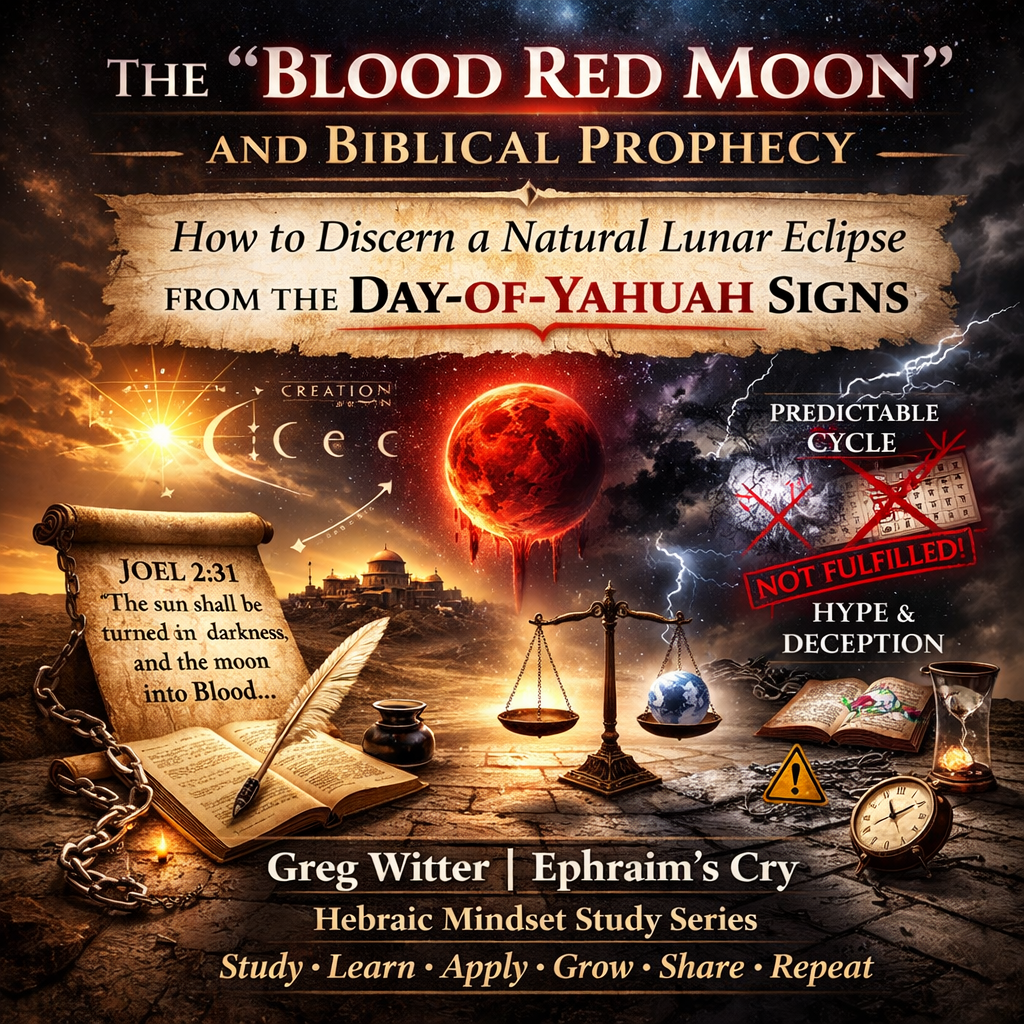
The “Blood Red Moon” and Biblical Prophecy
How to Discern a Natural Lunar Eclipse from the Day-of-Yahuah Signs
Greg Witter | Ephraim’s Cry
Hebraic Mindset Study Series
Study Learn Apply Grow Share Repeat
Observe creation with reverence—refuse sensationalism that adds to Scripture.
A “blood red moon” is coming on March 3, 2026, and many voices online are already framing it as a prophetic fulfillment event. Some are quoting Joel. Some are pushing fear. Some are building entire end-times narratives around a predictable astronomical cycle.
We are not going to do that.
We are going to tell the truth, prove what Scripture actually says, and expose the deception of hype.
What the March 3 Event Actually Is
March 3, 2026 is a lunar eclipse—an astronomical event where the earth moves between the sun and the moon, and the moon can take on a reddish hue because sunlight is refracted through earth’s atmosphere. It is predictable and measurable, and it has been calculated in advance.
Space
That means two things can be true at the same time:
It is a real heavenly sign in the general sense that the heavens declare the glory of Elohim (Psalm 19:1–2).
It is not automatically the “moon to blood” event of Joel just because it looks red.
The red appearance during totality is not mysterious. It is atmospheric physics.
Space +1
Should We Observe It?
Yes—observe it the way Scripture teaches you to observe the heavens: as part of creation’s order and as a reminder of Yahuah’s sovereignty.
Genesis 1:14 establishes that the lights in the heavens are for signs, appointed times, days, and years. This means sky events matter. They are not meaningless. But the text does not say, “Every eclipse fulfills apocalyptic prophecy.”
Discernment is the difference between watching and worshiping the hype.
What Joel Actually Says
Joel does not merely say “the moon looks reddish.”
Joel places the “moon to blood” within a stacked sequence of covenant-judgment language:
“I will show wonders in the heavens and in the earth: blood, and fire, and pillars of smoke. The sun shall be turned into darkness, and the moon into blood, before the great and terrible Day of Yahuah come.” (Joel 2:30–31)
Peter quotes this in Acts:
“I will show wonders in heaven above, and signs in the earth beneath; blood, and fire, and vapor of smoke: the sun shall be turned into darkness, and the moon into blood, before that great and notable Day of Yahuah come.” (Acts 2:19–20)
Bible Gateway
Joel’s “moon to blood” is not presented as an isolated astronomy moment. It is framed as a covenant-scale warning tied to the Day of Yahuah—a period of judgment, upheaval, and decisive intervention.
That matters.
The Prophets Use the Same Apocalyptic Pattern
Joel is not alone. Other prophets use the same “cosmic language” in Day-of-judgment contexts:
Isaiah describes the Day of Yahuah with the heavens shaken and lights darkened (Isaiah 13:9–10).
Ezekiel uses similar imagery when describing judgment (Ezekiel 32:7–8).
Yahusha uses the same pattern in end-time teaching: “the sun will be darkened, and the moon will not give its light…” (Matthew 24:29).
Revelation places cosmic disturbances in the seal judgments (Revelation 6:12–14).
The consistent pattern is this: when Scripture uses “sun darkened / moon blood” language, it is often covenant-judgment imagery tied to major historical or eschatological upheaval—not routine, predictable, recurring eclipses.
Why the March 3 Eclipse Is Not Joel’s Event
Here is the simple proof.
Lunar eclipses happen repeatedly across history. They are cyclical. They are calculable. If every red-looking lunar eclipse were Joel 2:31 fulfilled, then the “great and terrible Day of Yahuah” would have arrived again and again and again.
That is absurd on its face, and it empties prophecy of meaning.
Prophetic signs in Joel are not merely about appearance. They are about timing and context:
“before the Day of Yahuah”
“wonders” in heaven and earth
“blood and fire and vapor of smoke”
a convergence of judgment realities
A predictable eclipse, by itself, does not equal that prophetic convergence.
The Deception of Sensationalism
Here is how the deception works, and it is always the same:
Take a visible event (eclipse).
Rename it with loaded language (“blood moon prophecy”).
Quote Joel without context.
Declare fulfillment without covenant markers.
Stir fear, clicks, donations, and attention.
When nothing happens, move to the next sign.
This is not watchmanship. This is merchandising.
It trains people to treat Scripture like a headline generator instead of covenant truth.
It also damages credibility. When prophecy is constantly claimed and constantly fails, people either become cynical or they become addicted to the next fear hit. Neither is covenant maturity.
So What Should Our Posture Be?
Be sober.
Observe the eclipse. Give thanks to Yahuah for His ordered creation. Use it as a reminder that the heavens are His. Let it stir humility, not hysteria.
And keep your prophetic discernment anchored to the full counsel of Elohim:
Torah defines obedience and covenant boundaries.
Prophets warn and confirm the covenant pattern.
Writings teach wisdom and remembrance.
Yahusha and the apostolic witness warn against deception, panic, and lawlessness.
If someone is using the March 3 eclipse to push panic, date-setting, or “this is Joel fulfilled,” they are not handling Scripture faithfully.
Watch the heavens.
Do not be ruled by hype.
Do not confuse a natural astronomical event with the covenant-scale Day-of-Yahuah signs.
That is how you prove truth and expose deception.
#BloodMoon #LunarEclipse #Discernment #Joel231 #Acts2 #DayOfYahuah #WatchAndPray #TestEverything
#Prophecy #NoDateSetting #HebraicMindset #Torah #Prophets #Writings #EphraimsCry
