
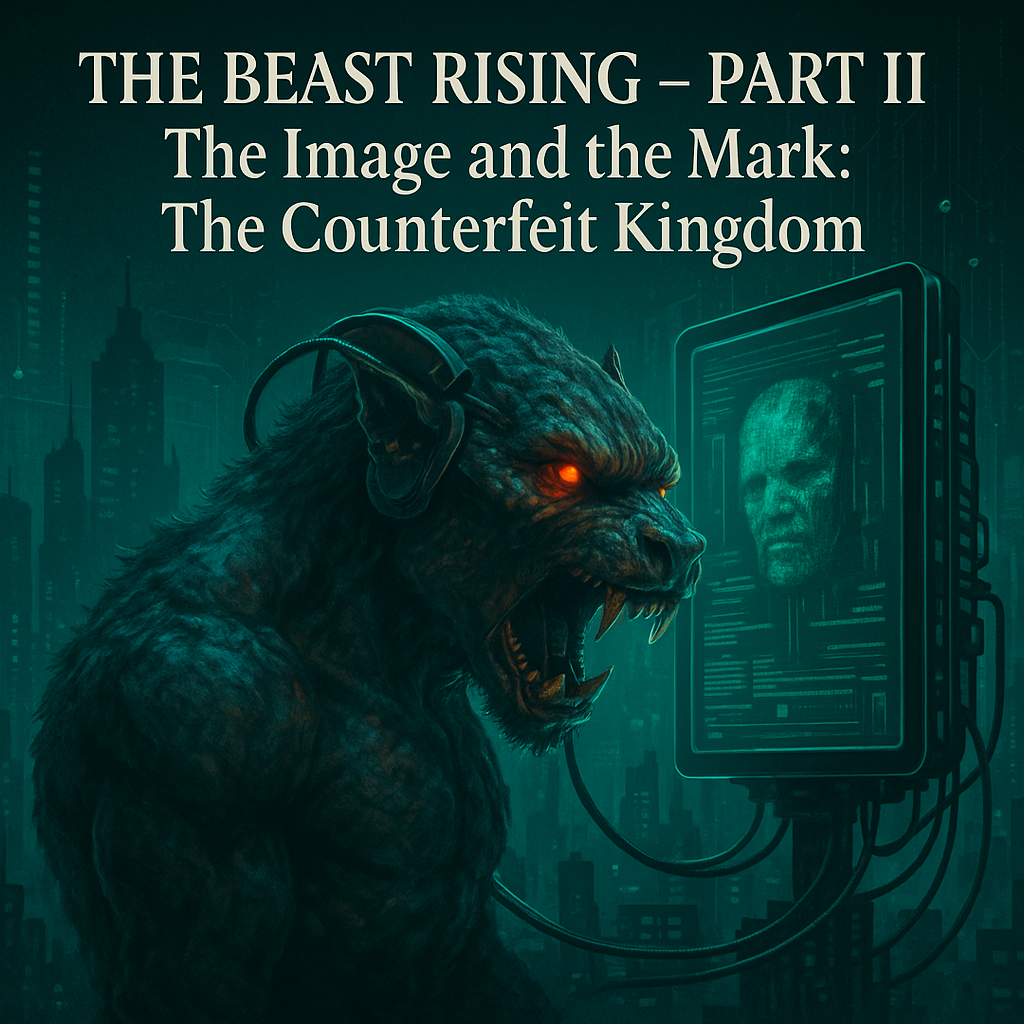
THE BEAST RISING — PART II
THE IMAGE AND THE MARK: The Counterfeit Kingdom
By Greg Witter | Ephraim’s Cry
Hebraic Mindset Study Series
Study • Learn • Apply • Grow • Share • Repeat
I. The Counterfeit Kingdom Unveiled
The Beast doesn’t merely rule by force; it counterfeits the Kingdom. It copies the structure of holiness and twists it into obedience to darkness. Where Yahuah seals His people with His Name and His Word, the Beast brands its followers with its image and its mark. Where the Kingdom trains disciples, the Beast manufactures dependents. Where worship should rise to the Creator, praise is diverted to the image of the system and the man it exalts.
The remnant must discern the difference between Kingdom seal and Beast mark; between true worship and compelled compliance; between image-bearing (Gen 1:26–27) and image-worship (Rev 13:15). The war at the end is not only about borders and armies; it is a war over worship.
II. Word Studies That Expose the Scheme
- “Beast” — θηρίον (thērion)
A wild, untamed creature; figuratively, an inhuman system devouring and dominating. In Revelation it is not merely a man; it is the system animated by the Dragon (Rev 13:2). - “Image” — εἰκών (eikōn)
Not just a statue, but a representation that carries the authority of the original. In the LXX, eikōn translates idols and likenesses. The second Beast causes the world to honor the representation of the first Beast’s authority (Rev 13:14–15). - “Mark” — χάραγμα (charagma)
A carved imprint, stamp, or engraved sign used on documents, coins, and slaves. It implies ownership and authorization. The mark is the visible token of allegiance that grants access to the Beast’s economy (Rev 13:16–17). - “Forehead/Right Hand”
Hebraically, this speaks to mind/authority and action/labor (cf. Deut 6:8). Yahuah’s covenant is bound “on the hand” and “between the eyes” (thought and deed). The Beast mimics this with its own sign upon thought and deed.
III. The Image: From Representation to Regulation
The second Beast (the False Prophet) uses propaganda, pseudo-miracles, and coercion to animate the image (Rev 13:14–15). The point is not the object itself but the authority it carries—to compel worship and authorize punishment (“as many as would not worship the image… be killed”).
This is the Beast’s sacrament of loyalty: approve the image, echo the slogans, bow to the narrative, pledge your obedience. In every age the image takes the shape of the dominant idol—emperor, empire, ideology, or system. In the end, it becomes globalized and enforced. The issue is not ancient sculpture but modern allegiance backed by systemic penalties.
The remnant must see through the theater: when a system demands celebration of its image (and punishes dissent), we are looking at image-worship by another name.
IV. The Mark: Allegiance, Access, and Authority
The mark is more than a gadget. It is a covenantal badge of belonging granting authorization to buy and sell inside the Beast’s economy (Rev 13:16–17). Spiritually, the mark signifies transfer of loyalty; practically, it unlocks participation in the marketplace the Beast controls.
- Allegiance: Who is your master? Yahuah or the system?
- Access: Who controls the gate to food, medicine, employment, travel?
- Authority: Whose name and law govern your choices under pressure?
Technology can be a delivery vehicle, but technology is not the essence. The essence is worship under duress. The mark fuses belief (forehead) and behavior (hand) into a binding agreement.
The wise therefore prepare to live, work, and worship free of the Beast’s permission—because the day comes when those permissions will be conditioned on denying truth.
V. The Seal of Yahuah vs. the Mark of the Beast
Scripture contrasts two communities: the sealed and the marked.
- The sealed have the Name of Yahuah and the Lamb on their foreheads (Rev 14:1; Rev 7:3). They keep the commands of Elohim and the faith of Yahusha (Rev 14:12).
- The marked receive the system’s token on hand/forehead and worship the image (Rev 13:16; 14:9–11).
This is covenantal language. The seal signifies ownership by Yahuah and alignment with His Torah; the mark signifies ownership by the Beast and alignment with lawlessness (ἀνομία, anomia). The end-time line is not denominational; it is covenantal: Torah + Testimony vs. Image + Mark.
VI. The Test of Worship Under Pressure
The pattern is ancient:
- Shadrach, Meshach, Abed-Nego: image on the plain of Dura; bow or burn (Dan 3).
- Mordechai: bow to Haman or be destroyed (Esth 3–4).
- Apostles: obey Elohim or human authorities (Acts 5:29).
The last test is the same—worship by coercion. The system will call compliance “love,” “unity,” “safety,” “peace.” Refusal will be labeled “hate,” “extremism,” “danger,” “terror.” The faithful must be prepared to lose access rather than lose allegiance.
VII. Preparing Households for the Mark Economy
1) Theological Preparedness — Settle the issue now: Whose Name is on my forehead? Teach your household what worship is (obedience), what idolatry is (compromise), and what the mark is (allegiance for access).
2) Moral Preparedness — Practice non-participation in small compromises. Discipline your life to say no to false peace. Train conscience, not convenience.
3) Practical Preparedness — Reduce dependence on systems that can be weaponized: food, finances, connectivity. Build remnant economies (skill-sharing, mutual aid, honest trade).
4) Communal Preparedness — Covenant communities survive pressure. Arrange accountability, discipleship, emergency care, and shared resources before the gate closes.
5) Witness Preparedness — Refusal without rage. Holiness without hostility. Prepare an answer seasoned with grace and truth when asked why you will not bow (1 Pet 3:15).
VIII. The Gospel in the Midst of the Beast
Revelation 14 shows three proclamations before the judgment falls:
- The everlasting Good News to every nation: Fear Elohim, give Him esteem, worship the Maker (Rev 14:6–7).
- Babylon has fallen (Rev 14:8).
- A warning against worshiping the Beast and receiving his mark (Rev 14:9–11).
Heaven’s order matters: Worship the Creator → Recognize Babylon’s doom → Refuse the mark. The remnant does not preach escape; we preach allegiance to the King even if it costs us the world.
Documentation & Foundations — Four Witnesses
Torah
- Shemoth (Exodus) 13:9 — A sign on hand and frontlets between eyes (covenant identity).
- Devariym (Deuteronomy) 6:6–8 — Bind the words on hand and between eyes (thought/action).
Prophets
- Dani’el 3 — The image, the furnace, and uncompromised worship.
- Yeshayahu 44:9–20 — The emptiness of images and idol-worshipers.
Writings
- Tehillim 115:4–8 — Those who make idols become like them.
- Mishlei 23:23 — Buy truth and do not sell it.
Apostolic
- Ḥazon (Revelation) 13:11–18 — Second Beast, animated image, coerced mark.
- Ḥazon 14:1, 6–12 — The sealed ones; the threefold heavenly message; the endurance of the set-apart ones.
- 2 Thessalonians 2:9–12 — Deception with signs and lying wonders for those who refuse love of the truth.
Call to the Remnant
Fix the Name of Yahuah on your forehead and the testimony of Yahusha in your heart. Let His commands bind your hands and shape your steps. Decide today that no access is worth lost allegiance.
When the image stands and the music plays, do not bow. When the market closes against you, do not sell truth. When the world offers safety in exchange for silence, speak.
The counterfeit kingdom is rising, but so is the courage of the saints.
Hold the line. Keep the commands. Keep the faith of Yahusha. Refuse the mark. Await the King.
Hashtags
#EphraimsCry #GregWitter #HebraicMindsetStudySeries #BeastRising #ImageAndMark #CounterfeitKingdom #Remnant #Watchmen #SetApart #TorahPursuant #CovenantKeepers #Revelation13 #Daniel3 #SealOfYahuah #RefuseTheMark #EndTimeProphecy #PrepareTheWay
