
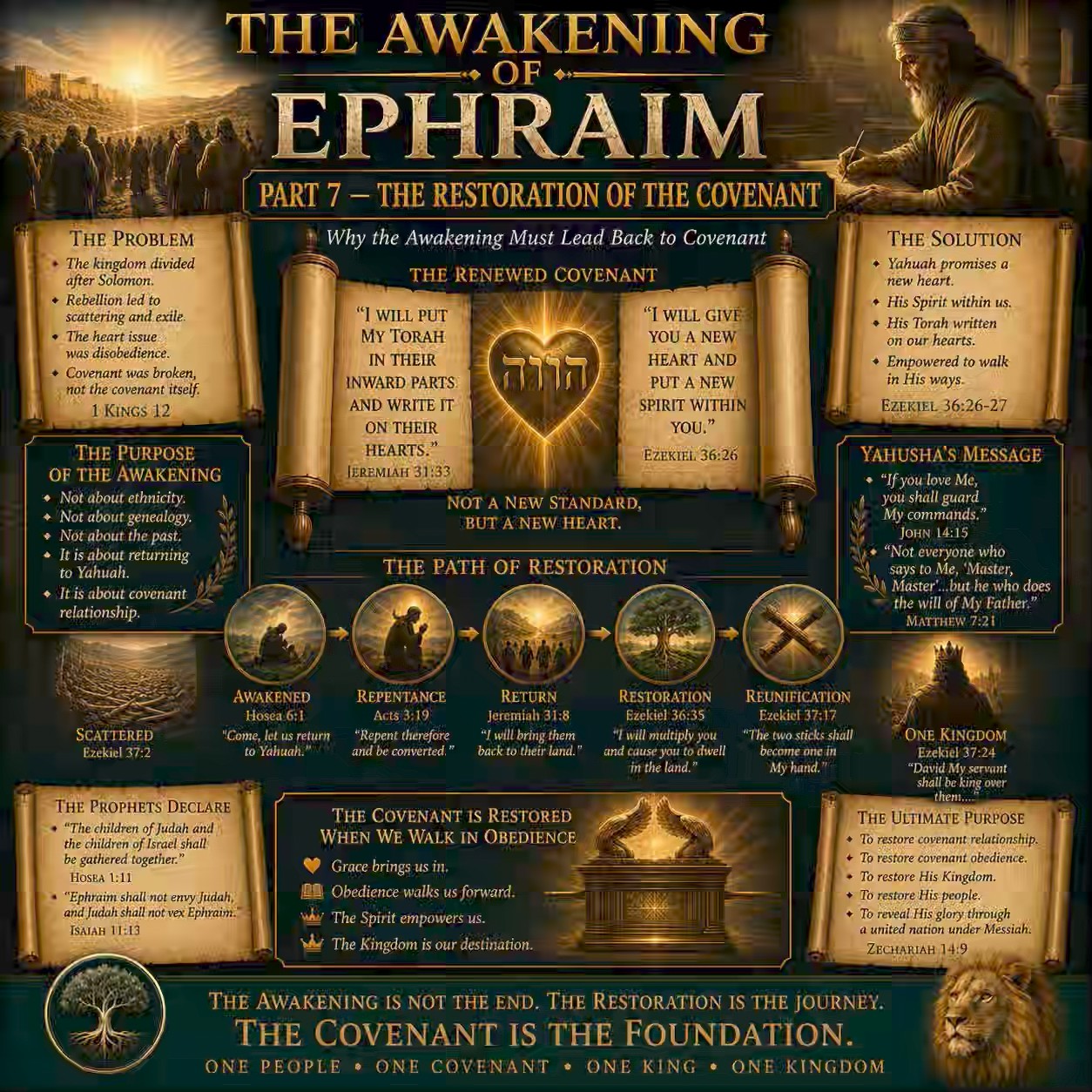
THE AWAKENING OF EPHRAIM
PART 7 — THE RESTORATION OF THE COVENANT
Why the Awakening Must Lead Back to Covenant
The awakening of Ephraim is not the destination.
It is the beginning of the journey.
One of the greatest mistakes people make is assuming that awakening alone fulfills prophecy.
It does not.
Awakening is the beginning.
Restoration is the objective.
Covenant is the goal.
Throughout Scripture, Yahuah never called His people merely to discover who they were.
He called them to return to Him.
The purpose of restoration was never genealogy.
The purpose was never ethnicity.
The purpose was never national identity.
The purpose was always covenant relationship.
This is why every restoration prophecy eventually returns to the covenant.
The prophets consistently move from awakening to repentance.
From repentance to restoration.
From restoration to obedience.
From obedience to covenant blessing.
This pattern appears repeatedly throughout Scripture.
The scattered are awakened.
The awakened repent.
The repentant return.
The returning are restored.
The restored walk in covenant.
This is the pattern.
This has always been the pattern.
One of the clearest examples appears in the prophecy of Hosea.
The House of Israel had become Lo-Ammi.
Not My people.
The covenant people had become indistinguishable from the nations.
Yet the solution was never simply recognizing their identity.
The solution was returning to Yahuah.
In Hosea 6:1-3, the prophet declares:
“Come, and let us return to יהוה.”
Notice the emphasis.
Return.
Not discover.
Not investigate.
Not speculate.
Return.
The restoration begins with returning.
The restoration begins with repentance.
The restoration begins with covenant renewal.
This is why the awakening taking place throughout the nations is only significant if it leads people back to covenant obedience.
Knowledge alone is not enough.
Information alone is not enough.
Identity alone is not enough.
Many people become fascinated with prophecy.
Many become fascinated with the tribes.
Many become fascinated with Israelite identity.
Yet if the awakening does not produce obedience, it has missed its purpose.
Yahuah never scattered Israel because they forgot their tribal identity.
He scattered Israel because they abandoned covenant.
He scattered Israel because they abandoned obedience.
He scattered Israel because they abandoned His ways.
If covenant breaking caused the scattering, covenant restoration must accompany the gathering.
This is why Jeremiah 31 is so important.
When Yahuah promises the renewed covenant, He immediately explains what that restoration looks like.
“I shall put My Torah in their inward parts, and write it on their hearts” (Jeremiah 31:33).
Notice what is written upon the heart.
Not a new morality.
Not a new religion.
Not a replacement law.
Not a replacement standard.
His Torah.
The location changes.
The standard does not.
The administration changes.
The covenant instructions remain.
The problem was never Torah.
The problem was the heart.
The problem was rebellion.
The problem was disobedience.
The problem was a people unwilling to walk in covenant.
The renewed covenant addresses the heart problem.
The renewed covenant empowers obedience.
The renewed covenant restores relationship.
The renewed covenant restores covenant faithfulness.
Many people read Jeremiah 31 and immediately assume the covenant itself changed.
That is not what Jeremiah says.
Jeremiah does not say Yahuah abandoned His standards.
Jeremiah does not say Yahuah abandoned His instructions.
Jeremiah does not say Yahuah abandoned His covenant expectations.
Jeremiah says the covenant would no longer be external only.
The covenant would become internal.
The Torah would move from stone tablets to transformed hearts.
The issue was never the Torah.
The issue was the people.
The issue was always the heart.
This same promise appears in Ezekiel.
“And I shall give you a new heart and put a new spirit within you” (Ezekiel 36:26).
Again, the focus is restoration.
Again, the focus is covenant.
Again, the focus is obedience.
Yahuah continues:
“And I shall put My Spirit within you, and shall cause you to walk in My laws and guard My right-rulings and do them” (Ezekiel 36:27).
Notice the purpose of the Spirit.
The Spirit is not given to eliminate obedience.
The Spirit is given to empower obedience.
The Spirit is not given to abolish covenant.
The Spirit is given to restore covenant.
The Spirit is not given to remove Yahuah’s instructions.
The Spirit is given to write those instructions upon the heart.
The restoration of Ephraim therefore cannot be separated from the work of the Ruach.
Dry bones require breath.
Awakening requires life.
Restoration requires transformation.
Knowledge alone cannot accomplish this.
Only the Spirit of Yahuah can.
This is why the restoration of Ephraim cannot be separated from Torah.
The entire purpose of the restoration is to bring people back into covenant relationship with Yahuah.
This truth continues into the Apostolic Witnesses.
Yahusha never preached lawlessness.
Yahusha never preached rebellion.
Yahusha never preached covenant abandonment.
Yahusha preached the Gospel of the Kingdom.
The Kingdom message calls people back under the authority of the King.
The Kingdom message calls people into covenant relationship.
The Kingdom message calls people to repentance.
The Kingdom message calls people to obedience.
This is why Yahusha repeatedly declared:
“If you love Me, you shall guard My commands” (John 14:15).
Love and obedience were never separated.
Faith and obedience were never separated.
Grace and obedience were never separated.
Relationship and obedience were never separated.
The modern tendency to separate grace from obedience would have been foreign to the biblical writers.
Grace was never permission for rebellion.
Grace was empowerment for obedience.
Grace was the mercy that allowed restoration.
Grace was the favor that made reconciliation possible.
Grace was never a license to continue walking contrary to Yahuah’s instructions.
This is precisely why Yahusha warned:
“Not everyone who says to Me, ‘Master, Master,’ shall enter into the reign of the heavens, but he who is doing the desire of My Father in the heavens” (Matthew 7:21).
A few verses later He gives one of the most sobering warnings in all of Scripture:
“Depart from Me, you workers of lawlessness” (Matthew 7:23).
The issue was never profession.
The issue was obedience.
The issue was never verbal confession alone.
The issue was covenant faithfulness.
The issue was whether people actually walked in the ways of Yahuah.
This same pattern appears throughout the Apostolic Witnesses.
Sha’ul never taught lawlessness.
Kefa never taught lawlessness.
Yochanan never taught lawlessness.
Ya’aqov never taught lawlessness.
In fact, Yochanan provides one of the clearest biblical definitions of sin:
“Sin is lawlessness” (1 John 3:4).
The restoration of the covenant therefore requires the restoration of biblical definitions.
The world defines sin one way.
Religion defines sin another way.
Scripture defines sin as lawlessness.
If sin is lawlessness, then repentance involves turning away from lawlessness.
If repentance involves turning away from lawlessness, then restoration necessarily involves returning to obedience.
This is why the covenant message is so critical.
The awakening is not about discovering who your ancestors were.
The awakening is about returning to Yahuah.
The awakening is about returning to covenant.
The awakening is about returning to His instructions.
The awakening is about returning to the Kingdom.
One of the greatest deceptions in modern religion is the idea that covenant can exist without obedience.
Scripture never teaches that.
From Genesis to Revelation, covenant relationship always includes covenant responsibility.
Abraham obeyed.
Isaac obeyed.
Jacob obeyed.
Joseph obeyed.
Moses obeyed.
Joshua obeyed.
David obeyed.
The prophets called for obedience.
Yahusha walked in obedience.
The apostles taught obedience.
The pattern never changes.
Salvation is by grace through faith.
But saving faith produces obedience.
Restoration produces obedience.
The Spirit produces obedience.
The Kingdom produces obedience.
This is why the restoration of the covenant is such a critical part of the awakening.
The dry bones do not merely live.
They become a people again.
The scattered do not merely gather.
They become a covenant people again.
The two sticks do not merely unite.
They become one covenant nation under one King again.
Everything points back to covenant.
Everything points back to relationship.
Everything points back to obedience.
Everything points back to the Kingdom.
The restoration story is ultimately not about ethnicity.
It is about covenant.
It is not about ancestry.
It is about relationship.
It is not about genealogy.
It is about obedience.
It is not about the past.
It is about returning to the King.
The scattered are awakening.
The dry bones are living.
The two sticks are becoming one.
The covenant is being restored.
The King is gathering His people.
And the Kingdom is drawing near.
Greg Witter | Ephraim’s Cry Hebraic Mindset Study Series Study • Learn • Apply • Grow • Share • Repeat
#EphraimsCry#GregWitter#HebraicMindset#HebraicMindsetStudySeries#TheAwakeningOfEphraim#Part7#RestorationOfTheCovenant
#Jeremiah31#Ezekiel36#TorahWrittenOnTheHeart#GospelOfTheKingdom#CovenantRestoration#ReturnToTorah#ReturnToYahuah
#Repentance#Obedience#KingdomMessage#Awakening#Remnant#Watchman#TruthMatters#StudyTheScriptures
#KingdomCitizens#FaithAndObedience#WholeCounselOfElohim
