
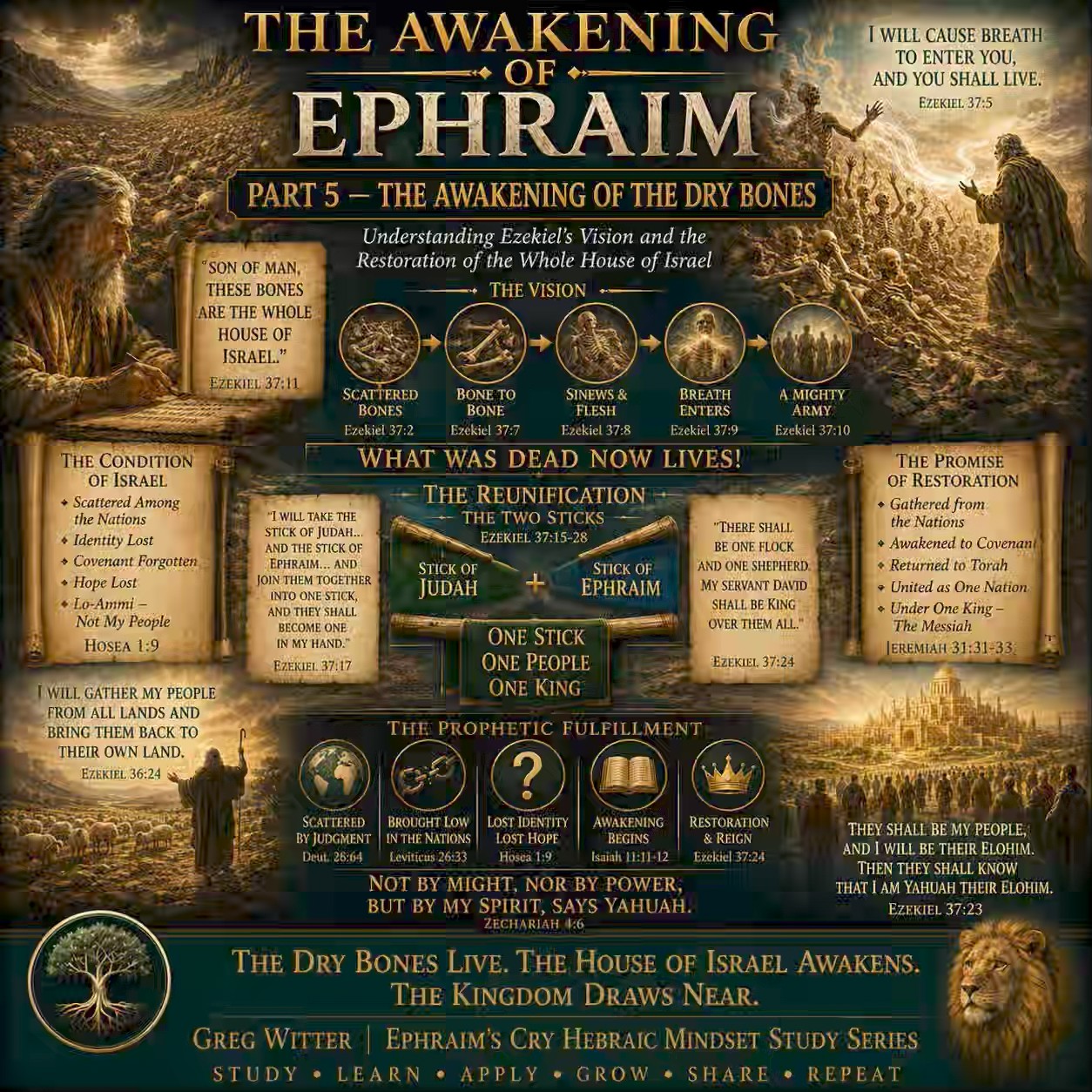
THE AWAKENING OF EPHRAIM
PART 5 — THE AWAKENING OF THE DRY BONES
Understanding Ezekiel’s Vision and the Restoration of the Whole House of Israel
One of the most powerful restoration prophecies in all of Scripture is found in Yechezqel (Ezekiel) 37.
Few passages have captured the imagination of believers more than the vision of the valley of dry bones.
Yet many people read the passage without understanding who the bones represent.
Many assume the vision is merely about resurrection.
Many assume it is merely symbolic.
Many assume it applies generally to spiritual renewal.
While elements of those ideas may exist within the broader prophetic picture, Yahuah Himself tells us exactly who the bones represent.
There is no need to speculate.
There is no need to guess.
There is no need to invent interpretations.
The text provides the answer.
In Ezekiel 37:11, Yahuah declares:
“Son of man, these bones are the whole House of Israel.”
Not Judah alone.
Not a portion of Israel.
Not a future religious movement.
Not a church.
Not a denomination.
The whole House of Israel.
This is one of the most important statements in the entire prophecy.
The vision is directly connected to the scattering, exile, and future restoration of Israel.
The dry bones represent a people who appear completely lost.
A people who appear completely forgotten.
A people who appear completely cut off.
A people whose national life seems impossible to restore.
The language of the prophecy reflects this reality:
“Our bones are dried up.”
“Our hope is lost.”
“We ourselves have been cut off.”
(Ezekiel 37:11)
This is precisely how the scattered House of Israel appeared after centuries among the nations.
The kingdom was gone.
The throne was gone.
The land was gone.
The identity was fading.
The covenant awareness was disappearing.
The people had become scattered throughout the world.
From a human perspective, restoration appeared impossible.
Yet what is impossible with men is not impossible with Yahuah.
The vision begins with a valley full of bones.
Not a few bones.
Not a small collection of bones.
A valley full of bones.
Bones scattered everywhere.
Bones separated from one another.
Bones disconnected from one another.
Bones representing the condition of the scattered House of Israel.
Notice carefully that the vision begins with bones.
Not living people.
Not an organized nation.
Not a restored kingdom.
Bones.
Dry bones.
The picture is intentional.
Dry bones have no life.
Dry bones have no strength.
Dry bones have no identity.
Dry bones have no future from a human perspective.
The message is unmistakable.
The restoration will not occur because Israel figures it out.
The restoration will not occur because a political movement succeeds.
The restoration will not occur because a religious institution succeeds.
The restoration will occur because Yahuah intervenes.
The entire vision is a testimony to the power and faithfulness of Yahuah.
Then Yahuah asks Ezekiel a remarkable question:
“Son of man, can these bones live?” (Ezekiel 37:3)
The question is not really about bones.
The question is about restoration.
Can a scattered people be restored?
Can a divided kingdom be reunited?
Can a covenant people be awakened?
Can those who have become lost among the nations return?
Can a people who have forgotten who they are remember again?
Can a people who have forgotten covenant return to covenant?
Yahuah answers the question Himself.
The bones begin to move.
Bone comes to bone.
Sinews appear.
Flesh appears.
The structure begins to form.
Yet there is still no life.
The body exists.
The structure exists.
The framework exists.
But the breath has not yet entered.
This is a profound picture.
Many awakenings begin with structure.
Many restorations begin with knowledge.
Many people begin learning Scripture.
Many people begin learning Torah.
Many people begin learning the appointed times.
Many people begin questioning traditions.
Many people begin returning to covenant.
Many people begin rediscovering their Hebraic foundations.
Yet information alone is not enough.
Knowledge alone is not enough.
Doctrine alone is not enough.
The breath must enter.
The Ruach must move.
The restoration must become living reality.
This is why the second stage of the vision is so important.
Yahuah commands Ezekiel to prophesy to the breath.
The breath enters.
The bones live.
The army stands.
The restoration advances.
What was dead becomes alive.
What was scattered begins to gather.
What was lost begins to return.
What was forgotten begins to awaken.
The progression is remarkable.
First the bones are scattered.
Then the bones are gathered.
Then the bones are assembled.
Then the breath enters.
Then the army stands.
This progression mirrors the prophetic story of Ephraim.
The House of Israel was scattered.
The House of Israel was assimilated.
The House of Israel lost its identity.
The House of Israel became hidden among the nations.
The House of Israel became as the Gentiles.
The House of Israel became Lo-Ammi, “not My people” (Hosea 1:9).
Then the awakening begins.
The scattered begin asking questions.
The scattered begin seeking truth.
The scattered begin returning to Scripture.
The scattered begin rediscovering covenant.
The scattered begin returning to the ancient paths.
The dry bones begin to move.
What makes this prophecy even more remarkable is what follows immediately afterward.
The vision of the dry bones is followed by the prophecy of the two sticks (Ezekiel 37:15-28).
This is not a separate prophecy.
It is the continuation of the same prophecy.
The dry bones lead directly into the reunification of the kingdom.
One stick represents Judah.
One stick represents Ephraim and the House of Israel.
Yahuah commands Ezekiel to bring them together.
The two become one.
This is critical.
The goal is not merely awakening.
The goal is reunification.
The goal is restoration.
The goal is one people under one King.
The divided kingdom becomes one kingdom.
The scattered become gathered.
The broken becomes restored.
The exile moves toward completion.
The restoration moves toward fulfillment.
This is exactly what the prophets repeatedly anticipated.
Hoshea anticipated it (Hosea 1:10-11).
Yeshayahu anticipated it (Isaiah 11:12-13).
Yirmeyahu anticipated it (Jeremiah 31:31-33).
Yechezqel anticipated it (Ezekiel 37:15-28).
Again and again, the prophets point toward a future restoration of both houses.
The restoration is not merely physical.
The restoration is not merely national.
The restoration is covenantal.
The restoration is spiritual.
The restoration is relational.
The restoration is Kingdom-focused.
The purpose is not simply returning people to land.
The purpose is returning people to Yahuah.
The purpose is returning people to covenant.
The purpose is returning people to obedience.
The purpose is returning people to the Kingdom.
Another important detail often overlooked is that Ezekiel never sees the bones remain scattered.
He never sees them remain dead.
He never sees them remain divided.
Every movement within the prophecy is toward restoration.
Every movement within the prophecy is toward unity.
Every movement within the prophecy is toward life.
This is why the dry bones prophecy remains so powerful.
It demonstrates that no condition is beyond restoration.
No exile is beyond redemption.
No scattering is beyond gathering.
No judgment is beyond mercy.
No separation is beyond reconciliation.
No division is beyond healing.
The same Elohim who scattered Israel promised to restore Israel.
The same Elohim who judged Israel promised to heal Israel.
The same Elohim who drove Israel among the nations promised to gather Israel from among the nations.
The same Elohim who allowed the bones to become dry promised they would live again.
The vision of the dry bones is therefore not a message of despair.
It is a message of hope.
It is a message of restoration.
It is a message of covenant faithfulness.
It is a message of Kingdom promise.
The bones live because Yahuah speaks.
The scattered gather because Yahuah calls.
The restoration happens because Yahuah promised.
And if the dry bones truly represent the whole House of Israel, then the awakening of the dry bones represents one of the most significant prophetic developments in the restoration story.
Many believers are watching the nations awaken to Torah.
Many believers are watching people question inherited traditions.
Many believers are watching people rediscover the Sabbath.
Many believers are watching people rediscover the appointed times.
Many believers are watching people return to covenant.
Many believers are watching people embrace the Gospel of the Kingdom.
Whether one agrees with every conclusion or not, the prophetic parallels are difficult to ignore.
The valley is not the end.
The grave is not the end.
The scattering is not the end.
The exile is not the end.
The dry bones live.
The House of Israel awakens.
The two houses become one.
The King gathers His people.
The Kingdom draws near.
And the Elohim who promised restoration is faithful to complete what He began.
Greg Witter | Ephraim’s Cry Hebraic Mindset Study Series Study • Learn • Apply • Grow • Share • Repeat
#EphraimsCry#GregWitter#HebraicMindset#HebraicMindsetStudySeries#TheAwakeningOfEphraim#Part5#DryBones#Ezekiel37
#HouseOfIsrael#Ephraim#HouseOfJudah#TwoSticks#RestorationOfIsrael#BiblicalProphecy#WholeCounselOfElohim
#CovenantRestoration#KingdomMessage#GospelOfTheKingdom#ReturnToTorah#Awakening#Remnant#Watchman
#TruthMatters#StudyTheScriptures#KingdomCitizens
