
THE AWAKENING OF EPHRAIM
PART 3 — THE MULTIPLICATION OF THE JUDGMENT
Understanding the 390 Years, the Sevenfold Punishment, and the Prophetic Timing of the Awakening
One of the most overlooked prophetic keys in all of Scripture is found in the relationship between Torah and the prophet Ezekiel.
Most believers understand that the House of Israel was judged.
Some understand that the Northern Kingdom was taken into Assyrian captivity.
Very few understand that Scripture appears to provide a prophetic framework concerning the duration and multiplication of that judgment.
To understand the awakening of Ephraim, we must first understand the judgment of Ephraim.
Yahuah does not judge arbitrarily.
Yahuah does not judge without warning.
Yahuah does not judge without first revealing His standard.
Throughout Torah, Yahuah repeatedly warned Israel that covenant blessings would follow obedience and covenant curses would follow rebellion.
The covenant relationship contained both promises and consequences.
Israel accepted the covenant.
Israel understood the covenant.
Israel knew the covenant requirements.
Yet the House of Israel repeatedly violated the covenant.
The result was judgment.
But Torah reveals something many readers overlook.
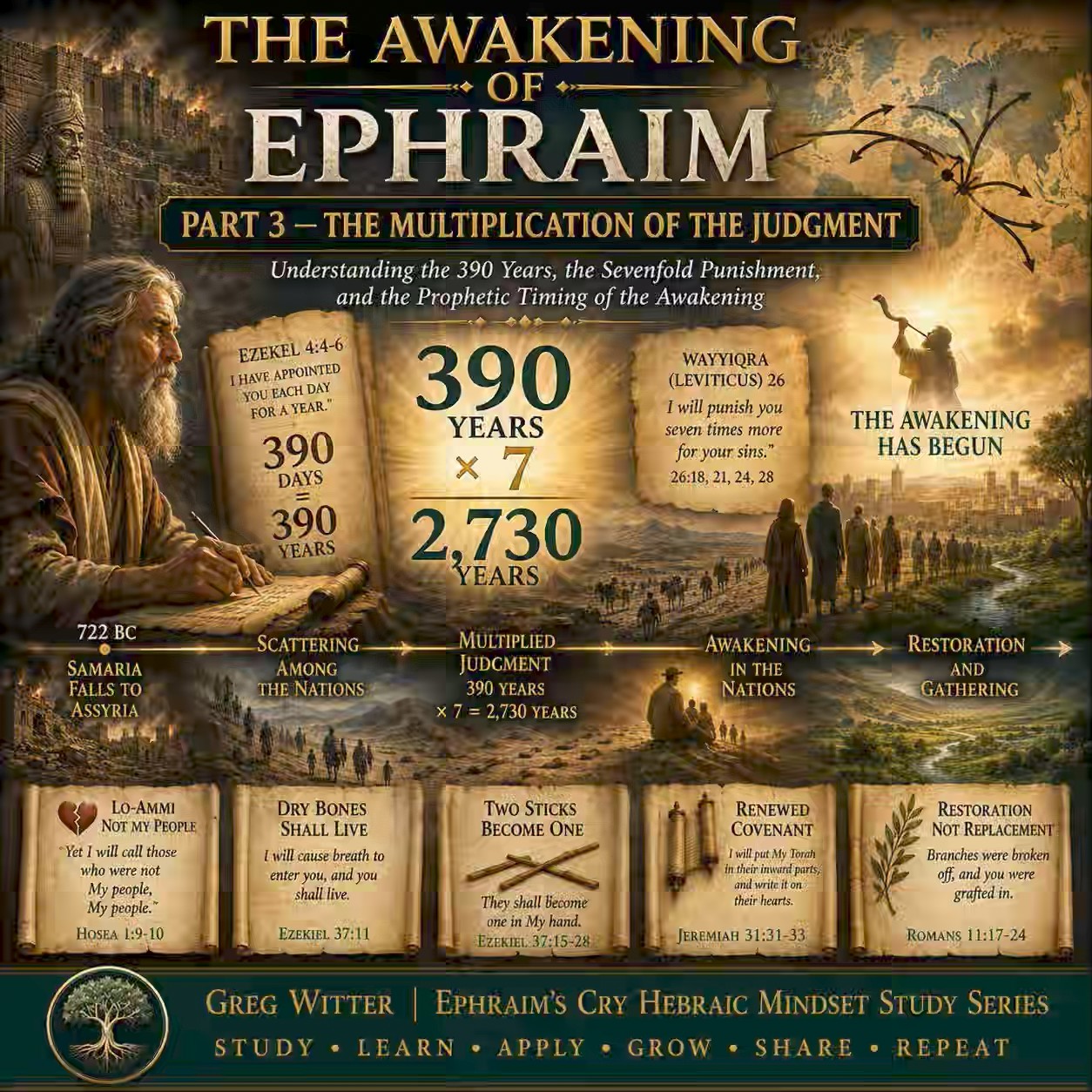
In Wayyiqra (Leviticus) 26, Yahuah repeatedly warns that if Israel refused to repent after judgment, He would multiply their punishment seven times. This warning appears repeatedly throughout the chapter (Leviticus 26:18, 21, 24, 28).
The principle is clear.
Judgment alone was not the issue.
The issue was continued rebellion after judgment.
If correction did not produce repentance, the discipline would be increased.
If warning did not produce repentance, the punishment would be multiplied.
Another prophetic key often overlooked is found in the blessing given by Ya’aqov to Yoseph’s sons. In B’reshit (Genesis) 48:19, Ya’aqov declares that Ephraim’s descendants would become a “multitude of nations.” The Hebrew phrase melo ha’goyim carries the idea of a fullness among the nations.
Long before the kingdom divided.
Long before Assyria invaded.
Long before the exile occurred.
Yahuah had already revealed that Ephraim’s future would be connected to the nations.
This becomes increasingly significant when we arrive at the prophetic writings.
The scattering of Ephraim was not merely a punishment.
It also became the means through which Ephraim would become dispersed among the nations exactly as had been foretold.
What appears to be judgment is also part of a much larger prophetic pattern unfolding across centuries.
This becomes extremely important when we arrive at the book of Ezekiel.
In Yechezqel (Ezekiel) 4, Yahuah commands the prophet to perform a prophetic sign.
Ezekiel is instructed to lie upon his side and bear the iniquity of the House of Israel.
The period assigned is 390 days.
Yahuah then explicitly provides the prophetic key:
“I have appointed you each day for a year” (Ezekiel 4:4-6).
This transforms the 390 days into 390 prophetic years.
Immediately we are confronted with an important question.
What happens if the House of Israel does not repent?
Torah already answered that question.
The punishment is multiplied seven times.
390 years multiplied by seven equals 2,730 years.
This is where the discussion becomes extremely significant.
The fall of Samaria and the final collapse of the Northern Kingdom is commonly placed around 722 BC.
Using that historical benchmark and applying the prophetic framework derived from Ezekiel and Leviticus produces a period extending into the modern era.
This does not establish an exact day.
This does not establish an exact year beyond all debate.
Prophecy rarely operates with modern mathematical precision.
What it does provide is a prophetic benchmark.
A prophetic framework.
A prophetic window.
A prophetic expectation.
And what becomes fascinating is what begins occurring within that general timeframe.
Across the nations, people begin awakening to the Hebraic foundations of Scripture.
Across the nations, people begin questioning inherited traditions.
Across the nations, people begin returning to Sabbath.
Across the nations, people begin returning to the appointed times.
Across the nations, people begin rediscovering the covenant.
Across the nations, people begin rediscovering the Gospel of the Kingdom.
The timing is difficult to ignore.
The House of Israel was scattered.
The House of Israel lost its identity.
The House of Israel became mixed among the nations.
The House of Israel became as the Gentiles.
Yet suddenly people throughout the nations begin asking questions.
Who are we?
What is Torah?
What is covenant?
What are the appointed times?
What is the Gospel of the Kingdom?
Why were these things hidden from us?
The awakening begins.
This does not mean everyone who awakens can prove tribal lineage.
That misses the point entirely.
The issue is not proving a bloodline.
The issue is awakening to covenant.
The issue is returning to Yahuah.
The issue is returning to His ways.
The issue is the restoration promised by the prophets.
The prophets repeatedly anticipated a future restoration following the scattering.
Hoshea (Hosea) declared that the House of Israel would become Lo-Ammi, “not My people” (Hosea 1:9).
Yet only a few verses later Yahuah promises that those called “not My people” would again be called the children of the living Elohim (Hosea 1:10).
The judgment was never intended to be permanent.
The scattering was never intended to be permanent.
The exile was never intended to be permanent.
The restoration was always part of the plan.
This is why Ezekiel 37 becomes so important.
The valley of dry bones represents the whole House of Israel (Ezekiel 37:11).
The bones are scattered.
The bones are lifeless.
The bones appear forgotten.
Yet Yahuah causes them to come together.
Bone to bone.
Sinew to sinew.
Flesh upon flesh.
Then breath enters them and they stand as a mighty army.
The vision is immediately followed by the prophecy of the two sticks, where the stick of Judah and the stick of Ephraim are reunited into one nation under one King (Ezekiel 37:15-28).
The progression is remarkable.
First comes the rebellion.
Then comes the scattering.
Then comes the multiplied judgment.
Then comes the awakening.
Then comes the reunification.
Then comes the Kingdom.
Jeremiah confirms this restoration theme through the promise of the renewed covenant.
The renewed covenant is not made with a Gentile church replacing Israel.
It is explicitly made with the House of Israel and the House of Judah (Jeremiah 31:31-33).
The same two houses divided after Solomon are the same two houses restored under the renewed covenant.
This theme continues into the Apostolic Witnesses.
Yahusha declared that He was sent to the lost sheep of the House of Israel (Matthew 15:24).
His mission was not limited to Judah alone.
The restoration of Israel stands at the center of the Kingdom message.
Sha’ul expands this further in Romans 9 through 11.
He quotes Hosea’s Lo-Ammi prophecy and applies it to the restoration process of those once called “not My people” (Romans 9:24-26).
He then describes branches broken off and branches grafted back into the cultivated olive tree (Romans 11:17-24).
The imagery is not replacement.
The imagery is restoration.
One of the greatest mistakes made by modern theology is reducing prophecy to isolated events while ignoring the larger covenant narrative.
The prophets were not merely predicting historical events.
They were revealing Yahuah’s redemptive plan.
Judgment was part of that plan.
Scattering was part of that plan.
Restoration was part of that plan.
The awakening was part of that plan.
The same Elohim who announced the judgment also announced the restoration.
The same Elohim who scattered Israel also promised to regather Israel.
The same Elohim who multiplied the punishment also promised an end to the punishment.
This is why understanding Leviticus and Ezekiel together is so important.
Leviticus explains the covenant consequences.
Ezekiel illustrates the prophetic timeline.
The two witnesses work together.
Torah provides the covenant foundation.
The prophet provides the prophetic application.
Together they reveal a remarkable picture.
A people judged.
A people scattered.
A people disciplined.
A people hidden among the nations.
A people eventually awakened.
The same prophetic pattern appears throughout Scripture.
What was scattered is gathered.
What was lost is found.
What was divided is reunited.
What was asleep is awakened.
What was judged is restored.
This is why the awakening of Ephraim matters.
It is not merely about history.
It is not merely about identity.
It is not merely about prophecy.
It is about the faithfulness of Yahuah to fulfill every covenant promise He has made.
The Elohim who scattered Israel promised to regather Israel.
The Elohim who judged Israel promised to restore Israel.
The Elohim who declared Lo-Ammi promised once again to declare Ammi.
The Elohim who spoke through Moses, Hosea, Jeremiah, Ezekiel, and the Apostolic Witnesses is bringing His prophetic plan toward its fulfillment.
Many believers struggle with the idea that we may be witnessing prophetic restoration in our generation.
Yet the prophets repeatedly point toward a future awakening.
They repeatedly point toward a future regathering.
They repeatedly point toward a future restoration.
They repeatedly point toward a future return to covenant.
The question is not whether Yahuah promised restoration.
The question is whether we recognize it when it begins.
The House of Israel spent centuries among the nations.
The House of Israel became mixed among the nations.
The House of Israel became hidden among the nations.
But Yahuah never lost sight of them.
Not one generation escaped His notice.
Not one exile escaped His attention.
Not one scattered descendant escaped His promise.
The covenant remained.
The promises remained.
The restoration remained.
And if the prophetic framework is correct, then what many are witnessing today is not the birth of a new movement.
It is the awakening of an ancient people to an ancient covenant and an ancient calling.
The judgment had a beginning.
The multiplication had a duration.
The restoration has a season.
And the awakening is part of that restoration.
Because the story of Ephraim did not end in Assyria.
The story did not end in exile.
The story did not end in scattering.
The story moves toward restoration.
The story moves toward regathering.
The story moves toward covenant renewal.
The story moves toward the Kingdom.
And the awakening of Ephraim is one of the clearest signs that the story is still unfolding.
Greg Witter | Ephraim’s Cry Hebraic Mindset Study Series Study • Learn • Apply • Grow • Share • Repeat
#EphraimsCry
#GregWitter
#HebraicMindset
#HebraicMindsetStudySeries
#TheAwakeningOfEphraim
#Part3
#TheMultiplicationOfTheJudgment
#HouseOfIsrael
#Ephraim
#NorthernKingdom
#Leviticus26
#Ezekiel4
#Ezekiel37
#390Years
#SevenTimes
#PropheticTimeline
#RestorationOfIsrael
#BiblicalProphecy
#Torah
#Prophets
#Writings
#ApostolicWitnesses
#WholeCounselOfElohim
#Hosea
#LoAmmi
#Jeremiah31
#Romans11
#LostSheepOfIsrael
#CovenantRestoration
#GospelOfTheKingdom
#KingdomMessage
#ReturnToTorah
#Awakening
#DryBones
#EndTimes
#Remnant
#FaithfulRemnant
#Watchman
#StudyTheScriptures
#TruthMatters
#PreparingTheWay
#KingdomCitizens
#RestorationOfAllThings
