
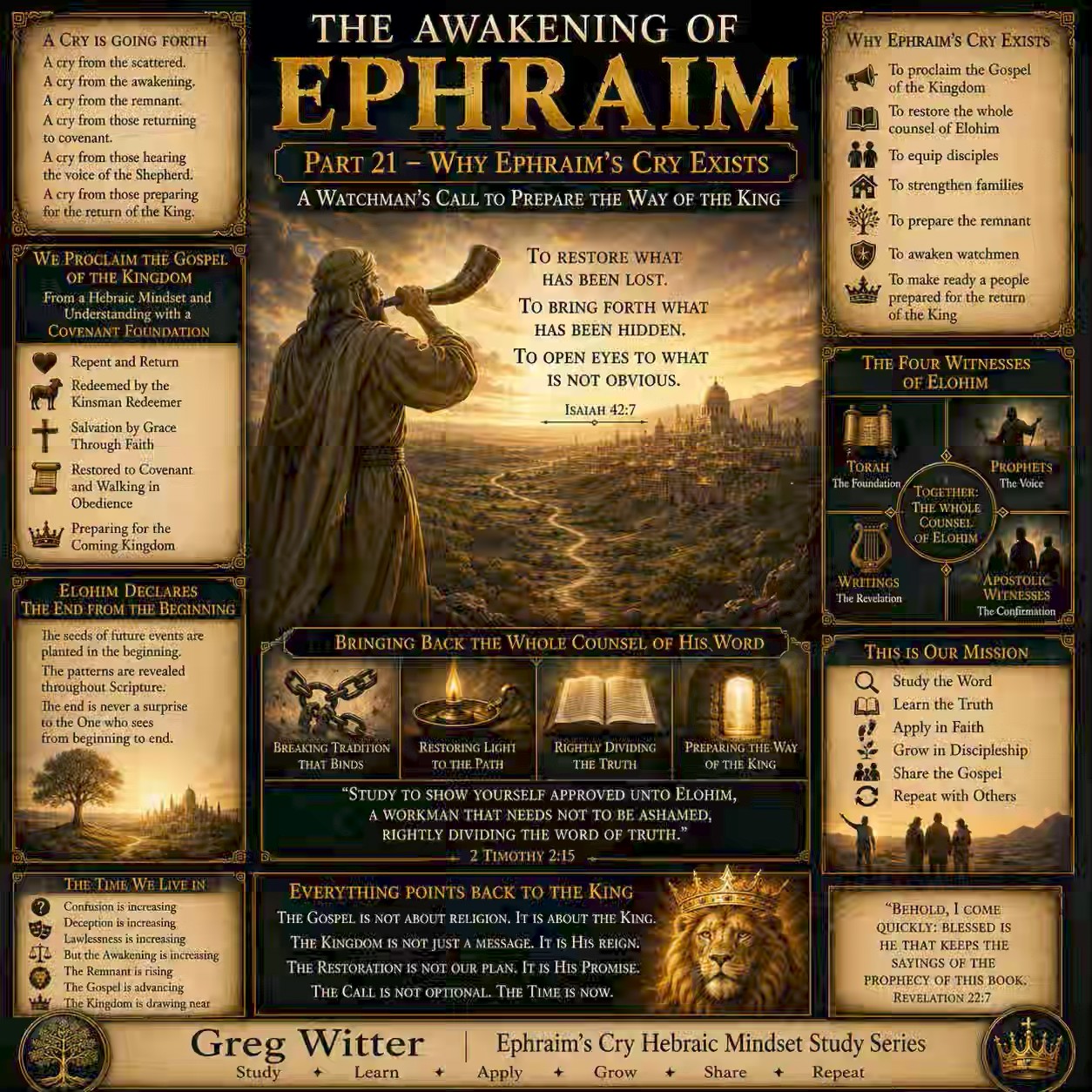
THE AWAKENING OF EPHRAIM
PART 21 — WHY EPHRAIM’S CRY EXISTS
A Watchman’s Call to Prepare the Way of the King
Every ministry begins somewhere.
Every calling begins somewhere.
Every assignment begins somewhere.
Yet the story of Ephraim’s Cry is not ultimately about a ministry.
It is not about a website.
It is not about books.
It is not about broadcasts.
It is not about an academy.
It is not about a man.
It is about a message.
It is about a calling.
It is about a burden.
It is about a watchman assignment.
The name Ephraim’s Cry was never chosen because of an interest in tribal identity.
It was never chosen to elevate Ephraim above Judah.
It was never chosen to create another movement.
It was never chosen to build another denomination.
It was chosen because it reflects a reality that is unfolding before our eyes.
A cry is going forth.
A cry from the scattered.
A cry from the awakening.
A cry from the remnant.
A cry from those returning to covenant.
A cry from those rediscovering the ancient paths.
A cry from those hearing the voice of the Shepherd.
A cry from those preparing for the return of the King.
That cry is being heard around the world.
Not in one nation.
Not in one denomination.
Not in one organization.
But among people from every background imaginable.
Men and women.
Young and old.
Jew and Gentile.
Former Christians.
Former atheists.
Former church leaders.
Former prodigals.
People who simply became hungry for truth.
People who became dissatisfied with traditions that could not withstand biblical examination.
People who began asking questions.
People who opened the Scriptures for themselves.
People who began following the evidence wherever it led.
This is where the story of Ephraim’s Cry begins.
Not with an organization.
But with a conviction.
A conviction that Scripture must be allowed to speak for itself.
A conviction that tradition must be tested.
A conviction that doctrine must be examined.
A conviction that the whole counsel of Elohim must be restored.
One of the greatest problems facing believers today is fragmentation.
People read Paul without Torah.
People read prophecy without Torah.
People read Revelation without understanding the prophets.
People read the Apostolic Witnesses without understanding the foundation upon which they stand.
People build doctrines from isolated verses.
People build systems from partial evidence.
The result is confusion.
Division.
Contradiction.
And endless theological debates.
Yet Scripture was never designed to be read that way.
Scripture interprets Scripture.
Torah lays the foundation.
The Prophets build upon the foundation.
The Writings illuminate the foundation.
The Apostolic Witnesses confirm the foundation.
The Four Witnesses work together.
The whole counsel works together.
The message works together.
This conviction became one of the foundational pillars behind Ephraim’s Cry.
The goal was never to create something new.
The goal was to restore what had been forgotten.
The goal was not innovation.
The goal was restoration.
The goal was not novelty.
The goal was truth.
The goal was not religious entertainment.
The goal was discipleship.
One of the most important reasons Ephraim’s Cry exists is because there is a desperate need to restore a Hebraic mindset and understanding with a covenant foundation to the study of Scripture.
Many people read the Bible through the lens of modern culture.
Many read it through denominational traditions.
Many read it through theological systems that developed centuries after the text was written.
As a result, they often miss the context.
They miss the language.
They miss the culture.
They miss the covenant.
They miss the Kingdom.
They miss the prophetic framework that connects Genesis to Revelation.
One of the foundational convictions behind Ephraim’s Cry is that Scripture was given by Hebrews, written primarily by Hebrews, to a Hebrew people living within a Hebrew covenant context.
This does not mean truth belongs only to Hebrews.
It means understanding the original context matters.
Context matters.
Language matters.
Culture matters.
Covenant matters.
Kingdom matters.
When the Hebraic context is restored, passages that once seemed disconnected suddenly begin fitting together.
Patterns emerge.
Prophecies connect.
Themes unite.
The whole counsel begins speaking with one voice.
This is why we consistently emphasize a Hebraic mindset and understanding.
Not because we are attempting to become culturally Jewish.
Not because we are attempting to imitate ancient customs for their own sake.
But because we desire to understand Scripture the way Scripture presents itself.
One of the greatest keys to this understanding is learning to see how Elohim declares the end from the beginning.
This principle is stated explicitly by Yahuah Himself.
He declares the end from the beginning.
The seeds of future events are planted in the earliest chapters of Scripture.
Genesis establishes patterns.
Torah establishes patterns.
The Prophets expand those patterns.
The Writings illuminate those patterns.
The Apostolic Witnesses confirm those patterns.
The end is revealed through the beginning.
The Kingdom is revealed through creation.
The Gospel is revealed through covenant.
The restoration is revealed through exile.
The regathering is revealed through the Exodus.
The coming King is revealed through the kings.
The Messiah is revealed through the sacrifices.
The future is revealed through the patterns established from the beginning.
This is one reason so much confusion exists today.
People often begin studying prophecy at the end of the book while neglecting the foundation laid at the beginning of the book.
Yet Yahuah consistently teaches through patterns.
Prophetic understanding grows when the beginning and the end are studied together.
This is why another central purpose of Ephraim’s Cry is bringing to light what has been hidden in plain sight.
Not hidden because Elohim desired to conceal truth forever.
Hidden because generations stopped looking.
Hidden because traditions replaced context.
Hidden because assumptions replaced study.
Hidden because doctrines replaced careful examination.
Hidden because many people inherited conclusions without ever examining the evidence for themselves.
When people begin reading Scripture through the lens of covenant, Kingdom, and Hebraic understanding, they often discover truths that were there all along.
The appointed times.
The Kingdom message.
The covenant structure of Scripture.
The restoration of Israel.
The role of the remnant.
The importance of discipleship.
The Gospel of the Kingdom.
The prophetic significance of the scattered and regathered people.
These things were not added to Scripture.
They were already there.
The goal is not to invent new truth.
The goal is to restore biblical truth.
This is also why Ephraim’s Cry places such a strong emphasis on the Four Witnesses of Elohim.
One of the greatest errors in modern biblical study is isolating portions of Scripture from one another.
People build doctrines from isolated passages.
People elevate one witness above another.
People read Paul while neglecting Moses.
People read Revelation while neglecting Isaiah.
People read the Apostolic Witnesses while neglecting the Prophets.
The result is imbalance.
The Four Witnesses restore balance.
Torah.
Prophets.
Writings.
Apostolic Witnesses.
Together they form the whole counsel of Elohim.
Together they provide context.
Together they establish doctrine.
Together they reveal the Kingdom.
Together they reveal Messiah.
Together they reveal the restoration story.
Together they reveal the Gospel of the Kingdom.
When all four witnesses speak together, confusion begins to disappear.
Contradictions begin to disappear.
Man-made divisions begin to disappear.
The larger picture begins to emerge.
This is why Ephraim’s Cry continually returns to the whole counsel of Elohim.
Not one witness.
Not two witnesses.
Not selected passages.
Not favorite doctrines.
The whole counsel.
The entire testimony.
The full witness of Scripture speaking in harmony.
Because truth is strongest when all four witnesses agree.
This is why the ministry consistently returns to the same themes.
The Gospel of the Kingdom.
The Hebraic mindset.
The whole counsel of Elohim.
The restoration of covenant understanding.
The restoration of discipleship.
The restoration of biblical literacy.
The restoration of Kingdom citizenship.
The restoration of preparation for the return of the King.
Everything ultimately points back to those foundations.
Because those foundations ultimately point back to Yahusha.
One of the greatest misconceptions people have about ministries is believing the objective is followers.
The objective is not followers.
The objective is disciples.
The objective is not building a platform.
The objective is building Kingdom citizens.
The objective is not creating dependency.
The objective is creating maturity.
The objective is not gathering crowds.
The objective is preparing a remnant.
This is why Ephraim’s Cry exists.
To help people study.
To help people learn.
To help people apply.
To help people grow.
To help people share.
To help people repeat the process with others.
Disciples making disciples.
Students becoming teachers.
Learners becoming leaders.
Families becoming covenant households.
Believers becoming Kingdom citizens.
This mission becomes increasingly important as we approach the end of the age.
Confusion is increasing.
Deception is increasing.
Compromise is increasing.
Lawlessness is increasing.
Biblical illiteracy is increasing.
Yet at the same time, hunger is increasing.
Questions are increasing.
The awakening is increasing.
The remnant is increasing.
People are searching for answers.
People are searching for truth.
People are searching for understanding.
People are searching for purpose.
People are searching for the Kingdom.
This is why teaching matters.
This is why discipleship matters.
This is why watchmen matter.
This is why preparation matters.
This is why the Gospel of the Kingdom matters.
This is why Ephraim’s Cry exists.
The ministry was never intended to become a destination.
It was intended to become a signpost.
A signpost pointing people toward Scripture.
A signpost pointing people toward covenant.
A signpost pointing people toward discipleship.
A signpost pointing people toward the Kingdom.
A signpost pointing people toward the King.
This is also why the Academy exists.
The Academy is not about collecting students.
The Academy is about making disciples.
The Academy is not about information transfer.
The Academy is about transformation.
The Academy is not about degrees.
The Academy is about Kingdom development.
The Academy is not about academic achievement.
The Academy is about spiritual maturity.
The Academy exists because the awakening requires discipleship.
The remnant requires discipleship.
The Kingdom requires discipleship.
The next generation requires discipleship.
The Gospel of the Kingdom requires discipleship.
A movement without discipleship eventually collapses.
A revival without discipleship eventually fades.
An awakening without discipleship eventually drifts.
The answer is not more information.
The answer is mature disciples who can study, learn, apply, grow, share, and repeat.
This is why books are written.
This is why teachings are produced.
This is why broadcasts are conducted.
This is why classes are taught.
This is why questions are answered.
This is why conversations continue.
Not because a ministry must grow.
But because the Kingdom must advance.
Not because a platform must expand.
But because the Gospel must spread.
Not because a name must become known.
But because the King must become known.
Everything returns to the King.
Everything returns to the Kingdom.
Everything returns to the Gospel.
Everything returns to the calling.
The awakening of Ephraim is not about Ephraim.
The awakening of Ephraim is about the King.
The restoration of Israel is not about Israel alone.
It is about the King.
The gathering of the remnant is not about the remnant.
It is about the King.
The Gospel of the Kingdom is not about information.
It is about the King.
The Kingdom is not about a system.
It is about the King.
This is why Ephraim’s Cry exists.
To proclaim the Gospel of the Kingdom from a Hebraic mindset and understanding with a covenant foundation.
To restore the whole counsel of Elohim.
To equip disciples.
To strengthen families.
To prepare the remnant.
To awaken watchmen.
To help people see how Elohim declares the end from the beginning.
To help people discover what has been lost.
To help people recover what has been forgotten.
To help people recognize what has been hidden in plain sight.
To help people understand the Four Witnesses of Elohim.
To help people understand the whole counsel of His Word.
To make ready a people prepared for the return of the King.
Because the King is gathering His people.
The Kingdom is drawing near.
The remnant is awakening.
The Gospel is advancing.
The restoration is unfolding.
And now is the time to prepare.
Greg Witter | Ephraim’s Cry Hebraic Mindset Study Series
Study • Learn • Apply • Grow • Share • Repeat
#EphraimsCry#GregWitter#HebraicMindset#HebraicMindsetStudySeries#TheAwakeningOfEphraim#Part21#WhyEphraimsCryExists
#GospelOfTheKingdom#DeclareTheEndFromTheBeginning#FourWitnesses#WholeCounselOfElohim#Discipleship#KingdomCitizens
#Restoration#Awakening#Remnant#Watchman#ReturnToYahuah#PrepareTheWay#KingdomRestoration#CovenantRestoration#OneKing
#OneKingdom#YahushaMessiah#MakeDisciples
