
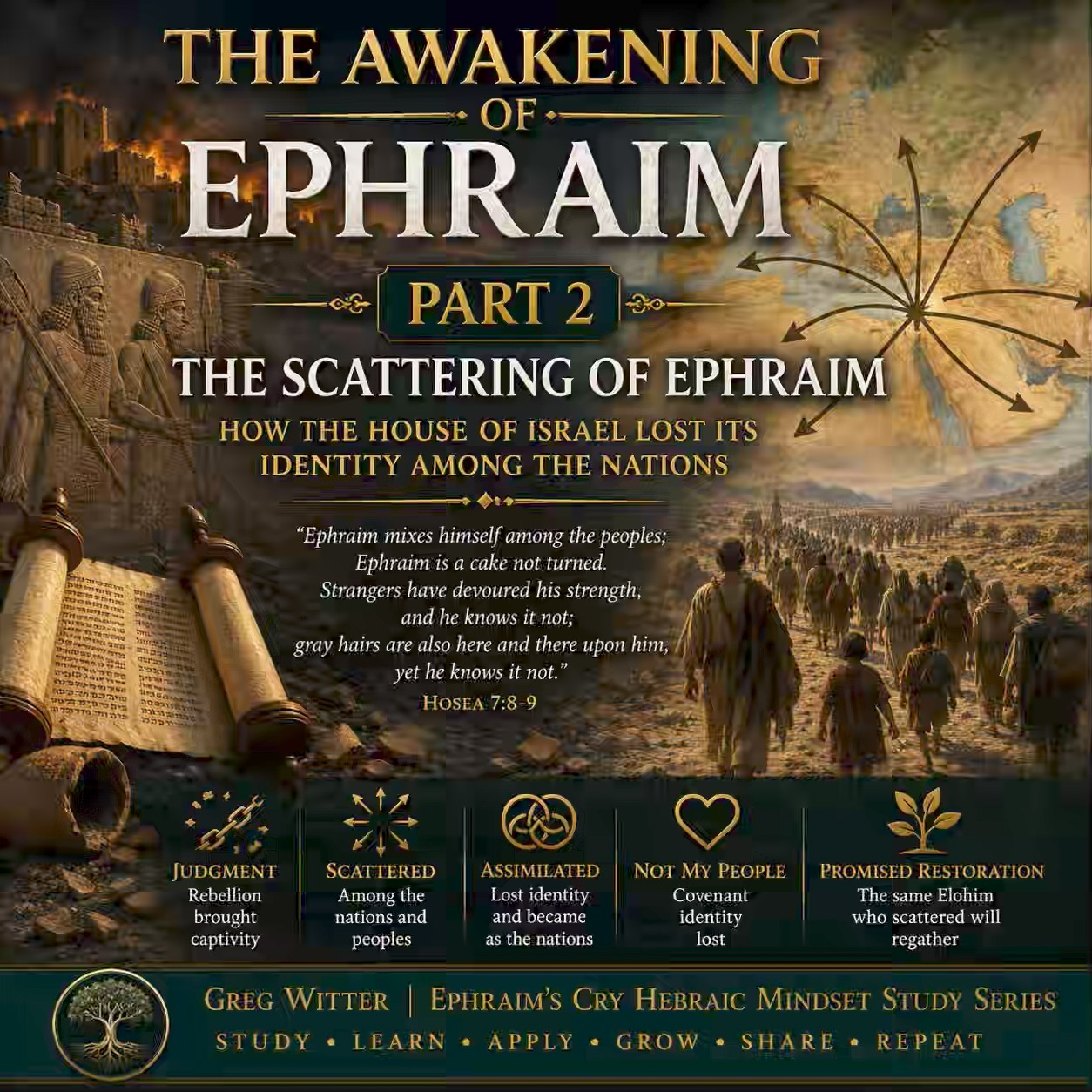
THE AWAKENING OF EPHRAIM
PART 2 — THE SCATTERING OF EPHRAIM
How the House of Israel Lost Its Identity Among the Nations
Most believers understand that Israel was judged. Far fewer understand how that judgment unfolded. Even fewer understand why the scattering of Ephraim is one of the most important prophetic events in all of Scripture.
The scattering of the Northern Kingdom was not a random historical event. It was not an accident of politics. It was not merely the result of military conquest. It was the direct fulfillment of covenant warnings given centuries earlier through Torah.
Long before Israel entered the Promised Land, Yahuah warned what would happen if His people abandoned His covenant. Blessing would follow obedience. Judgment would follow rebellion. Restoration would follow repentance. The covenant was never hidden. The consequences were never hidden. Israel knew the terms.
The Northern Kingdom chose rebellion anyway.
After the kingdom divided following Solomon’s reign, the House of Israel immediately began a path of compromise. Jeroboam established alternative places of worship. Golden calves were introduced. The people were told they no longer needed to go where Yahuah had placed His Name. Political convenience replaced covenant faithfulness.
That pattern continued for generations.
King after king walked in rebellion.
Prophet after prophet warned them.
Yahuah sent messengers.
Yahuah sent warnings.
Yahuah called for repentance.
Yet the nation refused to return.
The result was exactly what Torah had warned.
The Assyrians invaded.
The cities fell.
The people were deported.
The land was emptied.
The kingdom disappeared.
The House of Israel entered captivity.
Many believers stop the story there.
The prophets do not.
The prophets repeatedly describe something far more significant than simple captivity. They describe assimilation.
The House of Israel did not merely move geographically.
They lost their identity.
They became scattered among the nations.
They intermarried.
They adopted foreign customs.
They adopted foreign cultures.
They adopted foreign religious practices.
They became mixed among the peoples.
Hosea describes this reality in striking language:
“Ephraim mixes himself among the peoples” (Hosea 7:8).
That single statement explains much of what happened.
Ephraim became mixed.
Ephraim became scattered.
Ephraim became assimilated.
Ephraim became difficult to identify.
The House of Israel became like the Gentiles among whom they lived.
This is why Hosea uses the powerful phrase Lo-Ammi — “not My people” (Hosea 1:9).
Many misunderstand this phrase. Yahuah was not saying the House of Israel ceased to exist. He was saying they had become indistinguishable from the nations because they had abandoned covenant identity.
They became as the Gentiles.
They walked as the Gentiles.
They worshiped as the Gentiles.
They lived as the Gentiles.
The covenant people became scattered among the nations until they no longer appeared to be covenant people at all.
What many believers fail to recognize is that the scattering of the House of Israel was not merely a punishment. It was also part of a prophetic process that Yahuah had foreseen from the beginning.
Nothing caught Him by surprise.
Nothing happened outside His knowledge.
Nothing happened outside His sovereignty.
Before Israel ever entered the land, Yahuah already declared both the blessing and the curse. He declared the consequences of obedience and the consequences of rebellion. He declared the scattering long before the scattering occurred (Leviticus 26:14-39; Deuteronomy 28:15-68).
This is why the exile of the Northern Kingdom should never be viewed as an accident of history.
It was a covenant event.
It was a prophetic event.
It was a judicial event.
It was the fulfillment of warnings given centuries beforehand.
Yet within those warnings was always the promise of restoration.
One of the greatest mistakes made in modern theology is treating the House of Israel as though it simply disappeared from the biblical story after the Assyrian captivity.
The prophets never believed that.
Yahuah never taught that.
The Apostolic Witnesses never taught that.
The House of Israel remained a central part of the prophetic narrative.
In fact, many of the restoration prophecies become almost impossible to understand if the House of Israel no longer exists.
Who is being regathered?
Who is being restored?
Who are the dry bones?
Who are the two sticks?
Who are the outcasts of Israel?
Who are those called “not My people” who become “My people” again?
The answer repeatedly returns to the scattered House of Israel.
This is why the prophets consistently look beyond their own generation. They were not merely speaking about the Assyrian invasion. They were not merely speaking about Babylon. They were looking toward a future restoration that would occur among the nations. A restoration so large that it would require Yahuah to gather His people from the four corners of the earth (Isaiah 11:11-12; Jeremiah 31:7-10; Ezekiel 11:17).
This is important because the scattering of Ephraim was unlike the Babylonian captivity of Judah.
Judah maintained a recognizable identity.
Judah retained records.
Judah returned to the land.
The House of Israel largely disappeared among the nations.
Their identity became hidden.
Their lineage became mixed.
Their covenant awareness faded.
Their memory of who they were was lost.
This is precisely why the restoration prophecies are so remarkable.
Yahuah was not merely promising to bring back a people who knew who they were.
He was promising to awaken a people who had forgotten.
He was promising to restore a people who had become lost among the nations.
He was promising to call a people back to covenant who no longer even remembered the covenant.
This is why the language of awakening appears throughout the restoration narrative.
The dead come to life.
The dry bones receive breath.
The lost sheep are found.
The scattered are gathered.
The divorced wife is restored.
The children return.
The language is not accidental.
It is prophetic.
It is covenantal.
It is restorative.
Another aspect often overlooked is that the scattering placed the House of Israel among virtually every people group on earth.
The judgment dispersed them.
But the scattering also positioned them.
The House of Israel did not remain concentrated in one location.
They spread among the nations.
They became part of the nations.
They lived among the nations.
They raised families among the nations.
They established communities among the nations.
From a prophetic perspective, this becomes significant because the message of the Kingdom must ultimately reach the nations.
The scattering placed covenant descendants among the peoples of the earth.
The restoration calls them back from among those same peoples.
The scattering distributed them.
The restoration gathers them.
The scattering hid them.
The restoration reveals them.
The scattering silenced them.
The restoration awakens them.
The prophet Hosea foresaw this restoration when he declared that those called Lo-Ammi would once again be called the children of the living Elohim (Hosea 1:10). Isaiah foresaw it when he spoke of Yahuah recovering the remnant of His people from the nations (Isaiah 11:11-12). Jeremiah foresaw it when he spoke of Ephraim as Yahuah’s firstborn and declared that He would gather him again (Jeremiah 31:9-10). Ezekiel foresaw it through the vision of the dry bones and the reunification of Judah and Ephraim into one kingdom under one King (Ezekiel 37:11-28).
This is why understanding the scattering is essential to understanding the restoration.
The greater the scattering, the greater the regathering.
The deeper the exile, the greater the restoration.
The longer the dispersion, the more remarkable the awakening.
The House of Israel did not vanish.
The House of Israel was scattered.
And the Elohim who scattered them never lost track of a single one.
From the moment they were dispersed, the restoration was already part of His plan.
The gathering was already part of His purpose.
The awakening was already part of His promise.
And that promise continues to move toward its fulfillment even in our day.
Yet even within the judgment, Yahuah gave hope.
The same prophet who declared “not My people” also declared that they would once again be called the children of the living Elohim.
The same prophet who announced scattering announced restoration.
The same prophet who declared judgment declared mercy.
This is one of the greatest themes in Scripture.
Judgment is never the final chapter.
Restoration is.
Many people ask why the restoration prophecies are so important.
The answer is simple.
You cannot understand the restoration until you understand the scattering.
You cannot understand Ezekiel’s dry bones until you understand how the bones became scattered.
You cannot understand the two sticks becoming one until you understand why they were divided.
You cannot understand the regathering until you understand the dispersion.
The scattering explains the restoration.
The exile explains the return.
The judgment explains the mercy.
This is why the prophets spend so much time discussing the House of Israel.
Yahuah never forgot Ephraim.
The nations may have forgotten.
History may have forgotten.
Religion may have forgotten.
But Yahuah never forgot.
The same Elohim who scattered them promised to gather them.
The same Elohim who judged them promised to restore them.
The same Elohim who drove them from the land promised to bring them home.
The scattering was not the end of the story.
It was the beginning of a much larger prophetic plan.
A plan that would eventually reach every nation.
A plan that would eventually touch the ends of the earth.
A plan that would ultimately result in the restoration of the House of Israel and the proclamation of the Gospel of the Kingdom among the nations.
The House of Israel disappeared among the nations.
But Yahuah knew exactly where they were.
And the prophets repeatedly declare that the day would come when He would call them out of the nations, awaken them to covenant, and begin gathering them once again.
The story of Ephraim is not the story of a people who vanished.
It is the story of a people who were scattered.
And what is scattered can be gathered.
What is lost can be found.
What is asleep can be awakened.
And that awakening is the next part of the story.
Greg Witter | Ephraim’s Cry Hebraic Mindset Study Series Study • Learn • Apply • Grow • Share • Repeat
#EphraimsCry#GregWitter#HebraicMindset#HebraicMindsetStudySeries#TheAwakeningOfEphraim#Part2#TheScatteringOfEphraim
#HouseOfIsrael#NorthernKingdom#Ephraim#ScatteredIsrael#AssyrianCaptivity#RestorationOfIsrael#BiblicalProphecy
#WholeCounselOfElohim#LostHouseOfIsrael#CovenantRestoration#GospelOfTheKingdom#ReturnToTorah#Awakening
#Remnant#Watchman#TruthMatters#StudyTheScriptures#KingdomCitizens
