
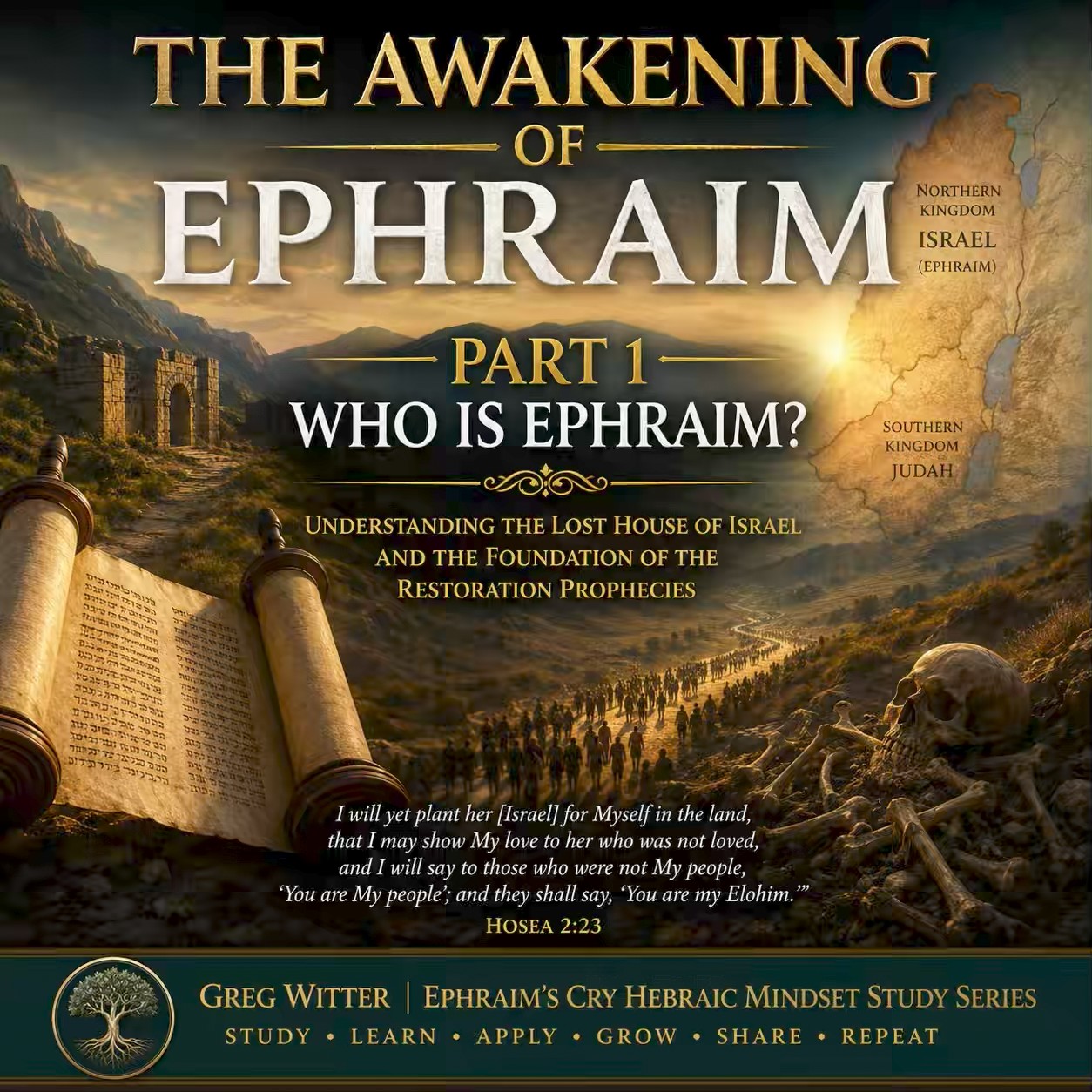
THE AWAKENING OF EPHRAIM
PART 1 — WHO IS EPHRAIM?
Understanding the Lost House of Israel and the Foundation of the Restoration Prophecies
For most believers, the story of Israel begins and ends with Judah. They know about Abraham. They know about Moses. They know about David. They know about the Babylonian captivity and the return of the Jewish people to the land. Yet one of the most significant prophetic themes in all of Scripture is rarely taught, rarely understood, and often completely ignored: the story of Ephraim, the House of Israel, the Northern Kingdom.
This omission creates a massive gap in biblical understanding because the prophets spend hundreds of chapters speaking about Ephraim, Israel, the scattered house, the divorced wife, the lost sheep, the dry bones, and the future restoration of the kingdom. Without understanding Ephraim, much of biblical prophecy becomes fragmented. Without understanding the scattering, the regathering makes little sense. Without understanding the division of the kingdom, the restoration of the kingdom cannot be fully appreciated.
The story of Ephraim is the story of judgment, scattering, assimilation, awakening, restoration, and ultimately the proclamation of the Gospel of the Kingdom to the nations.
Ephraim is not a modern denomination. Ephraim is not a race. Ephraim is not a political movement. Ephraim is not a recently invented doctrine. Ephraim was originally one of the sons of Yoseph. Through the blessing given by Ya’aqov, Ephraim received a unique prophetic destiny that would extend far beyond the borders of ancient Israel.
After the death of Solomon, the united kingdom divided. The Southern Kingdom consisted primarily of Judah, Benjamin, and much of Levi. This kingdom became known as Judah. The Northern Kingdom consisted of the remaining tribes and became known as Israel. Because Ephraim was the dominant tribe within that kingdom, the prophets frequently used the name Ephraim to refer to the entire Northern Kingdom.
This is why when we read Hosea, Isaiah, Jeremiah, and Ezekiel, we repeatedly encounter the name Ephraim. The prophets often use the terms Ephraim and Israel interchangeably because they are speaking about the same kingdom.
The problem is that many modern readers do not recognize this distinction. They read Israel and automatically think Judah. They read Ephraim and assume it is speaking only about a single tribe. As a result, they miss much of what the prophets are actually communicating.
The Northern Kingdom had a tragic history. Instead of remaining faithful to the covenant, they pursued idolatry, mixed worship, false religion, political compromise, and rebellion against Yahuah. Prophet after prophet warned them. Prophet after prophet called them to repentance. Prophet after prophet announced judgment if they refused to return. Yet they hardened their hearts.
Eventually the judgment promised in Torah arrived.
The Assyrians conquered the Northern Kingdom.
The people were removed from the land.
The kingdom ceased to exist as an independent nation.
The people were scattered among the nations.
Unlike Judah, which later returned from Babylonian captivity, the Northern Kingdom never returned as a kingdom.
They disappeared into the nations.
They assimilated into foreign cultures.
They intermarried.
They adopted foreign customs.
They lost their covenant identity.
They became as the Gentiles among whom they lived.
This was not an accident.
This was not a failure of prophecy.
This was prophecy being fulfilled exactly as Yahuah declared.
The same Elohim who promised blessing for obedience promised scattering for rebellion. The same Torah that promised inheritance also warned of exile. What Yahuah promised, He performed.
The prophets repeatedly describe Ephraim becoming mixed among the nations. Hosea declares that Ephraim is mixed among the people. Hosea declares that Israel would become Lo-Ammi, “not My people.” Not because Yahuah had forgotten them, but because they had abandoned their covenant identity and become indistinguishable from the nations around them.
This is one of the most important prophetic realities in all of Scripture.
The House of Israel did not cease to exist.
The House of Israel became scattered.
The House of Israel became assimilated.
The House of Israel became hidden among the nations.
But hidden is not the same as destroyed.
Scattered is not the same as forgotten.
Judged is not the same as abandoned.
The same prophets who announced the scattering also announced the restoration.
Hosea speaks of those who became “not My people” once again becoming “My people.”
Jeremiah speaks of Ephraim as Yahuah’s beloved son.
Isaiah speaks of the outcasts of Israel being gathered from the four corners of the earth.
Ezekiel speaks of the valley of dry bones rising again.
Ezekiel speaks of the stick of Judah and the stick of Ephraim becoming one in the hand of Yahuah.
Again and again the prophets point beyond the judgment and toward restoration.
The scattering was real.
The loss of identity was real.
The assimilation was real.
The punishment was real.
But the restoration is equally real.
In fact, the restoration is one of the central themes of biblical prophecy.
This is why understanding Ephraim matters.
It affects how we understand Hosea.
It affects how we understand Isaiah.
It affects how we understand Jeremiah.
It affects how we understand Ezekiel.
It affects how we understand the Gospel of the Kingdom.
It affects how we understand the regathering.
It affects how we understand the renewed covenant.
It affects how we understand the restoration of all things.
Most importantly, it affects how we understand the unfolding prophetic story running from B’reshit to Revelation.
The story of Ephraim is not merely ancient history.
It is the story of a people scattered because of rebellion.
It is the story of a people who lost their identity among the nations.
It is the story of a people who became as the Gentiles.
It is the story of a people whom Yahuah promised to restore.
It is the story of judgment followed by mercy.
It is the story of exile followed by restoration.
It is the story of covenant broken and covenant renewed.
It is the story of the dry bones awakening.
It is the story of a people being called home.
And before we can understand the awakening, we must first understand who Ephraim is.
Because once we understand who Ephraim is, the rest of the prophetic story begins to come into focus.
The scattering begins to make sense.
The restoration begins to make sense.
The regathering begins to make sense.
The renewed covenant begins to make sense.
The Gospel of the Kingdom begins to make sense.
And the words of the prophets begin to come alive in ways many believers have never considered.
Greg Witter | Ephraim’s Cry
Hebraic Mindset Study Series
Study • Learn • Apply • Grow • Share • Repeat
#EphraimsCry #GregWitter #HebraicMindset #HebraicMindsetStudySeries #TheAwakeningOfEphraim #WhoIsEphraim
#HouseOfIsrael #NorthernKingdom #Ephraim #ScatteredIsrael #RestorationOfIsrael #RestorationOfAllThings
#GospelOfTheKingdom #KingdomMessage #ReturnToTorah #Torah #Prophets #Writings #ApostolicWitnesses
#WholeCounselOfElohim #CovenantRestoration #BiblicalProphecy #Ezekiel37 #DryBones #HouseOfJudah #TwoSticks
#Remnant #FaithfulRemnant #KingdomCitizens #Watchman #PrepareTheWay #StudyTheScriptures #TruthMatters
#EndTimes #RestorationMovement
