
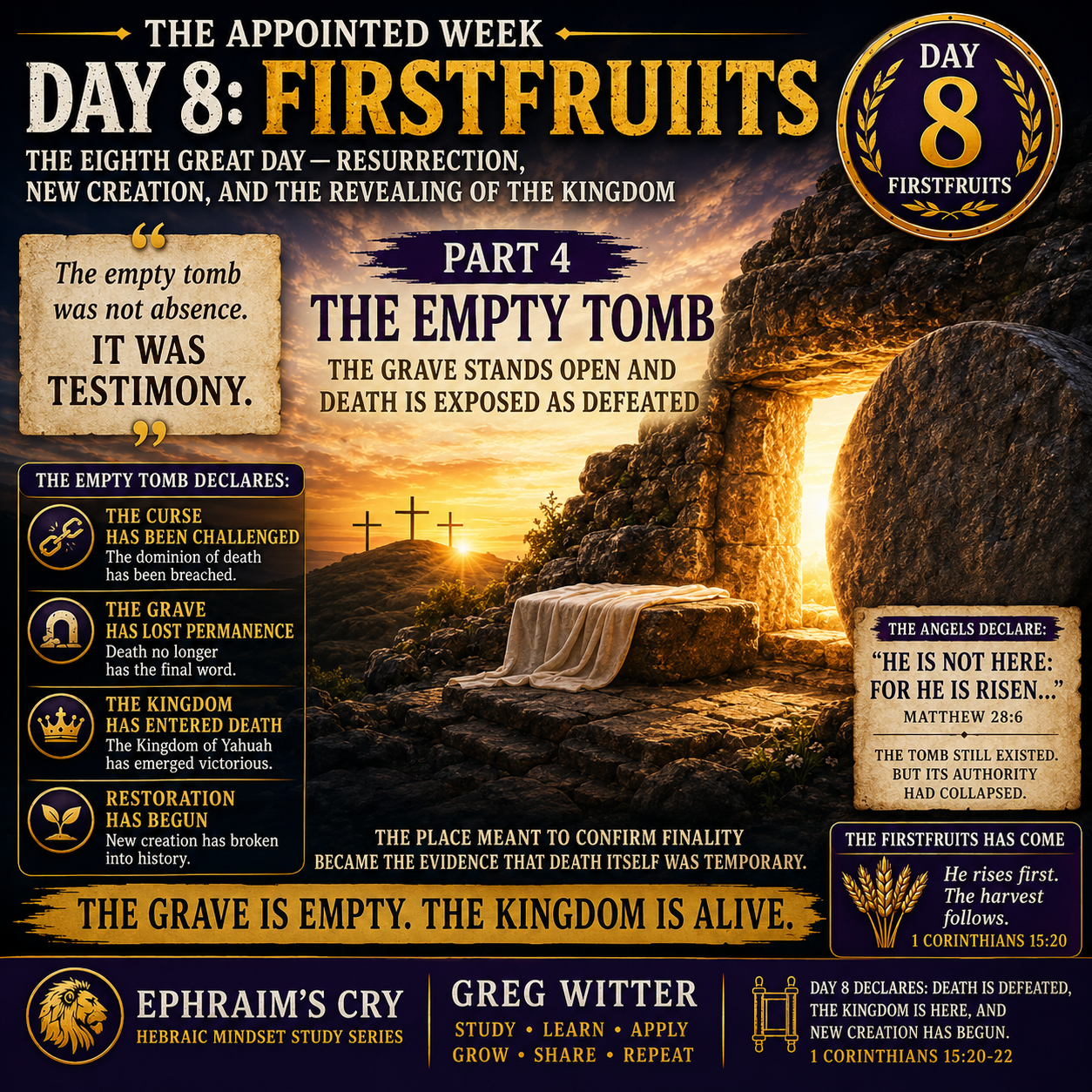
The Appointed Week — Day 8: Firstfruits
The Eighth Great Day — Resurrection, New Creation, and the Revealing of the Kingdom
“Day 7 ended in silence. Day 8 begins in revelation.”
Part 4 — The Empty Tomb
The Grave Stands Open and Death Is Exposed as Defeated
“The empty tomb was not absence. It was testimony.”
Greg Witter | Ephraim’s Cry
Hebraic Mindset Study Series
Study Learn Apply Grow Share Repeat
The empty tomb changes everything.
The stone had been moved.
The seal had failed.
The guards had collapsed beneath fear.
The grave clothes remained behind.
And now the place once occupied by death stood empty before the witnesses.
This becomes one of the greatest revelations of Day 8:
The grave did not keep Him.
Death did not hold Him.
The tomb became the public witness that resurrection had already broken into creation itself.
This is why the angels declare:
“He is not here: for he is risen…” (Matthew 28:6).
That declaration becomes one of the most powerful sentences in all of Scripture.
“He is not here.”
The tomb still existed.
The grave still stood physically before them.
The chamber remained carved into the earth.
The place of burial remained visible.
But its authority had collapsed.
This becomes one of the deepest revelations hidden within resurrection morning:
The resurrection did not erase the existence of death.
The resurrection destroyed death’s permanence.
That distinction matters profoundly.
Humanity still dies within the present age.
Graves still exist within the fallen world.
Creation still groans beneath corruption (Romans 8:22).
But resurrection morning announces that death no longer possesses ultimate authority.
The grave is no longer final.
This is why the empty tomb becomes so important prophetically.
The empty tomb was not merely missing a body.
The empty tomb was Heaven’s declaration that:
- the curse had been challenged,
- the dominion of death had been breached,
- the old order had been pierced,
- and the Kingdom of Yahuah had openly entered the realm of death and emerged victorious.
This becomes one of the deepest prophetic reversals in all of Scripture.
The place meant to confirm finality became evidence that finality itself had failed.
The grave became witness against itself.
The tomb was designed to hold the dead.
Instead, the tomb now testifies that resurrection life has invaded creation.
Again and again Scripture reveals this same covenant pattern:
The systems of darkness repeatedly become witnesses against themselves.
Pharaoh’s armies became evidence of deliverance once the sea closed over them.
The fiery furnace became evidence of divine preservation.
The lions’ den became evidence of covenant protection.
The cross became evidence of atonement and victory.
And now the grave itself becomes evidence that death has lost permanence beneath the authority of Yahuah.
This is why the empty tomb must never be treated casually.
The empty tomb stands at the center of covenant history itself.
Without the empty tomb:
- death remains final,
- the curse remains undefeated,
- the Kingdom remains unconfirmed,
- and restoration remains uncertain.
But because the tomb stands empty:
- resurrection becomes certain,
- restoration becomes inevitable,
- the promises stand confirmed,
- and the Kingdom moves openly into history through witness and proclamation.
This is why Paul later declares:
“And if Messiah be not raised, your faith is vain…” (1 Corinthians 15:17).
The resurrection is not an optional secondary doctrine.
The resurrection becomes the confirmation that:
- the covenant stands,
- prophecy stands,
- the promises stand,
- and Yahuah’s authority over death itself stands publicly revealed.
This is why the empty tomb changes the structure of reality itself.
Before resurrection:
- death appeared undefeated,
- the grave appeared unconquerable,
- corruption appeared permanent,
- and humanity remained trapped beneath the curse inherited from Adam.
But resurrection morning introduces something entirely new into creation.
Life emerges from the grave.
The curse begins breaking.
Death loses permanence.
And new creation begins moving openly within history.
This becomes one of the deepest revelations hidden within the Eighth Day.
The Eighth Day represents movement beyond the completed cycle of the old order into restored creation reality.
This is why resurrection occurs on Day 8.
Seven represented completion within the created order still groaning beneath death.
But eight moves beyond completion into renewal, restoration, and new beginning.
Now the empty tomb stands as the first visible doorway into that restored creation order.
This is why the resurrection is not merely about returning to ordinary life.
Lazarus returned to mortal life and later died again.
But resurrection morning reveals something different.
Messiah rises in resurrection victory beyond the authority of death itself.
This becomes critically important because the empty tomb therefore points beyond itself toward future restoration.
The empty tomb becomes the guarantee that death itself will ultimately lose its claim over all belonging to the Kingdom of Yahuah.
This is why Paul later calls Messiah:
“The firstborn from the dead” (Colossians 1:18).
And:
“The firstfruits of them that slept” (1 Corinthians 15:20).
The empty tomb therefore is not merely personal victory.
The empty tomb announces harvest.
The Firstfruits has emerged.
And the larger resurrection harvest still approaches behind Him.
This is why the resurrection morning carries such enormous prophetic weight.
The empty tomb announces that restoration itself has already begun within creation.
This is why the empty tomb also becomes one of the greatest confrontations against hopelessness in all of Scripture.
The grave had always represented humanity’s unavoidable destination beneath the curse.
Kings entered the grave.
Prophets entered the grave.
Priests entered the grave.
Empires entered the grave.
Every generation eventually disappeared beneath the same reality:
- dust,
- silence,
- corruption,
- and death.
This is why the grave carried such enormous symbolic weight throughout Scripture.
The grave represented the visible consequence of Eden.
Adam’s rebellion brought death into creation (Genesis 2:17; Romans 5:12). From that moment forward, humanity lived beneath the shadow of mortality. Every funeral, every burial, every tomb, every graveyard testified to the same painful reality:
The curse was real.
Death ruled visibly over fallen creation.
This is why resurrection morning becomes such a radical turning point within history.
The empty tomb publicly announces that the dominion established in Eden has now been openly challenged.
Death no longer remains unopposed.
The grave no longer remains invincible.
This is why Hosea prophetically declares:
“O death, I will be thy plagues; O grave, I will be thy destruction…” (Hosea 13:14).
That prophecy now begins openly manifesting through resurrection.
The empty tomb therefore becomes one of the first visible declarations that the curse itself is beginning to collapse beneath Kingdom authority.
This is why the resurrection cannot be separated from restoration theology.
The resurrection is not merely about individual survival after death.
The resurrection becomes the beginning of creation’s liberation from corruption itself.
Paul writes:
“For the creature itself also shall be delivered from the bondage of corruption…” (Romans 8:21).
The empty tomb becomes the first visible fracture in the bondage of corruption covering creation since Eden.
This is why creation itself reacted earlier through the earthquake.
The earth trembled because resurrection was not isolated from creation.
Resurrection entered creation to begin restoring what the curse had broken.
This becomes one of the deepest revelations hidden within the empty tomb:
The resurrection is not escape from creation.
The resurrection is the restoration of creation.
This directly confronts many modern spiritualized concepts that treat salvation merely as leaving the earth behind permanently. But the resurrection narrative reveals something much larger.
Messiah does not remain dead.
Messiah rises bodily.
The tomb stands empty physically.
Creation itself becomes the place where resurrection life openly manifests.
This points forward toward:
- restored creation,
- resurrected bodies,
- Kingdom inheritance,
- and the dwelling of Yahuah among mankind.
This is why Revelation does not end with souls escaping earth forever.
Revelation ends with:
- new heavens,
- new earth,
- restored access,
- removed curse,
- and the Kingdom openly dwelling among men (Revelation 21–22).
The empty tomb therefore becomes the first visible declaration that restoration has already begun moving toward that final outcome.
This is why the resurrection morning also destroys ultimate despair.
Without resurrection, death always has the final word.
Without resurrection:
- suffering remains unresolved,
- injustice remains unanswered,
- corruption remains victorious,
- and history ultimately collapses into hopelessness.
But the empty tomb changes the structure of hope itself.
Now death becomes temporary.
Now restoration becomes certain.
Now resurrection becomes guaranteed beneath the authority of Yahuah.
This is why Paul later declares:
“But thanks be to Elohim, which giveth us the victory through our Master Yahusha Messiah” (1 Corinthians 15:57).
Victory there is not metaphorical emotional encouragement.
Victory means death itself has lost permanence.
This becomes one of the deepest prophetic revelations hidden within Firstfruits.
The Firstfruits always guarantees the harvest.
The first sheaf appearing before Yahuah testifies that the larger gathering is coming behind it.
Now the empty tomb stands as the Firstfruits witness.
Messiah emerges first.
The harvest follows afterward.
This becomes one of the greatest promises hidden within resurrection morning:
The empty tomb is not merely about Him.
The empty tomb points toward the future restoration of all belonging to the covenant Kingdom.
This is why resurrection morning changes how the remnant interprets suffering, death, persecution, and loss.
Babylon still threatens.
The grave still exists temporarily.
The world still groans beneath corruption.
But the empty tomb already revealed the final outcome before history reaches completion.
The Kingdom wins.
The grave loses.
Death collapses.
And restoration advances openly into creation itself.
This is why the empty tomb becomes one of the greatest dividing lines in history.
Some see emptiness.
The remnant sees victory.
Some see absence.
The remnant sees fulfillment.
Some see mystery.
The remnant sees covenant prophecy standing openly before creation itself.
This is why the angels do not merely announce disappearance.
They announce resurrection.
“He is not here: for he is risen…”
The empty tomb therefore does not testify to loss.
The empty tomb testifies to triumph.
The grave is empty because the Kingdom of Yahuah has openly entered the realm of death and emerged victorious.
This is why the empty tomb also becomes one of the greatest exposures of false security in all of Scripture.
Everything the systems of man trusted had failed.
Rome trusted military authority.
The religious authorities trusted political manipulation and legal condemnation.
The grave trusted corruption and decay.
Death trusted permanence.
And the empty tomb exposed every one of those powers as temporary beneath the sovereignty of Yahuah.
This becomes one of the deepest revelations hidden within resurrection morning:
Human systems always appear strongest immediately before Heaven reveals their limitations openly.
Pharaoh appeared strongest before the sea closed over Egypt.
Nebuchadnezzar appeared strongest before he was humbled beneath Heaven’s authority.
Babylon appeared strongest before judgment arrived in a single night.
The religious authorities appeared strongest while sealing the tomb.
And then the grave stood empty.
Again and again Scripture reveals the same covenant principle:
The visible dominance of earthly systems is never proof of ultimate victory.
This becomes profoundly important prophetically because the final beast systems of Revelation will likewise appear overwhelming outwardly:
- economically,
- politically,
- militarily,
- technologically,
- and socially.
Babylon will appear secure.
The systems of man will appear unified.
Darkness will appear dominant.
And yet resurrection morning already reveals the final outcome before the conflict fully unfolds.
The grave itself could not maintain permanent control once Heaven’s appointed timing arrived.
This is why the remnant must learn to interpret reality covenantally rather than emotionally.
Visible appearances deceive.
The sealed tomb appeared final.
The stone appeared immovable.
The guards appeared authoritative.
The silence appeared complete.
And yet the grave already stood empty before the witnesses fully understood what Heaven had accomplished.
This becomes one of the deepest lessons of faith itself.
Faith is not denial of visible reality.
The tomb truly existed.
The crucifixion truly occurred.
The grief truly hurt.
The silence truly lingered.
But covenant faith recognizes that visible appearances never possess greater authority than the promises and decrees of Yahuah.
This is why Abraham “against hope believed in hope” (Romans 4:18).
This is why Job declared:
“Though he slay me, yet will I trust in him…” (Job 13:15).
This is why the remnant throughout Scripture continually remains aligned beneath pressure, silence, persecution, and delay.
The empty tomb now becomes the ultimate vindication of covenant trust.
Everything visible had appeared lost.
And yet Heaven had already secured victory beneath the surface.
This is why the empty tomb becomes one of the greatest prophetic encouragements for the remnant in the last days.
The world will repeatedly appear unstable.
Babylon will appear dominant.
Darkness will appear aggressive.
Truth will appear marginalized.
The faithful may appear scattered and weak outwardly.
But resurrection morning already revealed the deeper reality:
The Kingdom advances beneath the surface long before the visible world recognizes what Heaven is doing.
This is why the resurrection morning did not begin with public celebration before the nations.
The resurrection began quietly.
The witnesses discovered it progressively.
Understanding unfolded gradually.
And yet history itself had already changed forever.
This becomes one of the deepest revelations hidden within the Kingdom itself.
The Kingdom often advances beneath hiddenness before manifestation openly fills the earth.
This mirrors:
- seeds growing beneath soil,
- leaven spreading through dough,
- hidden treasure beneath the field,
- and mustard seeds becoming trees.
Again and again Yahusha taught that Kingdom growth often begins hidden before becoming openly visible.
The empty tomb therefore becomes the visible evidence that hidden fulfillment has now broken openly into creation.
This is why the resurrection cannot remain merely private truth.
The resurrection immediately moves outward toward proclamation.
The women become witnesses.
The disciples become witnesses.
Jerusalem becomes confronted with testimony.
The nations eventually become confronted with the Gospel of the Kingdom.
This is why Acts begins not with silence, but with proclamation:
- resurrection proclaimed publicly,
- the empty tomb proclaimed publicly,
- and the Kingdom proclaimed publicly.
The witness cannot remain confined within the grave.
This is why the tomb itself remains empty.
The Kingdom does not dwell among the dead.
Life has emerged.
Victory has emerged.
Resurrection has emerged.
This is why the empty tomb becomes the dividing line between the old order and the new creation.
Before resurrection:
- death governed visibly,
- corruption dominated creation,
- and humanity remained trapped beneath the shadow of the grave.
After resurrection:
- death loses permanence,
- restoration begins openly,
- the Kingdom advances outward,
- and new creation has already entered history through Firstfruits resurrection.
This is why the empty tomb matters so profoundly.
The empty tomb is not merely evidence that Messiah left the grave.
The empty tomb is Heaven’s declaration that the grave itself is no longer ultimate.
Website:
https://ephraimscry.com
Blog:
https://ephraimscry.com/blog
Academy:
https://ephraimscry.com/academy
Events & Live Teachings:
https://ephraimscry.com/events
YouTube:
https://www.youtube.com/@EphraimsCry
#TheAppointedWeek #Day8 #Firstfruits #TheEighthDay #TheEmptyTomb #ResurrectionMorning #HebraicMindset #EphraimsCry #GregWitter #Torah #KingdomOfElohim #WholeCounselOfElohim #FirstfruitsOffering #Resurrection #Covenant #Truth #Scripture #Kingdom #Restoration #Watchman #StudyLearnApplyGrowShareRepeat
