
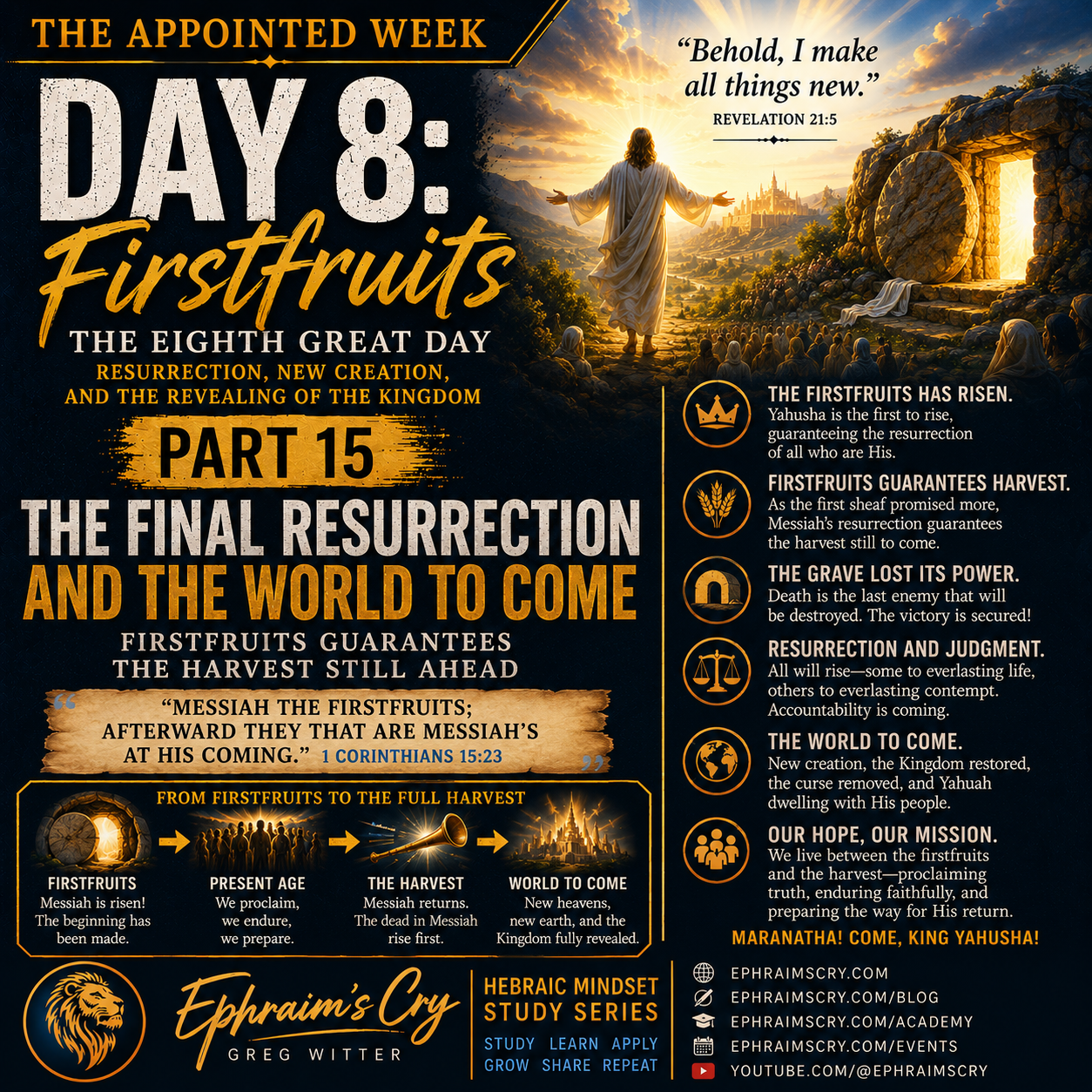
The Appointed Week — Day 8: Firstfruits
The Eighth Great Day — Resurrection, New Creation, and the Revealing of the Kingdom
“Day 7 ended in silence. Day 8 begins in revelation.”
Part 15 — The Final Resurrection and the World to Come
Firstfruits Guarantees the Harvest Still Ahead
“Messiah the firstfruits; afterward they that are Messiah’s at his coming.” (1 Corinthians 15:23)
Greg Witter | Ephraim’s Cry
Hebraic Mindset Study Series
Study Learn Apply Grow Share Repeat
The empty tomb was never the end of the resurrection story.
The empty tomb was the beginning.
That distinction matters profoundly because many people unconsciously treat the resurrection as though it were a completed isolated event disconnected from the future of creation itself. But Scripture never presents the resurrection that way. The resurrection of Yahusha is not merely proof that one man conquered death temporarily. The resurrection is the opening declaration of the final restoration still coming upon creation itself.
This is why Firstfruits matters so deeply.
Firstfruits never represented the entire harvest.
Firstfruits represented the guaranteed beginning of the harvest.
The first sheaf presented before Yahuah testified that more was coming afterward.
This is why Paul declares:
“But now is Messiah risen from the dead, and become the firstfruits of them that slept” (1 Corinthians 15:20).
That verse changes everything.
The resurrection of Messiah is not disconnected from the future resurrection of His people.
The resurrection of Messiah guarantees the resurrection harvest still ahead.
This becomes one of the deepest revelations hidden within Day 8 itself:
The Eighth Day reveals the future before the future fully arrives.
The resurrection already revealed where history is moving.
The resurrection already revealed the destiny of the Kingdom.
The resurrection already revealed the eventual defeat of death itself.
This is why the resurrection cannot remain merely inspirational theology detached from covenant reality.
The resurrection is prophetic declaration.
The resurrection publicly announces that death no longer possesses permanent authority over creation.
That matters because death entered through rebellion in Eden.
Adam’s transgression brought:
- corruption,
- separation,
- exile,
- decay,
- suffering,
- and mortality into human experience.
Paul writes:
“For as in Adam all die…” (1 Corinthians 15:22).
The entire created order became subjected to corruption beneath the curse.
Humanity became trapped beneath the dominion of death.
This is why the grave stands as one of the greatest symbols of the fallen world itself.
Every grave testifies:
something is wrong with creation.
Death was never the original design.
Death entered through rebellion.
But resurrection morning publicly declares that the dominion of death has now been breached openly through the risen Messiah.
This becomes one of the deepest revelations hidden within the empty tomb:
The grave did not merely fail once.
The grave lost its permanent authority.
That distinction matters profoundly.
The resurrection of Yahusha is not merely an exception to the human condition.
The resurrection becomes the beginning of the reversal of the human condition.
This is why Paul later declares:
“The last enemy that shall be destroyed is death” (1 Corinthians 15:26).
Death itself is treated as an enemy.
Death is not portrayed as natural completion.
Death is not portrayed as covenant perfection.
Death is the enemy introduced through sin and rebellion.
And now the resurrection openly begins the process of its destruction.
This becomes one of the deepest revelations hidden within Firstfruits itself.
Firstfruits means the final outcome is already guaranteed before the full harvest visibly arrives.
The harvest may still be future…
But the outcome is already secured through the Firstfruits.
This is why the resurrection becomes the foundation of biblical hope.
Without resurrection:
- covenant hope collapses,
- future restoration collapses,
- the promises collapse,
- and death remains undefeated.
But resurrection changes everything.
Now the remnant understands:
- the grave is temporary,
- Babylon is temporary,
- suffering is temporary,
- corruption is temporary,
- and the Kingdom of Yahuah is moving toward final restoration.
This becomes one of the deepest revelations hidden within the phrase:
“afterward they that are Messiah’s at his coming.”
The resurrection points forward toward:
- the resurrection of the dead,
- the regathering of the covenant people,
- the renewal of creation,
- the restoration of the Kingdom,
- and the world to come openly revealed.
This is why the resurrection cannot be separated from prophetic expectation.
The prophets repeatedly pointed toward:
- restoration,
- regathering,
- renewal,
- resurrection,
- Kingdom rule,
- and covenant fulfillment.
Isaiah declares:
“Thy dead men shall live…” (Isaiah 26:19).
Ezekiel sees dry bones restored to life (Ezekiel 37).
Daniel speaks of many awakening from the dust (Daniel 12:2).
Now the empty tomb openly declares that those promises are no longer distant abstractions.
The resurrection has already begun.
This becomes one of the deepest revelations hidden within the Kingdom itself:
The future world has already entered history through the risen Messiah.
The world still groans beneath corruption.
Babylon still operates temporarily.
The remnant still suffers.
The nations still rage.
Creation still waits.
And yet the future has already broken into the present age through resurrection life.
This is why the Eighth Day becomes so profoundly important prophetically.
Day 8 is not merely another day following the seven.
Day 8 represents:
- new creation,
- renewed order,
- restored covenant life,
- resurrection reality,
- and the world to come entering history openly.
This is why the Eighth Day points beyond the present age itself.
The Eighth Day becomes prophetic anticipation of:
- the resurrection harvest,
- the Kingdom fully revealed,
- the curse removed,
- the New Heavens and New Earth,
- and covenant fellowship fully restored beneath the reign of Yahuah.
The resurrection therefore becomes the bridge between the present age and the world to come.
The Firstfruits has already risen.
The harvest is still coming.
This is why the resurrection also becomes one of the greatest revelations concerning judgment itself.
The resurrection does not merely announce life for the faithful.
The resurrection announces the end of the present rebellious order.
That distinction matters profoundly.
Modern religion often presents resurrection primarily as private comfort detached from covenant accountability. But throughout Scripture, resurrection and judgment remain deeply connected.
Daniel speaks of resurrection leading toward:
- everlasting life,
- and everlasting contempt (Daniel 12:2).
Yahusha Himself declares:
“…all that are in the graves shall hear his voice” (John 5:28).
This becomes one of the deepest revelations hidden within Day 8:
The resurrection announces that history is moving toward final covenant reckoning beneath the authority of Yahuah.
The empty tomb therefore does not merely comfort the remnant.
The empty tomb warns Babylon.
Why?
Because resurrection means the present order is not ultimate.
Kings are not ultimate.
Empires are not ultimate.
Babylonian systems are not ultimate.
The grave itself is not ultimate.
The risen Messiah now stands as:
- judge,
- king,
- high priest,
- firstfruits,
- and ruler of the coming Kingdom.
This becomes one of the deepest revelations hidden within the phrase:
“the world to come.”
Scripture repeatedly points toward:
- the age to come,
- the Kingdom to come,
- the restoration to come,
- and the resurrection to come.
The present age is temporary.
The present systems are temporary.
The corruption governing the nations is temporary.
This is why the resurrection changes how the remnant interprets present reality.
Without resurrection:
- Babylon appears permanent,
- corruption appears undefeatable,
- death appears final,
- and suffering appears meaningless.
But resurrection reveals the deeper truth beneath visible appearances.
The Kingdom already entered history through the risen King.
This means history is not moving endlessly in meaningless cycles.
History is moving toward restoration, judgment, renewal, and Kingdom fulfillment.
This becomes one of the deepest revelations hidden within the prophets themselves.
The prophets continually pointed toward:
- the Day of Yahuah,
- the restoration of Israel,
- the regathering of the covenant people,
- the defeat of wickedness,
- the restoration of justice,
- and the reign of Yahuah over the earth.
Now resurrection morning openly declares that those promises are guaranteed through the risen Messiah Himself.
This becomes one of the deepest revelations hidden within hope itself.
Biblical hope is not escapism.
Biblical hope is covenant certainty rooted in resurrection reality.
The remnant therefore does not endure merely because conditions appear favorable outwardly.
The remnant endures because resurrection already revealed the final direction of history.
This becomes deeply connected to Revelation 21–22.
The final chapters of Scripture reveal:
- the New Jerusalem,
- the curse removed,
- tears wiped away,
- death abolished,
- the throne established,
- the river flowing,
- and the tree of life restored.
Those chapters are not disconnected from Day 8.
They are the final unfolding of what Day 8 began openly.
This is why the resurrection becomes the center of Kingdom proclamation throughout Acts and the Apostolic writings.
The resurrection means:
- the Kingdom is real,
- the covenant stands,
- the promises remain trustworthy,
- and the future restoration is guaranteed.
This is why Paul repeatedly anchors endurance in resurrection hope.
“If in this life only we have hope in Messiah, we are of all men most miserable” (1 Corinthians 15:19).
That statement matters profoundly.
The resurrection is not merely about improving the present life temporarily.
The resurrection points toward the full restoration of creation beneath the reign of Yahuah.
This changes how suffering itself is interpreted.
The remnant may still endure:
- persecution,
- pressure,
- refinement,
- loss,
- and temporary suffering.
But resurrection reveals those things are not ultimate.
This is why Paul writes:
“For our light affliction… worketh for us a far more exceeding and eternal weight of glory” (2 Corinthians 4:17).
Again, resurrection perspective changes everything.
The remnant learns to see temporary suffering through the lens of future restoration.
This becomes one of the deepest revelations hidden within Firstfruits itself.
The Firstfruits already appeared.
Therefore the harvest is certain.
The risen Messiah already stands alive.
Therefore death itself will ultimately fall completely.
This is why the remnant continues proclaiming resurrection truth even in dark times.
The empty tomb already declared:
- Babylon is temporary,
- corruption is temporary,
- suffering is temporary,
- and death is temporary.
But the Kingdom of Yahuah is eternal.
This becomes one of the deepest revelations hidden within Day 8:
The Eighth Day is the prophetic doorway into the world to come.
The resurrection reveals the future Kingdom before it fully arrives.
And the remnant now lives between:
- Firstfruits and harvest,
- resurrection and final restoration,
- present suffering and future glory,
- the old order passing away and the Kingdom openly revealed.
Website:
https://ephraimscry.com
Blog:
https://ephraimscry.com/blog
Academy:
https://ephraimscry.com/academy
Events & Live Teachings:
https://ephraimscry.com/events
YouTube:
https://www.youtube.com/@EphraimsCry
#TheAppointedWeek #Day8 #Firstfruits #TheEighthGreatDay #FinalResurrection #WorldToCome #FirstfruitsHarvest #ResurrectionMorning #HebraicMindset #EphraimsCry #GregWitter #Torah #WholeCounselOfElohim #Resurrection #Covenant #Truth #Scripture #Kingdom #Restoration #StudyLearnApplyGrowShareRepeat
