
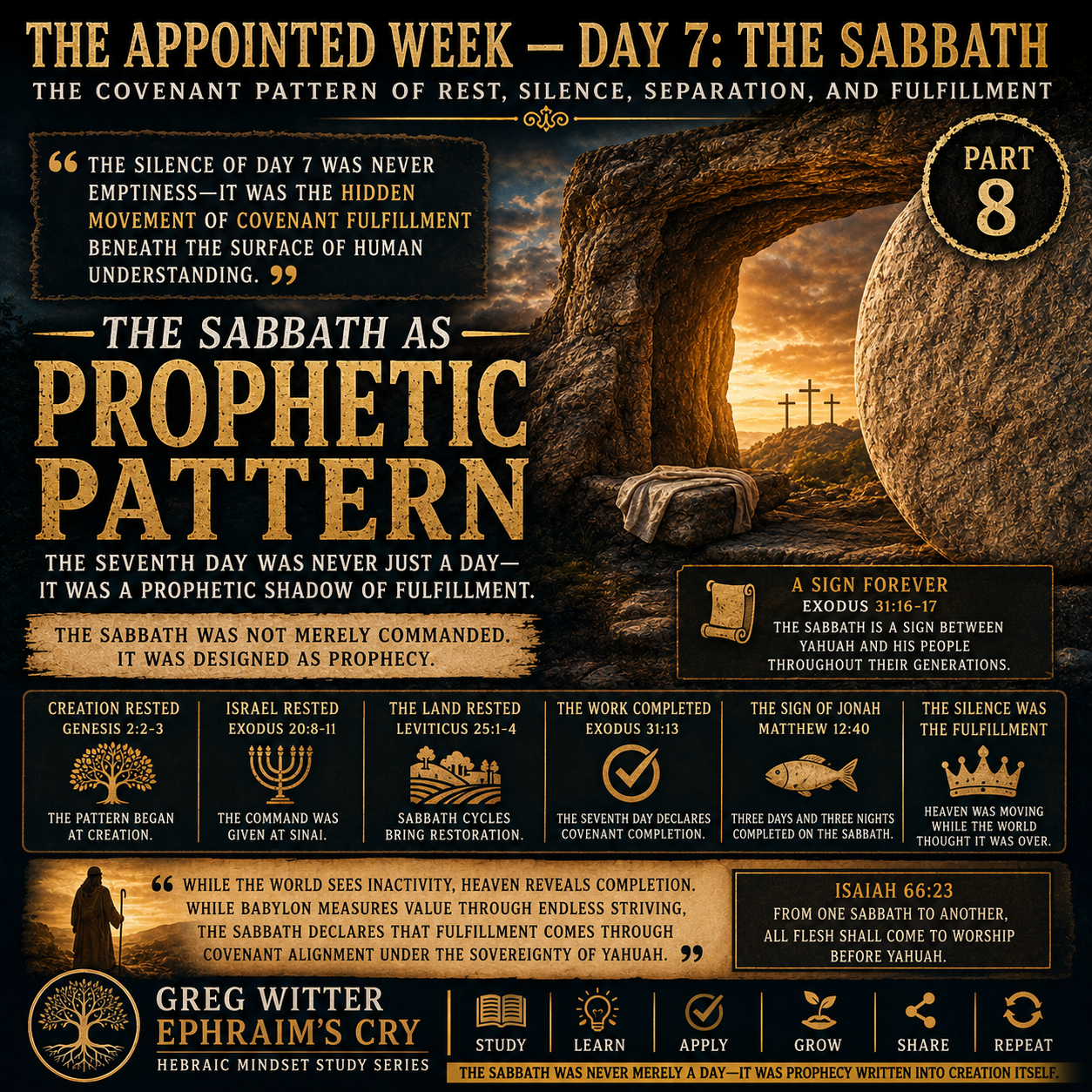
The Appointed Week — Day 7: The Sabbath
The Covenant Pattern of Rest, Silence, Separation, and Fulfillment
“The silence of Day 7 was never emptiness—it was the hidden movement of covenant fulfillment beneath the surface of human understanding.”
Part 8 — The Sabbath as Prophetic Pattern
The Seventh Day Was Never Just a Day — It Was a Prophetic Shadow of Fulfillment
“The Sabbath was not merely commanded. It was designed as prophecy.”
Greg Witter | Ephraim’s Cry
Hebraic Mindset Study Series
Study Learn Apply Grow Share Repeat
Day 7 is not an interruption in the story.
Day 7 is part of the revelation itself.
The Sabbath was never merely about resting from physical labor. From the beginning, the seventh day was embedded into creation itself as a prophetic structure pointing toward covenant completion, divine order, restoration, inheritance, Kingdom fulfillment, and the sovereignty of Yahuah over time itself.
This is why the Sabbath cannot be reduced to ritual alone.
The Sabbath is prophecy built into creation order.
Genesis establishes this pattern immediately:
“And on the seventh day Elohim ended his work which he had made; and he rested on the seventh day from all his work which he had made” (Genesis 2:2).
The seventh day appears before Sinai.
Before Israel becomes a nation.
Before Levitical structure.
Before priesthood administration.
Before monarchy.
Before temple systems.
The Sabbath enters history at creation itself because the Sabbath is woven into covenant order from the foundation.
This becomes critically important because modern systems often treat the Sabbath as though it were merely a temporary ceremonial restriction isolated within Israelite national law. But Day 7 reveals something far deeper:
The Sabbath functions prophetically within the entire covenant structure of Scripture.
Creation rests on the seventh day.
Israel rests on the seventh day (Exodus 20:8–11).
The land itself rests through Sabbath cycles (Leviticus 25:1–4).
Debts release within covenant timing structures (Deuteronomy 15:1–2).
The Jubilee emerges from multiplied Sabbath cycles (Leviticus 25:8–13).
And Messiah Himself rests within the tomb upon the Sabbath while the sign of Jonah completes exactly according to the appointed pattern (Matthew 12:40).
Nothing about Day 7 is accidental.
The timing is not random.
The structure is not incidental.
The Sabbath itself is testifying prophetically.
This becomes one of the deepest revelations hidden within the Appointed Week structure:
The Sabbath was designed not only as commandment—but as prophetic pattern.
The visible stillness of Day 7 conceals covenant completion beneath the surface.
This mirrors Genesis itself.
Creation moves through ordered stages until completion arrives at the seventh day. The seventh day becomes the declaration that the work has reached covenant completion beneath divine order.
The same pattern governs the tomb.
Messiah rests within the earth on the Sabbath because the covenant pattern itself is reaching fulfillment according to the structure established from creation.
This is why the sign of Jonah matters so profoundly.
“For as Jonas was three days and three nights in the whale’s belly; so shall the Son of man be three days and three nights in the heart of the earth” (Matthew 12:40).
The sign completes on the Sabbath.
That matters.
Not after the Sabbath.
On the Sabbath.
The third day and third night within the heart of the earth complete within Day 7 itself according to the covenant structure embedded into creation from the foundation.
This becomes one of the great overlooked revelations surrounding the crucifixion timeline.
The resurrection is the revelation of victory.
But the completion itself occurs within the Sabbath structure.
The work reaches covenant completion beneath the silence of Day 7 before resurrection manifests openly before creation.
This mirrors Yahusha’s own declaration:
“It is finished” (John 19:30).
The work itself reaches completion before manifestation becomes publicly visible.
This pattern appears throughout Scripture.
Yahuah repeatedly completes covenant structures beneath the surface before revelation openly manifests before the world.
Seeds complete hidden processes beneath the soil before harvest emerges openly into view.
Children complete development within the womb before birth manifests publicly.
The hidden process governs the visible revelation.
The same principle governs Day 7.
The Sabbath becomes the concealed completion space before resurrection morning openly reveals what Heaven already accomplished beneath the surface.
This is why Hebrews 4 becomes so important for understanding the prophetic nature of Sabbath:
“There remaineth therefore a rest to the people of Elohim” (Hebrews 4:9).
The Sabbath does not merely point backward toward creation.
The Sabbath points forward toward covenant fulfillment and Kingdom rest under the sovereignty of Yahuah.
This becomes one of the great prophetic dimensions of Day 7.
The seventh day continually testifies that Yahuah governs:
- time,
- fulfillment,
- covenant order,
- restoration,
- inheritance,
- and completion itself.
Babylon measures value through endless striving.
The Sabbath reveals fulfillment through covenant alignment beneath divine sovereignty.
This is why Pharaoh’s system directly opposed rest.
Egypt demanded endless production without cessation (Exodus 5:4–19). Slavery systems survive through continual burden-bearing, continual labor, continual fear, and continual dependency. Babylon follows the same pattern through endless motion, endless stimulation, endless urgency, endless accumulation, and endless distraction.
But Sabbath interrupts slavery systems.
The Sabbath declares that mankind was not created merely for endless production beneath oppressive systems.
Man was created for covenant relationship beneath the rule of Yahuah.
This is why Exodus declares:
“Verily my sabbaths ye shall keep: for it is a sign between me and you throughout your generations…” (Exodus 31:13).
The Sabbath becomes a covenant sign because it reveals allegiance.
Who governs time?
Who governs life?
Who governs labor?
Who governs provision?
Who governs fulfillment?
The Sabbath answers all of those questions beneath the sovereignty of Yahuah.
This becomes especially important during Day 7 because the systems of man believed they had ended the story.
Rome believed the tomb secured finality.
The religious authorities believed the movement had been neutralized.
Darkness celebrated prematurely beneath visible appearances.
But Heaven was following a pattern already established from creation itself.
The Sabbath was testifying all along.
The tomb resting upon the Sabbath was not accidental timing.
It was covenant fulfillment moving precisely within the prophetic structure written from the foundation of creation itself.
This is why the Sabbath must be understood as far more than a religious observance detached from covenant structure.
The Sabbath is woven into the architecture of Scripture itself.
From Genesis to Revelation, the seventh-day pattern continually testifies concerning completion, order, sanctification, inheritance, restoration, and the sovereignty of Yahuah over creation and history. The Sabbath becomes one of the great covenant witnesses embedded directly into time itself.
This is why Scripture repeatedly connects the seventh day with sanctification.
“And Elohim blessed the seventh day, and sanctified it…” (Genesis 2:3).
The seventh day is not merely acknowledged.
It is set apart.
Sanctified.
Distinguished from the other days.
That distinction matters because sanctification itself becomes one of the central covenant themes throughout Scripture. Yahuah continually separates what belongs to Him from what belongs to the systems of the world:
- light from darkness,
- clean from unclean,
- holy from common,
- covenant from mixture,
- Israel from the nations,
- the remnant from Babylon.
The Sabbath therefore becomes a weekly prophetic witness concerning separation unto Yahuah.
This is why Ezekiel declares:
“And hallow my sabbaths; and they shall be a sign between me and you, that ye may know that I am Yahuah your Elohim” (Ezekiel 20:20).
The Sabbath reveals relationship.
The Sabbath reveals covenant identity.
The Sabbath reveals allegiance beneath divine authority.
This becomes profoundly important during Day 7 because the tomb itself now rests within sanctified time.
The body of Messiah lies within the earth during the appointed Sabbath structure established from creation itself. The sign of Jonah completes within sanctified covenant time while the visible world remains unaware that fulfillment is unfolding exactly according to divine order.
Again, nothing about this timing is accidental.
The crucifixion does not abolish the Sabbath.
The crucifixion fulfills the covenant pattern embedded within the Sabbath.
This becomes one of the great prophetic reversals hidden within Day 7 because many systems attempt to present the Sabbath as though it became obsolete through the death and resurrection of Messiah. But the Appointed Week reveals the opposite reality.
The Sabbath itself participates in the revelation.
The Sabbath becomes part of the testimony.
The Sabbath holds the fulfillment structure in place.
This is why Luke carefully records:
“And they returned, and prepared spices and ointments; and rested the sabbath day according to the commandment” (Luke 23:56).
That statement appears simple on the surface, but prophetically it carries enormous weight.
The command still stood.
The women still honored it.
The covenant structure remained intact even while Messiah rested within the tomb.
The Sabbath was not suspended because the crucifixion occurred.
The Sabbath remained part of the fulfillment pattern itself.
This becomes one of the deepest revelations hidden within Day 7:
The covenant structure does not collapse at the cross.
The covenant structure is being fulfilled according to divine order.
This is why Yahusha repeatedly declared that He did not come to destroy the Torah or the Prophets (Matthew 5:17–19). Fulfillment does not mean abolition. Fulfillment means bringing covenant purpose into completion according to the design established by Yahuah from the foundation.
The Sabbath therefore becomes one of the clearest prophetic witnesses within the entire crucifixion narrative.
Creation rested on the seventh day.
Messiah rests within the tomb on the seventh day.
And the future Kingdom itself points toward ultimate covenant rest beneath the reign of Yahuah.
The pattern remains consistent.
This is why Hebrews 4 connects Sabbath with future prophetic reality rather than treating it merely as past ritual observance.
“There remaineth therefore a rest to the people of Elohim” (Hebrews 4:9).
The Sabbath points both backward and forward.
Backward toward creation.
Forward toward restoration.
Backward toward completion.
Forward toward Kingdom fulfillment.
This becomes one of the reasons prophetic timelines throughout Scripture repeatedly move in Sabbath structures:
- seventh day,
- seventh year,
- seven weeks,
- seven months,
- seven times,
- seven assemblies,
- seven seals,
- seven trumpets,
- seven bowls.
The number seven repeatedly governs covenant completion patterns throughout Scripture because the Sabbath structure itself becomes prophetic architecture woven throughout redemptive history.
Day 7 therefore cannot be isolated from the larger covenant framework.
The Sabbath functions as a living prophetic witness embedded into time itself.
This is why Babylon continually wars against covenant time structures.
Babylon seeks control over:
- time,
- seasons,
- worship,
- labor,
- identity,
- and allegiance.
Daniel even prophesies concerning systems that would “think to change times and laws” (Daniel 7:25).
Why?
Because time itself becomes connected to covenant authority.
Who determines sacred time?
Who defines worship?
Who governs rest?
Who establishes covenant order?
The Sabbath continually answers those questions beneath the authority of Yahuah.
This is why Day 7 becomes so prophetically powerful within the Appointed Week structure.
While the visible world believes the story has ended, Heaven is actually revealing the covenant structure hidden beneath history itself.
The Sabbath was testifying from the beginning.
The silence was part of the pattern.
The tomb was part of the pattern.
The rest was part of the pattern.
And the fulfillment was moving exactly according to the appointed order established from creation itself.
The systems of man believed they had secured death.
But Heaven was revealing covenant completion beneath sanctified time.
The Sabbath was never merely a day.
The Sabbath was prophecy written into creation itself.
This is why the prophetic structure of the Sabbath extends far beyond a single weekly observance.
The Sabbath becomes a covenant lens through which all of redemptive history can be understood.
The seventh day reveals the pattern of completion.
The Sabbath year reveals the pattern of release.
The Jubilee reveals the pattern of restoration.
And Day 7 within the Appointed Week reveals the pattern of concealed fulfillment before open manifestation.
Again and again Scripture reveals the same covenant rhythm:
- labor before rest,
- suffering before glory,
- wilderness before inheritance,
- hiddenness before revelation,
- and waiting before manifestation.
This is why the Sabbath becomes deeply connected to Kingdom expectation itself.
The prophets continually spoke concerning a future restoration where creation, covenant order, inheritance, and worship would be restored beneath the reign of Yahuah. The Sabbath therefore points beyond itself toward the larger reality of restored Kingdom order.
Isaiah declares:
“For as the new heavens and the new earth, which I will make, shall remain before me, saith Yahuah… And it shall come to pass, that from one sabbath to another, shall all flesh come to worship before me, saith Yahuah” (Isaiah 66:22–23).
That prophecy places Sabbath within future restoration itself.
The Sabbath therefore cannot be reduced to an obsolete relic of ancient Israelite life because Scripture continues projecting Sabbath structure forward into prophetic fulfillment.
This becomes especially important because modern systems often attempt to reinterpret fulfillment as cancellation. But throughout Scripture, fulfillment consistently means bringing covenant purpose into manifestation according to the original design established by Yahuah.
The Appointed Week reveals this clearly.
The Sabbath was not erased by the crucifixion.
The Sabbath participated in the fulfillment.
The tomb resting within sanctified time becomes part of the covenant witness itself.
The sign completes on the Sabbath.
The women rest according to the commandment on the Sabbath.
The hidden fulfillment unfolds beneath Sabbath silence.
Everything continues moving according to the prophetic structure established from creation.
This becomes one of the reasons Yahusha repeatedly identified Himself as “Master also of the sabbath” (Mark 2:28).
That statement is often misunderstood because many interpret it as though Messiah was abolishing Sabbath authority. But the Appointed Week reveals the opposite reality.
The Master of the Sabbath fulfills the prophetic structure of the Sabbath according to covenant order.
He governs it because it belongs within the covenant framework He came to fulfill—not destroy.
This is why Messiah repeatedly corrected false interpretations surrounding Sabbath observance throughout His ministry. The conflict was never between Messiah and the Sabbath itself. The conflict existed between covenant truth and distorted man-made burdens added around the Sabbath structure.
The Sabbath was created for blessing, restoration, covenant alignment, and recognition of divine sovereignty.
“The sabbath was made for man, and not man for the sabbath” (Mark 2:27).
That statement does not diminish Sabbath significance.
It restores Sabbath purpose.
The Sabbath becomes a covenant gift revealing:
- divine order,
- covenant rhythm,
- dependence upon Yahuah,
- sanctification,
- and prophetic fulfillment.
This becomes deeply important because Babylonian systems continually seek to sever humanity from covenant time structures. Babylon thrives through endless urgency, endless labor, endless stimulation, endless production, and endless distraction. The Sabbath directly confronts those systems by declaring that mankind ultimately belongs under the authority of Yahuah rather than beneath perpetual bondage to worldly structures.
This is why Sabbath observance itself becomes prophetic witness.
The seventh day continually testifies:
- Yahuah created,
- Yahuah sanctifies,
- Yahuah provides,
- Yahuah governs time,
- Yahuah governs fulfillment,
- and Yahuah governs restoration itself.
This is also why the Sabbath becomes connected to covenant remembrance.
“And remember that thou wast a servant in the land of Egypt, and that Yahuah thy Elohim brought thee out thence through a mighty hand…” (Deuteronomy 5:15).
The Sabbath reminds covenant people that they were not created for slavery systems.
They were redeemed for covenant relationship.
This becomes profoundly important within Day 7 because the tomb itself now rests beneath this covenant structure while Heaven moves toward resurrection fulfillment.
The visible world interprets the silence as defeat.
But Heaven interprets the silence through covenant completion.
This becomes one of the deepest revelations hidden within the Sabbath pattern:
The Kingdom often advances beneath stillness before revelation openly manifests before the world.
Creation rested before humanity moved outward into dominion.
The land rested before restoration cycles emerged.
The tomb rested before resurrection morning broke forth openly before creation.
Again and again the same covenant rhythm appears.
The hidden completion precedes visible manifestation.
This is why Day 7 becomes such a profound prophetic witness for the remnant.
The remnant must learn to interpret reality covenantally rather than merely visually.
The visible world saw:
- a sealed tomb,
- guarded stone,
- scattered disciples,
- and apparent defeat.
But covenant reality testified to something deeper:
- prophecy completing,
- fulfillment advancing,
- Kingdom order remaining intact,
- and Heaven moving precisely according to the appointed structure established from the foundation.
This is why the Sabbath atmosphere of Day 7 matters so deeply.
The silence was not empty.
The rest was not inactivity.
The stillness was not abandonment.
The hidden fulfillment beneath the Sabbath was moving exactly according to the prophetic pattern woven into creation itself from the beginning.
Full teaching series available at:
https://ephraimscry.com/blog
For deeper covenant reconstruction, join here:
https://www.facebook.com/greg.witter/subscribenow?surface=pinned_comments
#TheAppointedWeek #Day7 #TheSabbath #PropheticPattern #CovenantFaithfulness #HebraicMindset #EphraimsCry #GregWitter #Torah #KingdomOfElohim #WholeCounselOfElohim #Faithfulness #Remnant #Covenant #Truth #Scripture #Kingdom #Restoration #Sabbath #Watchman #StudyLearnApplyGrowShareRepeat
