
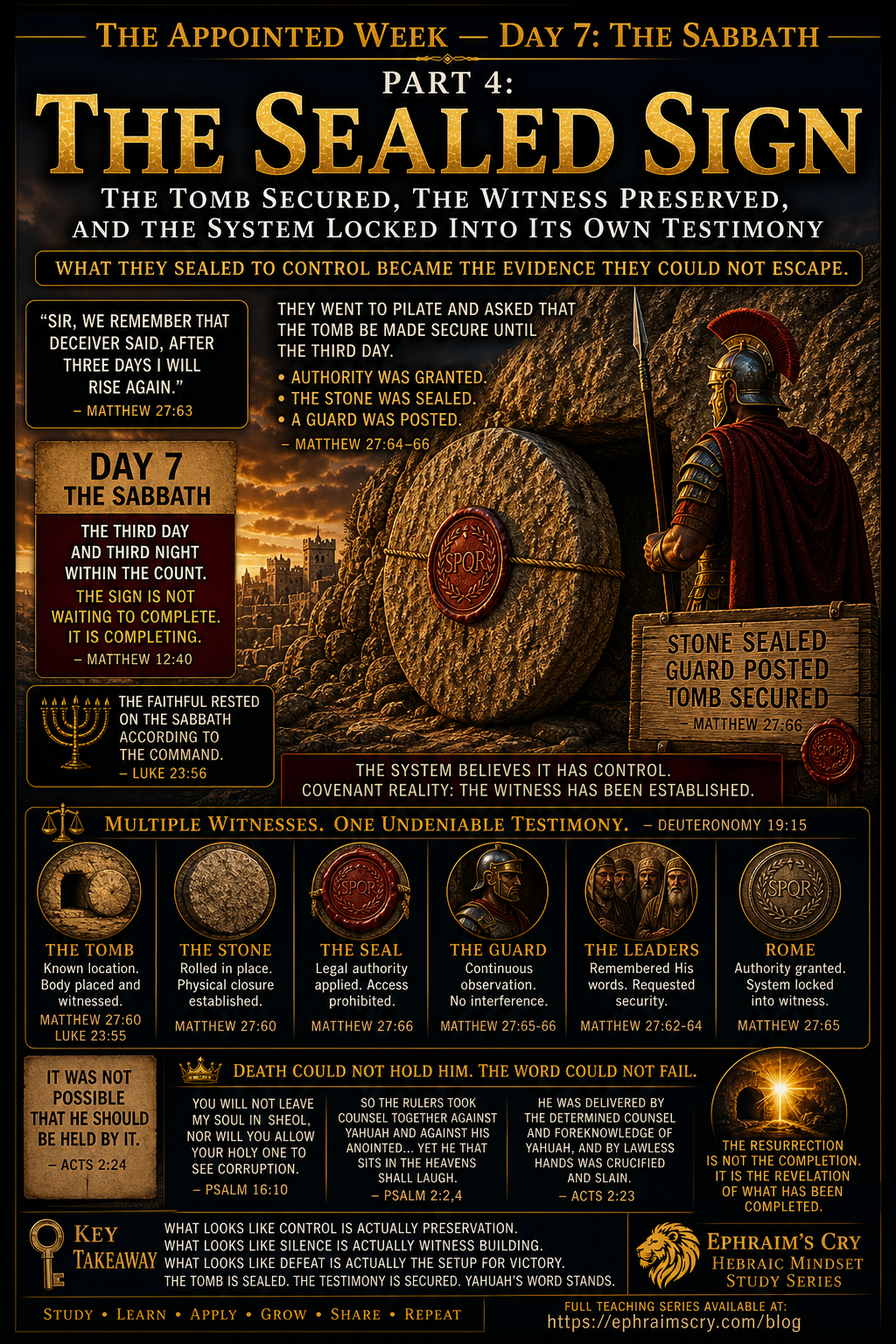
The Appointed Week — Day 7: The Sabbath — Part 4: The Sealed Sign
The Tomb Secured, the Witness Preserved, and the System Locked Into Its Own Testimony
Greg Witter | Ephraim’s Cry
Hebraic Mindset Study Series
Study Learn Apply Grow Share Repeat
There comes a moment in the appointed week where the system’s attempt to control the outcome becomes the very thing that exposes its defeat. That is what happens on Day 7. The tomb is no longer merely closed. It is secured. The stone is no longer merely rolled into place. It is sealed. The burial location is no longer merely known by the faithful women who saw where the body was laid (Luke 23:55). It is now under official attention, official concern, official fear, and official enforcement (Matthew 27:62–66). The system believes it is protecting itself. It believes it is preventing deception. It believes it is closing the door on the testimony of 𐤉𐤄𐤅𐤔𐤏 (Yahusha). But covenant reality sees something far deeper. What they seal to control becomes the evidence they cannot escape.
This must be understood from the beginning: the sealed tomb is not a side detail. It is not a dramatic addition to the resurrection account. It is not a small historical note placed there for color. It is legal witness. It is covenant witness. It is the system being forced—without understanding it—to preserve the very conditions that will later testify against it. Yahuah does not need the agreement of His enemies in order to establish truth. He does not need Rome to submit before He can use Rome’s authority. He does not need the chief priests and Pharisees to believe before He can make their actions serve the witness of what He has already decreed (Psalm 33:10–11; Proverbs 19:21; Acts 2:23).
The body of Yahusha has already been placed in the tomb. Joseph of Arimathea has taken the body, wrapped it in clean linen, and laid it in his own new tomb cut into the rock, with a great stone rolled to the entrance (Matthew 27:57–60; John 19:38–42). This burial was not uncertain. It was not hidden from all witnesses. It was not confused, vague, or left to rumor. The women who had followed from Galilee saw the tomb and how His body was laid (Luke 23:55). The location was known. The body was placed. The burial condition was established. And that matters because Yahusha did not define the sign by the moment of death alone; He defined it by the condition of being “in the heart of the earth” (Matthew 12:40).
That phrase must be held with precision. “In the heart of the earth” is not the suffering on the stake. It is not the trial. It is not the scourging. It is not the final breath. It is the burial condition: enclosed, placed, hidden from sight, within the earth, beyond the reach of ordinary human access. Jonah was not counted merely from the threat of death. He was counted from the condition of being in the belly of the great fish (Jonah 1:17). In the same way, the sign of the Son of Man begins when Yahusha is placed in the tomb, not before. The count begins at burial because burial establishes the condition He named (Matthew 12:40; Matthew 27:59–60).
Now the timing must be held exactly. The burial is completed before sundown because the Sabbath is approaching (John 19:31, 42; Luke 23:54). The 14th of Aviv, Passover, is closing (Leviticus 23:5). The 15th begins, the first day of Unleavened Bread, a commanded day of holy convocation and rest (Leviticus 23:6–7). John makes clear that this was a High Sabbath, not merely an ordinary weekly Sabbath reference (John 19:31). This matters because the appointed-time structure is governing the whole sequence. The Lamb is slain on Passover. The body is placed before the High Sabbath. The count begins at burial. The appointed sign moves through the appointed time.
By Day 7—the Sabbath—the count has reached its final measure. Night one and day one have passed. Night two and day two have passed. Night three and day three belong to the Sabbath completion of the sign, following the creation pattern of evening and morning (Genesis 1:5). Yahusha said “three days and three nights” (Matthew 12:40). That is not flexible language. It is not symbolic compression. It is not a phrase that can be bent to protect inherited tradition. It is a measurable sign. And on Day 7, the Sabbath, that sign is completing.
This is why the sealed sign carries such weight. The system is not sealing the tomb at the beginning of an uncertain period. It is sealing the tomb during the very count it fears. The leaders remember His words: “After three days I will rise again” (Matthew 27:63). That statement is devastating. They remembered. They heard enough to fear. They understood enough to act. They were not ignorant of the claim. They were resisting it. They did not come to Pilate because they had forgotten. They came because they remembered and wanted to prevent the testimony from spreading (Matthew 27:63–64).
That is informed resistance.
It is possible to remember the words of Yahusha and still oppose their authority. It is possible to know what was spoken and still move against it. It is possible to have enough truth to fear the outcome, but not enough humility to submit to the One who spoke it. That is what the leaders show here. They do not respond to His words with repentance. They respond with control. They do not test themselves against the sign. They try to secure the tomb against it. That is exactly the pattern of Psalm 2, where rulers take counsel together against Yahuah and against His Anointed (Psalm 2:1–2).
They say to Pilate, “Command therefore that the tomb be made secure until the third day” (Matthew 27:64). Even in opposition, they confirm the timing. They are trying to control the third day while unknowingly testifying that the third day matters. Pilate answers, “You have a guard; go your way, make it as secure as you know how” (Matthew 27:65). That phrase carries weight. Human authority is now being permitted to do its strongest work. Make it secure. Use the guard. Use the seal. Use the force of the system. Do everything man can do to hold the tomb in place.
And they do exactly that. “So they went and made the tomb secure, sealing the stone and setting a guard” (Matthew 27:66). Now the tomb is secured under official authority. The stone is sealed. The guard is posted. The condition is controlled. No one has lawful access. No one can approach without consequence. No one can remove the body without confronting military presence and official seal. From the system’s perspective, this is final control. From covenant reality, this is the building of undeniable witness.
They believe they are preventing deception. They are actually preventing denial.
Because once the tomb is sealed and guarded, every later excuse begins to collapse before it is even spoken. If someone later says the body was stolen, they must explain the guard (Matthew 27:65–66; Matthew 28:11–15). If someone says the tomb was tampered with, they must explain the seal (Matthew 27:66). If someone says the location was uncertain, they must explain the women who saw where He was laid and the leaders who secured that same tomb (Luke 23:55; Matthew 27:62–66). The system’s own actions remove the possibility of casual dismissal.
This is covenant legal structure. Torah establishes that a matter is confirmed by the mouth of two or three witnesses (Deuteronomy 19:15). Here, Yahuah allows more than the minimum. The tomb witnesses by its known location. The stone witnesses by its closure. The seal witnesses by legal authority. The guard witnesses by observation. The leaders witness by their own recorded fear of the third day. Rome witnesses by authorizing the guard. The women witness by having seen where the body was laid. The entire scene becomes a courtroom of evidence before the announcement is ever made.
The system does not agree with the truth, but it is establishing the record.
That is how Yahuah overturns false authority. He can take the resistance of men and make it serve His decree. Pharaoh resisted Yahuah, but that resistance became the stage upon which Yahuah displayed His name and power (Exodus 9:16; Romans 9:17). Joseph’s brothers acted with evil intent, but Yahuah governed the outcome for preservation and deliverance (Genesis 50:20). The rulers acted against Yahusha, yet Peter declares that what happened was according to the determined counsel and foreknowledge of Yahuah (Acts 2:23). The system thinks it is operating independently, but it is standing inside a larger decree it cannot overturn.
Now bring in the prophetic certainty. Psalm 16 declares, “You will not leave my soul in Sheol, nor will You allow Your Holy One to see corruption” (Psalm 16:10; Acts 2:27). That word was already established before the seal was placed. That word was already stronger than the stone. That word was already greater than Rome. That word was already above the fear of the chief priests and Pharisees. Acts later confirms the reality: Yahuah raised Him up, “because it was not possible that He should be held by it” (Acts 2:24).
Not difficult.
Not unlikely.
Not improbable.
Not possible.
Death could not hold Him because death had no lawful claim over Him. Corruption could not consume Him because He was the Righteous One (Acts 2:24–27; Romans 6:9). The grave could receive Him, but it could not retain Him. The tomb could contain His body for the appointed count, but it could not claim authority over His destiny. That means the seal was never a threat to Yahuah’s word. The guard was never an obstacle to resurrection. The stone was never the final authority. They were only witnesses being placed into position.
This is why the sealed sign must be expounded fully. The seal does not make resurrection harder. It makes denial harder. The guard does not make the tomb safer from truth. It makes truth more undeniable. The system’s authority does not restrain Yahuah. It becomes the unwilling documentation that no human hand produced the outcome. What they put in place to prevent testimony becomes the structure that validates testimony.
Now this must be placed back inside the Sabbath itself. Day 7 is not merely the day the tomb remains sealed. Day 7 is the Sabbath. The command still governs. Luke records that the women rested on the Sabbath according to the commandment (Luke 23:56). This is not a throwaway line. It is the covenant contrast. While the system moves in fear, the faithful remain under command. While the leaders go to Pilate, the women rest according to Torah. While the system seeks control, the faithful submit to what Yahuah has already spoken (Exodus 20:8–11).
That contrast is severe.
The system acts because it fears the word of Yahusha.
The faithful rest because they obey the command of Yahuah.
The system believes authority is expressed through seal, guard, and force.
The faithful are called to trust that authority rests in the word that cannot fail (Isaiah 55:10–11).
This is not passivity. It is alignment. Sabbath rest is not weakness here. It is covenant discipline. It is refusing to act outside the command even when everything appears to demand action. It is trusting that Yahuah does not need disobedient urgency to accomplish what He has appointed. The women do not break Sabbath to “help” the fulfillment. The disciples do not break the seal to “protect” the testimony. The faithful are not called to force movement. They are called to remain aligned.
That is hard for the flesh. The flesh wants to fix. The flesh wants to force. The flesh wants to intervene. The flesh wants visible movement as proof that Yahuah is still working. But Day 7 refuses that. Day 7 says the tomb can be sealed and Yahuah still reigns. The guard can be posted and the word still stands. The stone can be fixed in place and the count still completes. The faithful can be still and fulfillment can still be advancing.
Now the reader must be confronted. What do you believe when truth appears sealed? What governs you when the system appears organized, powerful, and in control? What do you trust when visible authority stands in front of the promise? Do you believe the seal more than the sign? Do you believe the guard more than the word? Do you believe the stone more than what Yahusha said? Do you assume that because the system can control access, it can control outcome?
That is the deception Day 7 exposes.
The system can seal a tomb, but it cannot seal the decree of Yahuah.
The system can guard a body, but it cannot give death lawful authority over the Righteous One.
The system can control the narrative for a moment, but it cannot stop the testimony Yahuah has appointed.
The sealed sign reveals the limitation of human authority. Men can restrict access, but they cannot restrict resurrection. Men can enforce silence, but they cannot stop fulfillment. Men can secure a stone, but they cannot secure death’s claim over the One whom death cannot hold (Acts 2:24). That is why the system is already defeated before the stone ever moves. The visible manifestation has not yet happened, but the verdict is already settled.
This is the difference between appearance and covenant reality. Appearance says the tomb is secured. Covenant reality says the witness is preserved. Appearance says the system has control. Covenant reality says the system has been locked into testimony. Appearance says the story is over. Covenant reality says the sign is completing. Appearance says death has the final word. Covenant reality says it was not possible for death to hold Him (Acts 2:24).
This is also why the phrase “until the third day” matters (Matthew 27:64). The leaders themselves mark the boundary. They are not securing the tomb indefinitely. They are securing it around the timing Yahusha declared. Their own fear testifies that the third day is not a vague idea. It is a point of concern. It is a boundary inthe timeline. They know the claim. They act because of the claim. And in trying to suppress the claim, they confirm that the claim was known before the tomb was opened.
That matters for testimony. The resurrection announcement is not invented afterward. The timing was known before. The leaders feared it before. The guard was posted because of it before. The seal was applied because of it before. The system itself admits that “after three days” mattered before the event was revealed (Matthew 27:63–66). That is powerful witness.
Now connect this with the broader pattern of Scripture. Human systems often expose themselves by how they respond to the word of Yahuah. Pharaoh hardened himself against the command to let Yahuah’s people go, and his resistance became the setting for Yahuah’s judgment and deliverance (Exodus 5:1–2; Exodus 14:4). The kings and rulers rage against Yahuah’s Anointed, but their counsel cannot overturn His decree (Psalm 2:1–6). The leaders in Acts oppose the name of Yahusha, yet the apostles understand that rulers had gathered against the Anointed exactly as Scripture said they would (Acts 4:24–28). The same pattern is at work at the sealed tomb. The system gathers. The system plans. The system secures. And the system testifies against itself.
This is why the sealed sign is not merely about the tomb. It is about how Yahuah turns opposition into witness. It is about how false authority becomes trapped by its own actions. It is about how narrative control collapses when truth is preserved beyond human interference. It is about how Yahuah does not need His enemies to stop acting; He can use their actions to prove His word.
That is a watchman lesson. The remnant must learn this. There will be times when systems appear to control the visible field. There will be times when truth appears buried, sealed, restricted, guarded, mocked, or silenced. There will be times when the faithful are commanded to stand, rest, wait, and remain aligned while the system appears to be the only thing moving. In those moments, weak faith panics. Flesh-driven religion forces action. But covenant faith discerns the pattern.
Sometimes what is sealed is not defeated.
Sometimes what is sealed is being preserved.
Sometimes what looks like control is actually containment for witness.
Sometimes Yahuah allows a matter to be locked down long enough that no one can later say man interfered.
That does not mean every sealed situation is automatically victory. It means the remnant must stop interpreting everything by sight. We must test everything by the word, the pattern, the command, and the covenant witness (Deuteronomy 13:1–4; Isaiah 8:20; Revelation 12:17; Revelation 14:12). Day 7 trains the reader to see beyond surface control. It teaches that the question is not merely, “What is the system doing?” The deeper question is, “What has Yahuah already spoken?”
The system sealed the tomb because it remembered the words of Yahusha (Matthew 27:63). That alone should pierce the reader. The enemies remembered His words. Do His followers remember them? The enemies acted because they feared what He said. Do His people stand because they trust what He said? The enemies secured the tomb until the third day. Do His people understand the third day with covenant precision?
That is the confrontation.
The sealed sign exposes two kinds of response to the same word. The system hears the word and reacts in fear. The faithful hear the command and remain aligned. The system attempts to control. The faithful are called to trust. The system builds security around death. The faithful rest under the authority of Yahuah. Only one response is covenant.
This is why Day 7 cannot be rushed. If we rush to the empty tomb, we miss the witness being established before the stone moves. If we rush to resurrection revelation, we miss the legal tightening that makes denial collapse. If we rush past Sabbath, we miss the command standing at the very moment the sign completes. The sealed sign forces us to sit inside the tension long enough to see what Yahuah is doing in the hidden.
The stone is still there.
The seal is still intact.
The guard is still watching.
The faithful are still resting.
The system still thinks it has control.
But the word of Yahuah has not moved.
That is the weight of this teaching. The sealed tomb is not the end. It is not the defeat of the promise. It is not the victory of the system. It is the final preserved condition before revelation. It is the witness being secured beyond dispute. It is the system locking itself into testimony. It is Yahuah allowing every human explanation to be removed before He reveals what He has done.
What they sealed to control became the evidence they could not escape.
What they guarded to prevent became the witness they could not silence.
What they secured as final became the setup for undeniable truth.
The tomb is secured.
The witness is preserved.
The system is locked into its own testimony.
And nothing—not Rome, not the priesthood, not the seal, not the guard, not the stone, not fear, not force, not narrative control—can stop what Yahuah has already established.
Full teaching series available at:
https://ephraimscry.com/blog
This is Part 4 of the Day 7 Sabbath teachings
in The Appointed Week series.
Inspection is uncomfortable.
But covenant demands it.
#GregWitter #EphraimsCry #HebraicMindset #TheAppointedWeek #Day7 #Part4 #TheSealedSign #Sabbath #TombSealed #GuardPosted #CovenantWitness #TruthEstablished #HiddenWork #Yahusha #Yahuah #Remnant
