
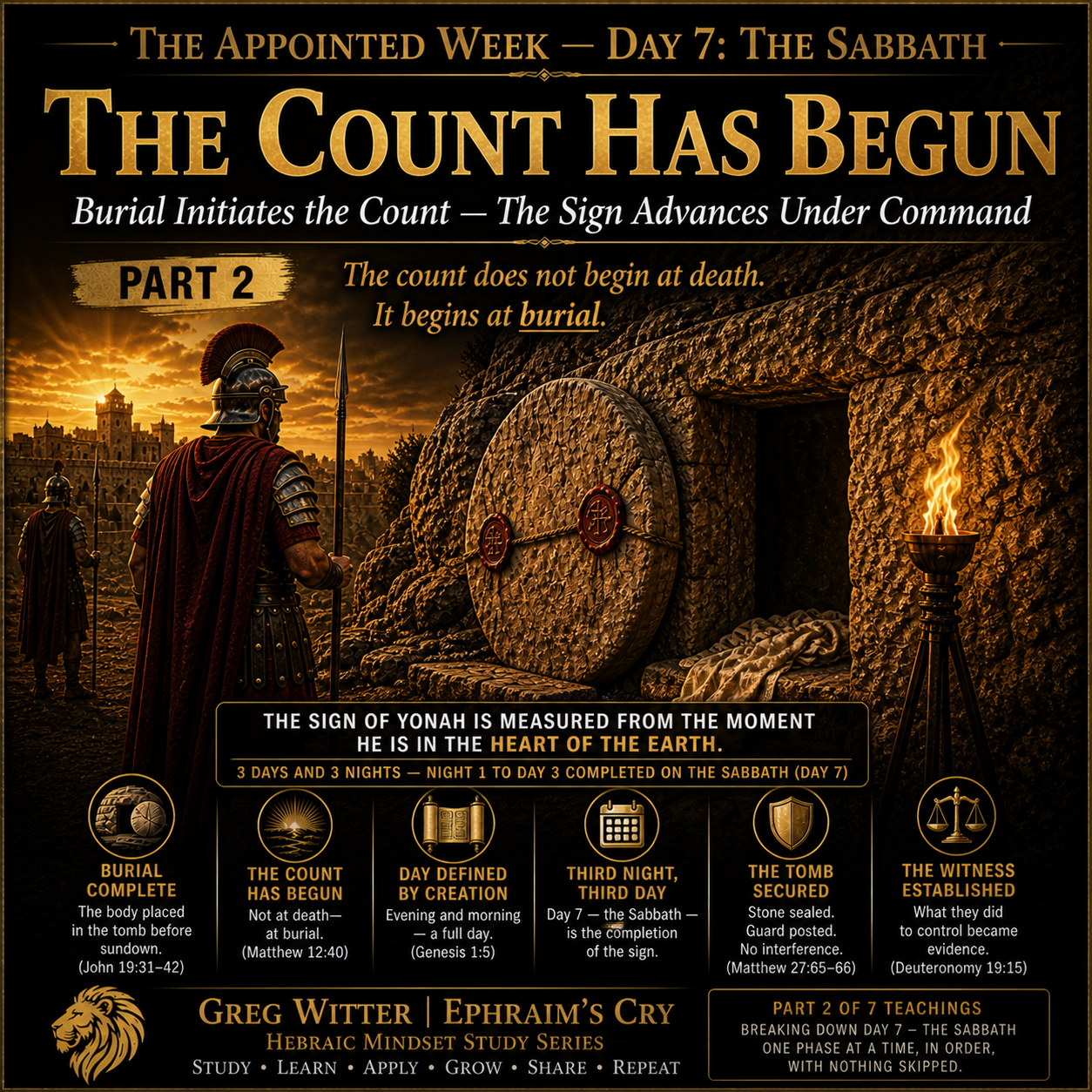
The Appointed Week — Day 7: The Sabbath — Part 2: The Count Has Begun
Burial Initiates the Count — The Sign Advances Under Command and Cannot Be Broken
Greg Witter | Ephraim’s Cry
Hebraic Mindset Study Series
Study Learn Apply Grow Share Repeat
Most people do not realize where the timeline breaks, because they never question where the count actually begins. They assume it begins at the crucifixion. They assume it begins at the moment of death. They assume that suffering is the starting point of the sign. But that assumption is not rooted in the words of Yahusha, and once the starting point is misplaced, everything that follows must be forced, compressed, or reinterpreted to defend what was never established in the text.
Yahusha did not speak in vague terms. He did not leave room for interpretive flexibility when it came to the sign. He defined it with precision: “For as Yonah was three days and three nights in the belly of the great fish, so shall the Son of Man be three days and three nights in the heart of the earth” (Matthew 12:40; Jonah 1:17). That phrase—in the heart of the earth—is not poetic abstraction. It is a defined condition. It speaks of burial, of enclosure, of placement beneath the surface, of being removed from the visible realm and confined within the earth itself.
Until that condition is met, the sign has not begun.
Death is not the beginning of that condition. Burial is.
This is where the correction must be made, and it must be made cleanly. The count does not begin at crucifixion. It does not begin when the body goes limp. It does not begin when the final breath is taken. It begins when the body is placed in the tomb, when the stone is set, when the burial is complete, and when the condition Yahusha described becomes reality (Matthew 27:59–60; John 19:41–42).
That is the starting line.
Now the Gospel accounts align perfectly when read through that lens. The body is taken down quickly because the Sabbath is approaching (John 19:31). Joseph of Arimathea receives the body, wraps it in linen, and places it in a new tomb (Luke 23:52–53). The women observe where He is laid (Luke 23:55). They prepare spices, intending to return. But then something interrupts their plan—not confusion, not fear, but command.
The Sabbath arrives.
Luke records it plainly: “And that day was the preparation, and the Sabbath drew on” (Luke 23:54). And then: “They rested on the Sabbath according to the commandment” (Luke 23:56).
That moment is the hinge.
Because the burial is complete, the tomb is closed, and the Sabbath begins. And from that exact moment—
the count has begun.
This is not optional. This is not interpretive. This is structural.
Now bring in the appointed times to anchor this further. The 14th of Aviv is Passover (Leviticus 23:5). The 15th begins Unleavened Bread—a High Sabbath (Leviticus 23:6–7). John confirms this was not an ordinary Sabbath: “for that Sabbath day was a high day” (John 19:31). That means the burial occurs just before a commanded Sabbath that stops all work.
And this is where another layer is often missed.
There are two Sabbaths in play:
The High Sabbath (15th of Aviv) and the weekly Sabbath (the seventh day).
This explains what many overlook. Luke 23:56 shows the women preparing spices before resting on the Sabbath. Mark 16:1 then shows them purchasing spices after a Sabbath. The only way both are true is if there are two Sabbaths with a preparation day between them. That aligns perfectly with the appointed structure and removes contradiction entirely.
Scripture does not conflict.
It exposes assumptions.
Now return to the count itself.
Scripture defines a day as evening and morning (Genesis 1:5). That means a full cycle consists of night followed by day. Yahusha did not say “three days” loosely. He said “three days and three nights” (Matthew 12:40). That is a complete structure—six segments, three full cycles.
Now let it stand without interference:
Night one → Day one
Night two → Day two
Night three → Day three
This leads directly and unavoidably to this:
Day 7—the Sabbath—is the third night and the third day.
Not approaching completion.
Not symbolic completion.
Completion.
This must be said again, because this is where most teachings fail:
The resurrection is not the completion of the sign.
It is the revelation of a completed sign.
The completion happens in the tomb, under the Sabbath, within the count. The revelation happens after. If those two are merged, the structure collapses and the words of Yahusha are forced into a framework they never declared.
Now bring in the covenant weight of Sabbath itself. Yahuah declared it to be a sign between Him and His people forever (Exodus 31:16–17). A sign does not vanish at fulfillment. A sign confirms. A sign witnesses. A sign identifies alignment.
Now look at what is happening here.
The Sabbath is a sign (Exodus 31:17).
The burial is a sign (Matthew 12:40).
The three days and three nights are a sign (Jonah 1:17; Matthew 12:40).
All three converge—
on this exact day.
This is not symbolic overlap.
This is layered testimony.
Now the legal dimension must be brought forward, because Scripture establishes that a matter is confirmed by witnesses (Deuteronomy 19:15). What is happening at the tomb is not random—it is establishing uncontestable testimony.
The body is placed.
The tomb is known.
The stone is set.
The system intervenes.
The leaders go to Pilate. They request security. They receive authority. They seal the stone. They post a guard (Matthew 27:62–66). They believe they are preventing deception. They believe they are securing control.
What they are actually doing is eliminating every alternative explanation.
Because now:
No one can enter.
No one can remove the body.
No one can interfere.
Which means when the tomb is opened—
there will be no argument left.
What they established as control becomes evidence. What they enforced as protection becomes testimony. What they intended to suppress becomes the very thing that proves the truth (Acts 2:23–24).
Now step back and see the contrast.
The system is active.
The faithful are resting.
The system is reacting in fear.
The faithful are governed by command.
The system is trying to control outcome.
The faithful are aligned under structure.
Only one of those positions is in covenant alignment.
Now bring in the internal tension of the moment. The disciples do not understand (Luke 24:21). Their expectations have collapsed. Their framework has failed. Everything they thought would happen has not happened the way they expected. The promise appears buried. The authority appears silenced. The movement appears over.
And yet—
the count is moving forward perfectly.
This is where the test becomes unavoidable.
Because Day 7 removes everything people depend on:
No movement.
No confirmation.
No visible progress.
Only:
The command (Exodus 20:8–11).
The structure (Genesis 1:5).
The word spoken (Matthew 12:40).
This is obedience without confirmation. This is alignment without reinforcement. This is faith that is not dependent on sight (2 Corinthians 5:7). This is where the remnant is revealed—not in the miracle, not in the victory, but in the silence between completion and revelation.
Most people want Day 8. They want resurrection. They want visible victory. They want confirmation. But they reject Day 7. They reject the stillness, the stopping, the submission, the surrender of control. They want outcome without alignment.
But covenant has never worked that way.
Hebrews warns that many did not enter into rest because of disobedience (Hebrews 4:3–11). Not because rest was unavailable—but because they would not align. That warning sits directly on this moment.
Day 7 is not passive.
It is the proving ground.
It is where:
- the sign is completed (Matthew 12:40)
- the command is upheld (Luke 23:56)
- the system is exposed (Matthew 27:65–66)
- the witness is established (Deuteronomy 19:15)
- the remnant is revealed (Revelation 14:12)
And it determines who will stand when what has already been completed is finally revealed.
The count has begun.
It cannot be stopped.
It cannot be shortened.
It cannot be redefined.
It will reach its full measure exactly as spoken.
And nothing—no system, no seal, no guard, no tradition, no reinterpretation—can alter what Yahuah has already established.
Full teaching series available at:
https://ephraimscry.com/blog
This is Part 2 of the Day 7 Sabbath teachings
in The Appointed Week series.
Inspection is uncomfortable.
But covenant demands it.
#GregWitter #EphraimsCry #HebraicMindset #TheAppointedWeek #Day7 #Part2 #TheCountHasBegun #ThreeDaysThreeNights #SignOfJonah #BurialMatters #SabbathTimeline #CovenantTruth #ScriptureOverTradition #Yahusha #Yahuah #Remnant
