
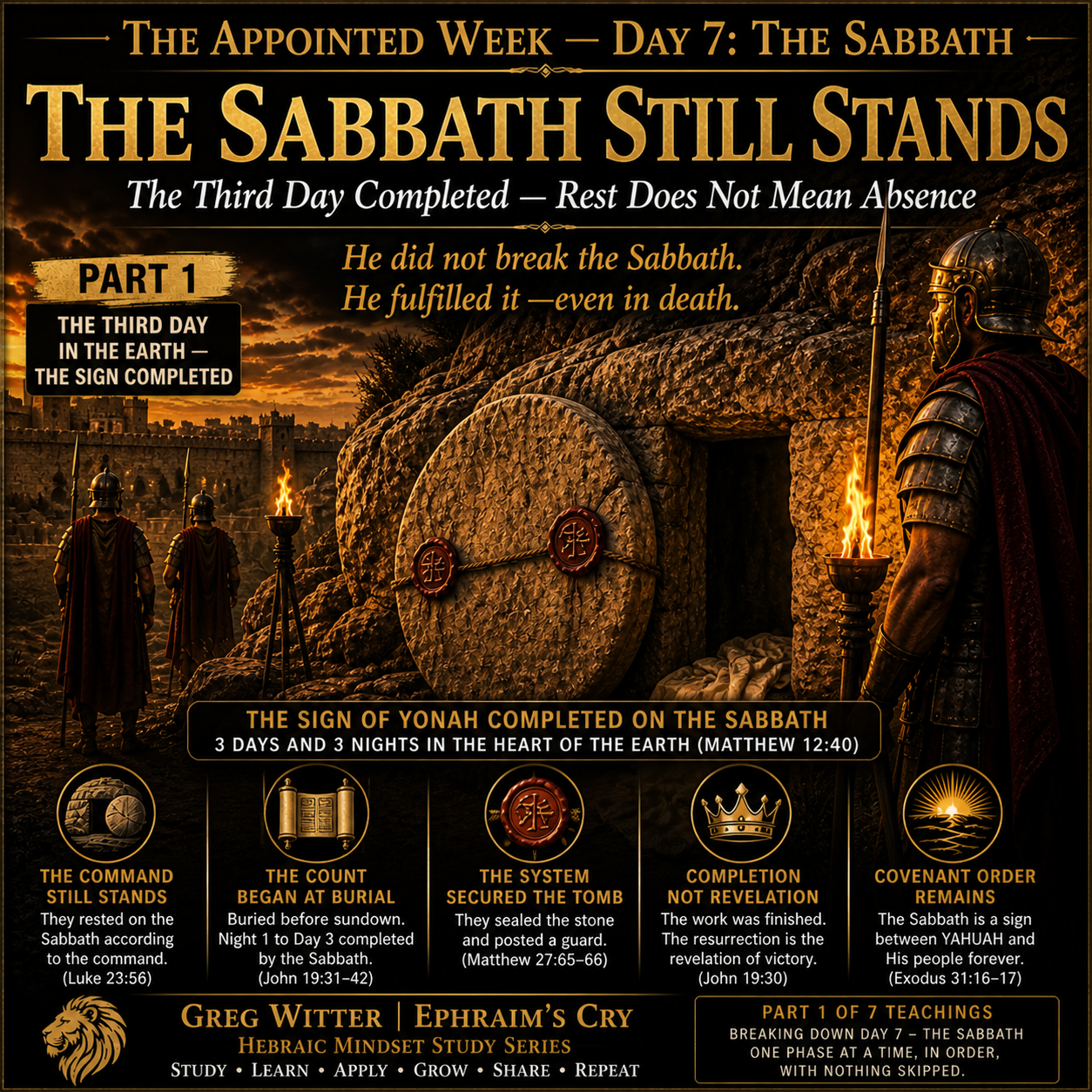
The Appointed Week — Day 7: The Sabbath — Part 1: The Sabbath Still Stands
Completion Does Not Cancel the Command — It Confirms It
Greg Witter | Ephraim’s Cry
Hebraic Mindset Study Series
Study Learn Apply Grow Share Repeat
Everything has just happened. The Lamb has been slain according to the appointed time (John 19:30; Exodus 12:6), His blood has been poured out for covenant atonement (Matthew 26:28; Leviticus 17:11), and His body has been taken down, wrapped, and placed into the tomb before the close of the 14th of Aviv (John 19:31–42; Luke 23:52–54). The visible work has ended, the public spectacle has ceased, the crowds have dispersed, and the scene that seemed to carry everything forward now appears to have come to an abrupt and final end (Matthew 27:55–56). From the outside, it looks finished. From the system’s perspective, it looks like control has been reestablished (Matthew 27:62–63). From the disciples’ perspective, it looks like hope has collapsed (Luke 24:17–21). And yet, in the middle of that apparent finality, something has not moved, not shifted, not weakened, and not been removed. The Sabbath still stands.
This is where most people lose the entire structure, because they assume that once the sacrifice has been made, the command no longer governs. They assume that fulfillment removes obligation, that completion replaces obedience, and that the moment something is “finished,” the structure that defined it is no longer necessary. But covenant does not operate that way, and Scripture does not support that conclusion. Completion does not cancel the command—it confirms it. What Yahuah establishes is not undone by the fulfillment of purpose; it is revealed more clearly through it (Matthew 5:17–19).
Now this must be anchored in time, not assumption. The burial is completed before sundown (John 19:31), the 14th of Aviv closes (Leviticus 23:5), and the 15th begins—the first day of Unleavened Bread, which is a High Sabbath in itself (Leviticus 23:6–7; John 19:31). This is not incidental timing. This is appointed timing. This is the structure Yahuah set in motion long before the crucifixion took place. And from the moment the body is placed in the tomb and the burial is complete, the count begins. Not from crucifixion. Not from the moment of death. From burial—because Yahusha defined the sign as being “in the heart of the earth” (Matthew 12:40), not merely dying on the stake.
That distinction matters, because until the body is placed in the tomb, the condition of the sign has not begun. Jonah was not counted from the moment he was thrown into the sea, but from the moment he was in the belly of the great fish (Jonah 1:17). In the same way, the sign given by Yahusha is not measured from the moment of death, but from the moment of burial. That is where the count begins. That is where the structure locks into place. And once that is established, the timeline becomes clear and cannot be compressed without breaking the sign itself.
Night one leads into day one, as established from creation where evening and morning define a full day (Genesis 1:5). Night two leads into day two. Night three leads into day three. This is not symbolic language. This is measurable time. This is the structure Yahusha Himself declared. And therefore it must be said clearly and without compromise: Day 7—the Sabbath—is the third night and the third day. It is not waiting for completion. It is completion. The sign has reached its full measure by the Sabbath.
This changes the entire weight of the day, because the resurrection is not the completion of the sign—it is the revelation of a sign already completed. If that distinction is blurred, the entire structure collapses. The words of Yahusha become subject to reinterpretation, and the authority of the sign is weakened. But if the count is allowed to stand as given, then the Sabbath becomes the moment where fulfillment reaches completion under command.
Now Luke records something that must not be minimized: “They rested on the Sabbath according to the command” (Luke 23:56). That statement is not background information. It is a declaration of authority. Because at the exact moment when the body is in the tomb (Matthew 27:59–60), when the sign is being fulfilled (Matthew 12:40), and when the third day is completing, Torah still governs. Not symbolically. Not spiritually only. Practically. Functionally. The women stop. Not because everything is resolved. Not because their desire to complete the burial process is gone. But because the command governs them (Exodus 20:8–11).
This is covenant alignment. It is obedience without confirmation. It is submission without visible reinforcement. It is the acknowledgment that Yahuah’s command does not bend to human urgency, emotion, or incomplete understanding. The Sabbath itself was already established as a covenant sign between Yahuah and His people forever (Exodus 31:16–17). That means it is not a temporary shadow that disappears at fulfillment. It is a sign that continues to witness. And here, on this exact day, that sign aligns directly with another sign—the sign of Jonah (Matthew 12:40)—and both are converging at the same moment.
This is not coincidence. This is covenant precision. The Sabbath stands as a sign. The burial stands as a sign. The three days and three nights stand as a sign. And all of them meet at this point—Day 7, the Sabbath, the completion of the count. That is why this moment carries such weight. It is not empty time. It is not passive waiting. It is the completion of the sign under the authority of the command.
Now bring in the creation witness. Yahuah completed His work and rested on the seventh day (Genesis 2:2–3). He did not continue working. He did not adjust what had been done. He did not revise it. Completion led to rest. Now Yahusha mirrors that pattern exactly when He declares, “It is finished” (John 19:30), and then enters into rest. This is not inactivity. This is completion under authority. The work of atonement has been accomplished (Hebrews 9:26–28), and now the pattern of rest confirms the work, not replaces it.
But here is where the tension increases. Nothing looks finished. The body is still in the tomb. The stone is still in place. The guard will soon be posted (Matthew 27:65–66). The system still appears to be in control. The disciples are still confused (Luke 24:21). Everything that can be seen suggests defeat. And this is where the test is revealed. Because the command does not change based on what is visible. The command still governs when everything appears unresolved.
This is the proving ground. This is where faith is exposed—not in the miracle, not in the resurrection, but in the silence between completion and revelation. Because while the faithful are resting according to the command (Luke 23:56), the system is still moving. The leaders go to Pilate, they remember Yahusha’s words, and they attempt to secure the tomb (Matthew 27:62–66). They are trying to prevent deception, to control the narrative, to ensure that nothing disrupts their version of events. But what they are actually doing is establishing the strongest possible witness against themselves.
The tomb is sealed. The guard is posted. Authority is officially involved. That means when the tomb is found empty, no honest explanation can bypass these facts. What they intended as control becomes evidence. What they established as protection becomes testimony. What they enforced as security becomes witness against them (Acts 2:23–24). And all of this is happening while the faithful are resting in obedience.
That contrast cannot be ignored. The system is working, but the faithful are aligned. The system is reacting in fear, but the faithful are submitted to command. The system is trying to control the outcome, but the faithful are trusting the structure already given by Yahuah. Only one of those positions is in covenant alignment.
Now bring this into the personal and prophetic layer. The disciples do not understand what is happening. Their expectations have collapsed (Luke 24:17–21). Everything they thought would unfold differently has not happened the way they expected. And yet the command still stands. That is the question Day 7 forces on every reader: what governs you when you do not understand? What governs you when nothing appears to be happening? What governs you when the promise looks buried?
Most people want Day 8. They want resurrection (Matthew 28:1–6). They want visible victory. They want confirmation. But they reject Day 7. They reject rest. They reject submission. They reject the stillness that requires trust. They want outcome without alignment. But that has never existed in covenant. Hebrews 4 warns that many did not enter into rest because of disobedience (Hebrews 4:3–11). Not because rest was unavailable—but because they would not align with what Yahuah commanded.
Day 7 is not passive. It is the proving ground. It is where the sign is completed (Matthew 12:40), the command is upheld (Luke 23:56), the system is exposed (Matthew 27:65–66), and the remnant is revealed (Revelation 14:12). It is the moment where everything is hidden, but nothing is uncertain. It is where obedience must stand without reinforcement, and where alignment must remain without visible confirmation.
The Sabbath still stands. The sign is complete. The command still governs. And the ones who will stand when Day 8 is revealed are the ones who remained aligned when everything was silent.
Full teaching series available at:
https://ephraimscry.com/blog
This is Part 1 of the Day 7 Sabbath teachings
in The Appointed Week series.
Inspection is uncomfortable.
But covenant demands it.
#GregWitter #EphraimsCry #HebraicMindset #TheAppointedWeek #Day7 #Part1 #Sabbath #ThreeDaysThreeNights #SignOfJonah #TorahStillStands #CovenantAlignment #FaithUnderPressure #HiddenWork #Yahusha #Yahuah #Remnan
