
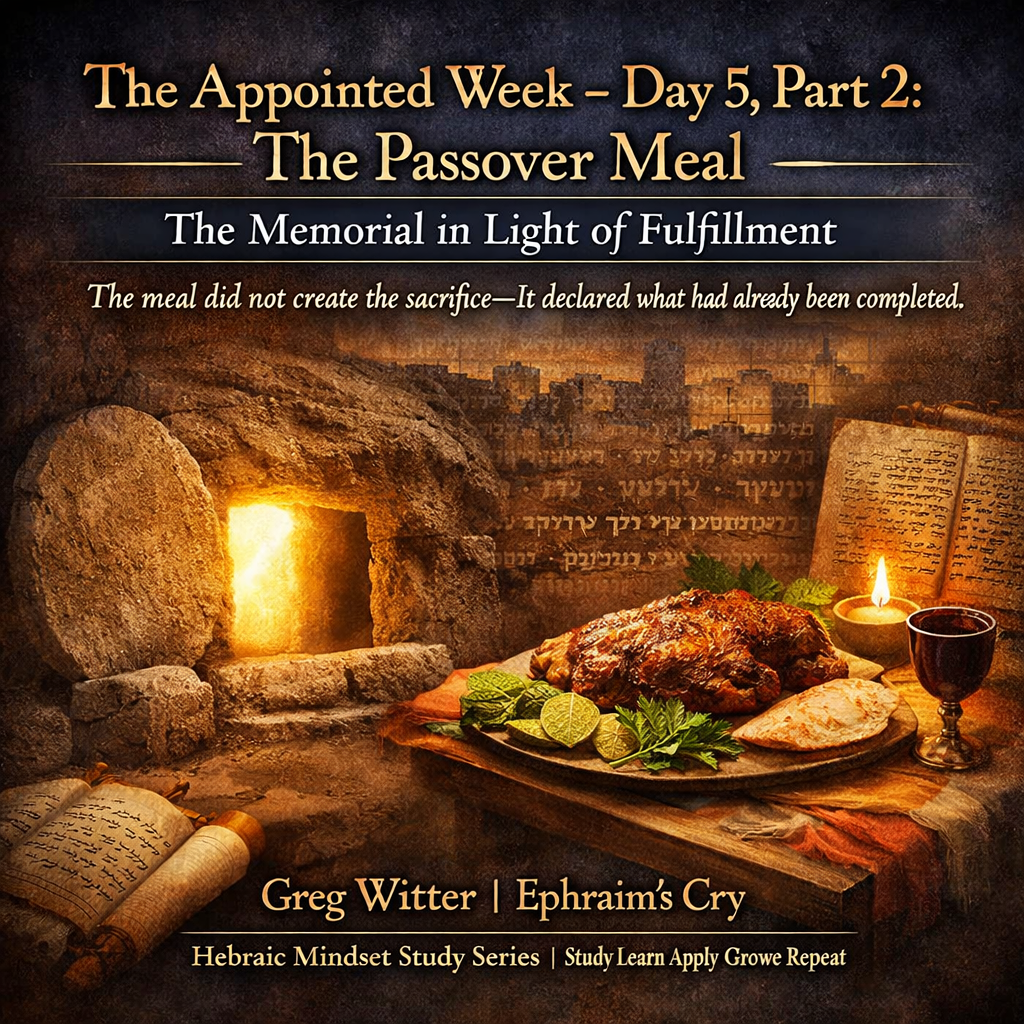
The Appointed Week — Day 5, Part 2: The Passover Meal
The Memorial in Light of Fulfillment
The meal did not create the sacrifice—it declared what had already been completed
Greg Witter | Ephraim’s Cry
Hebraic Mindset Study Series
Study Learn Apply Grow Share Repeat
The meal matters, and that is exactly where this teaching must begin, because most people do not understand what they are looking at when they arrive at this moment. They have inherited a broken order. They have been taught to merge what Scripture keeps separate, to flatten what Torah structures, and to rush to the outcome without stopping to examine the covenant sequence. They move too quickly from the death of the Lamb to the empty tomb, from the burial to the resurrection, from the offering to the victory, and in doing so they pass over one of the most important turning points in the entire appointed sequence. They do not stop at the table. They do not stop at the commanded memorial. They do not stop at the fact that while the true Lamb is already in the earth, the meal still stands, the command still stands, the house still matters, and the people are still called to obey. That is not a side detail. That is covenant order holding perfectly at the very moment most people lose it.
Day 5 does not begin in uncertainty. It begins in precision. The Lamb has already been slain at the close of the 14th of Aviv. The blood has already been poured out. The body has already been taken down and placed into the tomb before sundown, because the 14th was closing and the 15th was about to begin. That burial belongs where it was placed. It belongs at the end of the 14th. It must remain there. The line must not be moved. The Lamb is buried at the end of the 14th, and the meal is eaten at the beginning of the 15th. That distinction is not a technicality. It is the hinge. It is the difference between order and confusion. It is the difference between preserving Torah’s structure and collapsing it into religious sentiment. The 14th closes with the Lamb in the tomb. The 15th begins with the meal on the table. If that line is moved, the entire sequence breaks.
This is why Exodus 12 must be brought into the center and kept there without distortion. The instruction is not vague. The lamb is selected on the tenth day, according to Exodus 12:3. It is kept, examined, and found without blemish until the fourteenth, according to Exodus 12:5–6. It is slain between the evenings on the fourteenth, according to Exodus 12:6. The blood is applied to the doorposts and the lintel, according to Exodus 12:7. The blood becomes the sign because of which judgment passes over the house, according to Exodus 12:13. Then, and only then, after the lamb has been slain and the blood has been applied, the people are commanded to eat the lamb, according to Exodus 12:8. That order is not optional. It is not flexible. It is not symbolic layering that men are free to rearrange. It is covenant structure. Slaughter precedes the meal. Blood precedes participation. Deliverance precedes remembrance. The meal does not produce the deliverance. The meal declares it, remembers it, and participates in it, but it does not create it.
Now bring that structure into Day 5 and let the weight of it settle. The Lamb—𐤉𐤄𐤅𐤔𐤏 (Yahusha)—has already fulfilled the slaughter. The offering has already been made. The blood has already been poured out. The cry, “It is finished,” has already been spoken. The body has already been placed into the earth. The sacrifice is not pending. It is not half-done. It is not waiting for completion. It is complete. And now the 15th begins, and according to Torah the people sit down to eat the Passover meal. This is where the weight of the moment has to be felt with full force. The true Lamb is already in the tomb, and the memorial meal is being eaten. The fulfillment is in the earth, and the commanded memorial is on the table. The blood has already spoken, and the meal now declares. This is not contradiction. This is precision. This is not confusion. This is Torah functioning exactly as it was given, now illuminated by fulfillment rather than discarded by it.
That distinction must be driven deeper because this is where so much false teaching enters. The blood and the meal are not the same thing. In Exodus 12, the blood is applied externally. It marks the house. It is visible. It stands as a legal sign before Yahuah that judgment is to pass over that marked place. The blood answers judgment. The blood establishes covering. The blood is covenantally legal in its force. It is not just emotional symbolism. It is witness. It is declaration. It is the sign by which the destroyer does not enter in the same way. The meal, however, is internal. It is eaten. It is taken into the people. It is participation. It is identification. It is covenant embodiment. One is applied to the house. One is taken into the people. One addresses judgment from without. One enacts belonging from within. One marks the household under the authority of Yahuah. One marks the covenant people through participation. They are not opposed to one another, but they are not identical either. The blood is not the meal. The meal is not the blood.
That same distinction stands with even greater force on Day 5. The blood of 𐤉𐤄𐤅𐤔𐤏 has already been poured out. The legal witness has already been established. The sacrifice has already been completed. The Lamb has already been given. And now the people sit down to eat the memorial meal under that reality. They are not eating in order to make the sacrifice happen. They are eating under the reality that the sacrifice has already happened. They are not causing deliverance. They are declaring it. They are not producing the blood. They are participating under what the blood has already accomplished. This is why the line must not be blurred. The blood delivers. The meal declares and participates. The blood answers the judgment. The meal enacts covenant belonging. If the meal becomes the sacrifice, the structure is broken. If the meal becomes the blood, the pattern collapses. And when that happens, men begin to say things Torah never said and make the appointed order say what it never meant.
This is also where the shift from shadow to fulfillment must be handled with greater depth. In Egypt, the blood marked the houses so that death passed over. The people were protected from the judgment moving through the land. But on Day 5, the true Lamb is not merely shielding from death in symbolic form. He has entered the realm of death itself. That is a deeper movement. That is a more profound fulfillment. In Exodus 12, the people are preserved because of the blood on the house. On Day 5, Messiah has entered the hidden phase in the heart of the earth. The Lamb is not only the sign that causes death to pass over. He is the One who has entered the place where death appears to reign in order to break its claim. That means the people are eating the memorial of deliverance while the Deliverer is in the domain of death itself. The shadow protected from death. The fulfillment confronts death. The shadow caused judgment to pass over. The fulfillment moves into the deeper conflict itself. That is not a small layer. That is one of the central weights of the moment. The meal is not being eaten in a theological vacuum. It is being eaten while hidden victory has already begun.
The command also carries generational force, and that layer cannot be left weak. “This day shall be unto you for a memorial… throughout your generations.” Then the question of the children follows: “What mean ye by this service?” That means the meal is not a private inward reflection with no household or generational weight. It is a teaching mechanism. It is a covenant ordinance. It is designed to preserve identity, preserve memory, preserve truth, and preserve the story of deliverance by forcing every generation to answer the meaning of the service before Yahuah. The meal teaches children what judgment is, what blood means, what deliverance costs, what covenant identity looks like, and who it is that brought the people out. This is not optional remembrance. It is commanded continuity. It is covenant memory embodied and handed down.
That force remains on Day 5. The command has not disappeared because fulfillment has now occurred. The command remains, but the depth of meaning has expanded. The children must still be taught. The service must still be explained. The memorial must still be observed. But now the meaning is even greater, because the pattern has entered history in its fulfilled form. The command is unchanged, but the light shining through it is brighter. Egypt remains foundational, but now the true Lamb has actually been given. The memorial still stands, but now the people are remembering under the greater reality that the One to whom the lamb pointed has already entered the earth. That does not weaken the command. It intensifies it. That does not turn the memorial into dead ritual. It fills it with deeper covenant force. Yahuah does not discard the things He commanded because men become careless with them. He proves their depth by bringing them to fulfillment without breaking their structure.
The meal also carries boundaries, and those boundaries must not be softened to satisfy modern religious sentimentality. Exodus 12 speaks clearly about who may participate and who may not. That means the meal itself is boundary-marked. It is not a generic spiritual observance open to anyone who wants the atmosphere of deliverance without the terms of covenant identity. The meal is not anti-boundary. It is covenant-defined. It distinguishes belonging from non-belonging. It distinguishes participation from outsider status. It teaches that redemption is not approached on man’s terms. Yahuah defines the terms. Yahuahdefines the people. Yahuah defines what it means to belong and what it means to eat. That is uncomfortable for lawless religion because lawless religion wants symbols without submission, participation without belonging, and benefits without covenant identity. But Torah does not yield to that. The meal carries the seriousness of belonging.
That seriousness remains in Day 5. Fulfillment does not erase holiness. Fulfillment does not erase distinction. Fulfillment does not erase covenant seriousness. If anything, it raises it. If the shadow carried boundaries, then the fulfilled reality should be approached with even greater fear, greater clarity, and greater seriousness. This is why the meal cannot be turned into a casual religious ceremony stripped of covenant identity, covenant order, and covenant weight. That is not enlargement. That is corruption. That is not honoring the memorial. That is emptying it of its force. The true Lamb has been given. The blood has been poured out. The memorial still stands. That means the seriousness of participation has only increased.
Another layer that must be brought in is the instruction that nothing of the lamb remain until morning. That command reinforces totality. The lamb is not approached partially. The command is not obeyed selectively. There are no leftovers treated casually, no fragments left as though the people may engage as much as they prefer and leave the rest for later convenience. The lamb is dealt with fully under the command. That totality speaks powerfully into Day 5. The offering of Messiah is not partial. The work is not unfinished. The obedience is not fragmented. “It is finished” aligns with the totality embedded in the Passover instruction. Nothing required of the Lamb for that appointed hour remains undone. Nothing needed for that sacrifice is lacking. Nothing is left hanging. What had to be given was given. What had to be poured out was poured out. What had to be completed was completed. The memorial meal therefore stands under the declaration of full offering, not partial gesture.
The household structure must also be pressed harder because Exodus 12 is deeply household-centered. “A lamb for a house” is not a throwaway detail. It means this command is not framed as isolated individual spirituality detached from ordered family life. Covenant is lived in houses. The table matters in the home. Fathers teach. Children ask. Families participate. Homes are marked. Memory is preserved within the house. Identity is formed within the house. This is covenant order embodied in household life. Modern individualism hates that because modern religion wants faith to be private, internal, self-defined, and detached from ordered covenant responsibility. But Torah does not yield to that. The meal belongs in the house. The command belongs in the house. The explanation belongs in the house. The children are confronted in the house. The memorial is guarded in the house.
That force remains fully present on Day 5. The hidden Messiah does not remove household responsibility. The fact that the Lamb is now in the earth does not suspend the duty of households to obey, teach, remember, remove leaven, and stand in the commanded structure. In fact, hiddenness makes household order even more important. When the visible Messiah is no longer standing before them, what remains? The command remains. The table remains. The household remains. The responsibility remains. The memorial therefore becomes a direct rebuke to spiritual individualism and religious abstraction. Covenant is not just thought. It is ordered life before Yahuah. It is practiced remembrance. It is teaching in the house. It is obedience in the house. It is leaven removed from the house. That is how the structure lives.
The command to eat in haste must also be handled in full weight. This is not incidental background detail. This is covenant posture. They were to eat with loins girded, sandals on their feet, and staff in hand. That means the meal was not about static religious reflection. It was about readiness. It was about movement. It was about a people prepared to walk out what Yahuah was doing. They were not eating in order to settle more deeply into Egypt. They were eating because deliverance was at hand, and they were to be ready for departure. The meal therefore teaches that deliverance is unto movement. It is unto obedience. It is unto leaving bondage. It is unto stepping forward under command.
That posture matters on Day 5 as well. The meal is not passive nostalgia. It is not a frozen remembrance disconnected from life. The hidden work of Yahuah is already underway, and the people are called to remain in covenant posture even when they cannot yet see the full revealed outcome. They are still to be ready. They are still to be aligned. They are still to obey. Day 5 is hidden transition, not dead space. The meal fits that exactly. The people are commanded to remain in readiness while Yahuah continues moving the appointed sequence forward in ways they cannot yet see openly. That is not only ancient history. That is remnant training. That is covenant posture for every generation that must obey under hidden conditions.
The relationship between the meal and Unleavened Bread must also be expanded because the meal does not stand isolated from what follows. It opens into it. The meal is the threshold. It is the entry point. The people do not eat and then return to ordinary life as though the meaning ends at the table. They enter a seven-day process of removing leaven, removing mixture, removing corruption, and searching the house. That means the memorial meal is not just remembrance of deliverance. It is initiation into the sanctified response to deliverance. The blood leads into separation. The memorial leads into cleansing. The table opens the process of sanctification. That is covenant logic. Yahuah does not deliver His people so they may continue unchanged. He delivers them so they may walk out of bondage and into ordered separation.
That connection matters intensely in Day 5 because while Messiah is hidden in the earth, the visible obedience of the covenant people must now advance in the form of leaven removal. That is profound. While the hidden work is underway, the people are not called to passive speculation. They are called to activeobedience. They are called to search the house. They are called to remove corruption. They are called to continue in what was commanded. The hidden Messiah and the visible removal of leaven move together. That is not accidental. That is covenant symmetry. Yahuah works in the hidden, and the people obey in the visible. He does not call them to sit paralyzed because they cannot see the full outcome yet. He calls them to obey what He has already spoken. That is what the meal opens. That is why Part 2 presses directly into Part 3. The memorial is not the end of the process. It is the door into the cleansing.
All of this also drives directly against the corruption of dead ritual. The problem is not repetition. Yahuah commanded repetition. The problem is repetition severed from covenant meaning, covenant obedience, covenant identity, covenant fear, and covenant structure. When men keep the shell and discard the substance, they do not preserve the memorial. They hollow it out. When churchianity turns covenant realities into detached symbolic ceremonies with no Torah, no household order, no generational teaching, no leaven removal, no fear of Yahuah, and no covenant seriousness, it does not honor the command. It steals from it. The memorial meal is not a prop. It is not a nostalgia device. It is not a sentimental tradition emptied of constitutional force. It is loaded with meaning: blood, judgment, deliverance, belonging, instruction, readiness, household order, participation, separation, and covenant identity. Strip those away and it may still look religious, but it is no longer functioning according to the weight Yahuah gave it.
That is why the Passover meal in light of fulfillment becomes such a sharp rebuke to both lawless religion and shallow ceremonialism. It rebukes lawless religion because fulfillment does not abolish the covenant seriousness embedded in the command. It rebukes shallow ceremonialism because outward observance without depth, obedience, order, and fear is corruption rather than faithfulness. The memorial is not empty. It is a commanded witness. It declares who Yahuah is, what He has done, who His people are, how they must live, and what it means to belong to a delivered people under covenant order. On Day 5 that witness is intensified, because the true Lamb has already been given and hidden from sight.
That hiddenness is one of the deepest tests in the entire structure. The visible Messiah is gone. The teaching voice is silent. The miracles are absent. The public certainty is removed. The disciples are shaken and scattered. Fear is in the air. Confusion is growing. And yet the command still stands. The meal still stands. The leaven must still be removed. The convocation still stands. The people are still called to obey. That means Day 5 becomes a witness for every generation that covenant obedience is not suspended by hiddenness. The people of Yahuah are not called to obey only when the work is visible, immediate, and emotionally satisfying. They are called to obey because the command is clear, even when the deeper work is hidden. That is where Day 5 exposes hearts. It reveals whether people obey Yahuah’s word or merely follow what they can see.
That is what makes this meal so searching. The Lamb is in the tomb. The memorial is on the table. The blood has already been poured out. The command still stands. The people must decide whether they will obey in the absence of visible confirmation. Will the meal still be kept? Will the leaven still be removed? Will the house still be searched? Will the command still be honored? Day 5 says that covenant faith does not wait for visible certainty before it obeys. Covenant faith obeys because Yahuah has spoken, and hiddenness does not nullify His word. That is not just historical reconstruction. That is remnant training. That is how the people of Yahuah learn to walk when the visible signs are limited, when the hand of Yahuah is active but not yet openly displayed, and when obedience is being tested in the tension between what has been spoken and what has not yet been publicly revealed.
So the core line must remain fixed and govern the whole teaching: the Lamb is in the tomb, and the lamb is on the table. The fulfillment is in the earth, and the memorial is being observed. The blood has spoken, and the meal declares. The shadow has not been discarded. It has been illuminated. Deliverance has been accomplished. The command continues. The households must still obey. The children must still be taught. The leaven must still be removed. The people must remain ready. The meal is not ritual fluff. It is commanded witness under the light of fulfillment. It is covenant memory at the threshold of separation. It is the table under the shadow of hidden victory. It is the memorial in light of fulfillment.
And this is why the next movement becomes unavoidable. Once the meal has been understood in full weight, the house must now be searched. Once the Lamb has been given, the leaven must now go. Once the blood has answered judgment, the people must now walk in separation. The table leads to the cleansing. The memorial leads to the removal. Deliverance leads to sanctification. Part 2 does not end at the table. It presses into the house. It presses into the feast. It presses into the removal of mixture. The memory opens the separation. The meal opens the process of purification. And while the hidden Messiah is in the earth, the covenant people are commanded to bring their houses into alignment with what the Lamb means.
Full teaching series available at:
https://ephraimscry.com/blog
#GregWitter, #EphraimsCry, #HebraicMindset, #TheAppointedWeek, #Day5, #Part2, #PassoverMeal,
#MemorialInLightOfFulfillment, #Aviv15, #Torah, #Messiah, #Yahusha, #Yahuah, #CovenantTruth,
#GospelOfTheKingdom, #BiblicalTimeline, #UnleavenedBread, #BloodAndMeal, #HouseholdCovenant,
#GenerationalTeaching, #FaithWithoutSight, #HiddenVictory, #Remnant, #Watchman, #StudyLearnApplyGrowShareRepeat
