
The Appointed Week — Day 4: Review & Summation
The Covenant Confirmed in Blood and Body
This was not the ending of the covenant order, but the restoration, confirmation, and enforcement of it through the body and blood of 𐤉𐤄𐤔𐤅𐤏 (Yahusha), the Lamb, the King, and the Melchizedek High Priest.
Greg Witter | Ephraim’s Cry
Hebraic Mindset Study Series
Study Learn Apply Grow Share Repeat
Day 4 must never be treated like a collection of disconnected religious scenes. It must never be broken apart into sentimental fragments, devotional slogans, or isolated moments stripped from covenant structure. It is one day. One appointed day. One covenant day. One day in which the Lamb moves through every required phase in exact order. The covenant meal. The upper room. Judas departing. Gethsemane. The arrest. The trials. Pilate. The scourging. The crucifixion. “It is finished.” Death—blood and water. Burial. Nothing random. Nothing premature. Nothing accidental. Nothing out of sequence. What took place on Day 4 was not the collapse of a movement, not the failure of a prophet, not the tragic death of a good man, and not the replacement of Torah with something else. It was the execution of the covenant in exact alignment with the purpose of 𐤉𐤄𐤅𐤄 (Yahuah). It was the body given. It was the blood poured out. It was the covenant confirmed.
And the timing itself bears witness. This is one of the critical parts that cannot be reduced to a passing note, because the timing proves that what happened on Day 4 was not just meaningful in hindsight. It was meaningful in the moment. It was governed by the appointments of 𐤉𐤄𐤅𐤄 from beginning to end. 𐤉𐤄𐤔𐤅𐤏 (Yahusha) was crucified at approximately the third hour—around 9 a.m.—the time of the morning oblation, when the daily offering was presented. That is not incidental. That is not background information. That is not a decorative time marker. That is covenant timing. That is priestly timing. That is sacrificial timing. The Lamb is publicly lifted up at the hour the daily offering pattern was already speaking. The day opens under the witness of sacrifice.
Then, as the hours pass, the suffering continues until the ninth hour—approximately 3 p.m.—the time of the evening oblation. That too is not incidental. That is the closing daily offering. That is the late-afternoon sacrificial witness. And that same window is also the time when the Passover lambs were being slain in preparation for the meal that would be eaten at sundown. So when 𐤉𐤄𐤔𐤅𐤏 declares, “It is finished,” and gives up His spirit at approximately the ninth hour, He does not merely die sometime during Passover season. He dies on the clock of 𐤉𐤄𐤅𐤄. He dies in alignment with the daily sacrificial pattern and in the very window of Passover slaughter. That means the beginning of the crucifixion is framed by the morning oblation, and the completion of the offering is framed by the evening oblation and the slaughter of the lambs. The whole day is governed by appointment, not accident.
This matters because it destroys the shallow reading that this was just Roman brutality later given religious meaning. No. The meaning is already in the pattern. The pattern is already in the timing. The identity is already in the alignment. Morning oblation. Evening oblation. Passover slaughter. Body given. Blood poured out. Burial before sundown. Count begins. That is why this must be understood. It means He was not just called the Passover Lamb because the title sounds sacred. He is the Passover Lamb by timing, by sequence, by suffering, by witness, by death, and by burial. When the people were preparing to eat the Passover at sundown, the true Lamb had already been offered. His body had already been given. His blood had already been poured out. And before the day closed, He had already been placed in the earth. The work of Day 4 was complete.
That must be said plainly because many have been taught to read these events backward. They have been taught to treat the death of 𐤉𐤄𐤔𐤅𐤏 as the cancellation of what came before Him rather than the fulfillment, confirmation, and elevation of it. They have been taught to imagine that the shedding of His blood means covenant no longer matters, law no longer matters, obedience no longer matters, holiness no longer matters, and that somehow the most costly act in all of Scripture was performed in order to free men from the very order 𐤉𐤄𐤅𐤄 established. That is not just error. That is inversion. That is turning the covenant against itself. That is using the blood of the Lamb as an excuse to step outside the very order that required the blood in the first place. Day 4 destroys that lie if it is read in its actual structure.
Go back to where the day began. It began with the covenant meal. Not random bread. Not random wine. Not hollow ritual. Not a detached religious ceremony. The bread and the cup were interpretive. They told the meaning of the sacrifice before the public execution unfolded. The body would be given. The blood would be poured out. The covenant would be confirmed. But if there were no covenant to confirm, then those words lose their meaning. If the law were irrelevant, then the blood would not be covenant blood. If obedience were unnecessary, then body and blood would not be the means of restoring a people back into faithful order. The meal itself proves continuity. The table did not announce the abolition of covenant. It announced the cost of restoring it.
That alone should stop careless theology in its tracks. He does not take bread and cup and say, “Now none of what came before matters.” He takes bread and cup and interprets what is about to happen within covenant language. The body is given for covenant. The blood is poured out for covenant. This is not abolition language. This is confirmation language. This is the language of cost, obligation, relationship, and fidelity. A covenant meal only has meaning if covenant still stands. Blood only has covenant meaning if covenant still stands. The body given only has covenant meaning if covenant still stands. So the opening of Day 4 already refutes the idea that the death of the Lamb abolishes the order of 𐤉𐤄𐤅𐤄. It proves the opposite.
Then came the upper room, where truth was spoken before testing came. That matters because covenant is never restored through ignorance. The room was a chamber of exposure, alignment, instruction, and separation. Hearts were revealed. Pride was confronted. Betrayal was identified. Love was commanded. The Set-Apart Spirit was promised. Future hatred from the world was foretold. Union, abiding, and faithfulness were spoken into the ears of those who would soon be tested. If this were the beginning of a lawless age, then why such emphasis on remaining, abiding, keeping, loving, watching, and enduring? The upper room does not sound like the birth of spiritual anarchy. It sounds like covenant order intensified. It sounds like responsibility deepened. It sounds like the people of the covenant being prepared to walk in greater truth, not less.
The upper room also proves that covenant is not merely about being near sacred things. It is about being aligned to them. It is not enough to be in the room. It is not enough to hear the words. It is not enough to be physically close to 𐤉𐤄𐤔𐤅𐤏. The room reveals that hearts can be present while loyalties are split. The room reveals that men can hear truth and still resist its implications. The room reveals that covenant is not a casual identity label. It is a binding reality that exposes what is truly in a man. That is why the room comes before the garden. Truth is spoken before testing comes. Alignment is offered before pressure reveals what is really there.
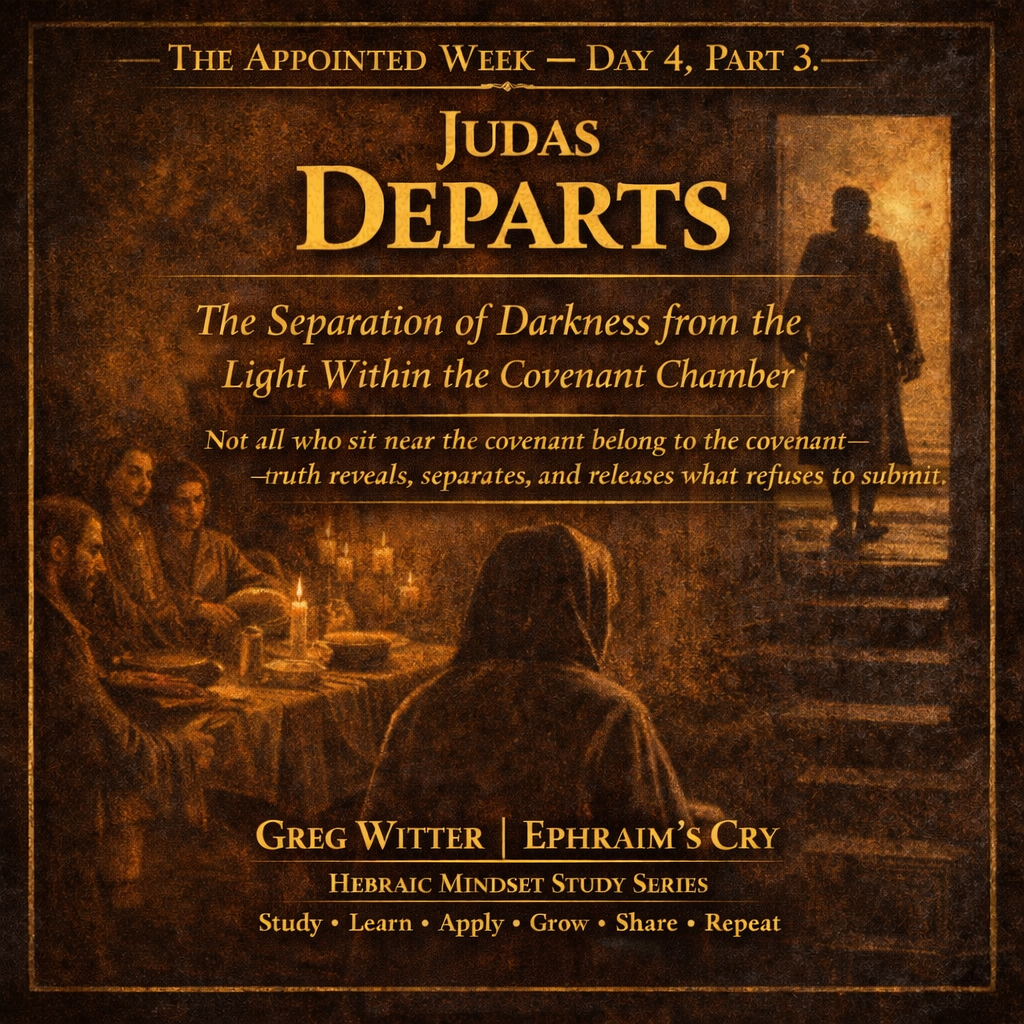
Then Judas departs, and that departure is itself part of the review because it proves something essential. A man may sit in the room and not belong to the covenant. A man may hear the words and still carry betrayal. A man may be near the truth and still choose darkness. That matters because covenant has always been more than outward nearness. Covenant demands inward alignment. Judas was close in proximity and far in loyalty. He did not leave because covenant was too strong. He left because darkness could not remain where truth was exposing hearts. Day 4 shows that covenant restoration does not erase the dividing line between faithfulness and treachery. It sharpens it.
And there is warning here for every generation. Proximity to truth is not the same as submission to truth. Familiarity with sacred language is not the same as covenant loyalty. Participation in outward forms is not the same as fidelity of heart. Judas is the living proof that one can walk among the covenant people and still carry treachery inwardly. So Day 4 is not only a story about what happened to 𐤉𐤄𐤔𐤅𐤏. It is also a revelation of what covenant exposes in everyone around Him. The room reveals. The departure confirms. The night begins its work.
Then Gethsemane. The pressing of the will. The settling of obedience under pressure. That belongs in the summation because the covenant is not restored by bare suffering alone. It is restored through obedient suffering. 𐤉𐤄𐤔𐤅𐤏 did not stumble reluctantly into the covenant work. He yielded to it. He faced the cup. He submitted the will. He prayed through the agony until the human will stood in full alignment with the will of the Father. This matters because if covenant obedience does not matter, then Gethsemane loses its force. But it does matter. Gethsemane shows that obedience is not optional decoration around redemption. Obedience is at the heart of redemption. The Son restores what disobedience shattered by walking all the way through perfect obedience under the most crushing pressure imaginable.
That is critical because many want the blood without the obedience. They want the sacrifice without the submission. They want the redemption without the pattern of yielded will. But Gethsemane refuses that distortion. The Son does not restore covenant by bypassing obedience. He restores covenant through obedience. The cup is not embraced lightly. The will is not aligned cheaply. The pressure is real. The anguish is real. The prayer is real. And that means covenant restoration is not a sentimental idea. It is obedience all the way down. It is faithfulness under crushing pressure. It is the Son doing what the first Adam did not do. It is covenant fidelity where man failed.
Then the arrest. The betrayal. The kiss. The weapons. The torches. The soldiers. The mob. Yet even there the Lamb is not overtaken. He yields. He speaks and they fall backward. He protects His own. He restrains the fleshly reaction of Peter. He refuses the path of carnal defense because the covenant is not being restored by human violence. It is being restored by surrendered obedience to the will of 𐤉𐤄𐤅𐤄. This matters in the review because it shows that the covenant is not preserved by men forcing outcomes. It is preserved by the obedient Lamb walkingthe appointed path.
That means even the arrest is not chaos. It is not men successfully overpowering the Messiah. It is not darkness seizing control from heaven. It is darkness being allowed to move within an appointed window already yielded to by the obedient Son. That distinction matters. If it is missed, then the whole night is misread. The Lamb is not dragged into unwilling defeat. He gives Himself. That is why He can protect His own even in arrest. That is why He can restrain Peter even in danger. That is why He can expose the weakness of flesh even while the mob closes in. The covenant path is not being lost there. It is being walked.
Then the trials begin, and with them comes the exposure of corrupted authority. False witnesses. Twisted testimony. Predetermined verdicts. Political calculation. Institutional fear. Crowd pressure. Cowardly civil authority. Religious manipulation. Day 4 shows what happens when men hold offices but no longer honor truth. Yet even this serves the covenant story, because truth must be condemned by the false system in order to expose the false system as false. 𐤉𐤄𐤔𐤅𐤏 stands as the righteous one before both religious and civil powers, and both fail. That matters because the covenant was not failing. The systems claiming to represent justice were failing. The Lamb was not exposed as deficient. The judges were exposed as corrupt.
And that matters for more than historical interest. Day 4 teaches that systems can retain titles, structures, robes, offices, and procedural appearances while being morally bankrupt. A council can sit in judgment and still be false. A governor can wield legal authority and still be cowardly. A crowd can speak with moral confidence and still be wrong. The Lamb standing righteous under false accusation reveals more than His innocence. It reveals the corruption of everything pretending to judge Him. That is why the trials are not dead history. They are enduring warning. Institutions without truth become weapons against truth.
Pilate proves this further. He finds no fault and still hands Him over. That is one of the clearest pictures in all Scripture of worldly authority without courage. Pilate knows enough to recognize innocence but not enough to stand in it. And there is a warning there for every generation. Knowing truth and refusing to stand in it is not neutrality. It is participation in injustice. The covenant is not upheld by recognition alone. It is upheld by faithful response. That same principle applies now. To say, “I know the law matters, but…” is still compromise. To say, “I see the truth, but it will cost too much to stand there,” is still surrender to the crowd. Pilate is not merely a historical figure to observe. He is a warning to those who fear pressure more than they fear 𐤉𐤄𐤅𐤄.
Then the scourging, the crown, and the mockery of the King. The body is torn. The head is crowned with thorns. The robe is placed in mock coronation. The reed is put in His hand. The soldiers bow in sarcasm. They spit. They strike. They treat the King as though kingship itself were a joke. Yet all of that only drives the irony deeper. The world mocks the King precisely while crowning Him in distorted form. It strikes the true ruler while pretending there is no true rule. That belongs in the review because the covenant is not merely legal. It is royal. The one whose blood confirms the covenant is not merely sacrificial victim. He is King. He is not just paying a price. He is establishing rightful dominion. So when people say, “We are not under law,” they are not merely speaking against commandment. They are speaking against kingdom order. They are resisting the rule of the King whose body and blood established the covenant.
This is critical. Covenant is not only about forgiven people. It is about ruled people. It is about a kingdom. It is about a throne. It is about rightful dominion. It is about a King whose authority is not symbolic. So the mock coronation, the crown of thorns, the robe, the reed, the bowing in derision—none of it is accidental mockery without meaning. It is the world revealing its hatred for true rule even while unintentionally testifying to who He is. The King is crowned in humiliation before He is crowned in open glory. The covenant is therefore not just sacrificial. It is kingdom. It is governmental. It is royal order restored through the suffering King.
Then the lifting up of the Lamb. The public execution. The open display. The innocent numbered with transgressors. The garments divided. The accusations thrown upward. The mockers beneath the stake. The words from the stake. The mother entrusted. The Scriptures fulfilled in detail. This too must be held in the summation because the crucifixion is not simply where pain peaks. It is where the covenant is publicly displayed. The Lamb is lifted up for all to see. The King is enthroned in blood before He is enthroned in glory. The one condemned by men is the one fulfilling everything men failed to keep. This is not Torah being destroyed. This is Torah being upheld at the highest possible cost.
And the public nature of it matters. This is not hidden suffering in a corner. The Lamb is lifted up. The covenant is displayed before heaven, earth, friend, enemy, Jew, Gentile, ruler, crowd, soldier, disciple, and mocker alike. The one who is holy is made visible under the judgment humanity deserved. The innocent is placed among transgressors. The righteous one stands in the place of the guilty without becoming guilty. This is covenant logic on display. The Lamb is not merely dying. He is being publicly identified as the one who bears what others owe. That is why the crucifixion cannot be reduced to one more execution among many. It is the appointed unveiling of the Lamb.
Then comes “It is finished.” That word must be guarded fiercely from false interpretation. “It is finished” does not mean Torah is finished. It does not mean covenant is finished. It does not mean holiness is finished. It does not mean obedience is finished. It does not mean 𐤉𐤄𐤅𐤄 has abandoned what He spoke before. It means the work required in that moment has been accomplished. The suffering appointed for that phase is complete. The sacrificial task has reached its end. The offering has been made. The obedient path has been walked. That is what is finished. The work of redemption is not the same thing as the abolition of righteousness. In fact, the very opposite is true. Redemption confirms the seriousness of righteousness. If sin were trivial, this price would not have been necessary. If law were irrelevant, this blood would not have been required. If covenant did not still stand, then this cry would mean nothing.
This is where many go wrong, and they go wrong badly. They hear, “It is finished,” and imagine that everything before it has been erased. But the cry means the assigned work has been completed, not that covenant standards have been abolished. In truth, the cry proves the enduring seriousness of covenant, because only a living covenant can require such a costly completion. Only a real law can make such blood necessary. Only real holiness can make such a sacrifice essential. So “It is finished” is not a banner for lawlessness. It is the declaration that what had to be done to restore a people into covenant has been done.
Then Death—blood and water. The spirit yielded. The darkness over the land. The earth shaking. The veil tearing from top to bottom. The unbroken bones. The spear in the side. The blood and water flowing forth. The centurion shaken. The witness standing. This phase is vital to the review because it proves the offering was truly made. It was not theater. It was not symbolism floating above history. The Lamb truly died. The side was truly opened. The witness truly flowed. The Passover pattern remained intact even in death. Not one bone broken. The sacrifice confirmed. The blood poured out. The cleansing witness accompanying it. If there were no law, this witness would have no covenant meaning. But there is law. There is covenant. There is sacrifice precisely because covenant violation is real and covenant restoration is costly.
And this too must be pressed in. The death is not assumed. It is witnessed. The offering is not vague. It is confirmed. The spear is not needless detail. The blood and water are not an ornamental flourish. They are visible testimony. The Passover Lamb remains unbroken in death. The side is opened. The witness flows. Heaven and earth answer through darkness, shaking, and torn veil. Even the hardened Gentile centurion begins to recognize that this was no ordinary execution. That matters because the scene itself preaches. The death itself testifies. The sacrifice itself bears witness. Day 4 does not leave the death abstract. It makes it visible, historical, bodily, and covenantal.
Then burial. The body taken down. Joseph stepping forward. Nicodemus bringing spices. The body wrapped in linen. The new tomb. The rich man’s grave. The garden. The stone. The seal. The guard. The women watching. The body placed in the earth. The sign of Yonah beginning. The three days and three nights count underway. This too matters in the review because burial is not merely what happened after the important part. Burial is the sealing of the sign. Burial is the beginning of the hidden interval. Burial is the transition from visible sacrifice to concealed priestly movement. Burial says the Lamb has entered fully into the earth and the appointed sequence is still moving. The covenant is not only sacrificial. It is priestly and kingly. The one laid in the tomb is not just a victim. He is the Melchizedek High Priest moving through the hidden phase before open presentation. He is the King whose reign will not be stopped by stone, seal, or guard.
And here again the timing matters. He dies at the time of the evening oblation and the slaughter of the lambs, and before sundown He is buried. That means the body enters the earth before the day closes. That means the sign begins in proper order. That means the first night of the count is now underway. Burial is therefore not epilogue. Burial is not cleanup. Burial is not incidental. Burial is the beginning of the sign. As Yonah was in the fish, so the Son of Man is now in the heart of the earth. The count has begun. The Lamb is offered, the body is placed, the sign is sealed, and the covenant story is still moving.
This also bears priestly meaning. The burial is not empty delay. It is not dead time. It is hidden interval. It is transition. It is the concealed phase between public offering and open presentation. That is why the Melchizedek priesthood belongs here. The old order is not being discarded into nothing. It is being brought to its appointed goal in the one who is not merely Lamb but Priest and King. Sacrifice, hidden interval, emerging life, firstfruits, presentation—these are not disconnected ideas. They belong to one pattern. Burial is therefore priestly as well as sacrificial. The one in the tomb is moving through the hidden phase before the next unveiling.
Now step back and look at the whole day together. What do you see? You do not see law being discarded. You see law being upheld so fully that the body and blood of the Lamb are required. You do not see covenant being canceled. You see covenant being confirmed. You do not see obedience being weakened. You see obedience demonstrated at the highest possible level. You do not see the kingdom diminished. You see the King crowned through suffering, sacrifice, and righteous endurance. You do not see priesthood abolished. You see priesthood transformed and elevated in the movement toward the Melchizedek order. Day 4 is not the end of covenant order. It is its deepest public confirmation.
That is why the common argument, “We are not under the law,” is not a harmless slogan. It is covenant ignorance at best and covenant rebellion at worst. Because what do those words even mean when placed against Day 4? If law no longer matters, then what required the sacrifice? If obedience no longer matters, then why did the Son obey unto death? If covenant no longer matters, then why speak of covenant blood? If holiness no longer matters, then why such a cost for cleansing? If righteousness no longer matters, then why must the innocent die in the place of the guilty? If the commands of 𐤉𐤄𐤅𐤄 are irrelevant, then Day 4 becomes a contradiction. But Day 4 is not a contradiction. It is the exact opposite. It proves that the covenant order of 𐤉𐤄𐤅𐤄 is so real, so enduring, so holy, and so non-negotiable that the restoration of a people back into it required the greatest sacrifice in all of Scripture.
So no, the law has not been done away with. That phrase has misled countless people because it treats law as though it were the enemy and blood as though it were the cancellation slip. But the law is not the enemy. Sin is the enemy. Rebellion is the enemy. Lawlessness is the enemy. The body and blood of 𐤉𐤄𐤔𐤅𐤏 were not given to free men into disobedience. They were given to restore men from disobedience. They were given to bring a people back into covenant faithfulness. They were given to cleanse, restore, and empower obedience. The law is not weakened by the blood. It is strengthened by the blood because now violation of covenant is no longer merely a matter of stone tablets and written witness. Now the covenant has been signed in blood. Now the command comes not merely with written expectation but with the cost of the Lamb attached to it. That does not lessen accountability. It deepens it.
And that is where many have been disastrously careless. They have taken grace and turned it into permission. They have taken mercy and turned it into indifference. They have taken the blood and turned it into a shield against obedience. They have made the death of the Lamb the excuse for the continuation of lawlessness, when in truth the death of the Lamb is the strongest possible witness against lawlessness. Day 4 does not say, “Do whatever you want because the price has been paid.” Day 4 says, “Look at the price that had to be paid because of sin, rebellion, covenant breach, and human corruption.” Day 4 says, “Return.” Day 4 says, “Repent.” Day 4 says, “Obey.” Day 4 says, “The covenant stands, and now it is confirmed in blood.”
This is where the review must become personal and practical. The question is not merely whether we understand the sequence of Day 4 correctly. The deeper question is whether we understand what it demands from us. If the covenant has been confirmed in His blood and by His body, then covenant response is required. If He gave everything for the covenant, then the answer cannot be casual belief with lawless living. If the King has taken His throne through suffering and obedience, then His subjects do not get to claim Him while rejecting His rule. If the Melchizedek High Priest has made the offering and entered the hidden priestly transition, then the people of the covenant do not respond by returning to impurity. The body and blood of 𐤉𐤄𐤔𐤅𐤏 demand covenant alignment.
That means covenant order must be restored. Covenant faithfulness must be restored. Covenant obedience must be restored. Not as legalistic performance for self-righteousness. Not as ritual without heart. Not as dead externalism. But as living, faithful, loyal, text-anchored alignment with what 𐤉𐤄𐤅𐤄 has spoken. The law written on the heart is not less law. It is more internalized law. It is not abolition. It is inscription. It is not permission to disobey. It is the bringing of the covenant standard inward so that obedience becomes the fruit of transformed loyalty rather than mere outward pressure. That is stronger, not weaker. More demanding, not less. More searching, not less.
And yes, now we have more, not less. We have more light. More witness. More accountability. More revelation. More covenant clarity. We have the Lamb. We have the King. We have the Melchizedek High Priest. We have the covenant blood. We have the body given. We have the sign sealed in burial. We have the promise of what comes next already approaching. This is not a diminished order. This is a heightened one. The person who says, “We are free from the law,” speaks as though less is now required. But Day 4 proves the opposite. More has been given. More has been revealed. More has been paid. Therefore more is demanded in response.
So this day must be read as restoration. Restoration of covenant order. Restoration of covenant faithfulness. Restoration of covenant obedience. Restoration of rightful kingship. Restoration of priestly access through the appointed offering. Restoration of a people back to 𐤉𐤄𐤅𐤄through the blood and body of 𐤉𐤄𐤔𐤅𐤏. Nothing was replaced. Nothing was removed. Nothing was rewritten. The greatest promise and the greatest story were not canceled here. They were brought forward. Confirmed. Enforced. Sealed. And still not fully concluded, because burial is not the end, and Day 4 itself closes with the sign underway and the next appointed movement already approaching.
That is why this teaching must end with warning and invitation together. Warning, because no one should dare use the blood of the covenant as permission for lawlessness. Invitation, because the covenant is open to those who will return, believe, obey, and align themselves to the King and Priest who gave Himself for it. The body was given for the covenant. The blood was poured out for the covenant. The King reigns for the covenant. The High Priest ministers for the covenant. The question now is whether we will live as covenant people or continue to hide rebellion behind religious language.
Day 4 stands as witness.
The covenant meal was spoken.
The room exposed hearts.
The betrayer departed.
The will was pressed.
The Lamb yielded.
The false systems judged.
The King was mocked.
The Lamb was lifted up.
The work was completed.
The blood and water bore witness.
The body was buried.
The sign began.
And all of it says the same thing:
The covenant stands.
The law has not been done away with.
The King has come.
The Priest has offered.
The blood has been shed.
The body has been given.
The covenant has been confirmed.
Now the response must come from us.
Now begins the count—three nights and three days in the sign of Yonah, the Lamb placed in the earth according to the appointed pattern. Day 4 closes, but the covenant is still moving. Let us now continue into the Passover meal—Day 5, the Feast, the beginning of Unleavened Bread, and the holy convocation.
#GregWitter, #EphraimsCry, #HebraicMindset, #TheAppointedWeek, #Day4, #CovenantConfirmed, #CovenantRestored, #CovenantFaithfulness, #CovenantObedience, #LawNotDoneAwayWith, #MelchizedekPriesthood, #KingAndPriest, #PassoverLamb, #BodyAndBlood, #ItIsFinished, #BloodAndWater, #Burial, #HeartOfTheEarth, #ThreeDaysThreeNights, #TorahAndTestimony, #𐤉𐤄𐤔𐤅𐤏, #𐤉𐤄𐤅𐤄
