
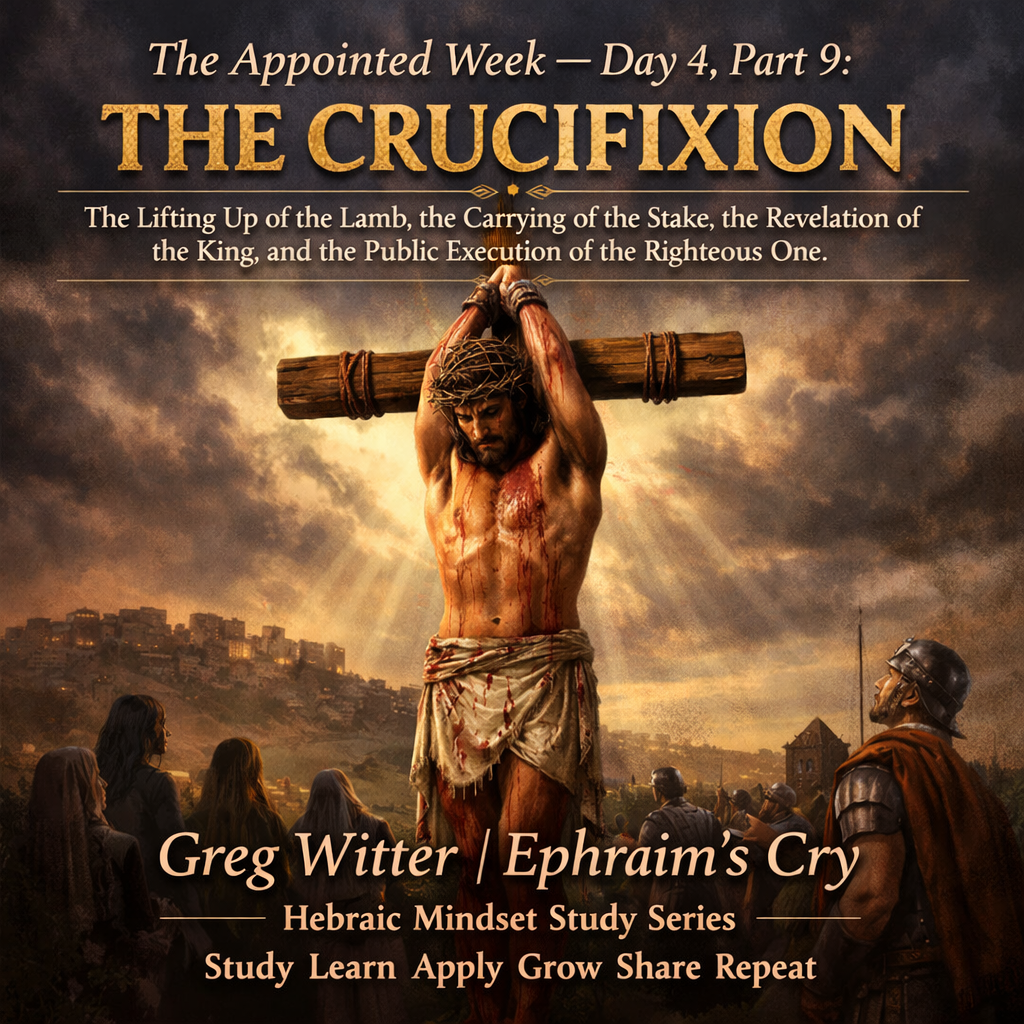
The Appointed Week — Day 4, Part 9: The Crucifixion
The Lifting Up of the Lamb, the Carrying of the Stake, the Revelation of the King, and the Public Execution of the Righteous One
What was rejected, mocked, scourged, and condemned is now lifted up for all to see—not as the defeat of the King, but as the appointed unveiling of the Lamb.
Greg Witter | Ephraim’s Cry
Hebraic Mindset Study Series
Study Learn Apply Grow Share Repeat
The crucifixion is not an isolated event. It is not merely the next thing that happened after the scourging. It is not just the most violent point in the story. It is the public unveiling of everything that has already been building. The Lamb has been selected. The Lamb has been examined. The Lamb has been found without blemish. The covenant meal has been declared. The Upper Room has exposed the hearts. Judas has departed into darkness. Gethsemane has pressed the will into full submission. The arrest has revealed the system. The trials have exposed false authority. The scourging and the mock coronation have shown what the world does to the true King when it cannot recognize Him. Now all of that converges in the place of lifting. Now the obedient Son is brought openly before the world and placed where all can see what fallen man does to truth, what covenant demands, and what redemption costs.
This must be stated immediately: the crucifixion is not simply execution. It is offering. It is not simply death by Roman power. It is the appointed public presentation of the Lamb. It is not simply humiliation. It is fulfillment. And because of that, this part must be handled with full covenant weight, full prophetic depth, and full textual care. Most people rush to the cross as a symbol. Scripture does not rush. Scripture layers. Scripture builds. Scripture connects Torah, the Prophets, the Writings, and the witness of 𐤉𐤄𐤔𐤅𐤏 Himself until this moment stands not as random brutality, but as the center of a pattern already spoken from the beginning.
The carrying of the stake belongs here, and it must not be minimized. John says, “And he bearing his stake went forth into a place called the place of a skull, which is called in Hebrew Golgotha,” John 19:17. That movement matters. He does not merely appear at the execution site. He goes forth bearing the instrument of His public death. The burden is visible. The weight is visible. The procession is visible. The world sees the condemned one carrying what He is about to be fixed upon. This is not merely logistical. It is revelatory. The one who bore the weight of the curse inwardly now bears the weight of the stake outwardly. The one who carried the covenant burden in Gethsemane now carries the visible emblem of Roman shame toward the place of execution. He does not only go to death. He goes bearing the appointed burden in full sight.
And yet the carrying is not merely about physical movement. It is about covenant movement. He is going forth. That language matters. The sacrifice is being brought out. The righteous one is being taken beyond the settled spaces of the city to the place where shame, blood, rejection, and public death converge. Hebrews later draws on this pattern explicitly when it says that Yahusha suffered outside the gate, Hebrews 13:11–13. That is not incidental. The sin offering pattern, the removal outside the camp, the place of uncleanness and reproach, all of that belongs here. He is not only being taken to a Roman execution site. He is moving into the place where reproach is borne, where the offering is displayed, where the righteous one is cast outside in order to carry what belongs to the unclean.
The Synoptic accounts also tell us that Simon of Cyrene was compelled to bear the stake after Him or for Him in the procession, Matthew 27:32, Mark 15:21, Luke 23:26. That detail matters too. It shows the sheer physical depletion produced by the scourging and abuse already endured. The body that has been torn, struck, mocked, and weakened is still moving toward the appointed place, but the burden becomes so heavy that another is compelled to carry it. That must not be softened. The crucifixion does not begin at the nails. It begins in the carrying. It begins in the procession. It begins in the visible humiliation of the bloodied King moving under the burden of the stake toward Golgotha. And Simon’s involvement also forms a shadow that the disciples and the remnant must recognize: “take up your stake and follow me” is no abstract metaphor when the Master Himself walks that road. Simon literally steps into the path of the condemned Messiah and bears the wood behind Him. That image must stay in the reader’s mind, because discipleship is never detached from that pattern of following through shame, weight, and public reproach.
Luke adds that as He went, there followed Him a great company of people, and of women, which also bewailed and lamented Him, Luke 23:27. That belongs here too. The procession is not silent. It is seen. It is mourned. It is observed by those broken by what they witness. And yet even while bearing the stake toward death, Yahusha turns and says, “Daughters of Jerusalem, weep not for me, but weep for yourselves, and for your children,” Luke 23:28. This must not be passed over. Even on the road to Golgotha, He is still teaching. He is still warning. He is still prophetically interpreting the moment. He will not allow grief to remain merely emotional. He directs it prophetically. He points forward to days of judgment, distress, and upheaval. “For if they do these things in a green tree, what shall be done in the dry?” Luke 23:31. That saying matters profoundly. If this is what corrupt systems do while the righteous one yet walks among them, what will happen when dryness, hardness, and fuller judgment come? This is not only commentary on that hour. It is prophetic warning. The road to the stake is already reaching into future judgment and the last-days pattern. The obedient one, rejected and condemned, becomes the measuring line for what men will later do to the remnant and what judgment will later do to the unrepentant.
And still deeper, the carrying of the stake exposes the contrast between human systems and covenant obedience. Rome means the carrying to be part of degradation. The kingdom means it as part of fulfillment. Fallen power means the procession as humiliation. 𐤉𐤄𐤅𐤄 means it as the visible path of the Lamb toward the place appointed. The same act carries two meanings depending on who is reading it. That is true throughout the whole crucifixion scene. Men think they are degrading Him. In reality, they are fulfilling what was written.
The place itself matters: Golgotha, the place of a skull, John 19:17, Matthew 27:33, Mark 15:22. Whether or not later traditions attach additional associations to the location, the text itself emphasizes the starkness of the place. This is not a hidden corner. This is a place of death. A place of public execution. A place meant to communicate shame, warning, and dominion by empire. Rome lifts men up in public to say, “This is what happens to those we condemn.” And yet here the very site intended to magnify Roman authority becomes the place where the authority of Rome is exposed as temporary, brutal, and blind. Golgotha becomes not the monument of Caesar’s triumph, but the place where the obedient Son is lifted up to fulfill Torah, Prophets, and Writings in full public view.
“And they crucified him,” Matthew 27:35, Mark 15:24, Luke 23:33, John 19:18. The plainness of that line in the Gospels is striking. Scripture does not sensationalize. It states. And in that plainness, the reader must supply all the weight Scripture has already built up. The nails. The piercing. The stretching of the body. The fixing of hands and feet. The public display. The lifted frame. The agony of suspended breathing. The slow draining of strength. The shame of exposure. The spectacle before watching eyes. All of that is contained in the simple declaration that they crucified Him. But the theological weight is even greater. This is not just pain. This is the righteous one being fixed in public as the one condemned under the systems of men while in truth bearing what belongs to others.
The lifting up must be brought out fully here. Yahusha Himself had already said, “And as Moses lifted up the serpent in the wilderness, even so must the Son of man be lifted up,” John 3:14. That statement is essential to Part 9. The crucifixion is not merely killing. It is lifting. It is public elevation. It is display. And the connection to Numbers 21 is not decorative. In the wilderness, Israel sinned. Fiery serpents came among the people. Death spread. The people cried out. 𐤉𐤄𐤅𐤄 instructed Moses to make a serpent of bronze and set it upon a pole, and whoever looked upon it lived, Numbers 21:4–9. That pattern must be read carefully. What was killing them became the symbol lifted before them. The judged thing was raised up visibly, and those who looked in faith lived.
Now bring that into the crucifixion. Sin is killing. Curse is killing. Judgment is deserved. Death is spreading through Adam’s line. And now the one who bears sin without becoming a sinner, the one who bears the curse without being accursed in His own conduct, is lifted up publicly. The place of death becomes the place of healing. The place of judgment becomes the place where life is opened. The one who is lifted up becomes the visible focus of faith. That is not accidental. John is not merely using a clever analogy. He is unveiling covenant logic. The Son of Man must be lifted up because the wilderness pattern was always pointing here. Israel looked and lived. Now the world must look and live. The one lifted up bears in Himself the burden of the judgment that belongs to others.
This also deepens the thorn-crown imagery from the previous part. In Numbers, the image of the thing associated with judgment is lifted up. In Part 8, the curse sign—the thorns—was pressed onto the King. Here in Part 9, the one crowned with the sign of the curse is lifted uppublicly. The curse-bearer is elevated before all. The judged one in the place of the guilty is displayed. The wilderness and the stake belong together. The serpent-on-the-pole pattern and the lifted-up Son belong together. The last Adam, bearing the curse-sign and lifted before the people, stands in direct covenant relation to the ancient wilderness remedy.
John 12 also belongs here: “And I, if I be lifted up from the earth, will draw all men unto me,” John 12:32. John then explains that He said this signifying what death He should die, John 12:33. The lifting is not only physical elevation; it is revelatory elevation. It is the point where the Son is publicly manifested in the very place the world thinks it has destroyed Him. It is also the point where the nations begin to be drawn, because the message will go out from this place of lifted sacrifice to all peoples. That is why the inscription matters too, and why John’s note that it was written in Hebrew, Greek, and Latin must not be missed, John 19:19–20. The execution is public. The kingship is declared publicly. The witness is multilingual. The whole world-order represented there—covenant people, Hellenistic culture, Roman power—is being addressed by what hangs before them.
He is crucified between two others, “and two others with him, on either side one, and Yahusha in the midst,” John 19:18, Luke 23:33. This too is covenantally loaded. Isaiah 53:12 says He was “numbered with the transgressors.” The innocent one is placed among the guilty. He is not aligned morally with them, but He is positioned among them. He stands in the midst as the righteous one surrounded by the condemned. This is substitutional placement in visible form. The righteous among the guilty. The innocent counted with transgressors. The one without blemish displayed in the company of the condemned. The scene itself preaches.
And above Him the charge is written: “This is Yahusha of Nazareth the King of the Yahudim,” Matthew 27:37, John 19:19. Again truth is proclaimed by men who do not believe it. The priests object, asking that it be changed to “He said, I am King of the Yahudim,” John 19:21. They do not want the declaration to stand. They want the claim softened into mere allegation. But Pilate answers, “What I have written I have written,” John 19:22. That line belongs here with great force. The same Pilate who failed to stand in truth still becomes the involuntary instrument by which truth is fixed above the lifted-up King. He would not defend the righteous one, but he cannot undo the written witness. The title stands above the crucified Messiah as a public declaration against the will of the priesthood. That is profound irony, and it is more than irony. It is providence. 𐤉𐤄𐤅𐤄 will have His testimony stand, even through compromised men.
This inscription must be drawn out further because it is not merely multilingual witness. It also forms part of the revealed-Name pattern. The Name of 𐤉𐤄𐤅𐤄 in Paleo-Hebrew carries pictographic force:
𐤉 — Yod, the hand or work
𐤄 — Heh, behold or reveal
𐤅 — Vav, the nail or connection
𐤄 — Heh, behold or reveal
Many have recognized in this sequence the pattern: “Behold the hand, behold the nail,” or more fully the revealed hand and the revealed nail. We must be careful not to force doctrine from pictographs alone, but we must also not ignore how strikingly the crucifixion presents pierced hands, visible wounding, and public revelation all at once.
And now the Name in the later square Hebrew script, vertically:
י
ה
ו
ה
When viewed in the visual logic already raised, the form can be contemplated as a man in vertical extension: the י as the head, the first ה as the separated arms, the ו as the body, and the final ה as the lower extension or legs. Again, this must be handled carefully, but the visual pattern is powerful in the context of crucifixion. A man lifted up, head above, arms extended, body central, lower body beneath—publicly revealed. In that sense, the vertical presentation of the Name becomes a striking contemplative witness alongside the crucifixion image itself. The lifted, pierced, revealed man becomes bound to the revealed Name, not in contradiction to covenant truth, but in visible harmony with it. The one hanging is not separate from the revelation of 𐤉𐤄𐤅𐤄’s saving work. He is the one in whom that saving work is being unveiled.
And when that is brought into the broader prophetic restoration theme—Ephraim and Judah, the divided house, the reunification promised in Ezekiel 37—the crucifixion stands at the center of the covenant work that makes that restoration possible. The inscription says King of the Yahudim, but the one lifted up is not the king of Judah alone. He is the one through whom the divided house is restored, the nations are addressed, and the covenant people are regathered. So while the crucifixion scene is not explicitly labeled in the text as the reunion of Ephraim and Judah, it is absolutely part of the covenant center that makes that restoration possible. The lifted King is the one who will rule over both sticks made one in His hand.
Then comes the dividing of garments. “Then the soldiers, when they had crucified him, took his garments, and made four parts… and also his coat… they said therefore among themselves, Let us not rend it, but cast lots for it,” John 19:23–24. This fulfills Psalm 22:18: “They part my garments among them, and cast lots upon my vesture.” This must be included here because it shows that even the smallest actions at the stake are already inside prophetic speech. Nothing is random. Not the inscription. Not the position between transgressors. Not the lifting. Not the garments. Even the gambling beneath the stake is already written. The soldiers treat His clothing like spoils. The righteous one is stripped, and His garments become the object of division and chance. Yet even this degradation serves prophecy. The scene is so fully governed by what was spoken before that even the details of clothing fall under the witness of Scripture.
At the stake, the crucifixion is not silent. It is not only pain. It is not only blood. It is not only the visible act of execution. It is also a place of words, and those words matter because they interpret the event while it is still unfolding. The lifted Lamb is still teaching. The King is still ordering. The Priest is still interceding. The Son is still revealing. That must not be missed. The world sees a dying man. Scripture reveals a speaking offering, an interceding High Priest, a ruling King, and an obedient Son bringing covenant realities into the open even while nailed to the stake.
The people present matter. John tells us that standing by the stake of Yahusha were His mother, His mother’s sister, Miriam the wife of Clopas, and Miriam Magdalene, John 19:25. That alone is important, because not everyone fled. Not everyone withdrew. There remained a remnant close enough to see, close enough to hear, close enough to remain at the place of greatest shame and suffering. This is not a small detail. The remnant often remains near where the world recoils. They do not necessarily understand everything, but they remain. They do not necessarily have strength to stop what is happening, but they remain. And in remaining, they become witnesses. That matters. The remnant is not absent from the place of lifting. The faithful are still there, even if in tears, even if in confusion, even if broken by what they see.
And His mother’s presence must be felt with full weight. This is not just another woman at the scene. This is the one who bore Him, carried Him, raised Him, and heard from the beginning that a sword would pierce through her own soul also, Luke 2:35. Now that word is being fulfilled before her eyes. The sword is not literal metal through her body, but the anguish of watching the righteous Son lifted up in shame and suffering before the world. She stands there as mother and as covenant witness. She stands there in grief and in prophecy. The crucifixion is not only about what is done to Him physically. It is also about what this moment costs those bound to Him in love.
Then comes one of the most tender and yet covenantally ordered conversations in the entire crucifixion scene: “Woman, behold thy son… Behold thy mother,” John 19:26–27. This is not random kindness. It is not merely sentiment in dying moments. It is order preserved under suffering. It is provision established under pressure. It is covenant faithfulness continuing even while the body is being emptied out. He does not cease to be Son because He is suffering. He does not abandon responsibility because the cross is heavy. He does not allow the pain of the moment to erase household order. In the midst of public humiliation, He still arranges care, relationship, and duty. That must be brought out strongly. The King remains ordered. The Son remains faithful. The covenant man remains obedient all the way through.
And John, the beloved disciple, receives that word and takes her unto his own home from that hour, John 19:27. That is not incidental either. The word spoken from the stake has effect. It establishes responsibility. It creates relational realignment. The words of the crucified one are not powerless dying words. They carry authority. They shape lives. They assign duty. Even in that moment, He is not merely enduring what men do. He is still governing what must be done among His own.
And then there is the crowd, the passersby, the rulers, the priests, the soldiers, and the criminals. The crucifixion becomes a place where all kinds of voices gather, and every voice reveals the heart behind it. Matthew says that those who passed by reviled Him, wagging their heads and saying, “Thou that destroyest the temple, and buildest it in three days, save thyself. If thou be the Son of Elohim, come down from the stake,” Matthew 27:39–40. This must be understood for what it is. They are not merely mocking pain. They are mocking truth they never understood. The same words they distorted in the trials they now weaponize in the execution. Truth rejected in the hearing becomes mockery in the public square. What they could not understand, they now use as a taunt.
The chief priests, scribes, and elders do the same. “He saved others; himself he cannot save,” Matthew 27:42. Again, this is one of the deepest inverted truths in the whole scene. He cannot save Himself precisely because He is saving others. He will not come down because the offering must remain. He will not escape because the pattern must be fulfilled. The Lamb remains on the altar. The obedient Son remains under the will of 𐤉𐤄𐤅𐤄. The mockers read obedience as weakness because they only understand power in fallen terms. They think power means escape. They think authority means force. They think kingship means self-preservation. But the true King reveals His rule through obedience, self-giving, and perfect alignment with the Father’s will.
And the rulers continue: “If he be the King of Israel, let him now come down from the stake, and we will believe him,” Matthew 27:42. But that statement is hollow. They would not believe. They have already rejected sign after sign, truth after truth, witness after witness. This is not an honest condition for faith. This is mockery speaking in the language of proof. Hardness of heart always asks for one more sign while rejecting the meaning of the signs already given. So the statement condemns them more than Him. It shows that unbelief can stand before the fullest revelation and still demand something else.
The soldiers also mock. Luke says they came and offered Him vinegar and said, “If thou be the King of the Yahudim, save thyself,” Luke 23:36–37. The same theme continues: come down, prove yourself, protect yourself. The world continually tempts the obedient to break obedience in order to satisfy unbelief. But He does not answer that temptation. He already answered it in Gethsemane. The will is already settled. The cup is already accepted. So the voices rise, but the obedience does not crack.
Then the two criminals speak. Luke’s account must be brought out more fully because this is not just a side conversation. One of the criminals reviles Him: “If thou be Messiah, save thyself and us,” Luke 23:39. That is the language of fallen man. Save yourself first. Prove yourself onour terms. Use power for immediate escape. But the other criminal rebukes him and says, in substance, do you not fear Elohim, seeing you are under the same condemnation, and we indeed justly, but this man hath done nothing amiss? Luke 23:40–41. That confession is enormous. A condemned man bears witness that the one beside him is innocent. The guilty identifies the righteous one as righteous. In the place of death, truth is still being confessed.
Then comes one of the most important conversations on the stake: “Master, remember me when thou comest into thy kingdom,” Luke 23:42. This statement must be felt. He sees kingdom in the midst of apparent defeat. He sees kingship in the middle of public humiliation. He sees beyond the nails, beyond the blood, beyond the mockery. He does not ask merely to be rescued from immediate pain. He asks to be remembered in the Kingdom. That is faith seeing through the visible catastrophe into the invisible reality. And the answer comes with royal authority: “Verily I say unto thee, Today shalt thou be with me in paradise,” Luke 23:43. This shows that He is not waiting to become King. He is King while crucified. He is not stripped of authority by suffering. He is exercising authority in the middle of it. That must be stated strongly. The King reigns even on the stake. The Priest mediates even on the stake. The Son speaks life even on the stake.
And then there is the first great intercessory word: “Father, forgive them; for they know not what they do,” Luke 23:34. This deserves fuller weight. This is priesthood in real time. This is mediation in the middle of torment. He is not only being offered; He is actively interceding. He is not merely the victim of injustice; He is the Priest speaking over those committing it. And the phrase “they know not what they do” does not mean the act is morally harmless. It means the blindness behind it is profound. They do not understand the fullness of who He is, what they are doing, and what Scripture they are fulfilling. This aligns with Torah categories of sin done in ignorance, even while not reducing the guilt of the act. He is naming blindness and covering ignorance at the same time. That belongs here because it reveals the stake as both judgment-bearing and priestly intercession.
Now the two drinks must be handled distinctly, because they are often blended together when they should not be. First, Matthew 27:34 says, “They gave him vinegar to drink mingled with gall,” and Mark 15:23 says, “They gave him to drink wine mingled with myrrh: but he received it not.” This earlier mixture had pain-dulling properties. Myrrh was known medicinally. Such mixtures could serve as a numbing or dulling drink. He tastes and refuses it. That matters greatly. The offering will not be anesthetized. The obedience will not be numbed. The suffering will be borne consciously. He will drink the cup given by the Father, John 18:11, but not the mixture offered by men to soften the edge of it.
Later, after knowing that all things were now accomplished, He says, “I thirst,” John 19:28. Then they put vinegar on a sponge and lift it to His mouth on hyssop, John 19:29. This is not the same as the earlier analgesic mixture. This later act fulfills Psalm 69:21: “in my thirst they gave me vinegar to drink.” And the hyssop is deeply significant. Hyssop is tied to Passover in Exodus 12:22, where the blood of the lamb was applied with hyssop to the doorposts. Now hyssop reappears at the crucifixion. The same plant associated with the application of blood in Egypt stands present as the Lamb reaches the final stage of the offering. That is not accidental. The Passover pattern is still alive in the smallest details.
Darkness comes over the land, Matthew 27:45, Mark 15:33, Luke 23:44. This belongs to the crucifixion scene itself because creation is bearing witness. This is not a normal death. Heaven and earth are drawn into the moment. The visible order darkens as the obedient one hangs beneath the accusations of men and the burden of sin. Creation responds to the gravity of the hour.
Then comes the cry: “My Elohi, my Elohi, why hast thou forsaken me?” Matthew 27:46, Mark 15:34. This must not be mishandled. This is Psalm 22 being spoken. This is not the collapse of covenant trust. It is the invocation of a Psalm that begins in anguish and moves through suffering, pierced hands and feet, parted garments, mockery, and ends in vindication, proclamation, and future generations hearing what 𐤉𐤄𐤅𐤄 has done. He is not speaking outside Scripture. He is speaking from within it, from the very Psalm that is unfolding around Him.
Then John records, “It is finished,” John 19:30. This is not “I am finished.” It is the completion of the appointed work. The offering has reached its intended end. The obedient path has been walked fully. The pattern has been fulfilled. The Lamb has not merely suffered. The Lamb has accomplished.
And Luke records, “Father, into thy hands I commend my spirit,” Luke 23:46. Even in death, the surrender is not to Rome, not to the crowd, not to the priests, not to the executioners. It is to the Father. Control has not been lost. The spirit is entrusted. The final movement remains in covenant alignment.
Now stepping back, the crucifixion stands at the intersection of realms. Heaven—the will of 𐤉𐤄𐤅𐤄 is being fulfilled. Earth—human systems are executing judgment. Under the earth—sin, death, curse, and the realm of corruption are being addressed. The mediator stands between. Lifted between heaven and earth. Publicly revealed. Bearing. Connecting. Fulfilling.
This also points forward prophetically. The world still mocks obedience. The world still crowns falsely. The world still rejects truth. The remnant must understand that what looks like defeat may be obedience at its highest level. The path of the King includes public misunderstanding, visible suffering, and apparent defeat that is actually covenant fulfillment. If the crucifixion is misunderstood, the life of covenant obedience will be misunderstood as well.
The crucifixion is public. Nothing is hidden. Passersby see. Rulers see. Soldiers see. The faithful remnant sees. The inscription stands. The languages speak. The mockery is heard. The witness is made plain.
The world saw.
And still did not understand.
This is the crucifixion. The carrying of the stake. The lifting of the Lamb. The fulfillment of the serpent pattern. The visible declaration of the King. The manifestation of the Name. The bearing of the curse. The public execution of the righteous one. The fulfillment of Scripture down to the garments and the drink. The division of hearts at the stake. The conversations of the Priest, the King, the Son. The completion of the work.
Not defeat.
Fulfillment.
#GregWitter #EphraimsCry #HebraicMindset #TheAppointedWeek #Day4 #Crucifixion #LiftedUp #PassoverLamb
#SerpentInTheWilderness #CarryTheStake #Psalm22 #Isaiah53 #𐤉𐤄𐤅𐤄 #𐤉𐤄𐤔𐤅𐤏
