
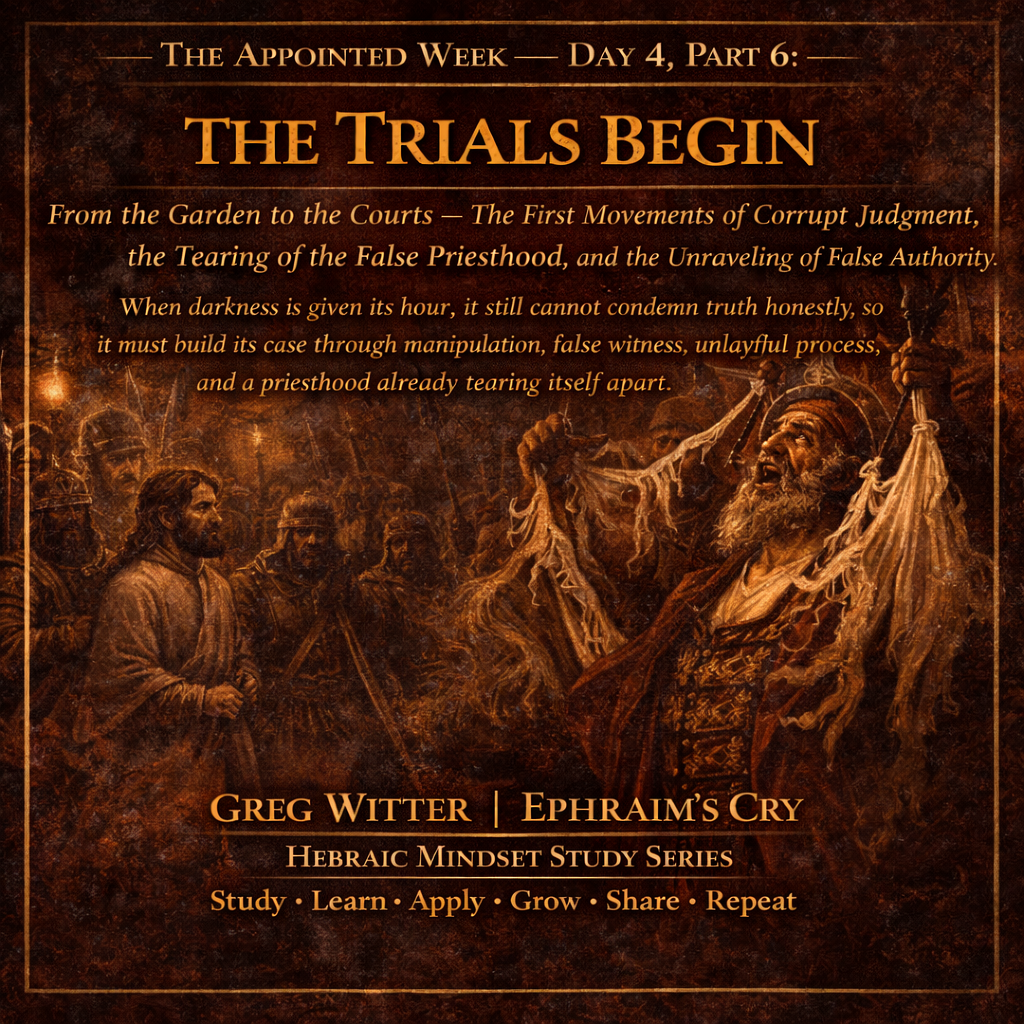
The Appointed Week — Day 4, Part 6: The Trials Begin
From the Garden to the Courts — The First Movements of Corrupt Judgment, the Tearing of the False Priesthood, and the Unraveling of False Authority
When darkness is given its hour, it still cannot condemn truth honestly, so it must build its case through manipulation, false witness, unlawful process, and a priesthood already tearing itself apart.
Greg Witter | Ephraim’s Cry
Hebraic Mindset Study Series
Study Learn Apply Grow Share Repeat
The arrest is not the end of the movement. It is the transfer into the next appointed phase. The garden gives way to the courts. The surrender of the obedient Son gives way to the accusation of corrupted authority. The prayer of Gethsemane gives way to the procedure of darkness trying to justify what darkness has already chosen to do. That is what these trials are. They are not honest examinations. They are not lawful searches for truth. They are not careful efforts to discern whether 𐤉𐤄𐤔𐤅𐤏 (Yahusha) has actually done evil. They are the machinery of a threatened system trying to wrap predetermined murder in the language of legality, religion, and public order. If that is not understood at the beginning, then everything that follows in this part will be misread. These are not trials in the true sense. These are staged proceedings designed to create the appearance of justice while carrying out the will of men already aligned against the truth.
This matters because Scripture does not merely show us that the righteous can be hated. It shows us how they are hated. They are not always attacked openly at first. They are often pulled into process. They are moved into hearings, interrogations, councils, tribunals, accusations, false witnesses, manipulated procedure, and manufactured verdicts. Darkness prefers process when process can be weaponized. It prefers the language of order when order can be bent. It prefers institutional cover when open lawlessness would expose too much too quickly. That is why the movement from the garden to the court matters so much. The arrest itself reveals force. The trials reveal method. The arrest shows that the system is willing to seize. The trials show how the system justifies the seizure. This is one reason why the remnant must pay close attention here, because what is revealed is not merely what happened to the Messiah in that hour, but how false authority behaves when confronted by truth it cannot control.
This is also why the seven-trial structure matters. This is not one simple hearing. This is not one accidental confrontation. This is the beginning of a sequence. In the full reconstruction of Day 4, there are seven trial movements that unfold as religious and civil powers each take their turn handling, rejecting, mocking, and condemning the truthful one. Annas. Caiaphas and the night council. The formal morning council. Pilate. Herod. Pilate again. And the final public handing over. That sequence matters because it shows that every layer of corrupted authority must expose itself in relation to 𐤉𐤄𐤔𐤅𐤏. Religious authority fails. Temple authority fails. Political authority fails. Crowd pressure fails. The whole visible order is being tested by truth, and every corrupt layer breaks against it. This is not only about one man being judged. It is about a whole order being revealed.
John tells us that after the arrest, 𐤉𐤄𐤔𐤅𐤏 was led first to Annas, for he was father-in-law to Caiaphas, who was high priest that year, and John reminds us that Caiaphas was the one who had already said it was expedient that one man should die for the people, John 18:13–14. That reminder is devastating, because it tells you that the verdict already existed before the hearing. The conclusion preceded the process. The sentence was already living in the heart of the system before the witnesses were gathered. That means everything now unfolding is not discovery but justification. They are not trying to determine whether He deserves death. They are trying to construct a path by which the death they already desire can be made to look righteous.
That alone exposes a principle the remnant must understand. Corrupt systems begin with outcome and then manufacture process. They do not begin with truth and allow truth to lead them where it will. Once preservation of institution becomes more important than submission to 𐤉𐤄𐤅𐤄, the system is already in rebellion even if it still wears sacred garments and speaks sacred language. That is exactly what is happening here. A priesthood that should have trembled before truth is instead conspiring to preserve itself against truth. A council that should have examined according to Torah is instead searching for false witness. An office that should have mediated rightly is now being used as cover for judicial corruption.
When Annas questions 𐤉𐤄𐤔𐤅𐤏 about His disciples and His doctrine, John 18:19, the issue is not merely curiosity. Corrupt authority fears not only the speaker but the spread of the speaker. It fears disciples. It fears transmission. It fears influence. It fears continuity. It asks not only what was said, but who is now shaped by what was said. That is still true in every age. Systems threatened by covenant truth do not merely attack the message; they map the people carrying it. They want the doctrine and the disciples. They want the teaching and the network. They want the source and the spread.
And 𐤉𐤄𐤔𐤅𐤏 answers with devastating simplicity: He has spoken openly to the world, taught in synagogue and temple, and said nothing in secret, John 18:20. That answer tears the mask off the proceeding. If His words were public, why the night arrest? If His teaching was open, why the hidden transfer? If the people heard Him daily, why the urgency of seizure instead of public examination? The answer is plain: they are not looking for truth. They are managing threat. That is the pattern. When systems already know the truth but reject it, they stop asking honest questions and begin creating strategic proceedings.
Then He says, in essence, ask those who heard Him. Let witnesses speak, John 18:21. That is lawful language. That is Torah-grounded language. That is the language of proper testimony. And it is exactly that lawful clarity which provokes violence. One of the officers strikes Him, John 18:22. Violence enters because truth is not cooperating with fraud. That slap is not a stray detail. It is the beginning of the stripping away of restraint. False systems often move from procedure to abuse very quickly once procedure fails to dominate truth. And 𐤉𐤄𐤔𐤅𐤏 answers, “If I have spoken evil, bear witness of the evil: but if well, why smitest thou me?” John 18:23. Again, He forces the matter back to truth, back to evidence, back to lawfulness. Corrupt systems hate that because they want atmosphere, not truth; intimidation, not witness; outcome, not justice.
From there the movement goes to Caiaphas and the council, Matthew 26:57. And here the matter becomes even clearer, because Scripture states it without ambiguity: “The chief priests, and elders, and all the council, sought false witness against Yahusha, to put him to death,” Matthew 26:59. They sought false witness. Not truth. Not clarification. Not righteous testimony. False witness. That is the whole hearing in one line. The process is exposed before it proceeds. This is not justice malfunctioning. This is justice being intentionally replaced. And yet even falsehood struggles to hold. Mark says many bore false witness, but their witness did not agree, Mark 14:56. That is what happens when truth is absent from the foundation. Lies fracture. Contradictions multiply. Coherence breaks down. But notice: the lack of agreement does not stop the system, because once truth is no longer the goal, coherence no longer matters as it should.
Eventually two come forward concerning the temple statement, Matthew 26:61. Even here the words are twisted. What 𐤉𐤄𐤔𐤅𐤏 spoke concerning the temple of His body is now turned into something accusatory. This too is part of the pattern. Truth is not only denied. It is reframed. It is taken out of covenant meaning, stripped from its true referent, and then reintroduced as evidence of danger. That is how hostile systems work. They do not need honest understanding. They need usable distortion.
And still 𐤉𐤄𐤔𐤅𐤏 answers nothing. He holds His peace, Matthew 26:63. That silence is not emptiness. It is prophetic alignment. Isaiah 53:7 is alive in the room. He is not silent because He lacks defense. He is silent because the process is not rooted in truth. There are moments when silence is not surrender to corrupt men, but submission to the will of the Father in the face of corrupt men. Silence here is one more witness against the hearing. It shows that He is not trapped by their categories or their manipulation.
Then Caiaphas presses directly: “I adjure thee by the living Elohim, that thou tell us whether thou be the Messiah, the Son of Elohim,” Matthew 26:63. Now the issue is exposed fully. The temple statement, the witnesses, the formalities—all of that was scaffolding. The core issue has always been identity. Who are You? By what authority do You stand? Are You who You have revealed Yourself to be? And when 𐤉𐤄𐤔𐤅𐤏 answers, He does not merely concede the question. He declares the future vindication of His authority: they will see the Son of Man sitting at the right hand of power and coming in the clouds of heaven, Matthew 26:64. That answer is not defensive. It is judicial. The one they are condemning names Himself in the very categories of Danielic authority and enthronement. The true Judge stands before false judges and tells them they will yet see His vindication.
And then comes the point you rightly said must be brought out strongly: Caiaphas tears his garments, Matthew 26:65. This is not a throwaway reaction. This is not merely emotional outrage. This is not just dramatic high-priestly theater. It is sign, rupture, exposure, and prophetic fracture all at once. The high priest tears his garments at the very moment the true High Priest stands before him. The earthly priesthood, already corrupted in function, now visibly tears itself in the presence of the one in whom the true priesthood stands whole.
That moment must be seen covenantally. The office has already been compromised. The council has already sought false witness. The hearing has already become fraudulent. But now the priesthood itself performs a visible sign of its own disorder. The garments tear. The outward representation of priestly office is rent at the moment when the office is misused to condemn the truthful Son. This is not a holy act. It is an exposure of rupture. The human priesthood in its corrupted form is tearing under the weight of the truth it cannot receive.
And yes, this points directly toward Hebrews. The tearing of Caiaphas’s garments belongs in the larger covenant transition. The Levitical and earthly priesthood, already shown in this moment to be compromised, temporary, and unable to receive the one who fulfills its own shadows, stands in contrast to the indestructible priesthood of 𐤉𐤄𐤔𐤅𐤏 after the order of Melchizedek. Hebrews does not arise in a vacuum. Hebrews is explaining what these scenes reveal. A priesthood that can be corrupted, manipulated, politicized, and turned against truth is not the final priesthood. A priesthood that must be replaced from generation to generation because death prevents continuance is not the final priesthood. A priesthood that can sit in judgment against the Son and misuse sacred office to condemn the truthful one has exposed its inadequacy fully.
Hebrews says that the former commandment is set aside because of its weakness and unprofitableness in bringing perfection, Hebrews 7:18–19. It says that 𐤉𐤄𐤔𐤅𐤏 has become priest not according to the law of a fleshly commandment, but according to the power of an endless life, Hebrews 7:16. It says that because He continues forever, He holds His priesthood permanently, Hebrews 7:24. It says He is holy, harmless, undefiled, separate from sinners, and higher than the heavens, Hebrews 7:26. All of that belongs here. Caiaphas tearing his garments is not just the rage of a man. It is the visible fracture of a priestly order that cannot bear the presence of the one who fulfills and surpasses it. The earthly office rends itself before the heavenly priesthood standing embodied in 𐤉𐤄𐤔𐤅𐤏.
This is why this must be preached powerfully. The tearing is not restoration in itself. It is exposure making restoration necessary. It is the false priesthood showing itself unable to carry the true burden of mediation. It is the human order breaking where the true order stands whole. It is the old, corruptly administered structure visibly fracturing in the presence of the one who will become the mediator of a better covenant, enacted on better promises, Hebrews 8:6. Caiaphas tears. Yahusha remains whole. Caiaphas rages. Yahusha declares. Caiaphas rends the garment. Yahusha embodies the unbroken priesthood.
And this is prophetic for the last days as well. You are right. These are the last days of Messiah’s earthly ministry, but they are also a picture of what is to come in the last days more broadly. Corrupt priesthood. Corrupt spiritual leadership. Corrupt systems wearing sacred language but opposing covenant truth. Garments intact outwardly until truth is spoken, and then the tearing begins. Offices remain, titles remain, structures remain, but inwardly they are already ruptured. When the truthful one speaks, the false order reacts violently and tears itself rather than repent. That is exactly the last-days pattern. Institutions claiming to mediate for Elohim while rejecting those who walk in His commandments and the testimony of His Messiah. Outward religious structure. Inward rebellion. Sacred appearance. False judgment. And when truth comes too near, the system tears.
Then Caiaphas names the answer blasphemy. But it is not blasphemy. It is truth. Still, this is another recurring pattern. Corrupt systems relabel truth as offense. They call revelation blasphemy. They call obedience rebellion. They call covenant faithfulness danger. They do this not because the truthful thing is false, but because they must rename it before they can justify attacking it. That is what false authority always does. It redefines in order to condemn.
Once the verdict is declared—“He is guilty of death,” Matthew 26:66—restraint vanishes quickly. They spit in His face. They buffet Him. Others strike Him and mock Him, Matthew 26:67–68. That movement from hearing to humiliation is not accidental. Once truth has been officially recast as blasphemy, the conscience of the wicked is loosened. They feel authorized to abuse what they have already condemned. That is another last-days picture as well. Once systems relabel truth successfully, persecution becomes easier, mockery becomes easier, and cruelty feels justified to those administering it.
And while this is happening inside, Peter is outside. That contrast remains essential. The trials do not only reveal the corruption of the system. They reveal the condition of the disciple. Peter is questioned and denies. Again and again. Until the rooster crows. This must still be tied back to Gethsemane. Public collapse grows out of private unreadiness. The one who could not watch cannot stand. The one who reacted with the sword cannot endure in the courtyard. This is not to destroy Peter, but to expose the process by which even sincere men fail when they are not yet fully formed in vigilance and obedience. And the look from 𐤉𐤄𐤔𐤅𐤏 to Peter, Luke 22:61, seals that exposure with mercy-filled truth. Peter’s tears show the difference between weakness and treachery. Judas hardens into darkness. Peter breaks into repentance.
This too speaks to the remnant. There will be betrayers. There will be deniers. There will be false systems. There will be misused process. There will be false witness. There will be labels of blasphemy and rebellion thrown at the truthful. There will be tears of failing disciples and hardened betrayal from compromised insiders. There will be a tearing of false spiritual structures under the weight of truth. And there will be the ongoing necessity of understanding that the true priesthood does not reside in corrupted human office, but in 𐤉𐤄𐤔𐤅𐤏, who alone remains the unbroken High Priest forever.
So has this now been strengthened? It needed to be. Because the tearing of the high priest’s garments is not decorative. It is one of the great signs in the trial sequence. It shows rupture. It shows exposure. It shows the earthly priesthood, corrupted in its final form, unable to receive the truthful Son. And by contrast, it pushes the reader toward the reality Hebrews later unfolds: the better priesthood, the unbroken priesthood, the Melchizedek priesthood, the true mediator, the one who does not tear, does not fail, does not die out, does not corrupt, does not need replacement, and does not sit in false judgment. He stands as Priest forever.
The trials begin, then, not merely as legal proceedings, but as a complete unveiling. They unveil corrupt authority. They unveil false witness. They unveil the instability of lies. They unveil the silence of the righteous one. They unveil the rage of a tearing priesthood. They unveil the need for a better priesthood. They unveil the weakness of the disciple. They unveil the prophetic pattern of the last days. And they unveil the growing distinction between what is false, temporal, and collapsing—and what is true, eternal, and unbroken in 𐤉𐤄𐤔𐤅𐤏.
This is not filler between the arrest and crucifixion.
This is the beginning of the sevenfold judicial assault on truth, and the visible tearing of the corrupted earthly order in the presence of the true High Priest.
And it must be read with that weight.
#GregWitter #EphraimsCry #HebraicMindset #TheAppointedWeek #Day4 #TrialsBegin #SevenTrials #TornPriesthood
#MelchizedekPriesthood #Hebrews #FalseWitness #CorruptAuthority #PeterDenial #LastDaysPattern
#TorahAndTestimony #𐤉𐤄𐤔𐤅𐤏 #𐤉𐤄𐤅𐤄
