
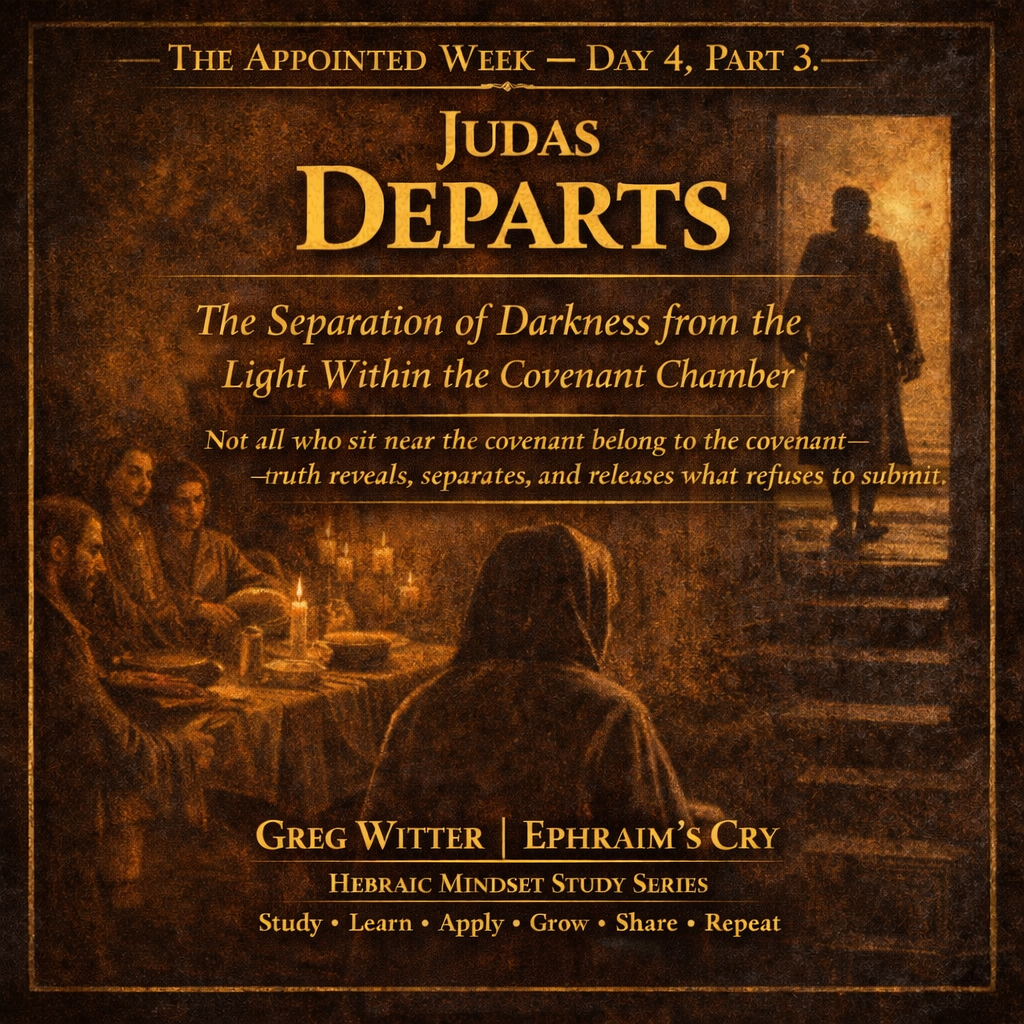
The Appointed Week — Day 4, Part 3: Judas Departs
The Separation of Darkness from the Light Within the Covenant Chamber and the Exposure of False Covenant Alignment
Not all who sit near the covenant belong to the covenant; truth reveals, separates, and releases what refuses to submit.
Greg Witter | Ephraim’s Cry
Hebraic Mindset Study Series
Study Learn Apply Grow Share Repeat
Judas leaving the room is not a side detail. It is not narrative housekeeping. It is not a small movement inserted between the meal and the garden so the story can proceed. Judas departing is one of the great fracture points of Day 4. It is the moment where hidden rebellion stops pretending to belong. It is the moment where proximity to 𐤉𐤄𐤔𐤅𐤏 (Yahusha) is exposed as something less than covenant faithfulness. It is the moment where darkness, having sat in the room long enough to hear the truth, finally rises and walks out to do what it had already chosen to do. If this moment is mishandled, then the arrest will be mishandled, the kiss will be mishandled, the trials will be mishandled, and the entire movement of the night will be flattened into bare events instead of read as covenant revelation. Judas does not merely leave a room. Darkness separates itself from the light after being exposed by the light.
That is why this teaching must begin where the text begins: with the reality that Judas was not outside the covenant chamber looking in. He was inside. He was present in the room. He was near the table. He heard the words. He saw the basin. He watched the washing. He received the bread. He sat close enough to the truth to be directly exposed by it. And that is precisely what makes this moment so severe. Betrayal is not coming from a Roman soldier who never heard the teaching. It is not coming first from a priest who never walked the dusty roads with Him. It is coming from one who traveled with Him, heard Him, saw the works, handled the money, and moved among the disciples as though he were one of them. That alone destroys the shallow assumption that outward association with truth equals inward submission to truth. It does not. A man may live near the covenant and still refuse the covenant in his heart.
The room has already established this pattern. The Upper Room is not merely a chamber of comfort; it is a chamber of exposure. The covenant meal has been declared. The bread has been identified. The cup has been named. The feet have been washed. The argument over greatness has exposed the weakness of the others. Peter’s boldness is already shown to be unstable. The room has already begun revealing men for what they are. But Judas represents something different from weakness. Peter is weak and will be restored. The others are confused and will be gathered again. Judas has moved beyond weakness into treachery. Weakness trembles under pressure. Betrayal makes peace with darkness before the pressure comes. Weakness can be broken and healed. Betrayal protects itself, calculates, conceals, and then acts when it believes the time is right. That is why Judas must be handled distinctly. He is not simply a frightened disciple. He is a divided man who has chosen another allegiance while still outwardly remaining near 𐤉𐤄𐤔𐤅𐤏.
Scripture does not leave us guessing about the beginnings of that fracture. John tells us plainly that Judas was a thief and had charge of the money bag and used to take what was put into it (John 12:4–6). That matters because it shows that the betrayal in the garden did not begin in the garden. It began in hidden compromise. It began in private lawlessness. It began in secret theft. Long before Judas kissed 𐤉𐤄𐤔𐤅𐤏, Judas had already made peace with violating trust. Long before he led armed men into the garden, he had already allowed greed to sit in his heart unchallenged. Long before he handed over the Master for silver, he had already been serving silver in smaller ways. This is how darkness works. It rarely announces its full form at the beginning. It seeks tolerated places. Small theft. Private compromise. Quiet resentment. Hidden disagreement. Secret offense. Divided loyalty. A man does not usually wake up and immediately commit the final act. He feeds the hidden thing until the hidden thing becomes the governing thing. Judas is the proof of that pattern.
This is one reason why the account in John 12 is so important. When Miriam pours costly ointment on 𐤉𐤄𐤔𐤅𐤏 and Judas objects, his objection sounds almost righteous on the surface. Why was this not sold and given to the poor? It sounds pious. It sounds responsible. It sounds like stewardship. But John tears the mask off. He said this not because he cared for the poor, but because he was a thief (John 12:5–6). That is exactly how false alignment often presents itself. It borrows righteous language to hide unrighteous motives. It speaks as though it is protecting principle while actually serving self-interest. Judas is not merely greedy. He is deceptive. He knows how to speak within the language of righteousness while being governed by another spirit altogether. That belongs in this teaching because Judas departing is not only the movement of a man into darkness; it is the unveiling of hypocrisy within covenant space. He has been near truth, but he has not loved truth. He has used proximity to truth while resisting the authority of truth.
And there is something else that must be faced if this teaching is going to be full. Judas did not only love money. He also refused the form of Messiah that stood before him. Many want Judas to be explained by greed alone, but the text suggests something deeper as well. He stayed near 𐤉𐤄𐤔𐤅𐤏 long enough to see what kind of kingdom He was actually bringing. He heard the teachings on humility, service, suffering, losing life to save it, loving enemies, taking the lowest place, and laying down life. He saw a Master who would wash feet rather than seize earthly power. He saw a King who rode humbly rather than took up the sword. He saw 𐤉𐤄𐤔𐤅𐤏 move toward sacrifice when many expected visible over throw. And Judas did not submit to that path. Whether he wanted money, control, force, influence, or some version of messianic action on his own terms, the plain fact is that he would not yield to the Messiah who actually stood before him. He stayed near Him without surrendering to Him. That is a terrifying category. A man can admire power, want outcomes, expect a kingdom, and even remain in the circle of disciples, yet still reject the actual nature of the King if that King refuses to serve his fleshly expectations.
This is why John 6 also matters. 𐤉𐤄𐤔𐤅𐤏 had already said long before Day 4, “Did I not choose you twelve, and one of you is a devil?” and John tells us He was speaking of Judas (John 6:70–71). That means Judas’s condition was not born in the room that night. The fracture had long been there. The room does not create it; the room exposes it. Truth does not manufacture darkness. It reveals darkness. The presence of 𐤉𐤄𐤔𐤅𐤏 does not turn Judas evil. It unmasks the evil Judas has chosen not to forsake. That is why the Upper Room and Judas’s departure belong so tightly together. In the room, truth is spoken so clearly, so directly, so searchingly, that what refuses truth can no longer stay hidden under the appearance of fellowship. The room is therefore the place where mixture becomes impossible.
When 𐤉𐤄𐤔𐤅𐤏 says, “One of you shall betray me” (John 13:21; Matthew 26:21; Mark 14:18; Luke 22:21), He is not merely forecasting. He is exposing. The statement does not create the betrayal; it draws it into the light. The disciples begin to question, to search, to wonder. That too matters. The righteous response to exposure is self-examination. “Master, is it I?” is a far better response than self-assured blindness. But Judas’s problem is not that he has questions. His problem is that he has already made arrangements in his heart. The others are weak, confused, unstable, and still open to being corrected. Judas is already set. He is already moving toward darkness, and the room is simply pulling back the cover.
Then Psalm 41:9 comes into focus: “Yea, mine own familiar friend, in whom I trusted, which did eat of my bread, hath lifted up his heel against me.” This is not an ornamental quotation. It is covenantal. Shared bread is not casual in Scripture. To eat together is fellowship. To share the table is participation. Bread signifies nearness, life, provision, and relational bond. That is what makes the betrayal so perverse. Judas does not betray from a distance. He betrays from the table. He lifts his heel against the very one whose bread he has received. That is not just prophecy fulfilled; that is the exposure of covenant treachery in its ugliest form. The closer the fellowship appears, the sharper the betrayal when the heart is false.
And then comes the dipped morsel. 𐤉𐤄𐤔𐤅𐤏 identifies Judas by dipping and giving him the morsel (John 13:26). This act must not be treated as incidental. In the very space where the covenant meal is being declared and interpreted, Judas is singled out by the Lord Himself. Truth makes the hidden visible. The room is narrowing. The exposure is focusing. There is now no excuse for pretending the issue is still vague or distant. And then John records one of the most severe lines in all of Scripture: “And after the sop Satan entered into him” (John 13:27). That is not poetic language. It is not metaphorical shorthand. It is the culmination of prior alignment. Satan does not step into an empty room. Judas has already been making room. Hidden theft. Secret offense. Unsubmitted desire. Divided loyalty. Refusal of the Messiah as He truly is. All of that has been preparing the place. Now what has been internally cultivated becomes fully activated.
That means Judas’s choice of darkness is not random, and it is not merely imposed from outside. He chooses darkness because he has been agreeing with darkness. He chooses disobedience because disobedience has been operating in him before the final act. He chooses betrayal because he has already tolerated what makes betrayal possible. This is why lawlessness matters so much. Lawlessness is not merely breaking a command here or there. It is living without submitting the heart to the rule of 𐤉𐤄𐤅𐤄 (Yahuah). It is wanting benefit without covenant government. It is wanting nearness without obedience. It is wanting the appearance of belonging without the actual surrender that belonging requires. Judas is a living warning that outward ministry presence does not conquer inward lawlessness. A man may function in the circle and still remain inwardly lawless.
This is exactly where Matthew 7 belongs. “Many will say to me in that day, ‘Master, Master, have we not prophesied in your name? and in your name have cast out devils? and in your name done many wonderful works?’ And then will I profess unto them, ‘I never knew you: depart from me, ye that work lawlessness’” (Matthew 7:22–23). Yes, it belongs here. It belongs here directly and forcefully. Judas is a concrete narrative picture of that very principle. A man can operate in visible proximity to the works of the Kingdom and still not be known in covenant truth. He can be close to power, close to teaching, close to holy things, and yet remain a worker of lawlessness. He can say the right words, move in the right company, and outwardly look the part, yet still not belong. Judas is not merely one bad disciple in a set of otherwise clean categories. Judas is the warning that false alignment can exist right next to true discipleship for a time, but when truth fully exposes, lawlessness is told to depart.
And notice the language in both scenes. In the room, Judas departs into the night. In Matthew 7, the lawless are told to depart from the presence of the Messiah. The connection is not accidental in principle. What refuses submission cannot remain in the light indefinitely. Truth eventually forces separation. That is why Judas departing is not only about one man’s historical choice. It is about the nature of covenant truth. Light does not endlessly coexist with darkness in a state of comfortable confusion. It exposes, divides, and separates. The room becomes the place where that separation begins visibly. Judas goes out. The lawless depart. What does not belong to the covenant chamber eventually leaves the covenant chamber, whether by being exposed now or by being rejected then.
That is why 𐤉𐤄𐤔𐤅𐤏’s words to Judas, “That thou doest, do quickly,” must be read with care (John 13:27). This is not approval. It is not cooperation with evil. It is the release of an exposed traitor into the path he has chosen. The room has done its work. The false has been revealed. There is no more benefit in pretending. Once exposure is complete, separation proceeds. This belongs in the covenant sequence of Day 4. The meal declares. The room exposes. Judas departs. Then the garden receives him again, not as disciple but as betrayer. The order matters because darkness is not allowed to remain concealed at the table once truth has named it.
And John’s statement, “and it was night,” must be allowed to carry its full weight (John 13:30). It is, of course, historically night. But John is far too deliberate a writer for that to be only a clock reading. Night is the fitting realm for what Judas has chosen. Earlier in John’s Gospel, light and darkness have already been major themes. Men loved darkness rather than light because their deeds were evil (John 3:19). Whoever walks in darkness does not know where he goes (John 12:35). Judas stepping into the night is therefore a theological action. He is leaving the unveiled presence of the Light of the world and moving into the realm that matches his heart. This is why the text feels so heavy. The man who sat in the room of truth now exits into the domain that corresponds to his inward choice. Darkness is no longer merely tolerated internally; it now manifests externally.
But this teaching is not complete if Judas is treated only as a villain and not as a warning. Judas is a warning to those who want the benefits of association without the cost of obedience. Judas is a warning to those who can speak pious language while secretly serving appetite. Judas is a warning to those who outwardly travel with truth while inwardly negotiating with darkness. Judas is a warning to those who think function equals faithfulness. Judas is a warning to those who believe nearness to holy things automatically means a clean heart. Judas is a warning to anyone who would rather preserve hidden compromise than come fully into the light. The room exposes him precisely so that the reader will fear the category he represents.
This is why his remorse later cannot be confused with true repentance. Matthew records that Judas, seeing that 𐤉𐤄𐤔𐤅𐤏 was condemned, repented himself in the sense of regret and brought back the thirty pieces of silver, saying, “I have sinned in that I have betrayed innocent blood” (Matthew 27:3–5). But regret is not the same as repentance unto life. Regret feels the terror of consequence. Repentance returns to 𐤉𐤄𐤅𐤄 in submission and truth. Judas feels horror, but he does not return rightly. He throws down the silver and goes to destruction. That belongs inthis teaching because it shows that being overwhelmed after exposure is not the same thing as true turning. Esau sought the blessing with tears, yet the issue was deeper than tears. Judas feels the ruin, but he does not enter restoration. Peter will weep bitterly and be restored. Judas will feel regret and go out to death. Again, weakness and betrayal are not the same category.
There is another layer that belongs here as well. In the room, Judas leaves so that what remains may be addressed more directly. Once he is gone, 𐤉𐤄𐤔𐤅𐤏 continues speaking to His own in a more intimate and unveiled way. That too is instructive. False presence in covenant space hinders clarity. Mixture clouds the atmosphere. When darkness departs, the room sharpens. The command to love one another, the promises concerning the Spirit, the vine and branches teaching, the warnings, the prayer—all of that continues with Judas gone. That does not mean the others are perfected. It means the false has been separated from the inner circle’s next stage of instruction. In other words, truth not only exposes and separates; it also preserves and clarifies for those who remain.
And still the most searching question remains: why did Judas choose darkness? He chose darkness because he would not submit his loves. He chose darkness because he allowed greed, self-interest, and hidden lawlessness to grow unchecked. He chose darkness because he preferred his own interior agenda to the Messiah standing before him. He chose darkness because he wanted nearness without surrender. He chose darkness because he would not let the light judge him and cleanse him. He chose darkness because once truth exposed him, he did not bow under the exposure—he proceeded in the path he had already chosen. He chose darkness because darkness matched what he had become.
That is why this teaching must be fierce in its warning. No one simply trips into Judas’s final act in one moment. Men arrive there by feeding private compromise, defending disobedience, speaking righteous language over unrighteous motives, remaining near truth while resisting its rule, and refusing to let the light fully cleanse what it exposes. Judas is the final picture of what happens when a man lives in covenant atmosphere while refusing covenant submission. He becomes proof that the issue is never mere outward nearness. The issue is whether 𐤉𐤄𐤔𐤅𐤏truly knows the man as His own, and whether the man truly belongs in obedient covenant fidelity.
So Judas departs, and the night begins moving toward the garden. But the garden is not the beginning. The kiss is not the beginning. The arrest is not the beginning. The beginning of the visible betrayal is in the room where truth exposes it. That is the structure of Day 4. First the covenant meal. Then the covenant chamber. Then the departure of darkness from the presence of truth. Then the darkness returns armed with men and weapons to do openly what it has already chosen privately.
This is why the phrase must be allowed to stand with its full theological weight: Judas departing is not just a man leaving a room. It is darkness separating itself from the light after being judged by the light. It is false covenant identity being exposed. It is lawlessness leaving holy space to manifest itself fully. It is the principle of Matthew 7 appearing in narrative form before the cross: near, active, associated, outwardly involved, and yet never truly known in covenant truth. It is the warning that not everyone who says “Master, Master” belongs. Not everyone who handles holy things is holy. Not everyone in the room is in the covenant.
The room has spoken. The light has exposed. The betrayer has departed. The night will now do what the room has already revealed.
And that is Judas departing.
Not simply a movement of feet out of a doorway, but the unveiling of what happens when hidden lawlessness refuses the cleansing power of truth. Not simply a narrative transition, but the separation of darkness from light in the very place where the covenant is being declared. Not simply one man’s failure, but a permanent warning to all who would confuse proximity with obedience, function with faithfulness, and outward religion with true covenant submission.
Before the betrayal was acted out, it was exposed. Before darkness moved in the garden, it was judged in the room. Before the kiss was given, the heart had already chosen night. And when truth revealed what Judas was, Judas did what darkness always does when it refuses to repent:
he departed.
#GregWitter #EphraimsCry #HebraicMindset #TheAppointedWeek #Day4 #JudasDeparts #CovenantExposure
#LightAndDarkness #LawlessnessExposed #TorahAndTestimony #BetrayalRevealed #𐤉𐤄𐤔𐤅𐤏 #𐤉𐤄𐤅𐤄
