
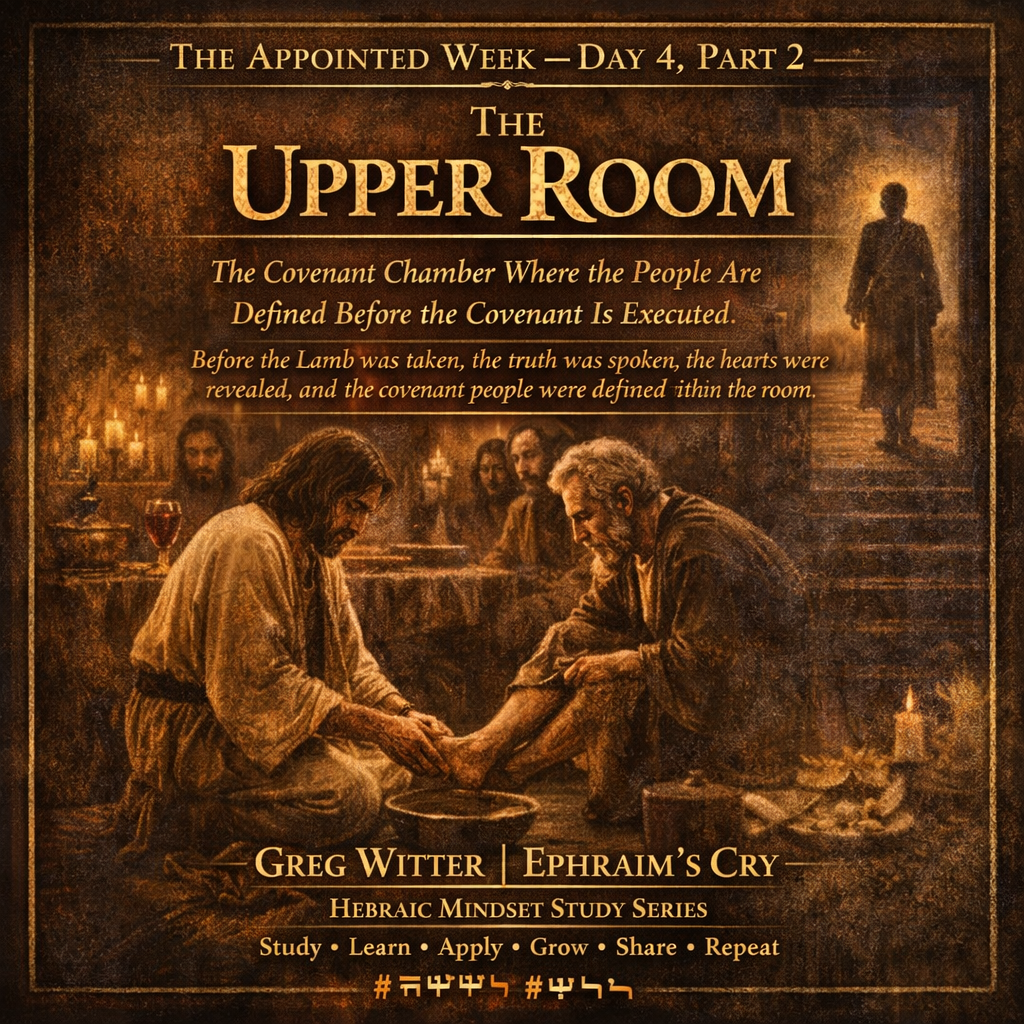
The Appointed Week — Day 4, Part 2: The Upper Room
The Covenant Chamber of Instruction, Exposure, Cleansing, and Alignment Before the Night Unfolds
Before the Lamb was taken, the truth was spoken, the hearts were revealed, and the covenant people were defined within the room.
Greg Witter | Ephraim’s Cry
Hebraic Mindset Study Series
Study Learn Apply Grow Share Repeat
The Upper Room is not a transition. It is not a passing scene between the covenant meal and Gethsemane. It is not background atmosphere. It is not a sentimental farewell setting placed into the narrative merely to slow the pacing before the conflict intensifies. The Upper Room is the covenant chamber of Day 4. It is the place where 𐤉𐤄𐤔𐤅𐤏 (Yahusha) gathers those closest to Him and brings everything into the open before the darkness begins to move in full force. If this room is treated lightly, everything that follows will be misunderstood. If this room is handled as though it were only a location, then the garden, the arrest, the trials, the denial, the scattering, and even the execution itself will be read out of order. The room is where the meaning of the night is spoken before the night unfolds. The room is where covenant truth is declared before covenant pressure tests every person present. The room is where what is hidden in men is brought into the light before the system outside the room tries to drag everything into darkness.
That is why the setting matters. This is not a random house with a borrowed corner. This is a prepared upper room, furnished and made ready beforehand according to the direction 𐤉𐤄𐤔𐤅𐤏 had already given (Mark 14:12–16; Luke 22:7–13). That detail is not filler. Prepared space matters in Scripture. Sinai was a set-apart mountain. The tabernacle was a set-apart dwelling. The holy place and the most set-apart place were structured spaces of ordered approach. In the same way, the Upper Room functions as an appointed chamber where covenant realities are declared before the next stage of the day proceeds. The Lamb has already been selected in the earlier movement of the week. He has already confronted the house. He has already been examined and found without blemish. Now, before He is handed over, there is one final chamber where those who claim to belong to Him are addressed directly. This room is not for the crowds. It is not for His enemies. It is not for curious observers. It is for those who have walked with Him, eaten with Him, learned from Him, claimed loyalty to Him, and believed themselves to be His own. And that is exactly why the room becomes so searching, because being in covenant space is not the same thing as being in covenant truth.
That fracture appears immediately once the room begins to unfold. Judas is in the room. Peter is in the room. The others are in the room. Yet the room itself proves that nearness is not the same thing as fidelity. Proximity is not the same thing as covenant integrity. Participation is not the same thing as surrender. This is one of the great dangers exposed in the Upper Room. Men can sit close to truth and still not yield to truth. They can hear truth spoken directly and still resist what it demands. They can stand in covenant atmosphere and still not be right in heart. That means the Upper Room is not merely a place of comfort. It is a place of exposure. It reveals what men are before the pressure publicly exposes them. It shows who is clean and who is not. It shows who is weak and who only thinks he is strong. It shows who is teachable and who is proud. It shows who is near the covenant and who is actually in it.
The covenant meal has already been declared in this setting. The bread has been identified before the body is broken. The cup has been named before the blood is poured out. The covenant has been spoken before the covenant is executed (Luke 22:19–20). But the room does not stop with the declaration of bread and cup, because covenant is not only declared. Covenant is walked. Covenant is embodied. Covenant is lived out in relation to the one who establishes it. That is why the movement from table to basin is so important. John’s account drives the reader into the inner logic of the room by showing 𐤉𐤄𐤔𐤅𐤏 rise from supper, lay aside His garments, take a towel, gird Himself, pour water into a basin, and begin washing the disciples’ feet (John 13:1–17). This is not a side lesson. This is not an isolated humility illustration detached from the meal. It belongs to the room, and it belongs to the covenant meaning of the room.
Feet matter because the walk matters. Feet carry the dust of the road. Feet speak of where a person has gone, what he has touched, what he has stepped through, and how he has moved through the world. To wash the feet is to address the walk. To cleanse the feet is to deal with how a person lives, not merely what he says. And this is where the room becomes sharper than many want it to be. 𐤉𐤄𐤔𐤅𐤏 is not merely being kind. He is confronting the reality that those who belong to Him must be cleansed by Him. This is priestly language. This is covenant access language. This is servant-king language. The one who is Master and Teacher becomes the one who stoops. The one whose body has just been identified in covenant language now kneels to cleanse the walk of those who claim a part in Him. That is not softness. That is covenant order. Before the pressure comes, the walk is addressed. Before the betrayer departs, the basin appears. Before the arrest, the question of belonging is brought to the surface.
Peter’s reaction shows how offensive true covenant cleansing is to human pride. “You will never wash my feet,” he says in substance. That is the natural man speaking. He wants relationship on terms he can still manage. He wants nearness without being exposed. He wants belonging without yielding to the form in which the Master chooses to cleanse. But the answer from 𐤉𐤄𐤔𐤅𐤏 is direct and absolute: “If I wash thee not, thou hast no part with me” (John 13:8). No part. No share. No portion. No covenant inheritance in Him apart from receiving what He alone provides. That is not decorative language. That is covenant definition. The room is not merely telling us to be humble. The room is telling us that belonging to Him requires submission to His cleansing. You cannot remain untouched and still claim part in Him. You cannot reject His way of making clean and still say you belong. You cannot cling to the dust of your own walk while speaking covenant words at His table.
Then comes the deeper fracture. “Ye are clean, but not all” (John 13:10–11). That line runs through the entire room like a blade. Judas is sitting there. Judas is in the company. Judas is near the table. Judas is inside the prepared room. Judas has heard the teaching, seen the basin, felt the weight of the moment, and still is not clean. This is one of the great warnings of the Upper Room: covenant space does not automatically produce covenant truth. A man can sit among the disciples and still be false. He can be near the bread and the cup and still not belong. He can hear the words of life and still walk out into darkness. The room is therefore not only a place of blessing. It is also a place of division. The true and the false are both present, but not for long. The room will expose the distinction before the night is over.
That exposure intensifies when 𐤉𐤄𐤔𐤅𐤏 testifies that one of them will betray Him (John 13:21). This is not an abstract prophecy thrown into the air. This is covenant fracture revealed in the room itself. The betrayal is not outside the circle; it is inside it. Psalm 41:9 comes alive in that moment: the familiar friend who ate bread has lifted up his heel against the righteous one. Betrayal is now shown for what it is. It is not merely opposition from enemies. It is treachery from nearness. It is the lifted heel of one who shared bread. It is darkness operating from within the company of those who outwardly appear close. That makes the room all the more sobering. It means the Upper Room is not only a chamber of covenant declaration. It is a chamber of covenant exposure. What is false will not remain hidden forever. The dipped morsel, the identification of Judas, and his departure into the night are all part of the room’s work. “And it was night” (John 13:30) is not merely a note about time. It is a statement about what has happened. Darkness has moved from internal intention into outward motion. Yet even there, the order remains: the betrayal is exposed in the room before it is executed outside the room. Truth is spoken before evil advances.
But Judas is not the only fracture in the room. If Judas reveals treachery, the others reveal weakness and pride. Luke’s account makes clear that a dispute arose among them over which of them should be accounted the greatest (Luke 22:24–27). That detail is humiliating and instructive. At the very hour when the covenant chamber is unfolding, when the Master is moving toward sacrifice, when betrayal is at hand, when the night is already loaded with meaning, the disciples are still thinking in terms of rank. That is the human condition laid bare. Men want position even in sacred space. They want significance on their own terms. They want to know who stands highest. And 𐤉𐤄𐤔𐤅𐤏 answers that not with a lecture alone but with Himself. He is among them as one who serves. The Master kneels. The King washes. Authority is redefined in the room before the world’s form of authority shows itself outside the room in swords, torches, accusations, and coercion. The Upper Room therefore establishes the order of the Kingdom over against the order of worldly and religious systems. In His Kingdom, greatness is not grasped. It is expressed through service. Leadership is not self-elevation. It is cleansing, bearing, stooping, and giving. If this is not seen in the room, later structures built in His name will be corrupted because they will preserve the pride of men rather than the order of the King.
Then the room gives the command to love one another as He has loved them (John 13:34–35). This must be handled rightly. It is not a cancellation of Torah, as though the older command to love neighbor is being replaced by a softer new ethic. It is a sharpening and defining of covenant love by the example of the one about to give Himself. Love here is not sentiment. It is not mere affection. It is not tolerance. It is not abstract emotional warmth. It is covenant action measured by sacrifice. It is truth joined to service. It is fidelity shaped by the self-giving pattern of the Bridegroom. The room speaks this before the cross so that the cross will interpret the command. Once the body is given and the blood is poured out, no one will have grounds to redefine love in weak or lawless terms. The Upper Room therefore sets the measure of covenant love in advance: “as I have loved you.” That means the room is shaping the community ethically before the pressure of persecution and failure comes upon them.
Peter then becomes the next focal point of exposure. Unlike Judas, Peter is not false in the same way. But he is unstable. He is sincere and yet self-confident. He believes more strongly in his own strength than he should. That is why 𐤉𐤄𐤔𐤅𐤏 warns him directly that Satan has desired to sift him as wheat, but that prayer has already been made for him so that his faith will not utterly fail and that when he turns back he is to strengthen his brothers (Luke 22:31–32). Then comes the direct prediction of denial before the rooster crows (Luke 22:33–34; John 13:36–38). The room, then, is not only exposing outright betrayal; it is exposing weakness in those who truly belong. It is showing that zeal is not the same thing as stability. Bold speech is not the same thing as endurance. Public confidence is not the same thing as covenant maturity. The room is painfully honest about the people in it. Judas will betray. Peter will deny. The others will scatter. Pride has already surfaced. Confusion is already present. Yet the one thing not shaken in the room is 𐤉𐤄𐤔𐤅𐤏 Himself. He is the stable center of the chamber. He knows every fracture before it manifests, and He speaks to each condition with precision.
From there the room deepens into one of the richest stretches of instruction in all of Scripture. John 14 through 16 belongs in this teaching because it is part of the room’s covenant disclosure. “Let not your heart be troubled” (John 14:1) is spoken because the room already is troubled. The disciples do not understand everything unfolding around them. Betrayal has been exposed. Departure is being spoken of. The atmosphere is heavy. So He speaks peace before the storm breaks, not after. Then He says He is going to prepare a place for them and will come again to receive them unto Himself (John 14:2–3). That is not detached comfort language. It carries covenant and bridegroom resonance. The one who is about to leave speaks of preparing a place and returning to receive His own. The room therefore stretches beyond the immediate crisis into the larger covenant horizon. This is not merely about surviving the night. This is about belonging to the Bridegroom whose departure is purposeful and whose return is promised.
That same section also gives doctrinal clarity at the highest level: “I am the way, the truth, and the life: no man cometh unto the Father, but by me” (John 14:6). This belongs in the room because the room is defining access. Before priestly systems outside the room conduct their mock trials, the true mediator defines the true way to the Father. The Upper Room is therefore not merely emotional preparation. It is theological clarity. It reveals who He is, how the Father is known, and how access is actually secured. Thomas’s uncertainty and Philip’s confusion only intensify how necessary the room’s teaching is. Even those closest to Him do not yet fully grasp the identity of the one standing before them. So the room becomes the place where He interprets Himself before the world tries to misinterpret Him in court.
Then comes the promise of the Set-Apart Spirit. This too belongs centrally in the Upper Room because covenant continuity after His departure depends on more than memory alone. He promises another Helper, the Spirit of truth, who will dwell with them and in them, who will teach them all things, and who will bring all that He has said to remembrance (John 14:16–17, 26; 15:26; 16:13–15). This does not replace Torah. It fulfills the prophetic promise of inward covenant reality. Jeremiah had already spoken of Torah written on the heart (Jeremiah 31:31–33). Ezekiel had already spoken of cleansing, a new heart, and the Spirit causing the people to walk in His statutes (Ezekiel 36:25–27). So the room is not launching something alien to the covenant line. It is speaking the internalization and empowerment of what the Prophets had already promised. The Spirit is not given to create lawlessness. He is promised so that the covenant words spoken in the room and embodied in 𐤉𐤄𐤔𐤅𐤏 will be remembered, taught, and walked out by His people.
Then comes the vine and branches discourse in John 15. It belongs here because the room is not only about one night’s meaning; it is about life after this night. “I am the true vine, and my Father is the husbandman” (John 15:1) establishes covenant union in living form. Abiding is not optional. Fruitlessness is not neutral. Branches that do not remain are taken away. Branches that remain are pruned so that they may bear more fruit. Apart from Him they can do nothing (John 15:1–8). This belongs in the Upper Room because the room is defining what real belonging looks like after the bread, the cup, the basin, and the coming arrest. It is not enough to have sat in the room once. One must abide. One must bear fruit. One must remain. The room therefore exposes not only present conditions but future categories: those who abide and those who do not, those who bear fruit and those who are cut off. Covenant life is living, enduring, fruitful union with Him. The room says that before the scattering begins.
The room also prepares them for hatred from the world. “If the world hate you, ye know that it hated me before it hated you” (John 15:18). They will be cast out. Some will think they are serving Elohim by harming them (John 16:1–4). This means the Upper Room is not a chamber of soft comfort. It is a chamber of preparation. The Bridegroom does not lie to His people about what belonging to Him will cost. He warns them. He tells them that covenant truth will bring collision with the world and with religious systems that reject Him. That matters because the room is not only preparing them for the next few hours. It is preparing them for the entire shape of faithful witness after His departure.
Even the sorrow-to-joy teaching in John 16 belongs here. He tells them plainly that they will weep and lament while the world rejoices, but that their sorrow will be turned into joy (John 16:20–22). He uses the language of labor and birth to show that pain can be the doorway to life. This too belongs in the room because the room is the place where immediate sorrow is interpreted before it arrives. The Upper Room therefore does not only say that pain is coming. It says what that pain means and what it will yield. That protects the disciples, and the reader, from misreading the events of the night as pure defeat. The room interprets the coming anguish in advance.
Then the room reaches one of its highest points in John 17, where 𐤉𐤄𐤔𐤅𐤏 lifts His eyes and prays. This is not an incidental closing prayer. This is high priestly intercession flowing out of the covenant chamber. He prays for glorification through obedience, for the preservation of those given to Him, for their sanctification in the truth, for their unity, and even for those who will later believe through their word (John 17:1–26). This means the room is not only a place of teaching and exposure. It is a place of priestly covering. Before the arrest, He intercedes. Before the trials, He prays. Before the scattering, He presents His own before the Father. The Upper Room is therefore also a priestly chamber. He does not merely explain covenant. He actively mediates for His people as the covenant representative.
The room also echoes backward and forward at the same time. Backward, it resonates with Sinai where covenant words were spoken, blood applied, and a meal shared in the presence of Elohim (Exodus 24:3–11). Backward, it resonates with tabernacle order, priestly cleansing, and the covenantal shaping of a people. Backward, it resonates with the manna in the wilderness, daily dependence, and life from the mouth of 𐤉𐤄𐤅𐤄. Forward, it resonates with the prepared place, the promised return, the Bridegroom receiving His own, the deferred cup until the Kingdom, and the marriage-supper horizon to come (Matthew 26:29; John 14:2–3; Revelation 19:7–9). The Upper Room is therefore not isolated. It stands inside the whole covenant arc, from Sinai to Kingdom, from meal to wedding, from cleansing to union, from warning to endurance, from prayer to consummation.
So what is the Upper Room? It is the covenant chamber where the meal is declared, the walk is cleansed, the false is exposed, the proud are corrected, the weak are warned, love is defined, access is clarified, the Spirit is promised, abiding is commanded, hatred is anticipated, sorrow is interpreted, and intercession is made. It is the place where the people are defined before the covenant is executed. It is the room where everything is spoken before everything is tested. It is the place where the internal condition of the disciples is exposed before the external machinery of betrayal and condemnation begins moving against 𐤉𐤄𐤔𐤅𐤏.
That is why the order matters so much. Before the garden, there is the room. Before the betrayal is acted out, it is exposed. Before Peter denies, he is warned. Before the disciples scatter, they are instructed. Before the arrest, there is intercession. Before the night closes in, the truth is spoken plainly. If the room is missed, the rest of the night will be flattened into events without covenant interpretation. But if the room is heard, everything outside the room becomes legible. Judas’s betrayal, Peter’s denial, the disciples’ scattering, the world’s hatred, the coming sorrow, and even the promise of joy all have already been spoken inside the room.
This is why the Upper Room cannot be treated as an outline point. It is too full for that. It is the covenant chamber of Day 4. It is where the people are revealed, where the covenant community is defined, and where the meaning of the night is set before the night unfolds.
Before the Lamb was taken, the truth was spoken. Before the darkness advanced, the betrayer was exposed. Before the scattering, the disciples were warned. Before the trials, the Mediator prayed. Before the covenant was executed in blood, the covenant people were addressed in the room.
That is the Upper Room.
#GregWitter #EphraimsCry #HebraicMindset #TheAppointedWeek #Day4 #UpperRoom #CovenantChamber
#CovenantInstruction #CovenantAlignment #TorahAndTestimony #ExecutionOfTheCovenant #𐤉𐤄𐤔𐤅𐤏 #𐤉𐤄𐤅𐤄
