
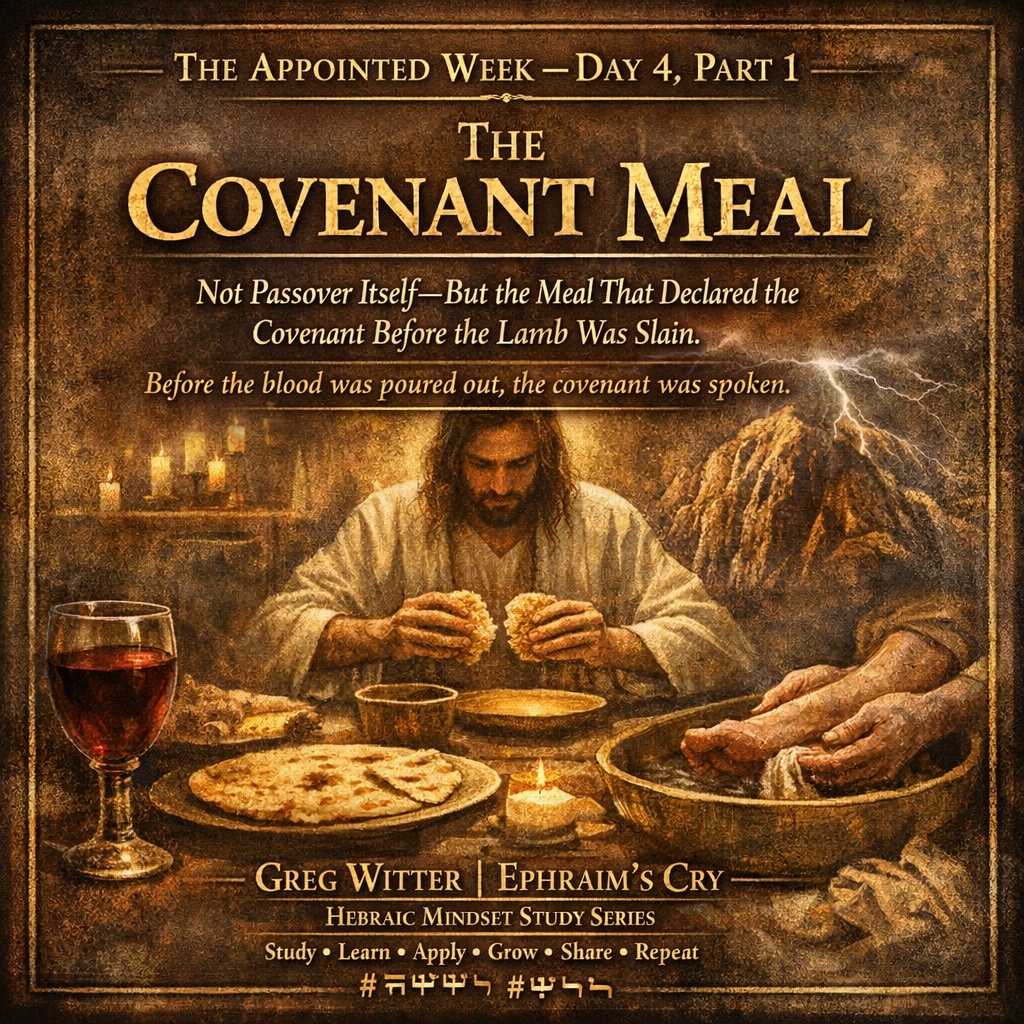
The Appointed Week — Day 4, Part 1: The Covenant Meal
Not Passover Itself — But the Meal That Declared the Covenant Before the Lamb Was Slain
Before the blood was poured out, the covenant was spoken.
Greg Witter | Ephraim’s Cry
Hebraic Mindset Study Series
Study Learn Apply Grow Share Repeat
The table matters.
That is where this teaching must begin, many people think or believe this is a Passover meal, because most people move too fast. They rush to Gethsemane. They rush to the arrest. They rush to the trials. They rush to the execution stake. They rush to the blood, the darkness, the cry, the spear, and the burial. They want the climax without the covenant frame. They want the sacrifice without the table that interprets the sacrifice. They want the blood without the words that declared what the blood would mean. And when they do that, they break the order of the day and lose the weight of what took place before the violence of the night unfolded.
Day 4 does not begin with men laying hands on 𐤉𐤄𐤔𐤅𐤏 (Yahusha). It begins with 𐤉𐤄𐤔𐤅𐤏 taking bread, taking a cup, speaking covenant, exposing hearts, washing feet, identifying betrayal, warning of scattering, giving instruction, promising the Set-Apart Spirit, speaking of union, praying as High Priest, and setting the meaning of His death before He ever walks out into the night. If that order is not preserved, the teaching collapses into fragments. If the table is mishandled, the rest of the day will be mishandled. This meal is not a sentimental prelude. It is the covenantal, legal, relational, prophetic, and priestly declaration that frames everything that follows.
This is why it must be said plainly again: this was not the Passover meal itself. This was a covenant meal within the Passover season and within the Passover pattern, but it was not the lamb-eaten meal after the Lamb had been slain according to the fixed order of Torah. Exodus 12 is not vague. The lamb is selected on the tenth day, kept until the fourteenth, examined, then slain between the evenings; blood is applied, and the lamb is eaten according to command (Exodus 12:3–11). The order matters because 𐤉𐤄𐤅𐤄 (Yahuah) established it. The Lamb cannot be both sitting alive at the table declaring the meaning of His coming death and already be the slain Passover consumed according to the command. That confusion breaks the pattern. The table must therefore be understood as covenant declaration before covenant execution, as interpretation before offering, as the meal that names the body and blood before the body is broken and the blood is poured out.
That is not a small point. It is the hinge.
Once that is seen, the meal opens up in its full force. This is not simply a supper. This is the covenant meal. This is the restoration meal. This is the betrothal meal. This is the legal table. This is the interpretive table. This is where Torah, the Prophets, the Writings, and the prior words of 𐤉𐤄𐤔𐤅𐤏 are gathered and spoken over one appointed moment.
To understand that, the teaching must go back before the Gospels. Covenant does not begin at this table. Covenant begins with 𐤉𐤄𐤅𐤄. Covenant in Scripture is never a vague inward feeling. Covenant is spoken, ordered, binding, witnessed, remembered, and costly. It establishesbelonging. It defines relationship. It brings obligation. It sets terms. It marks loyalty and exposes treachery. When 𐤉𐤄𐤅𐤄 cut covenant with Abram, animals were divided and covenant passed through blood and promise (Genesis 15:7–18). When Israel stood at Sinai, Moses read the Book of the Covenant, the people answered with assent, blood was sprinkled, and then the representatives of Israel ate and drank in the presence of Elohim (Exodus 24:3–11). That is not a side note. That is covenant form: words, assent, blood, meal. That is legal, relational, and holy.
And Sinai is not merely constitutional. The Prophets reveal its relational depth by describing covenant in marriage language. Israel is addressed as bride, wife, adulteress, and promised-restored spouse (Isaiah 54:5–8; Jeremiah 2:2; Jeremiah 3:1–14; Ezekiel 16; Hosea 2:14–23). That means covenant is not only about law in the abstract. It is about fidelity, belonging, union, betrayal, return, cleansing, and restoration. Sinai therefore carries more than institutional force. It carries marriage force. Terms are spoken. Agreement is made. Blood is applied. A meal confirms the relationship. That is why it is not improper to speak of ketubah weight, proposal weight, binding relational identity when standing at this table. The canon itself pushes in that direction.
Now the table on Day 4 comes into focus.
𐤉𐤄𐤔𐤅𐤏 is not inventing a new religion. He is not severing Himself from Torah. He is not canceling the covenant line. He is not launching something detached from the fathers, detached from Sinai, detached from the prophets, and detached from the promises. He is bringing the covenant line to its appointed crisis and appointed revelation in Himself. He is the faithful Son, the obedient Servant, the true Bread, the Bridegroom, the Shepherd, the Lamb, the Mediator, the coming King, and the living Temple. At this table He names what the night will mean.
The bread is not random. Bread throughout Scripture speaks of provision, sustenance, dependence, life received, and covenant supply. Manna trained Israel in dependence and taught that man does not live by bread alone but by every word that proceeds from the mouth of 𐤉𐤄𐤅𐤄(Deuteronomy 8:3). The bread of the Presence stood before 𐤉𐤄𐤅𐤄 in ordered worship as a covenantal sign of nearness, provision, and ordered priestly service (Exodus 25:30; Leviticus 24:5–9). The psalms speak of bread as provision from His hand (Psalm 104:14–15). Then 𐤉𐤄𐤔𐤅𐤏openly declares Himself to be the true bread from heaven, the one by whom man truly lives, the one whose flesh is true food and whose life is the life of the world (John 6:32–58). So when He takes bread and breaks it and says in effect, “This is my body,” He is not offering thin symbolism. He is identifying the offering. He is declaring Himself as the provision, the sustenance, the body given, the life-bearing one through whom covenant restoration will come. The bread says more than body. It says provision, embodiment, dependence, gift, and participation.
The cup is no less weighty. “This is my blood of the covenant,” or “the renewed covenant in my blood,” is not language hanging in midair (Matthew 26:27–28; Mark 14:23–24; Luke 22:20; 1 Corinthians 11:25). It is Sinai language. “Behold the blood of the covenant,” Moses said when covenant was sealed (Exodus 24:8). Blood is not optional to covenant. Life is in the blood (Leviticus 17:11). Cleansing, mediation, and covenantal sealing all converge there. So when 𐤉𐤄𐤔𐤅𐤏 names the cup, He is not abolishing the older witness but bringing its meaning to fullness in Himself. This is covenant blood named before it is poured out. This is the Mediator declaring the sealing witness before the offering is visibly completed.
And here the marriage force must be seen. The cup is not only sacrificial. It is relational. In Hebraic covenant marriage understanding, the bridegroom presents the cup; if the bride drinks, she accepts the covenant. That does not need to be exaggerated into folklore to see the canonical resonance. The marriage language of the Prophets, the bridegroom language of 𐤉𐤄𐤔𐤅𐤏 Himself, and the future wedding imagery of the Kingdom all converge here (Matthew 9:15; John 3:29; Matthew 22:1–14; Matthew 25:1–13; Revelation 19:7–9). The cup is covenant offered. The cup is relationship defined. The cup is the cost of union declared openly by the Bridegroom. This is why the table is not mere memory. It is covenantal identity and relational belonging.
That is also why “Do this in remembrance of me” must be restored to covenant weight (Luke 22:19; 1 Corinthians 11:24–26). Remembrance in Scripture is not passive recollection. It is covenantal rehearsal. The feasts themselves are memorial acts that preserve identity, keep truth before the generations, and resist covenant forgetfulness (Exodus 12:14, 24–27; Leviticus 23). Forgetting leads to drifting, and drifting leads to betrayal. So when He commands remembrance, He is not saying, “Occasionally think about me in a spiritualized ceremony.” He is binding His people to recurrent covenant remembrance. This can be held yearly in alignment with covenant memorial structure, and it may be kept more often as often as it is done, so long as the meaning is not severed from its covenant frame. Every observance says: remember the body given, remember the blood, remember the Bridegroom, remember the proposal, remember who you belong to, remember what was pledged, remember what it cost, remember the coming consummation. This is why “communion,” as commonly handled, is not enough. It is too thin. Too detached. Too church-shaped. Too stripped of Torah, covenant, memorial, marriage, and Kingdom expectation. A wafer and a sip with no covenant depth do not do justice to this table.
But even that is not enough. The table on Day 4 is not only bread and cup. It is also basin and towel.
This is where many teachings fracture again, because they separate the foot washing from the covenant meal as though it were a different lesson detached from the table. It is not detached. It belongs here. John’s account does not emphasize the bread-and-cup wording the way the Synoptics do; instead, it draws the reader into the internal covenant logic of the room by showing 𐤉𐤄𐤔𐤅𐤏 rising from supper, laying aside His garments, taking a towel, girding Himself, pouring water into a basin, and washing the disciples’ feet (John 13:1–17). That is not a sentimental humility demonstration with no deeper covenant force. It is the Servant-King cleansing the walk of those who belong to Him. It is Priesthood language. It is servant language. It is cleansing language. It is relational language. It is authority redefined in covenant terms.
The one who is about to be identified in bread and cup as the offering now kneels to wash the feet of those who will claim to follow Him. That is not secondary. That is the table unfolding its meaning. If covenant relationship is to be restored, then the people must be cleansed. If the Bridegroom is taking a people to Himself, then their walk must be addressed. If the Mediator is bringing them into covenant, then uncleanness cannot be ignored. Peter’s resistance shows how jarring this is: “Thou shalt never wash my feet.” But the answer cuts to the core: “If I wash thee not, thou hast no part with me” (John 13:8). That is covenantal language. No part with me. No share in me. No portion in me. The basin is not decorative. It declares participation, cleansing, belonging, and the necessity of receiving from Him what one cannot secure for oneself.
And yet even there, the foot washing exposes another layer. “He that is washed needeth not save to wash his feet, but is clean every whit,” and then the warning, “and ye are clean, but not all” (John 13:10–11). The room is divided inwardly even before it is divided outwardly. One is clean in the broad sense of covenant association and participation in the company, yet not all are clean in truth. Judas sits in the room. Judas hears the teaching. Judas sees the basin. Judas receives the exposure. Judas is present at the covenant table, but he is not aligned with the covenant he is near. That is a warning built directly into the meal. A man can sit at the table, hear the words, and still move toward betrayal. Proximity is not fidelity. Participation is not submission. External nearness is not internal truth.
This is why John also gives the dipped morsel and the departure into the night (John 13:18–30). Psalm 41:9 had already spoken of the familiar friend who ate bread and lifted up his heel against the righteous one. That thread belongs here. The table does not merely comfort the faithful; it exposes the false. The dipped sop, the identified betrayer, the night into which Judas goes, and the statement that Satan entered into him all intensify the meaning of the room. Covenant is being declared, and betrayal is being unmasked in the same setting. The table is therefore both invitation and exposure. It is mercy and witness. It blesses the faithful and reveals the treacherous. That has never changed.
And still the room keeps unfolding.
If John 13 gives the basin and towel, John 14–17 gives the covenant discourse that many never properly bind to the meal. But it belongs here. It all belongs here. The table is not only bread, cup, and basin. It is instruction before the Bridegroom departs. It is covenant reassurance before the pressure descends. “Let not your heart be troubled” (John 14:1). “In my Father’s house are many dwelling places… I go to prepare a place for you” (John 14:2–3). That is not disconnected comfort language. That is bridegroom language resonating with covenant expectation. The Bridegroom will depart. The place will be prepared. He will come again and receive His own. The betrothal force of the meal is carried forward in the words spoken at the table.
Then comes the promise of the Set-Apart Spirit, the Spirit of truth, the one who will teach, remind, witness, and dwell (John 14:16–18, 26; 15:26; 16:7–15). That belongs here because covenant renewal is not bare externality. Jeremiah had already promised Torah written on the heart (Jeremiah 31:31–33). Ezekiel had already promised cleansing, a new heart, and the Spirit causing the people to walk in His statutes (Ezekiel 36:25–27). So the table is not simply backward-looking. It is the moment where the covenant line from Sinai through the Prophets is brought to its threshold of internalization, cleansing, and empowered obedience. Bread, cup, basin, Spirit, promise, abiding, fruitfulness, and obedience all belong together here. “If ye love me, keep my commandments” (John 14:15). “Ye are my friends, if ye do whatsoever I command you” (John 15:14). Those statements are not detached moral sayings floating around the supper. They are covenant definitions spoken at the covenant table.
Then there is the vine imagery. “I am the true vine, and my Father is the husbandman” (John 15:1). That belongs here too. After the cup, after the statement about not drinking again of the fruit of the vine until the Kingdom, the vine discourse deepens the covenant union theme. Abiding. Remaining. Bearing fruit. Being cut off if fruitless. Being pruned if fruitful. This is not soft spirituality. This is covenant life. Union with the Bridegroom is not mystical vapor. It is abiding obedience, fruit-bearing, and continued life in Him. The table points not merely to forgiveness but to union and fruitfulness. Those who belong remain. Those who do not remain are exposed.
The room also holds warning. 𐤉𐤄𐤔𐤅𐤏 warns Peter of denial (Luke 22:31–34; John 13:36–38). He warns of scattering (Matthew 26:31; Mark 14:27, citing Zechariah 13:7). He warns of hatred from the world (John 15:18–25; 16:1–4). That means the covenant meal is not only tender; it is bracing. It does not merely say, “You are mine.” It also says, “You are going to be tested.” The Bridegroom does not deceive His people about the cost of belonging. He strengthens them before the fracture, warns them before the fall, and prays for them before the night splits them apart.
That priestly prayer in John 17 belongs here as well. Too often it is treated as a separate teaching unrelated to the covenant meal, but it is part of the same movement. Before He crosses the Kidron, before the arrest, the Bridegroom and Mediator prays: for glorification through obedience, for the preservation of those given to Him, for their sanctification in the truth, for their oneness, and for those who will believe through their word (John 17:1–26). This is High Priestly covenant intercession flowing out of the table. He has spoken the covenant, washed the feet, exposed the betrayer, promised the Spirit, defined abiding, warned of scattering, and now He prays. That is not accidental sequencing. It is covenant fullness in motion.
And the room is also charged with memorial continuity. The Passover season is the backdrop; Exodus 12 hovers over the entire evening. The lamb, blood, deliverance, judgment passing over, and memorial command all stand in the background. Yet this table does more than rehearse the first exodus. It names the greater restoration. The first exodus brought a people out from Egypt. This covenant meal declares the body and blood by which a people are restored more deeply than outward liberation alone. This reaches back to Noah through judgment, to Abraham through promise, to Sinai through blood, to the wilderness through manna, to the prophets through promised restoration, and forward to the Kingdom through the deferred cup. The table is therefore not a narrow ordinance; it is the covenant spine drawn tight.
Now the foot washing must be seen again in this wider setting. Bread names provision. Cup names blood. Basin names cleansing. Towel names servanthood. Together they interpret the Bridegroom. He is the one who gives Himself, cleanses His own, and defines leadership through lowliness. “If I then, your Master and Teacher, have washed your feet; ye also ought to wash one another’s feet” (John 13:14). The table therefore does not only speak of what He does for His people; it also establishes the relational ethic of the covenant community. This is not churchhierarchy. This is kingdom service. No striving for seats of power. No grasping for status. Luke’s account specifically frames part of the room with dispute over greatness, and 𐤉𐤄𐤔𐤅𐤏 corrects it by defining greatness through service (Luke 22:24–27). That belongs here. The covenant meal exposes the pride of men even while the Bridegroom stoops to wash their feet. The contrast is deliberate. Human systems seek rank. The covenant King kneels with a basin.
What else belongs here? The Hallel thread. Though not every detail is expanded in each account, the Gospels note that after the supper they sang a hymn before going out to the Mount of Olives (Matthew 26:30; Mark 14:26). Within the Passover season and meal context, this naturally evokes the Hallel psalms, especially Psalm 113–118. That matters because Psalm 118 carries the rejected stone imagery, deliverance language, and festal procession themes already resonant with the appointed week. To sing praise on the threshold of betrayal and death is not incidental. It shows that the covenant meal is held in the atmosphere of scriptural praise, not in despair. The Bridegroom walks into the night with the language of the Psalms on His lips.
And still there is more woven in. The room is charged with the commandment to love one another as He has loved them (John 13:34–35). That is not some sentimental substitute for Torah. It is covenant love sharpened by the example of the Bridegroom who is about to lay down His life. The standard is not generic niceness. The standard is self-giving covenant fidelity. Love is defined by Him, not by sentiment. Later John will say, “By this we know love, because he laid down his life for us” (1 John 3:16). The table on Day 4 announces that definition before the act visibly unfolds.
So what, then, happened at this covenant meal?
The body was identified before it was given.
The blood was named before it was poured out.
The covenant was spoken before it was executed.
The feet were washed before the road to Gethsemane began.
The betrayer was exposed before he left into darkness.
The disciples were warned before they scattered.
The Spirit was promised before the departure.
The place was promised before the absence.
The vine was explained before the pruning.
The priestly prayer was offered before the arrest.
The future feast was pointed to before the cup was deferred.
Nothing in that room is random.
Nothing is filler.
Nothing is detachable.
This is why the teaching cannot stop with bread and cup alone. The full covenant meal includes the bread, the wine, the washing, the exposure, the instruction, the promise, the warning, the prayer, and the future-oriented hope. If those are severed from one another, the room is broken apart and the teaching loses its force. The room must stay together because the room itself is a covenant whole.
This is also why the phrase “Do this in remembrance of me” carries even greater weight than many realize. It is remembrance not only of death but of the whole covenant declaration: the Bridegroom, the body, the blood, the cleansing, the commandment, the promise, the warning, the prayer, the coming again. To keep this yearly in covenant awareness, and as often as it is rightly done in fidelity to that meaning, is to say again and again: we remember who our Bridegroom is; we remember what He pledged; we remember what He gave; we remember what He requires; we remember that we have no part with Him apart from His cleansing; we remember that betrayal can sit at the table; we remember that love must be self-giving; we remember that obedience and abiding are inseparable from belonging; we remember that He has gone to prepare a place; we remember that He will drink the cup anew in the Kingdom. That is why communion language by itself does not cut it. It is too thin for this room.
This room is covenant.
This room is restoration.
This room is betrothal.
This room is cleansing.
This room is exposure.
This room is instruction.
This room is promise.
This room is warning.
This room is intercession.
This room is preparation for sacrifice.
And because of that, Day 4 begins here.
Not at the arrest.
Not at the trial.
Not at the execution stake.
At the table.
Before the Lamb was slain, the covenant was spoken. Before the blood was poured out, the cup was named. Before the people scattered, the feet were washed. Before the betrayer left, the room exposed him. Before the night deepened, the Bridegroom declared what His death would mean. And everything that follows in Day 4 is the execution of what was spoken at this table.
Additional covenant anchors that belong within this teaching and must remain in view:
- Exodus 12:3–14, 24–27 — the selected lamb, the slain lamb, the blood, the memorial.
- Exodus 24:3–11 — covenant words, people’s assent, blood of the covenant, meal in Elohim’s presence.
- Deuteronomy 8:3 — bread and dependence.
- Leviticus 17:11 — life in the blood.
- Psalm 41:9 — betrayal by one who ate bread.
- Isaiah 54:5–8; Jeremiah 31:31–33; Ezekiel 36:25–27; Hosea 2:14–23 — marriage, restoration, inward covenant renewal.
- Matthew 26:26–30; Mark 14:22–26; Luke 22:14–30; John 13–17; 1 Corinthians 11:23–26 — the table in its full layered witness.
This was not “just supper.”
This was not a church ordinance in seed form.
This was not a sentimental farewell.
This was the covenant meal.
The restoration meal.
The betrothal meal.
The cleansing meal.
The interpretive meal.
The table where the Bridegroom named the body, named the blood, washed the feet, exposed the false, strengthened the weak, promised the Spirit, prayed for His own, and set the meaning of the night before He stepped into it.
And if the table is missed, the cross will be mishandled. If the basin is missed, belonging will be cheapened. If the cup is missed, covenant will be thinned. If the bread is missed, provision will be misunderstood. If the prayer is missed, the priesthood will be dimmed. If the warning is missed, betrayal will be underestimated. If the future feast is missed, remembrance will become past-only ritual. The whole room must stay intact.
Before the Lamb was slain, the covenant was spoken.
Before the blood was poured out, the Bridegroom named the cup.
Before the disciples walked into the night, their feet were washed.
Before the covenant was executed, the meaning of the covenant was declared.
That is where Day 4 begins.
#GregWitter #EphraimsCry #HebraicMindset #TheAppointedWeek #Day4 #CovenantMeal #FootWashing
#PassoverPattern #TorahAndTestimony #ExecutionOfTheCovenant #𐤉𐤄𐤔𐤅𐤏 #𐤉𐤄𐤅𐤄
