
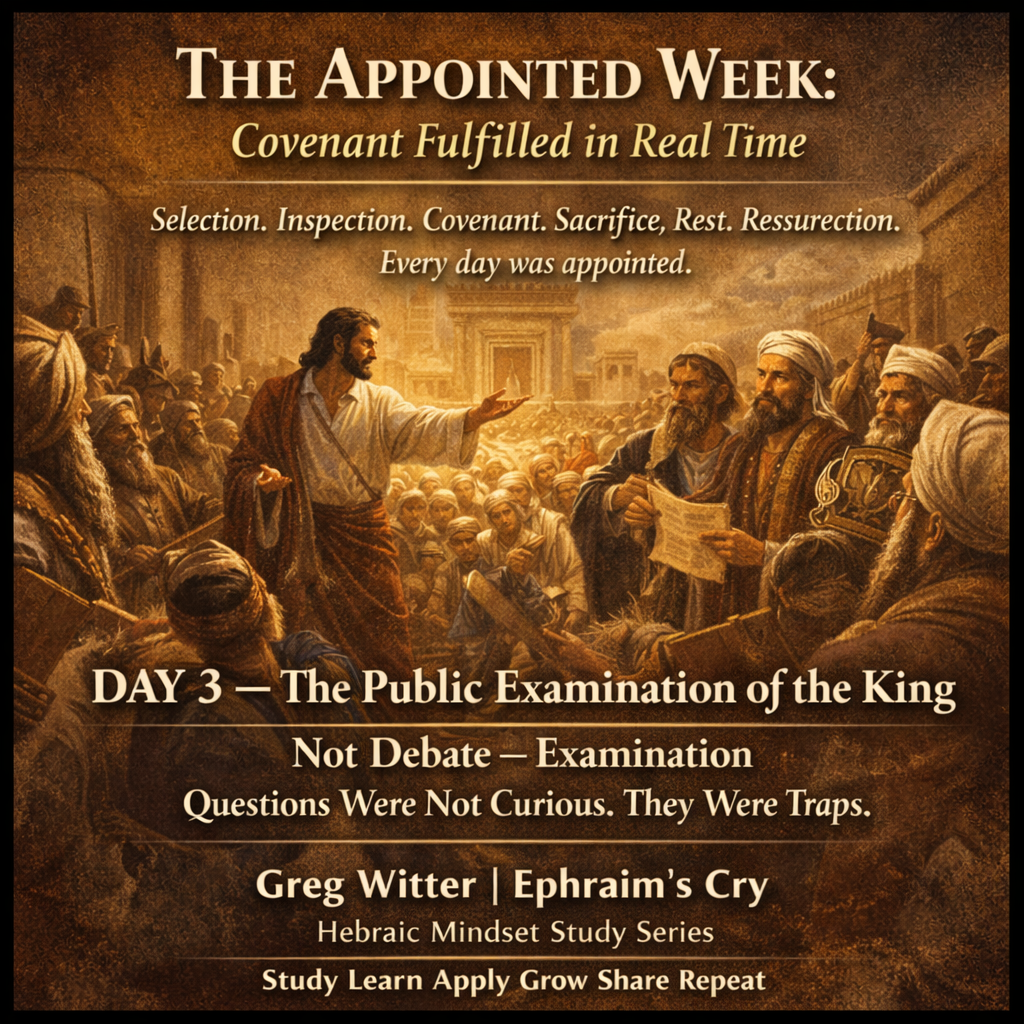
THE APPOINTED WEEK: Covenant Fulfilled in Real Time
A Day-by-Day Constitutional Reconstruction from the Selection of the Lamb to First Fruits
Selection. Inspection. Covenant. Sacrifice. Rest. Resurrection.
Nothing was random. Every day was appointed.
DAY 1 — The Selection of the Lamb
10th of Aviv — The Public Presentation Before Inspection
This Was Not a Parade. It Was a Legal Appointment.
Greg Witter | Ephraim’s Cry
Hebraic Mindset Study Series
Study Learn Apply Grow Share Repeat
Biblical Date: 10th of Aviv
Biblical Day: Saturday Sundown → Sunday Sundown
Modern Orientation: What many call “Palm Sunday”
This day is not sentimental.
It is constitutional.
Exodus 12:3 establishes the structure:
“On the tenth day of this month every man shall take for himself a lamb… and you shall keep it until the fourteenth day of the same month.”
The lamb was not slaughtered immediately.
It was selected.
Brought into the household.
Observed.
Examined.
Tested.
For four days.
This was not decorative ritual. It was legal procedure.
The lamb had to be without blemish (Exodus 12:5). Not assumed. Proven. Inspected.
Now lock in what Torah is actually doing in Exodus 12, because this is the blueprint for the entire appointed week.
Selection is not merely choosing an animal. Selection is covenant responsibility placed on the household. “Every man… for a household” (Exodus 12:3–4) means the head is accountable. The lamb becomes identified with the house. The house becomes identified with the lamb. The life of the firstborn becomes tied to the blood of the substitute. That is not symbolism. That is covenant law.
“Without blemish” (Exodus 12:5) is not a vibe. It is a standard. No defect. No compromise. No hidden flaw. A lamb that fails inspection cannot be offered as the covenant substitute. That is the legal logic behind the four-day keeping. The household lives with the lamb. The household can observe the lamb. The lamb is visible. The lamb is known. The lamb is tested in plain sight.
And the timing is not flexible. The lamb is kept “until the fourteenth day” (Exodus 12:6). Then it is slain “between the evenings.” That phrase matters because it anchors the slaughter in the late-afternoon window leading into sundown. Torah is building a calendar-legal structure: selection, inspection, slaughter, blood application, meal, removal of leaven, and a holy convocation. When people flatten these steps, they flatten the covenant pattern.
Now move forward to the final week of Messiah’s earthly ministry.
He does not wander into Jerusalem casually. He orchestrates His entry.
He instructs the disciples to retrieve a colt — one on which no one has ever sat (Mark 11:2; Luke 19:30). That detail matters. In Torah, animals never ridden were reserved for sacred purposes (Numbers 19:2; Deuteronomy 21:3). This is consecrated imagery.
He fulfills Zechariah 9:9 exactly:
“Behold, your King is coming to you; righteous and having salvation, humble and riding on a donkey.”
This is not improvisation. It is prophetic alignment.
Now add the pressure-cooker reality that most people ignore.
Passover week is not calm. Passover week is volatile. Jerusalem swells with pilgrims. The city becomes crowded, tense, economically active, and politically dangerous. Rome does not relax during Passover; Rome tightens control during Passover. A feast celebrating deliverance from Egypt is the last thing an occupying empire wants turning into national uprising. That is why the presence of Roman authority and temple policing matters. The atmosphere is charged, suspicious, and ready to explode.
So when Yahusha enters publicly, deliberately, and prophetically, this is not a “nice religious moment.” This is a provocation. It is a declaration. It is a public presentation that forces response—crowd response, leadership response, and Roman response.
Now examine the crowd response.
They cry from Psalm 118:
“Hoshia na!” — “Save now!”
“Blessed is He who comes in the name of Yahuah.”
Psalm 118 is part of the Hallel (Psalms 113–118) sung during the pilgrimage feasts, including Passover. This is feast language. Deliverance language. Messianic expectation language.
But what are they actually witnessing?
They see a king.
Torah sees a lamb.
The 10th of Aviv was the day the lamb was selected and brought into the house.
Jerusalem is the covenant house.
The Temple is the covenant center.
The Lamb has entered.
The pattern is exact.
This is not enthusiasm.
This is appointment.
Now expand Psalm 118 where it must be expanded, because the crowd is unknowingly testifying against the leadership.
Psalm 118 is not only praise. It is covenant litigation. It contains the line that will define the entire week: “The stone the builders rejected has become the cornerstone” (Psalm 118:22). Builders are leadership. Rejection is embedded in the very Psalm they are celebrating. That means this entry carries both honor and indictment.
And Psalm 118 also contains sacrificial courtroom language: “Bind the sacrifice with cords to the horns of the altar” (Psalm 118:27). That is Passover-level vocabulary. That is altar-level vocabulary. That is not a children’s parade. This is a prophetic script being acted out in real time—king language and sacrifice language converging in one day.
From this moment forward, inspection begins.
Mark 11:11 records that after entering Jerusalem, He goes into the Temple, looks around at everything, and leaves because it is late. That detail is often skipped. It should not be.
He surveys.
Inspection has begun.
On the following day He will cleanse the Temple (Isaiah 56:7; Jeremiah 7:11). But the selection occurs first.
The Lamb is now in the city.
Now add the covenant reversal that must be stated plainly.
The house was supposed to inspect lambs.
Now the Lamb inspects the house.
That is not poetry. That is judgment. That is ownership. That is authority. The Temple is not a neutral stage. It is covenant ground. It is where sacrifice is regulated, where priesthood is accountable, where worship order is enforced. When Yahusha walks in, looks around, and returns to cleanse, He is not “having a moment.” He is prosecuting corruption as the rightful King and the true High Priest in fulfillment.
Now align the chronology carefully.
If this is the 10th of Aviv, then four days later is the 14th — the day the lamb is slain.
Between the 10th and the 14th the lamb is observed.
What happens between this entry and the crucifixion?
Public questioning.
Public testing.
Public confrontation.
Chief priests question His authority (Mark 11:27–33).
Pharisees attempt to trap Him on tribute to Caesar (Mark 12:13–17).
Sadducees challenge Him on resurrection doctrine (Mark 12:18–27).
A scribe tests Him on the greatest commandment (Mark 12:28–34).
Each of these is inspection.
Each of these is examination.
Each of these is an attempt to expose blemish.
But what is found?
Nothing.
Even Pilate will later say, “I find no fault in Him” (John 18:38).
Inspection complete.
Without blemish.
Now push the inspection motif harder, because this is the legal spine of the week.
Inspection is not merely “people asked questions.” Inspection is the covenant process of attempting to establish a charge. They probe doctrine. They probe loyalty. They probe authority. They probe His relation to Torah. They probe His relation to Rome. They probe His relation to resurrection—the future hope of Israel. These are not random topics; these are the precise topics that determine legitimacy.
And this is where the covenant courtroom opens:
The religious court cannot convict Him honestly.
The civil court cannot convict Him legitimately.
They must manufacture grounds.
That is the builders rejecting the stone.
That is the leadership failing inspection while attempting to inspect the Lamb.
Now consider the legal layer.
Exodus required the lamb to be selected publicly within the household.
Messiah presents Himself publicly within Jerusalem.
He does not remain hidden in Bethany.
He does not avoid confrontation.
He enters visibly.
The leadership sees Him.
The crowds see Him.
Rome will see Him.
He is not arrested secretly in obscurity. He is publicly presented first.
Selection precedes sacrifice.
Now add Luke’s visitation warning because it belongs here and it sharpens the prosecution.
Luke records Yahusha weeping over Jerusalem and declaring judgment because “you did not know the time of your visitation” (Luke 19:44). That phrase is covenant explosive. Visitation is not a casual visit. Visitation is an accounting. Visitation is inspection. Visitation is the arrival of the rightful authority to evaluate the state of the house.
So Day 1 is not only selection of the Lamb.
It is visitation of the King.
And rejection of visitation triggers covenant consequences.
Now integrate Leviticus 23 explicitly because appointment language cannot be implied; it must be anchored.
“These are the appointed times of Yahuah… in the first month, on the fourteenth day… is Passover” (Leviticus 23:4–5). Appointment requires precision. Precision requires timing. Timing requires alignment.
If Messiah is the Passover Lamb (1 Corinthians 5:7), then His presentation must align with the selection pattern.
If His slaughter aligns with the 14th, then His entry aligns with the 10th.
Otherwise the pattern fractures.
And the pattern does not fracture.
Now layer Genesis 22 because covenant memory demands it.
Abraham is called to offer the beloved son. The location is the mountain of Yahuah’s provision. Isaac carries the wood. A substitute is provided. And Abraham declares the prophetic line: “Yahuah will provide for Himself the lamb” (Genesis 22:8). That is not a cute verse. That is a covenant prophecy. Jerusalem is not merely a city; it is the stage where provision becomes fulfillment.
So when the Lamb enters Jerusalem on selection day, you are watching Genesis 22 move toward its appointed completion. The Lamb is being provided. Not invented. Not improvised. Provided.
Now bring Daniel’s macro frame without turning Day 1 into a date-setting circus.
Daniel speaks of Messiah appearing and being “cut off” (Daniel 9:26). The point here is not speculative charts. The point is covenant timing: Messiah’s appearance is not random. His public presentation has a prophetic clock behind it. That is why Day 1 must be treated as an appointed unveiling, not a spontaneous crowd event.
Now examine the emotional tone of the crowd.
They expect deliverance from Rome.
They expect political revolution.
They expect throne restoration.
But the Passover pattern speaks of deliverance through blood.
Not military overthrow.
They cry “Hosanna” without understanding the method.
They shout Psalm 118 without realizing Psalm 118 also says:
“The stone the builders rejected has become the cornerstone.”
Rejection is embedded in the Psalm they are singing.
They proclaim.
The leadership plots.
The Lamb stands in the middle of both.
Now add the fig tree layer as a forward marker, because it belongs to inspection week and it ties directly into covenant fruit.
Yahusha will soon address fruitlessness and hypocrisy in Israel’s leadership and in the religious system (Mark 11:12–21). The fig tree is not about horticulture. It is a covenant sign-act about appearance without fruit—leaves without righteousness, religious display without obedience, system without life. That is inspection language. That is visitation language. That is covenant judgment on a house that looks alive but is hollow.
This day begins the final sequence.
Four days of exposure.
Four days of rising tension.
Four days of public scrutiny.
The Lamb has entered the house.
Now the house will react.
This is not “Palm Sunday.”
This is 10th of Aviv.
Selection Day.
From this point forward, covenant history accelerates toward its appointed hour.
The Lamb will be inspected.
The leadership will attempt to trap.
Rome will become involved.
And on the 14th, the Lamb will be slain.
But none of it is accidental.
He is not overtaken by events.
He is fulfilling appointment.
This day establishes the pattern:
The King is the Lamb.
The Lamb is without blemish.
The week is structured.
The clock is fixed.
The outcome is written.
And if this day is misread, the rest of the week becomes sentimental instead of constitutional.
The Lamb was chosen before He was slain.
And He entered on the appointed day.
#GregWitter #EphraimsCry #HebraicMindset #FinalWeek #10thOfAviv #SelectionOfTheLamb #PassoverPattern
#AppointedTimes #TorahAlignment #CovenantFulfillment #KingAndLamb #WholeCounselOfElohim
#TempleInspection #Psalm118 #Zechariah99 #Luke1944 #Genesis22 #Leviticus23 #Exodus12
#ObedientFaith #StandFirm #ReturnToTorah
