
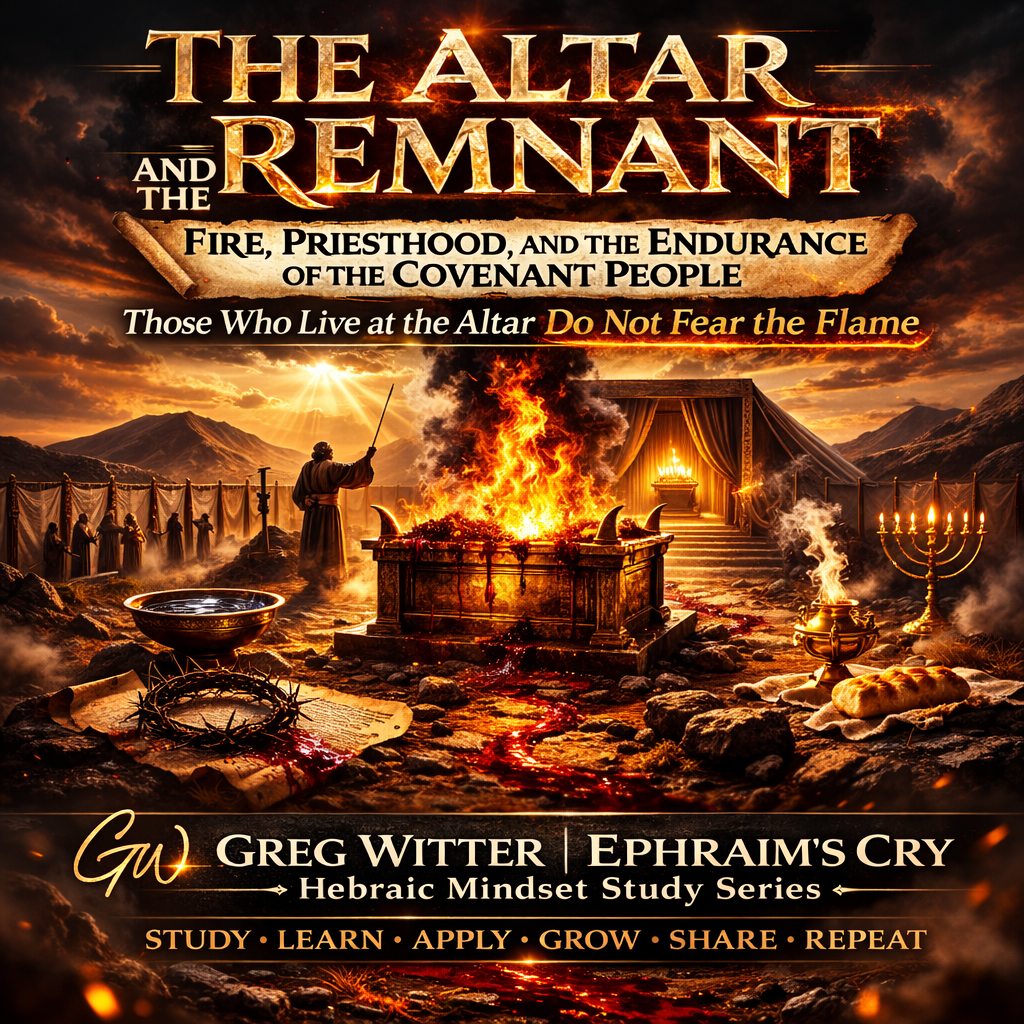
THE ALTAR AND THE REMNANT
Fire, Priesthood, and the Endurance of the Covenant People
Those Who Live at the Altar Do Not Fear the Flame
Greg Witter | Ephraim’s Cry
Hebraic Mindset Study Series
Study Learn Apply Grow Share Repeat
INTRODUCTION — FIRE DOES NOT CREATE FAITHFULNESS, IT REVEALS IT
Fire does not make a man covenantal.
It reveals whether he already is.
Pressure does not produce obedience.
It exposes whether obedience was ever rooted in surrender.
The altar is not proven in comfort.
It is proven when flame intensifies.
Part One established the altar as the architecture of approach — blood, surrender, covenant access.
Part Two now asks:
What happens when altar people are tested?
Because Scripture is not silent about this. From Torah to Revelation, the altar stands not only as a place of access — but as a place of identity under pressure.
I. TORAH — THE ALTAR IS STRUCTURE, NOT SYMBOL
The bronze altar (Exodus 27) was not decorative. It was the legal gateway into covenant space.
No priest entered the Holy Place without first dealing with blood.
Exodus 29:12 — blood applied to the horns of the altar.
Leviticus 6:13 — fire shall never go out.
The altar was maintained daily.
And then comes Leviticus 10.
Nadab and Abihu offer strange fire.
Fire that did not originate from the commanded source.
And they are consumed.
Why?
Because covenant worship is not self-designed.
The source of fire matters.
The lesson from Torah is clear:
• Fire must come from Yahuah
• Blood must precede approach
• Order must be maintained
• Priesthood must function properly
The altar does not bend to creativity.
It demands alignment.
II. THE PROPHETS — BROKEN ALTARS AND RESTORED FIRE
By the time of Elijah, Israel still had identity — but the altar was broken.
1 Kings 18:30
“Elijah repaired the altar of Yahuah that was broken down.”
He did not begin with fire.
He began with structure.
He rebuilt with twelve stones — covenant identity.
Only after covenant order was restored did fire fall.
Fire does not validate mixture.
Fire confirms obedience.
Jeremiah 6:16 calls Israel back to the ancient paths.
Isaiah 6 shows a coal taken from the altar touching the prophet’s lips — purification preceding commission.
Ezekiel 44 rebukes priests who allowed defilement into the sanctuary.
The prophets repeatedly warn:
When altar is neglected, corruption enters.
When covenant order collapses, judgment follows.
The prophetic pattern reinforces Torah:
• Repair precedes fire
• Purity precedes power
• Consecration precedes commission
III. THE WRITINGS — THE INWARD ALTAR
Psalm 51:17
“The sacrifices of Elohim are a broken spirit…”
David reveals the inward altar.
Not only external structure — but internal surrender.
The true altar is not merely bronze and wood.
It is the heart laid open.
Psalm 24:3–4
“Who shall ascend…? He that hath clean hands and a pure heart.”
Psalm 1 contrasts two paths.
One rooted in Torah.
One rooted in counsel of the wicked.
The inward altar forms:
• Contrition
• Humility
• Softness toward correction
• Alignment with instruction
Without the inward altar, the outward structure becomes performance.
The writings deepen the pattern:
Altar must exist internally before it endures externally.
IV. THE APOSTOLIC WITNESS — THE ALTAR FULFILLED AND CONTINUED
Hebrews 13:10
“We have an altar…”
The altar did not disappear at the execution stake.
It intensified.
Hebrews 9–10 builds the covenant argument:
Blood once for all.
Access opened.
Veil torn.
But then comes warning.
Hebrews 10:29
How much sorer punishment for those who trample the Son and count the blood common?
The apostolic witness makes something clear:
Grace is not casual.
Blood is not cheap.
Justification does not eliminate obedience.
Romans 12:1
Present your bodies a living sacrifice.
Living sacrifice means:
The altar is now daily.
1 Peter 2:5
You are built as spiritual priests to offer spiritual sacrifices.
Revelation 1:6
Made kings and priests.
The priesthood did not end.
It expanded.
The altar is now carried in the life of the believer.
V. REVELATION — THE REMNANT UNDER THE ALTAR
Revelation 6:9
Souls under the altar slain for the Word and testimony.
Revelation 8
Incense rising from the altar before judgment falls.
Revelation 12:11
They overcame by blood and testimony and loved not their lives unto death.
Revelation 14:12
They keep the commandments and the faith of Yahusha.
The remnant identity is altar language.
They are not lawless.
They are not performance-driven.
They are covenantally aligned and blood-redeemed.
The altar defines the remnant.
VI. THE COST OF DISCIPLESHIP — FIRE TESTS MATERIAL
1 Corinthians 3:12–15
Gold. Silver. Precious stones.
Wood. Hay. Stubble.
Fire tests everything.
Luke 14:26–33
Count the cost.
John 12:24
Unless a grain falls and dies, it remains alone.
Hebrews 12:4
Resisting unto blood.
The altar prepares you for cost.
If you have already died in surrender, persecution cannot control you.
If self has already been crucified, accusation has no leverage.
VII. WHAT ALTAR PEOPLE LOOK LIKE
Altar-formed disciples are not loud.
They are stable.
They:
• Repent quickly
• Guard speech
• Refuse bitterness
• Keep Sabbath discipline
• Maintain prayer under pressure
• Teach without compromise
• Endure without theatrics
They do not chase platform.
They guard presence.
They do not panic in opposition.
They remain steady.
Because their identity was forged before flame intensified.
VIII. WHY OPPOSITION COMES
Those who repair altars threaten systems built on mixture.
Elijah was opposed.
Jeremiah was rejected.
Yahusha was crucified.
The apostles were persecuted.
Opposition is not anomaly.
It is confirmation.
When altar is rebuilt, Baal is threatened.
Expect resistance.
Stand anyway.
IX. THE FULL COVENANT PATTERN
From Genesis to Revelation:
• Blood establishes access
• Fire confirms acceptance
• Priesthood maintains order
• Brokenness sustains purity
• Commandments define faithfulness
• Testimony declares allegiance
• Endurance proves authenticity
This is altar theology in full arc.
CONCLUSION — DO NOT FEAR THE FIRE
Do not ask for influence.
Ask for surrender.
Do not pray for platform.
Pray for altar.
Do not seek to avoid flame.
Seek to be formed before it comes.
Because those who dwell at the altar are not destroyed by fire.
They are refined by it.
And when judgment shakes nations,
altar-formed people remain steady.
REINFORCEMENT SUMMARY
The altar:
• Defines covenant access
• Guards priesthood identity
• Produces inward humility
• Anchors obedience
• Prepares for persecution
• Forms remnant endurance
Without altar:
Pressure produces compromise.
With altar:
Pressure produces refinement.
HASHTAGS
#EphraimsCry #GregWitter #AltarAndRemnant #TorahAndTestimony #KeepTheCommandments #FaithOfYahusha
#CovenantEndurance #WatchmanCall #ReturnToCovenant #Overcomers
