
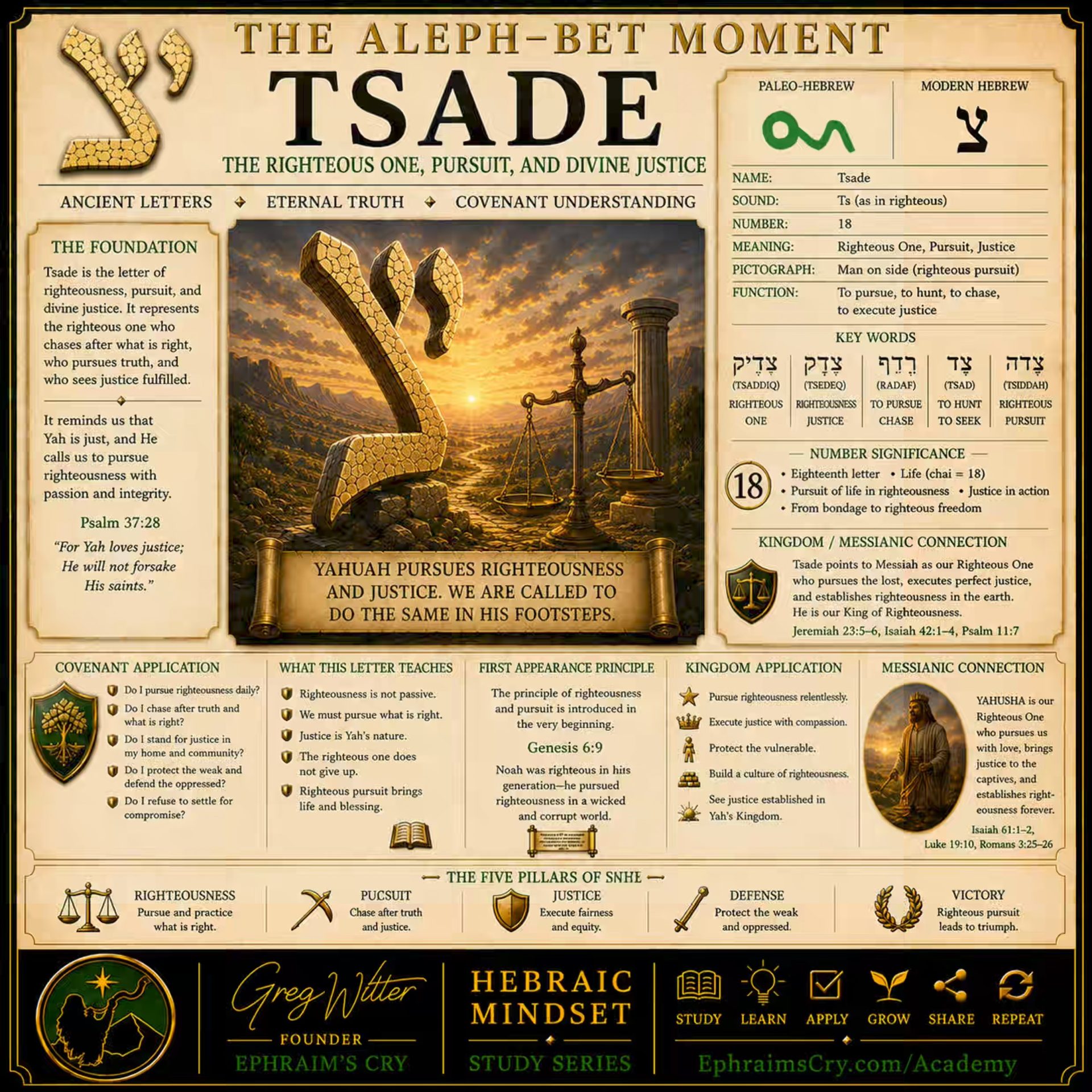
THE ALEPH-BET MOMENT
Tsade
The Righteous One, Humility, and the Path of Covenant Faithfulness
Ancient Letters • Eternal Truth • Covenant Understanding
Greg Witter | Ephraim’s Cry
Hebraic Mindset Study Series
Study • Learn • Apply • Grow • Share • Repeat
Introduction
The eighteenth letter of the Hebrew Aleph-Bet is Tsade. If Pe teaches us about speaking truth, Tsade teaches us how truth is lived.
Tsade is the letter of righteousness.
The letter of humility.
The letter of obedience.
The letter of covenant faithfulness.
Throughout Scripture, righteousness is not merely believing the right things. Righteousness is walking in right relationship with Yahuah according to His covenant instructions. The righteous do not simply hear the Word. They live it.
Tsade reminds us that true righteousness is visible.
It produces fruit.
It shapes conduct.
It reveals character.
It demonstrates covenant loyalty.
The Letter
Paleo-Hebrew: 𐤑
Modern Hebrew: צ
Name: Tsade
Sound: Ts
Numerical Value: 90
The Ancient Picture
The original Paleo-Hebrew Tsade is commonly understood as a man lying down, a humble person, or a righteous one submitted to authority.
To the ancient Hebrew, righteousness was connected to humility.
The righteous person recognizes the authority of Yahuah.
The righteous person submits to His instructions.
The righteous person walks according to covenant.
The pictograph reflects a posture of surrender rather than self-exaltation.
Definition
Righteous One.
Humility.
Submission.
Function
To obey.
To walk uprightly.
To submit.
To live faithfully.
Covenant Role
Tsade reminds us that covenant life is measured by faithfulness.
Scripture repeatedly describes the righteous as those who walk in the ways of Yahuah.
Noah was called righteous.
Abraham was counted righteous.
David desired righteousness.
The prophets called Israel back to righteousness.
The covenant is not sustained by religious appearance.
It is sustained by faithful obedience.
The Number Ninety
Tsade carries the numerical value of ninety.
Throughout Scripture, ninety is often associated with fulfillment following a long season of waiting.
Sarah was ninety years old when the promised son was born.
The number frequently points toward covenant promises brought to fulfillment through faithfulness.
Word-Picture Development
The humble servant bows before the king.
The faithful disciple follows the teacher.
The righteous man walks in obedience.
The ancient Hebrew understood that righteousness begins with submission.
Before there is fruit, there must be surrender.
Before there is blessing, there must be obedience.
The pictograph teaches that true greatness is found in humble faithfulness.
Key Hebrew Words
Tsaddiq (צדיק)
Righteous.
Just.
Upright.
The foundational word associated with Tsade.
Tsedaqah (צדקה)
Righteousness.
Justice.
Right conduct.
Tsiyon (ציון)
Zion.
The covenant dwelling place associated with Yahuah’s kingdom purposes.
Tsemach (צמח)
Branch.
Sprout.
A prophetic title associated with Messianic expectation.
These words reveal recurring themes of righteousness, justice, growth, covenant faithfulness, and future restoration.
First Appearance Principle
One of the clearest early Tsade themes appears in Noah.
Genesis repeatedly identifies Noah as righteous in his generation.
His righteousness distinguished him from the corruption surrounding him.
His faithfulness preserved his household.
From the beginning, righteousness becomes the dividing line between covenant faithfulness and rebellion.
Letter Throughout Scripture
Tsade themes appear throughout the Bible.
Noah walks faithfully.
Abraham obeys.
Joseph remains upright.
David seeks righteousness.
The Psalms celebrate the righteous.
The prophets call for righteousness and justice.
Again and again, Scripture reveals that righteousness is demonstrated through covenant faithfulness.
The Letter and Yahusha
The themes of Tsade find perfect fulfillment in Yahusha.
He is the Righteous One.
He walks in complete obedience.
He fulfills the Father’s will.
He demonstrates perfect covenant faithfulness.
Every aspect of His life reveals righteousness in action.
Yahusha becomes the ultimate example of Tsaddiq.
The Letter in the Name of Yahuah
The themes associated with Tsade reveal Yahuah as perfectly righteous, perfectly just, and perfectly faithful.
His standards never change.
His judgments are always true.
His ways are always right.
The Letter in the Name of Yahusha
The ministry of Yahusha reflects the righteousness, humility, obedience, and faithfulness associated with Tsade.
He teaches righteousness.
He demonstrates righteousness.
He calls His followers to walk in righteousness.
Covenant Application
Tsade challenges us to examine our walk.
Are we merely hearing truth?
Or are we living truth?
Do our actions reflect covenant faithfulness?
Do our decisions reflect submission to Yahuah?
Righteousness is not perfection.
Righteousness is faithful obedience.
The covenant life requires humility and submission to the authority of Yahuah.
Aleph-Bet Moment
The righteous person walks differently.
The righteous person thinks differently.
The righteous person lives differently.
Tsade reminds us that righteousness is not merely a doctrine.
It is a way of life.
True righteousness is visible through humble obedience and covenant faithfulness.
Discussion Questions
- Why is Tsade associated with righteousness?
- How does humility relate to righteousness?
- What is the difference between religious appearance and covenant faithfulness?
- What significance does the number ninety carry?
- How did Yahusha fulfill the themes of Tsade?
- Why was Noah called righteous?
- What does righteous living look like today?
Fill-in-the-Blank Review
- Tsade is the __________ letter of the Hebrew alphabet.
- The original pictograph for Tsade represented a __________ person.
- Tsade carries the numerical value of __________.
- Tsade is associated with righteousness and __________.
- The Hebrew word Tsaddiq means __________.
- Righteousness is demonstrated through __________.
- Covenant faithfulness requires __________.
Key Terms
Tsade — The eighteenth letter of the Hebrew alphabet.
Tsaddiq — Righteous person.
Tsedaqah — Righteousness and justice.
Humility — Submission to Yahuah’s authority.
Obedience — Walking according to covenant instructions.
Faithfulness — Consistent loyalty to Yahuah.
Closing Charge
The journey through the Aleph-Bet continues with Tsade.
The letter of righteousness.
The letter of humility.
The letter of covenant faithfulness.
Aleph taught us authority.
Bet taught us the house.
Gimel taught us provision.
Dalet taught us access.
Hey taught us revelation.
Waw taught us connection.
Zayin taught us defense.
Chet taught us boundaries.
Tet taught us hidden character.
Yod taught us action.
Kaph taught us stewardship.
Lamed taught us instruction.
Mem taught us provision.
Nun taught us continuity.
Samekh taught us support.
Ayin taught us perception.
Pe taught us proclamation.
Tsade teaches us that truth must not only be seen and spoken—it must be lived.
Want to go deeper?
Get the Aleph-Bet Restoration Bundle and continue your journey through the language of Scripture.
Restore the Language. Recover the Covenant.
Study it. Learn it. Teach it. Share it.
#GregWitter #EphraimsCry #HebraicMindsetStudySeries #AlephBetMoment #Tsade #Tsaddiq #Righteousness #CovenantFaithfulness #PaleoHebrew #AncientHebrew #HebrewAlphabet #BiblicalHebrew #HebraicMindset #TorahStudy #BibleStudy #ScriptureStudy #HebrewLetters #CovenantLanguage #Humility #Obedience #Justice #KingdomLiving #GospelOfTheKingdom #Remnant #Watchman #BiblicalTruth #Torah #Yahuah #Yahusha
