
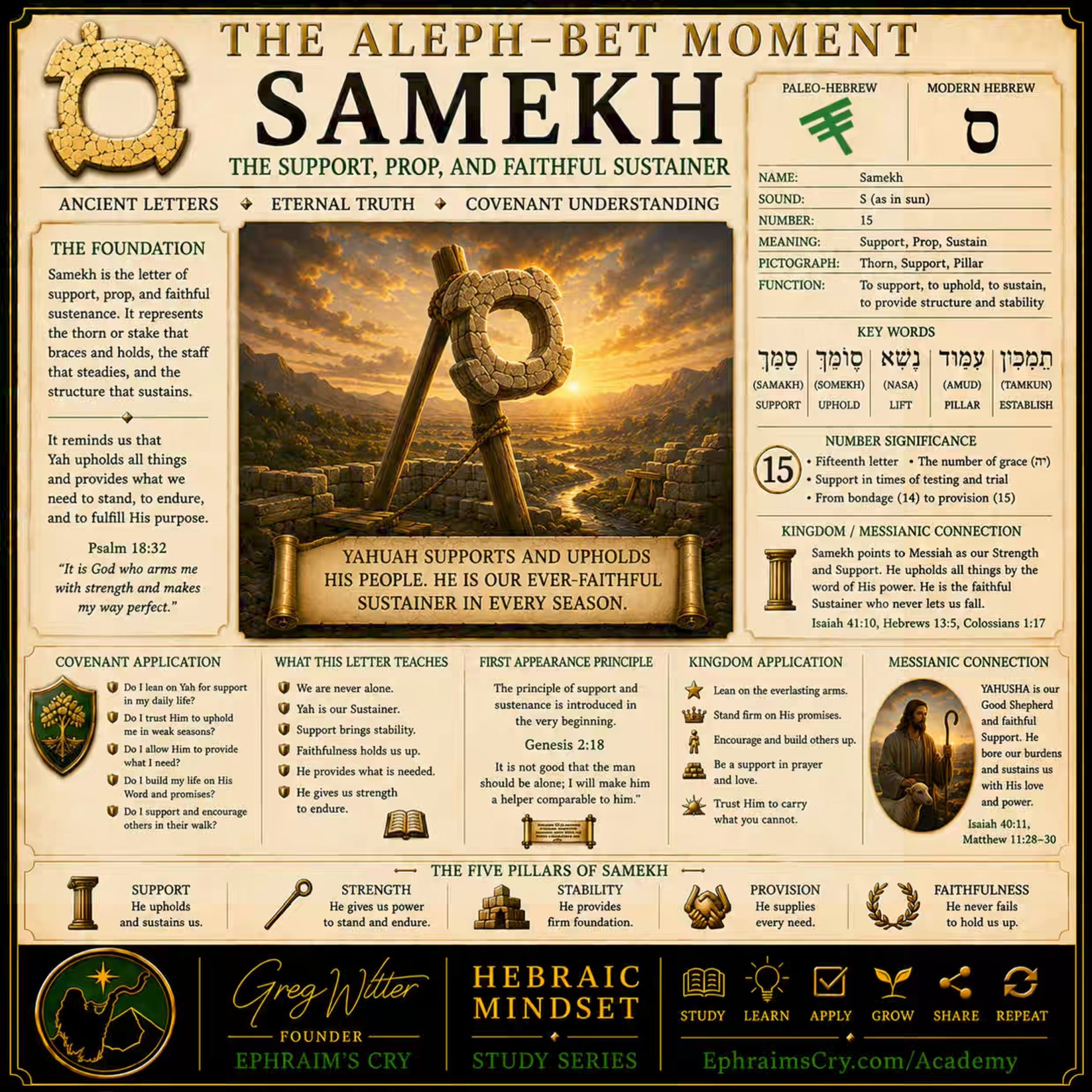
THE ALEPH-BET MOMENT
Samekh
The Support, Protection, and Covenant Foundation
Ancient Letters • Eternal Truth • Covenant Understanding
Greg Witter | Ephraim’s Cry
Hebraic Mindset Study Series
Study • Learn • Apply • Grow • Share • Repeat
Introduction
The fifteenth letter of the Hebrew Aleph-Bet is Samekh. If Nun teaches us about the seed and future generations, Samekh teaches us what sustains that growth.
Samekh is the letter of support.
The letter of protection.
The letter of sustaining strength.
The letter of the foundation that keeps something standing.
Every seed requires support to grow.
Every family requires support to thrive.
Every nation requires support to endure.
Every covenant relationship depends upon the sustaining faithfulness of Yahuah.
Samekh reminds us that we stand not because of our own strength, but because Yahuah upholds what belongs to Him.
The Letter
Paleo-Hebrew: 𐤎
Modern Hebrew: ס
Name: Samekh
Sound: S
Numerical Value: 60
The Ancient Picture
The original Paleo-Hebrew Samekh is commonly understood as a support, prop, pillar, or protective enclosure.
To the ancient Hebrew, support structures were essential.
A tent required poles.
A roof required beams.
A wall required reinforcement.
A vine required support.
Without support, collapse eventually follows.
The pictograph teaches stability, dependence, and preservation.
Definition
Support.
Prop.
Foundation.
Function
To uphold.
To strengthen.
To sustain.
To protect.
Covenant Role
Samekh reminds us that covenant life is sustained by Yahuah.
He supports His people.
He strengthens His people.
He preserves His people.
He upholds His covenant.
Again and again throughout Scripture, Yahuah demonstrates His faithfulness by sustaining those who trust in Him.
The covenant survives because the Covenant Maker remains faithful.
The Number Sixty
Samekh carries the numerical value of sixty.
Throughout Scripture, sixty is often associated with:
Strength.
Abundance.
Provision.
Established order.
Mature fruitfulness.
While less prominent than some other biblical numbers, sixty frequently appears in contexts involving increase, maturity, and stability.
Word-Picture Development
A support beam is rarely noticed.
People admire the building.
People admire the roof.
People admire the structure.
Yet hidden within the structure are supports holding everything together.
The ancient Hebrew understood that unseen support is often more important than visible beauty.
The pictograph teaches that lasting strength requires a solid foundation.
Key Hebrew Words
Samekh (סמך)
To support.
To uphold.
To sustain.
The foundational word associated with the letter itself.
Sefer (ספר)
Book.
Written record.
A preserved witness.
Sod (סוד)
Counsel.
Secret.
Hidden wisdom revealed by Yahuah.
Sela (סלע)
Rock.
A place of strength and stability.
These words reveal recurring themes of preservation, wisdom, support, and stability.
First Appearance Principle
One of the earliest Samekh themes appears in the preservation of Noah and his family.
While judgment falls upon the earth, Yahuah provides support and protection through the Ark.
The Ark becomes a picture of divine preservation.
Yahuah sustains what He purposes to preserve.
Letter Throughout Scripture
Samekh themes appear throughout the Bible.
Yahuah sustains Abraham.
He strengthens Joseph.
He preserves Israel in Egypt.
He supports Mosheh.
He upholds David.
He preserves a remnant through times of judgment.
Again and again, Scripture reveals the sustaining hand of Yahuah working behind the scenes.
The Letter and Yahusha
The themes of Samekh find powerful fulfillment in Yahusha.
He strengthens the weary.
He upholds the weak.
He restores the broken.
He sustains those who trust in Him.
He repeatedly invites people to find rest, strength, and support in the Father’s provision.
The Letter in the Name of Yahuah
The themes associated with Samekh reveal Yahuah as the One who upholds creation, sustains covenant, and preserves His promises throughout every generation.
The Letter in the Name of Yahusha
The ministry of Yahusha reflects the sustaining and preserving themes of Samekh through healing, restoration, discipleship, and covenant faithfulness.
Covenant Application
Samekh challenges us to examine the foundation upon which we are standing.
What supports our lives?
What sustains our faith?
What anchors our decisions?
When difficulties arise, weak foundations become visible.
Strong foundations endure.
The covenant life requires dependence upon the One who never fails.
Aleph-Bet Moment
A building stands because of its supports.
A vine grows because it is upheld.
A family survives because it is strengthened.
Samekh reminds us that covenant life is sustained by Yahuah.
He is the support behind the structure.
He is the strength behind the endurance.
He is the foundation beneath the covenant.
Discussion Questions
- Why is Samekh represented by support or a prop?
- What role did support structures play in ancient Hebrew life?
- How does Samekh reveal the faithfulness of Yahuah?
- What significance does the number sixty carry?
- How did Yahusha demonstrate the themes of Samekh?
- What foundations are supporting our lives?
- How can believers strengthen their covenant foundation?
Fill-in-the-Blank Review
- Samekh is the __________ letter of the Hebrew alphabet.
- The original pictograph for Samekh was a __________.
- Samekh carries the numerical value of __________.
- Samekh is associated with support and __________.
- The Hebrew word Samekh means to __________.
- Covenant life is sustained by __________.
- Strong foundations produce __________.
Key Terms
Samekh — The fifteenth letter of the Hebrew alphabet.
Support — The original pictographic image associated with Samekh.
Foundation — The base upon which something stands.
Preservation — Being sustained and protected.
Sela — Rock, strength, stability.
Faithfulness — The enduring reliability of Yahuah.
Closing Charge
The journey through the Aleph-Bet continues with Samekh.
The letter of support.
The letter of preservation.
The letter of covenant stability.
Aleph taught us authority.
Bet taught us the house.
Gimel taught us provision.
Dalet taught us access.
Hey taught us revelation.
Waw taught us connection.
Zayin taught us defense.
Chet taught us boundaries.
Tet taught us hidden character.
Yod taught us action.
Kaph taught us stewardship.
Lamed taught us instruction.
Mem taught us life-giving provision.
Nun taught us covenant continuity.
Samekh teaches us that everything Yahuah plants, He also sustains.
The same Elohim who begins the work is faithful to uphold it.
Want to go deeper?
Get the Aleph-Bet Restoration Bundle and continue your journey through the language of Scripture.
Restore the Language. Recover the Covenant.
Study it. Learn it. Teach it. Share it.
#GregWitter #EphraimsCry #HebraicMindsetStudySeries #AlephBetMoment #Samekh #Support #Foundation #CovenantStrength #PaleoHebrew #AncientHebrew #HebrewAlphabet #BiblicalHebrew #HebraicMindset #TorahStudy #BibleStudy #ScriptureStudy #HebrewLetters #CovenantLanguage #Faithfulness #Preservation #Stability #KingdomLiving #GospelOfTheKingdom #Discipleship #Remnant #Watchman #BiblicalTruth #Torah #Yahuah #Yahusha
