
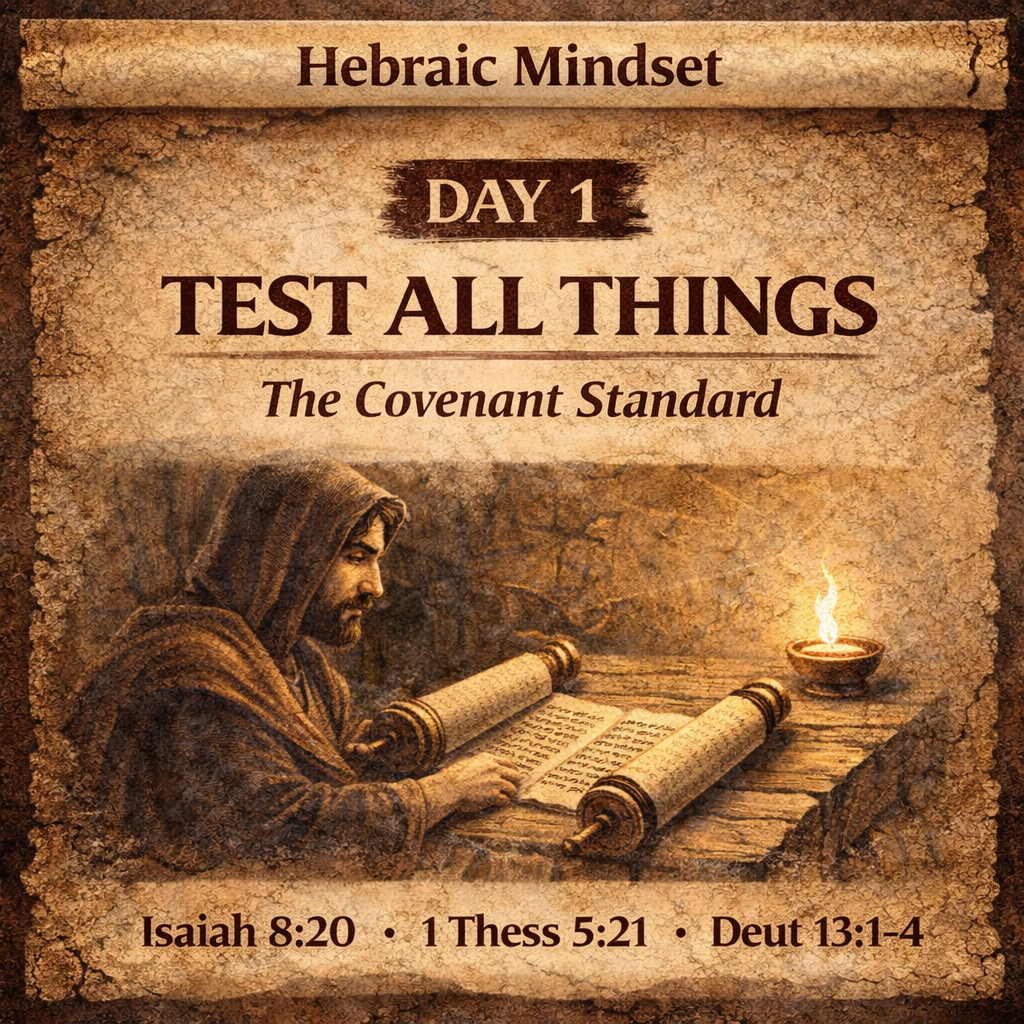
TEST ALL THINGS
The Covenant Standard for Discernment
Truth is not assumed — it is proven
Greg Witter | Ephraim’s Cry
Hebraic Mindset Study Series
Study Learn Apply Grow Share Repeat
Orientation
Day One establishes the non-negotiable foundation for everything that follows in this series. Before corruption can be identified, before priesthood can be evaluated, before access, obedience, or renewal can be discussed, one question must be settled:
By what standard is truth measured?
Scripture does not leave this open to interpretation, personality, tradition, or institutional authority. From the Torah forward, Yahuah has required His people to test all claims, prove all instruction, and reject anything that deviates from His revealed Word. Discernment is not a spiritual gift reserved for a few—it is a covenant responsibility placed upon all who claim allegiance to Him.
This teaching addresses why testing is required, how Scripture defines the test, and why failure to test inevitably leads to deception, corruption, and covenant collapse.
The Command to Test Is Explicit
1 Thessalonians 5:21
“Test all things; hold fast what is good.”
Paul’s instruction is not advisory. It is a command. The phrase “test all things” assumes three realities:
Not everything presented as truth is truth
Truth can be objectively tested
Believers are accountable for whether they test or not
Testing requires a fixed reference point. Without a standard, “testing” becomes subjective preference. Scripture never authorizes that. Paul’s instruction assumes continuity with the covenant Scriptures already established—Torah, Prophets, and Writings (Romans 3:31; Acts 17:11).
Notice also that Paul does not say “test some things” or “test things you disagree with.” He says all things. Popular teaching, inherited tradition, charismatic leaders, supernatural experiences—none are exempt.
The Torah and the Testimony Are the Standard
Isaiah 8:20
“To the Torah and to the testimony! If they do not speak according to this word, it is because there is no light in them.”
Isaiah’s statement is absolute. He does not say there is less light, or partial light. He says no light. That means sincerity, passion, religious activity, or claimed spiritual experiences cannot compensate for deviation from the Word.
This verse also defines the method of discernment:
Torah: the covenant instruction defining righteousness and sin
Testimony: the witness of what Yahuah has spoken and done
Anything that contradicts Torah or undermines covenant obedience fails the test—regardless of how persuasive, emotional, or widespread it may be (Psalm 119:105; Deuteronomy 4:2).
This is why Scripture never allows doctrine to evolve beyond obedience. Growth in understanding never means departure from the standard; it means deeper alignment with it.
Signs Do Not Override Obedience
Deuteronomy 13:1–4
This passage dismantles one of the most dangerous assumptions in religious culture: that supernatural manifestation validates a message.
Yahuah warns Israel that even if a sign or wonder occurs—and even if it comes to pass—if the message leads people away from obedience, it is a test. The purpose of the test is to reveal where the heart truly stands.
The criteria is clear:
Does the message lead to loyalty to Yahuah?
Does it uphold His commandments?
Does it preserve covenant faithfulness?
If the answer is no, the messenger is false—no matter how impressive the experience may appear.
This principle alone disqualifies vast portions of modern teaching that elevate experience above obedience and feeling above instruction. Scripture consistently places faithfulness over fascination (Matthew 7:21–23; Jeremiah 23:16–22).
Why Testing Is Resisted
Testing is resisted for one primary reason: it removes plausible deniability.
When truth is measured objectively, people can no longer hide behind:
“That’s how I was taught”
“That’s my denomination”
“That’s what my pastor said”
“That’s what feels right to me”
Testing forces responsibility. Once something has been measured against Scripture, neutrality ends. This is why awakening is not comfortable—it carries accountability (Ezekiel 33:7–9; James 4:17).
This also explains why corrupted systems discourage testing. Authority that cannot withstand examination relies on control, not truth. Scripture, by contrast, invites scrutiny because it does not fear exposure (Psalm 119:160; John 17:17).
The Berean Pattern
Acts 17:11
The Bereans are praised—not for emotional response, not for submission to apostolic authority alone—but because they searched the Scriptures daily to verify what they were being taught.
This is critical. Paul did not rebuke them for questioning an apostle. Scripture commends them for it. That alone destroys the idea that questioning leaders is rebellion. In Scripture, unquestioned authority is the danger, not discernment.
The Berean model establishes the correct relationship between teaching and testing:
Teachers speak
Scripture judges
The hearer is responsible
This is covenant order.
The Consequences of Failing to Test
Failure to test always produces the same outcomes:
Truth becomes mixed with error (Galatians 1:6–9)
Obedience is reframed as optional (Judges 21:25)
Leaders drift without accountability (Malachi 2:8)
The people stumble and are destroyed (Hosea 4:6)
Scripture does not treat this lightly. Testing is not an intellectual exercise; it is a protective function designed to preserve covenant fidelity and guard the people from deception (Matthew 24:4; Revelation 2:2).
The Watchman Call
Testing is not divisive. Truth divides light from darkness. Division comes when error is defended, not when truth is clarified (Hebrews 4:12).
Day One sets the foundation:
If a message cannot be tested by Torah and testimony, it cannot be trusted.
If a teaching discourages testing, it reveals its own insecurity.
If obedience is diminished, the message has already failed.
Everything that follows in this series builds on this single, immovable principle.
Closing Charge
Do not assume truth.
Do not inherit doctrine without proof.
Do not submit your conscience to men.
Test all things.
Hold fast what is good.
Walk in covenant faithfulness.
Tomorrow, we will examine what happens when priesthood itself becomes corrupted—and how Scripture identifies that corruption without ambiguity.
#EphraimsCry #GregWitter #HebraicMindset #HebraicMindsetStudySeries #TestAllThings #Isaiah820 #FirstThessalonians521 #Deuteronomy13 #Acts1711 #TorahTruth #CovenantFaithfulness #Discernment #Watchman #WholeCounsel
