
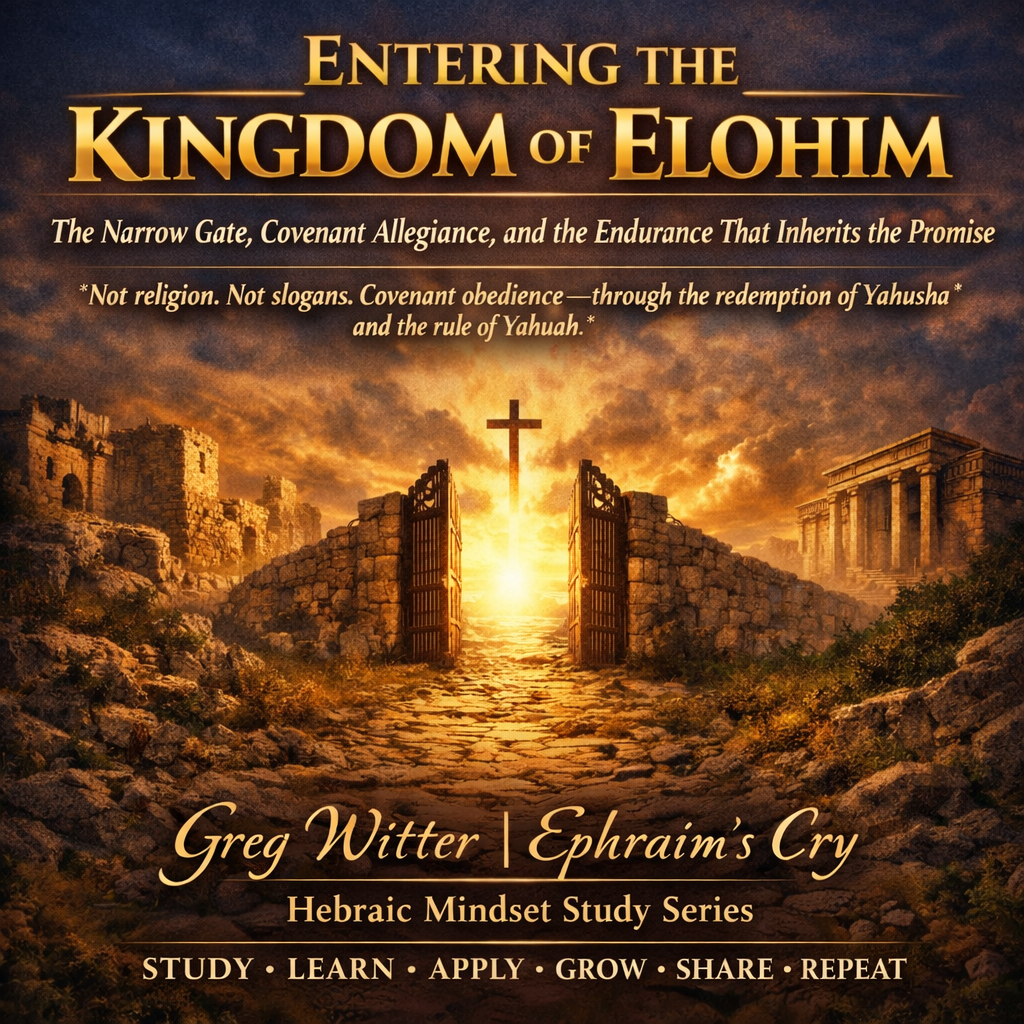
Present Without Compromise: Entering the Kingdom of Elohim
The Narrow Gate, Covenant Allegiance, and the Endurance That Inherits the Promise
Not religion. Not slogans. Covenant obedience—through the redemption of Yahusha and the rule of Yahuah.
Greg Witter | Ephraim’s Cry
Hebraic Mindset Study Series
Study • Learn • Apply • Grow • Share • Repeat
The question is simple, but it is not shallow: “What must I do to enter the Kingdom of Elohim?” Scripture does not treat this as an abstract theological debate. It treats it as life-and-death reality. And the reason the question matters is because churchianity has trained people to answer it with slogans, not Scripture; with systems, not covenant; with emotions, not obedience; with denomination language, not the whole council of Elohim. That is why the internet is filled with confident answers that are spiritually lethal—because they sound comforting while quietly contradicting the Torah, the Prophets, the Writings, and the Apostolic witness.
So we will answer the question the only lawful way: by the four witnesses of Scripture, in covenant context, with the full weight of the text speaking for itself. Not cherry-picked. Not trimmed down. Not modified for modern comfort.
First, we must establish the biblical definition of the Kingdom. The Kingdom is not “going to heaven when you die.” The Kingdom is the reign, rule, authority, and government of Yahuah established through His Messiah. That Kingdom has present reality (submission now) and future manifestation (resurrection, judgment, and the restored earth under the King). This is why Yahusha preached “the Gospel of the Kingdom” and called men to repentance as the entrance response (Matthew 4:17; Mark 1:14–15). The Kingdom is not merely a destination; it is a dominion. To ask how to enter the Kingdom is to ask how to come under the rightful rule of the King—lawfully, covenantally, and truly.
And Scripture is blunt: not everyone who claims the King will enter His Kingdom. Many will be rejected precisely because they practiced lawlessness while using His Name as cover.
“Not everyone who says to Me, ‘Lord, Lord,’ shall enter the Kingdom of Heaven, but he who does the will of My Father in heaven.” (Matthew 7:21)
“Many will say to Me in that day… ‘Have we not… done many mighty works?’ And then I will declare to them, ‘I never knew you; depart from Me, you who practice lawlessness!’” (Matthew 7:22–23)
This instantly destroys the modern lie that verbal confession or religious activity equals entrance. Yahusha does not reject them for lacking religious claims. He rejects them for lawlessness—because the Kingdom is a government, and governments do not inherit rebels. You can say “Lord” and still be a rebel. You can do ministry and still be lawless. The Kingdom does not belong to those who use the King’s Name while refusing the King’s rule.
So what must a man do to enter?
Repentance is the first gate, because repentance is the turning of the heart back to covenant order. Repentance is not a church ritual. It is not emotional sorrow. It is a change of direction and a return to obedience. Yahusha’s first public proclamation establishes the Kingdom entry point: “Repent, for the Kingdom of Heaven is at hand.” (Matthew 4:17). The prophetic witness matches it: “Let the wicked forsake his way… and let him return to Yahuah.” (Isaiah 55:7). The Torah witness matches it: “Return to Yahuah your Elohim… and obey His voice.” (Deuteronomy 30:1–2). True repentance always includes a return to covenant alignment, because the King’s government runs on the King’s instructions. Repentance that refuses obedience is not repentance; it is self-soothing.
But repentance alone is not the entire answer, because Scripture also requires faith—yet not the invented faith of churchianity that demands no obedience. Biblical faith is allegiance. It is trust that produces submission. That is why Scripture never separates faith from walking.
“Faith without works is dead.” (James 2:17)
“Even the demons believe—and tremble.” (James 2:19)
“Here is the patience of the saints; here are those who keep the commandments of Elohim and the faith of Yahusha.” (Revelation 14:12)
“And the dragon was enraged with the woman, and went to make war with the remnant… who keep the commandments of Elohim and have the testimony of Yahusha Messiah.” (Revelation 12:17)
These are not fringe verses. These are end-times identity markers. They define the remnant who endure. The Kingdom does not belong to a people who claim faith while rejecting obedience. The Kingdom belongs to those who have the faith of Yahusha and keep the commandments of Elohim.
Now we must state plainly what churchianity tries to hide: the Kingdom requires redemption, because all men are born under the curse of sin and death. You cannot “work your way” into the Kingdom, because the debt must be paid. The legal claim of death must be broken. That is why Scripture presents Yahusha as Kinsman-Redeemer, Lamb, and High Priest. Redemption is not merely “forgiveness.” Redemption is purchase—buying back what was lost. That is why the Apostolic witness says, “You were bought with a price.” (1 Corinthians 6:20). That is why Messiah’s blood is the covenant blood, because blood deals with life-for-life and debt settlement (Leviticus 17:11; Hebrews 9:22). That is why the Gospel includes the proclamation that He “gave Himself a ransom” (Mark 10:45; 1 Timothy 2:6). Redemption is the legal act that breaks the slave-master claim. Without that, no one enters.
But redemption is not permission to remain a rebel. This is where churchianity’s “grace” gospel becomes lawlessness. Scripture never teaches that the King dies to excuse rebellion. He dies to redeem us out of it.
“Do we then make void the law through faith? Certainly not! On the contrary, we establish the law.” (Romans 3:31)
“What then? Shall we sin because we are not under law but under grace? Certainly not!” (Romans 6:15)
“Being then made free from sin, you became slaves of righteousness.” (Romans 6:18)
Redemption changes ownership. It does not eliminate government. It transfers you from the dominion of darkness into the Kingdom of the Son (Colossians 1:13). And if you are now in the Kingdom, you are under the King’s rule. There is no Kingdom without Torah, because Torah is instruction, direction, and covenant order.
But “entering” also requires new birth, because the Kingdom is not inherited by flesh. Yahusha is explicit: “Unless one is born from above, he cannot see the Kingdom of Elohim.” (John 3:3). This is covenant language: a new heart, a new spirit, and Torah written within.
“I will give you a new heart and put a new spirit within you… and cause you to walk in My statutes, and you shall keep My judgments and do them.” (Ezekiel 36:26–27)
“I will put My Torah within them, and write it on their hearts.” (Jeremiah 31:33)
This is the New Covenant in plain terms: not abolition of Torah, but internalization of Torah. Not removal of obedience, but empowerment unto obedience. Not freedom to be lawless, but freedom from sin’s mastery so the righteous requirement can be walked out. This is why grace is not permission. Grace is power. Grace trains.
“For the grace of Elohim that brings salvation has appeared… teaching us that, denying wickedness… we should live soberly, righteously, and reverently in the present age.” (Titus 2:11–12)
So if someone claims “grace means you’re not required to obey,” they are contradicting grace itself. Grace trains. Grace disciplines. Grace empowers obedience.
And because the Kingdom is a covenant government, Scripture makes a distinction that must be understood: obedience does not purchase redemption, but obedience proves allegiance. Obedience is not the price; it is the fruit. Yet fruitless faith is dead faith. The tree is known by fruit (Matthew 7:16–20). This is why Yahusha says:
“If you love Me, keep My commandments.” (John 14:15)
“He who has My commandments and keeps them, it is he who loves Me.” (John 14:21)
“Why do you call Me ‘Lord, Lord,’ and do not do what I say?” (Luke 6:46)
“Blessed are those who hear the word of Elohim and keep it.” (Luke 11:28)
John confirms the same:
“By this we know that we know Him, if we keep His commandments. He who says, ‘I know Him,’ and does not keep His commandments, is a liar, and the truth is not in him.” (1 John 2:3–4)
“For this is the love of Elohim, that we keep His commandments. And His commandments are not burdensome.” (1 John 5:3)
So the question “What must I do to enter the Kingdom?” cannot be answered with “Just believe and nothing else matters,” because Scripture calls that person a liar if they claim relationship while rejecting obedience. That lie is widespread because it produces a comfortable religion. It also produces a people unprepared for judgment.
And yes, endurance is required—not as earning, but as covenant faithfulness. The remnant are marked by patience, obedience, and testimony. That is why Revelation defines them as those who keep the commandments and the faith/testimony of Yahusha (Revelation 12:17; 14:12). That is why Messiah warns:
“He who endures to the end shall be saved.” (Matthew 24:13)
“Be faithful unto death, and I will give you the crown of life.” (Revelation 2:10)
“Hold fast what you have, that no one may take your crown.” (Revelation 3:11)
The Kingdom is inherited by overcomers, not by quitters, not by rebels, not by pretenders.
And Scripture provides a final, unignorable summary of entrance into the city—the Kingdom consummated:
“Blessed are those who do His commandments, that they may have the right to the tree of life, and may enter through the gates into the city.” (Revelation 22:14)
That is not “works salvation.” That is covenant reality: the redeemed are restored to obedience and therefore restored to access. Eden was lost by disobedience. The City is entered by those restored to covenant order under the King.
So here is the biblical answer in full covenant clarity, without churchianity confusion:
You enter the Kingdom of Elohim by repenting and returning to covenant order, believing the true Gospel of the Kingdom, being redeemed by the blood of Yahusha the Kinsman-Redeemer, being born from above into a new heart where Torah is written, walking in obedience empowered by grace through the Ruach, and enduring as a faithful witness—keeping the commandments of Elohim and holding the testimony of Yahusha.
Not slogans. Not denomination. Not performance religion. Not lawlessness with a Bible verse.
The Kingdom is the King’s government. To enter the Kingdom is to come under the King—His Name, His covenant, His instruction, His authority—by redemption, new birth, allegiance, obedience, and endurance.
If you want the Kingdom, you must want the King. If you want the King, you will submit to His rule. Anything else is churchianity.
HASTAGS
#EphraimsCry,#GregWitter,#HebraicMindset,#GospelOfTheKingdom,#Yahuah,#Yahusha,#Elohim,#Torah,
#Covenant,#Obedience,#FaithAndWorks,#EndureToTheEnd,#TestimonyOfYahusha,#CommandmentsOfElohim,
#Revelation1217,#Revelation1412,#Revelation2214,#NewCovenant,#TorahOnTheHeart,#RepentAndReturn,
#KinsmanRedeemer,#RedemptionByBlood,#GraceThatTrains,#ComeOutOfHer,#TrueEkklesia,
#Remnant,#KingdomGovernment,#Watchman,#PrepareTheWay,#PresentWithoutCompromise
