
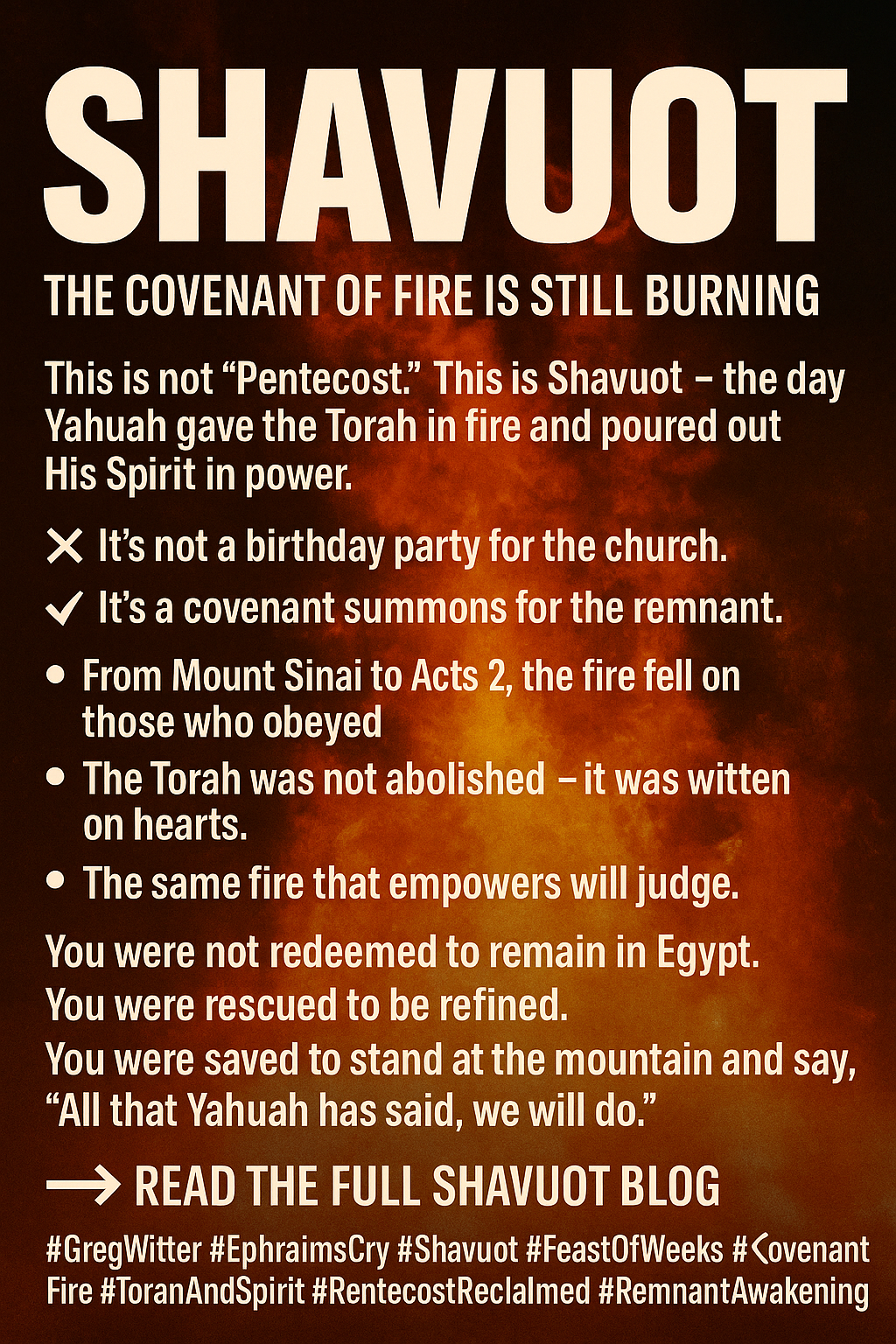
Shavuot — The Feast of Weeks
The Covenant of Fire, The Giving of the Word, and the Empowering of the Remnant
✍ By Greg Witter
Ephraim’s Cry | Hebraic Mindset Study Series
Proclaiming the Restoration of Truth — Study ◇ Learn ◇ Apply ◇ Grow ◇ Share ☆ Repeat
📖 Scripture Reading List
Torah
• Wayyiqra (Leviticus) 23:15–21
• Deḇarim (Deuteronomy) 16:9–12
Prophets
• Yeḥezqel (Ezekiel) 36:26–27
• Yirmeyahu (Jeremiah) 31:31–33
Writings
• Tehillim (Psalms) 119:142
• Mishlĕ (Proverbs) 6:23
Apostolic Writings
• Ma’asei (Acts) 2:1–4
• 1 Qorintiyim (1 Corinthians) 15:20–23
🔥 Introduction
Shavuot is not the birth of the church—it is the covenant empowerment of the remnant. It is the day where fire fell, not once, but twice. First on a mountain of stone, then on living stones. First as a voice that thundered, then as tongues of flame. Shavuot is the day Yahuah speaks covenant—and expects a covenant response.
Modern Christianity has lost this connection. Pentecost has become a spectacle, disconnected from Torah and severed from identity. But when restored to its rightful place in Yahuah’s appointed times, Shavuot reveals the full picture: a redeemed bride, standing at the mountain, being sealed with the covenant of fire.
Will you receive the Word—or will you reject the fire?
✏ Section 1: The Command to Count and the Day of Appointment
“Count seven weeks for yourself. Begin to count seven weeks from the time you begin to put the sickle to the grain. Then you shall observe the Feast of Weeks…”
— Deḇarim (Deuteronomy) 16:9–10, TS2009
Hebrew & Greek Roots
Shavuot (שָׁבוּעוֹת) — Weeks, sevens, cycles of time
Pentēkostē (πεντηκοστῆ) — Greek for “fiftieth”
Paleo-Hebrew Word Picture
• Shin (𐤔) = consume
• Bet (𐤁) = house
• Ayin (𐤏) = see
• Waw (𐤅) = secure
• Tav (𐤕) = covenant
→ “The house that sees and secures the covenant by fire”
Teaching
Shavuot begins with obedience to count. From the day after the Sabbath during Unleavened Bread, we count 49 days—7 complete Sabbaths—culminating in the 50th day. This appointed time is fixed by Torah, not tradition. It marks not just the wheat harvest, but the moment when the Redeemed are called to maturity. The counting is not just about time—it’s about preparation.
Prophetic Insights
• Counting the Omer is covenant rehearsal.
• The 50th day is not random—it is appointed.
Torah & Prophets Connection
Wayyiqra (Leviticus) 23:15–21 outlines the full procedure, including the grain offering and the set-apart gathering.
✏ Section 2: The Covenant Fire at Mount Sinai
“And Mount Sinai was completely in smoke, because Yahuah descended upon it in fire…”
— Shemoth (Exodus) 19:18, TS2009
Hebrew & Greek Roots
Torah (תּוֹרָה) — Instruction, teaching, covenant law
Ketubah (כְּתוּבָּה) — Marriage contract
Paleo-Hebrew Word Picture
• Tav (𐤕) = covenant
• Waw (𐤅) = nail
• Resh (𐤓) = head
• Hey (𐤄) = reveal
→ “Covenant nailed to the head revealed”
Teaching
Shavuot at Sinai was not quiet. It was thunder, smoke, fire, and voice. Yahuah proposed to a people He redeemed, and Torah was the covenant contract. Israel accepted: “All that Yahuah has spoken we will do.” This wasn’t just about rules—it was about identity, purpose, and bridal preparation. Shavuot was—and is—the wedding day of a nation.
Prophetic Insights
• Torah is not law—it is the covenant voice.
• Shavuot is where redemption becomes relationship.
Torah & Prophets Connection
Yirmeyahu (Jeremiah) 31:31–33 promises the Torah will be written on hearts—not replaced.
✏ Section 3: The Fire Falls Again — Acts 2 Restored
“And when the day of Shavuot had fully come… fire appeared to them, divided as tongues…”
— Ma’asei (Acts) 2:1–3, TS2009
Hebrew & Greek Roots
Ruach (רוּחַ) — Spirit, breath, wind
Ekklesia (ἐκκλησία) — Assembly, called-out ones
Paleo-Hebrew Word Picture
• Resh (𐤓) = head
• Waw (𐤅) = secure
• Chet (𐤇) = fence/separation
→ “The head secured by set-apartness”
Teaching
The disciples were gathered for Shavuot—not a Christian holiday, but a Torah command. What they received was fire. Not a new religion—but empowerment to walk in the old paths with Spirit and Truth. The fire fell again—not on stone, but on people. Torah was written on hearts, and the same voice that thundered at Sinai now whispered in tongues of flame.
Prophetic Insights
• Acts 2 is not new—it’s renewed.
• The Spirit doesn’t replace Torah—it empowers obedience.
Torah & Prophets Connection
Yeḥezqel (Ezekiel) 36:27 declares the Spirit will cause us to walk in Yahuah’s statutes.
✏ Section 4: The Mystery of the Two Loaves
“Bring from your dwellings for a wave offering two loaves of bread… they are baked with leaven, first-fruits to Yahuah.”
— Wayyiqra (Leviticus) 23:17, TS2009
Hebrew & Greek Roots
Challah (חַלָּה) — Loaf, rounded bread
Bikkurim (בִּכּוּרִים) — Firstfruits
Paleo-Hebrew Word Picture
• Bet (𐤁) = house
• Qof (𐤒) = back, last
• Resh (𐤓) = head
→ “The last from the house shall rise”
Teaching
Two loaves. Leavened. Waved before Yahuah. This is not Messiah—it is people. The two houses of Israel: Judah and Ephraim. Though divided, corrupted, and scattered, Yahuah receives them as a prophetic firstfruits of what He will unify. The leaven is not excused—but sanctified. He is restoring the whole house of Israel through covenant and Spirit.
Prophetic Insights
• Judah and Ephraim are not replaced—they are restored.
• Shavuot is the day the divided house is waved as one.
Torah & Prophets Connection
Yeḥezqel (Ezekiel) 37:15–28 speaks of the two sticks becoming one in Yahuah’s hand.
🔥 Prophetic Application
Shavuot is not optional. It is not obsolete. It is the line in the sand.
You are either wheat—or chaff. You are either prepared for the fire—or destined to be consumed by it. This is not about emotion—it is about obedience. Yahuah is not calling for revival—He is calling for a remnant who will stand at Sinai again.
You must:
• Count the days with purpose
• Receive the Torah with trembling
• Be filled with the Spirit without compromise
This is the appointed time. The mountain is shaking. The fire is falling. Will you ascend?
📊 Summary
Shavuot is the appointed time where Yahuah speaks again to His people. It is where Torah is given, where fire descends, and where identity is sealed. This is not a feast of tradition—it is the covenant day of empowerment. From Exodus to Acts, the pattern is clear: deliverance, instruction, Spirit.
The remnant does not ignore Shavuot—they prepare for it.
📝 Reflection / Discussion Questions
- What is the true meaning of Shavuot in the context of Torah?
- How does the count from Unleavened Bread to Shavuot prepare us?
- What is the connection between Shavuot at Sinai and Acts 2?
- Why are two leavened loaves waved instead of unleavened?
- How does the Ruach empower obedience to Torah?
- What does Shavuot teach us about covenant and identity?
- Are you personally prepared to stand at the mountain?
✅ Answers to Reflection / Discussion Questions
- Shavuot is the covenant day of empowerment, marking the giving of Torah and the outpouring of the Ruach HaQodesh.
- The 49-day count disciplines and sanctifies the heart for covenant reception.
- Both events involve divine fire, spoken Word, and a call to covenant loyalty.
- The loaves symbolize the flawed people of Judah and Ephraim—sanctified, not rejected.
- The Ruach writes the Torah on hearts, enabling obedience through transformation.
- Shavuot confirms that Torah is our covenant identity—not a burden but a seal.
- Preparation requires daily surrender, counting, cleansing, and readiness for fire.
✍ Author Footer
✍ By Greg Witter
Ephraim’s Cry | Hebraic Mindset Study Series
Proclaiming the Restoration of Truth — Study ◇ Learn ◇ Apply ◇ Grow ◇ Share ☆ Repeat
📛 Hashtags
#GregWitter #EphraimsCry #Shavuot #FeastOfWeeks #TorahAndSpirit #RuachEmpowerment #WalkAsHeWalked #RemnantAwakening #CovenantObedience #YahushaNotJesus #TwoHousesRestored #CountingTheOmer #PentecostReclaimed
