
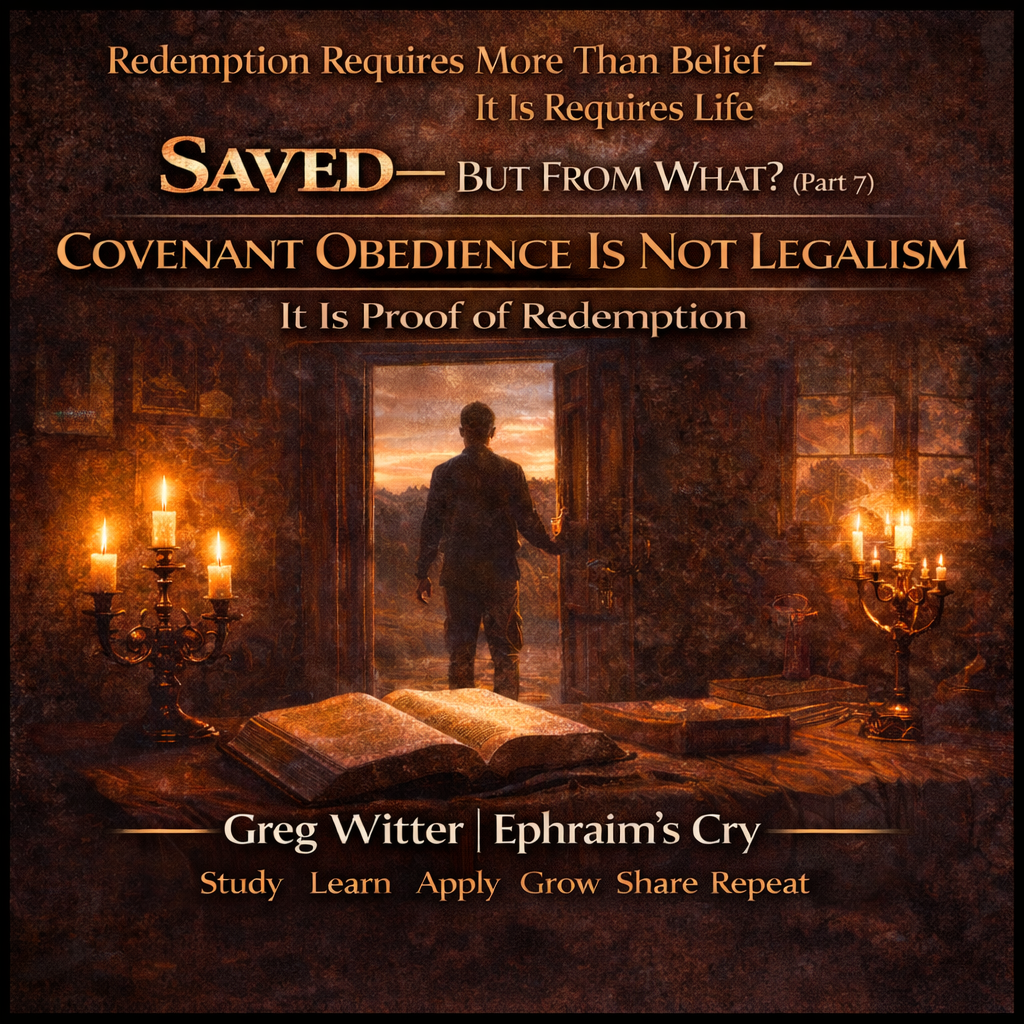
Saved — But From What? (Part 7)
Salvation, Covenant, and the End of Believism
Covenant Obedience Is Not Legalism
It Is Proof of Redemption
Greg Witter | Ephraim’s Cry
Hebraic Mindset Study Series
Study Learn Apply Grow Share Repeat
By this point in the series, one lie can no longer survive.
If redemption was real,
if blood was required,
if covenant justice was satisfied,
if ownership was transferred,
then obedience is not optional — and it is not legalism.
Legalism assumes obedience earns standing.
Covenant obedience assumes standing has already been restored.
The modern religious system confuses the two because it does not understand redemption, ownership, or covenant authority.
Legalism Obeys to Earn
Covenant Obedience Obeys Because It Belongs
Legalism works toward acceptance.
Covenant obedience flows from acceptance.
Legalism tries to create righteousness.
Covenant obedience responds to righteousness already granted.
Scripture never teaches that obedience purchases salvation.
It teaches that obedience confirms redemption.
“If ye love Me, keep My commandments.” (John 14:15)
Love does not replace obedience.
Love produces it.
Redemption Restores Authority, Not Autonomy
One of the most destructive lies of modern Christianity is the belief that salvation restores personal autonomy.
It does not.
Redemption transfers ownership.
“Ye are not your own; for ye are bought with a price.” (1 Corinthians 6:19–20)
What is purchased belongs to the purchaser.
What is redeemed comes under rightful authority.
Freedom in Scripture is never freedom from authority.
It is freedom under the correct authority.
The goal of redemption is not independence.
The goal of redemption is alignment.
Lawlessness Is Not Freedom — It Is Slavery Repackaged
Scripture does not define sin emotionally.
It defines sin legally.
“Whosoever committeth sin transgresseth also the law: for sin is lawlessness.” (1 John 3:4)
Lawlessness does not liberate.
Lawlessness enslaves.
Yahusha said it plainly:
“Whosoever committeth sin is the servant of sin.” (John 8:34)
Modern religion rebrands lawlessness as liberty because it has separated grace from covenant. But grace never removes Torah — grace restores the ability to walk in it.
The Law Was Never the Curse
Scripture never calls Torah a curse.
Scripture calls disobedience a curse.
“Cursed be he that confirmeth not all the words of this law to do them.” (Deuteronomy 27:26)
The curse is not instruction.
The curse is rebellion.
Sha’ul affirms this without hesitation:
“Wherefore the law is holy, and the commandment holy, and just, and good.” (Romans 7:12)
The problem was never Torah.
The problem was the heart enslaved to sin.
Redemption fixes the heart — not by removing instruction, but by restoring alignment to it.
Obedience Is the Evidence of Redemption
Scripture does not ask whether someone believed once.
It asks whether they are walking now.
“And hereby we do know that we know Him, if we keep His commandments.” (1 John 2:3)
“He that saith, I know Him, and keepeth not His commandments, is a liar.” (1 John 2:4)
This language is not abusive.
It is diagnostic.
Obedience does not earn redemption.
Obedience reveals whether redemption occurred.
Obedience Is Covenant Loyalty Under Pressure
Obedience only proves allegiance when it costs something.
Israel learned this in the wilderness:
“Thou shalt remember all the way which Yahuah thy Elohim led thee… to humble thee, and to prove thee, to know what was in thine heart, whether thou wouldest keep His commandments, or no.” (Deuteronomy 8:2)
Obedience in comfort is assumed.
Obedience under pressure is tested.
This is why Scripture links obedience with endurance:
“He that shall endure unto the end, the same shall be saved.” (Matthew 24:13)
Lawlessness increases under pressure.
Covenant loyalty is revealed under pressure.
Obedience Separates — It Always Has
Obedience does not merely indicate salvation.
It divides.
“Not every one that saith unto Me, Lord, Lord, shall enter into the kingdom… but he that doeth the will of My Father.” (Matthew 7:21)
“Depart from Me, ye that work lawlessness.” (Matthew 7:23)
The issue is not profession.
The issue is practice.
The same division appears in the parable of the virgins. All were invited. All had lamps. But only those prepared — those who lived faithfully — entered. The door was shut on the rest.
Obedience determines who is inside and who remains outside.
Obedience Protects Against Deception
Scripture never teaches that deception is primarily intellectual.
It teaches that deception is moral.
“And with all deceivableness of unrighteousness… because they received not the love of the truth.” (2 Thessalonians 2:10)
Deception does not begin with false ideas.
It begins with rejected obedience.
Torah warned Israel of this explicitly:
“If there arise among you a prophet… and giveth thee a sign or a wonder… saying, Let us go after other gods… thou shalt not hearken.” (Deuteronomy 13:1–3)
Signs do not authenticate truth.
Obedience does.
This is why end-time deception targets obedience first.
The Spirit Does Not Replace Obedience — The Spirit Enables It
The renewed covenant was never lawlessness.
“I will put My law in their inward parts, and write it in their hearts.” (Jeremiah 31:33)
“I will put My Spirit within you, and cause you to walk in My statutes.” (Ezekiel 36:27)
The Spirit does not free people from obedience.
The Spirit frees people to obey.
Spirit without obedience is not biblical.
Obedience without Spirit is impossible.
Obedience Is a Walk, Not Perfectionism
Covenant obedience is not flawlessness.
It is faithfulness.
“For this commandment which I command thee this day, it is not hidden from thee, neither is it far off.” (Deuteronomy 30:11)
“He hath shewed thee, O man, what is good… to walk humbly with thy Elohim.” (Micah 6:8)
Walking implies movement, growth, correction, and endurance — not sinless performance.
Obedience Is Lived in Households, Not Just Individuals
Covenant obedience is public and generational.
“As for me and my house, we will serve Yahuah.” (Joshua 24:15)
Redemption restores order — not just individuals. Households marked by obedience become testimonies in a lawless world.
The Weight of This Truth
If redemption was real, obedience follows.
If blood was costly, rebellion is not casual.
If covenant was restored, loyalty is required.
The remnant is not defined by claims.
It is defined by obedience under pressure.
“Here is the patience of the saints: here are they that keep the commandments of Elohim, and the faith of Yahusha.” (Revelation 14:12)
Salvation does not remove responsibility.
It restores it.

#SavedButFromWhat #HebraicMindset #CovenantSalvation #CovenantObedience #NotLegalism #GraceThatTrains #TorahAndTestimony #WholeCounselOfElohim #RemnantFaith #EnduranceOfTheSaints #WatchmanCall #GregWitter #EphraimsCry
