
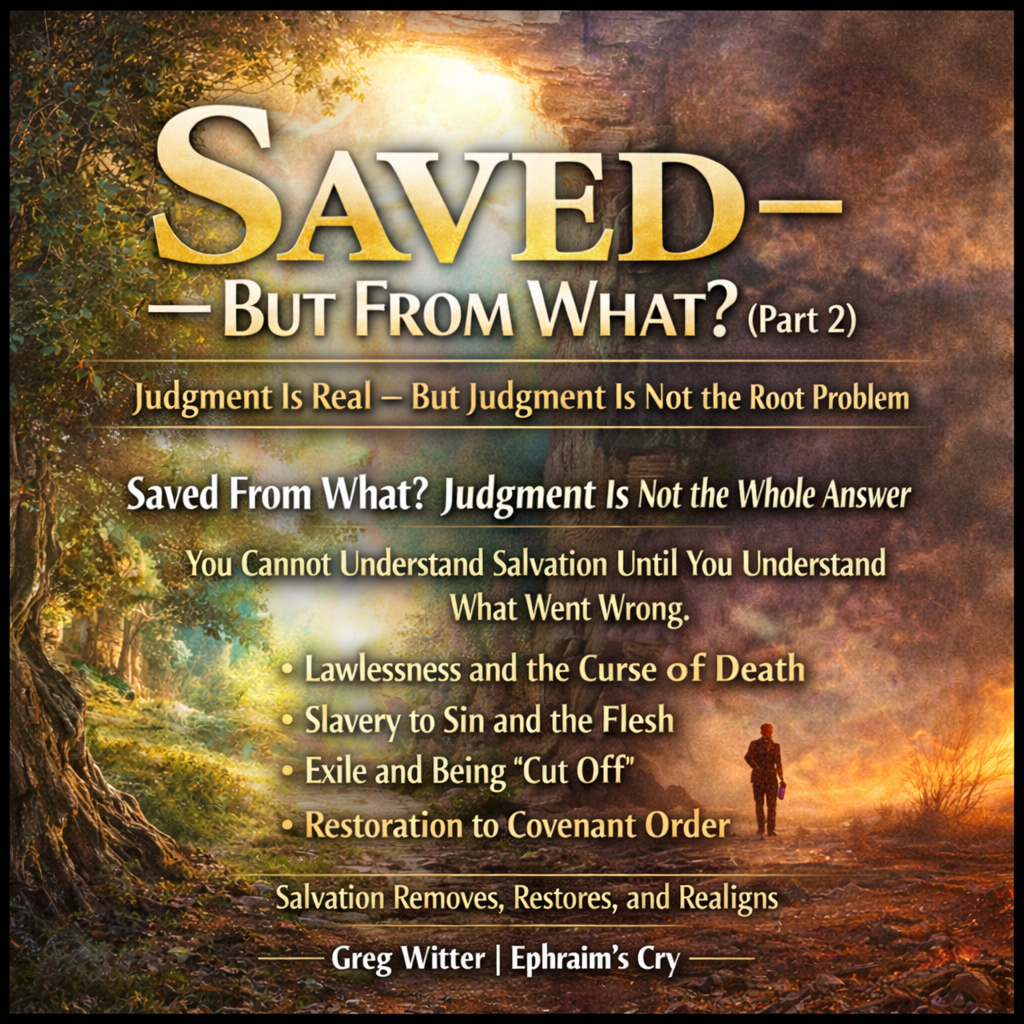
Saved — But From What? (Part 2)
Salvation, Covenant, and the End of Believism
Judgment Is Real — But Judgment Is Not the Root Problem
Saved From What? (Judgment Is Not the Whole Answer)
Until the Problem Is Defined Correctly, Salvation Will Be Misunderstood
Greg Witter | Ephraim’s Cry
Hebraic Mindset Study Series
Study Learn Apply Grow Share Repeat
When people hear the word salvation, most have been trained to answer reflexively: saved from hell. Judgment is real. Eternal consequence is real. Scripture does not minimize that reality (Matthew 25:46; Revelation 20:11–15). But when salvation is reduced to nothing more than escaping punishment, the covenant framework collapses. Salvation becomes a future destination rather than a present rescue. It becomes an insurance policy instead of a restoration.
Scripture never begins the salvation story at the verdict.
It begins at the breach.
Judgment is not the root problem. Judgment is the result of a deeper covenant failure. Until that failure is correctly identified, salvation cannot be correctly understood—and false gospels will continue to feel sufficient while leaving people unchanged.
The Root Problem Is Lawlessness, Not Judgment
Scripture defines the problem with precision:
“Sin is lawlessness.” (1 John 3:4)
Sin is not merely moral weakness, human imperfection, or failure to live up to personal standards. Sin is rejection of covenant authority. It is living as though Elohim’s instructions do not govern life.
Lawlessness is not accidental. It is a posture.
Yahusha warned that many who believe themselves secure will be rejected—not because they lacked religious language, miracles, or activity—but because they practiced lawlessness:
“And then will I profess unto them, I never knew you: depart from me, ye that work lawlessness.” (Matthew 7:23)
These are not outsiders. These are those who assumed belonging while remaining misaligned. This is why salvation cannot be defined as emotional reassurance or verbal profession. Salvation must address lawlessness itself.
Torah Is Not the Curse — Death Is the Curse of Disobedience
One of the most damaging distortions in churchianity is the claim that Torah is a curse. Scripture teaches the opposite:
“Wherefore the law is holy, and the commandment holy, and just, and good.” (Romans 7:12)
Torah defines righteousness. Torah reveals the will and character of Elohim. Torah does not curse anyone. What brings the curse is disobedience.
From the beginning, death is tied to rebellion—not instruction:
“But of the tree of the knowledge of good and evil, thou shalt not eat of it: for in the day that thou eatest thereof thou shalt surely die.” (Genesis 2:17)
Sha’ul confirms this covenant reality:
“The wages of sin is death.” (Romans 6:23)
Death is the covenant penalty attached to lawlessness. Torah exposes sin; it does not create it. To say we are saved from Torah is to misidentify the problem entirely. We are saved from the judgment of death that comes from rejecting covenant order.
If Torah is framed as the enemy, salvation becomes incoherent and obedience becomes optional by definition.
Saved From Slavery — Because There Is No Neutral Ground
Scripture does not present humanity as neutral. Everyone serves a master.
“To whom ye yield yourselves servants to obey, his servants ye are…” (Romans 6:16)
Lawlessness does not produce freedom. It produces slavery—slavery to sin, to the flesh, and ultimately to death. Sha’ul explains that those who were once servants of sin are freed through obedience and become servants of righteousness (Romans 6:17–18).
This is why Scripture uses purchase language:
“Ye are bought with a price.” (1 Corinthians 6:20)
Being bought is ownership language. Salvation is a transfer of mastery. A person is removed from one authority and placed under another.
Modern culture defines freedom as autonomy—no boundaries, no authority, no obligation. Scripture defines freedom as right alignment. Every boundary-free space in Scripture becomes a death space. Egypt had structure, economy, and culture—but it was slavery. Covenant has boundaries—but it is life.
Salvation does not remove authority. It restores the right authority.
Saved From Exile — The Forgotten Dimension of Salvation
Exile is one of the most neglected aspects of salvation teaching, yet it is central to Scripture’s covenant logic.
When covenant is rejected, exile follows:
Adam and Eve expelled from the garden (Genesis 3:23–24).
Israel scattered among the nations (Deuteronomy 28:64–68).
The northern kingdom removed (2 Kings 17:6–18).
Judah exiled to Babylon (2 Chronicles 36:15–21).
Exile is not merely geographical. It is relational, legal, and covenantal. It means separation from presence, protection, inheritance, and identity.
The prophets consistently describe salvation as regathering and restoration:
“I will take you from among the heathen… and bring you into your own land… and cause you to walk in My statutes.” (Ezekiel 36:24–27)
Sha’ul echoes this covenant reality:
“But now in Messiah Yahusha ye who sometimes were far off are made nigh.” (Ephesians 2:13)
Nearness is covenant language. Salvation restores access, standing, and belonging.
Saved From Being Cut Off — A Real Covenant Consequence
Torah repeatedly warns of being cut off from among the people (Exodus 12:15; Leviticus 17:4; Numbers 15:30–31). This is not metaphorical language. It describes loss of covenant standing, inheritance, and protection.
To be cut off is to be excluded from covenant life.
Salvation reverses that status. It restores a person to the people, the promises, and the inheritance. Salvation is not merely about avoiding punishment—it is about restoration to covenant identity and lawful standing.
Salvation Brings Restoration — Not Just Rescue
Salvation does not merely remove a person from something. Salvation restores a person to something.
Saved from lawlessness to covenant alignment.
Saved from slavery to rightful mastery.
Saved from exile to nearness.
Saved from death to life.
Saved from being cut off to belonging and inheritance.
This restoration is not symbolic. It is covenant reality. It returns a person to the boundaries where life is found and where protection exists.
This is why Scripture repeatedly presents only two ways:
Life or death (Deuteronomy 30:15–19).
Blessing or curse.
Obedience or rebellion.
Inside or outside (Matthew 8:11–12; Revelation 22:14–15).
There is no neutral ground.
Judgment Is the Verdict — Not the Disease
Judgment is real. Scripture never minimizes it. But judgment is the verdict, not the disease.
When salvation is framed only as escape from judgment, it collapses under pressure because it has no covenant substance. But when salvation is understood as rescue from lawlessness, slavery, exile, and covenant breach—and restoration into covenant order—judgment is correctly seen as what occurs when restoration is refused.
Belief alone does not resolve lawlessness (1 John 3:4).
Belief alone does not transfer mastery (Romans 6:16–18).
Belief alone does not restore nearness and covenant standing (Ephesians 2:12–13).
Salvation must address the root.
Core Teaching
Salvation rescues from:
Lawlessness.
The curse of death.
Slavery to sin and the flesh.
Exile from covenant presence.
Being cut off from the people and inheritance.
And salvation restores:
Covenant alignment.
Right authority.
Freedom within boundaries.
Nearness to Elohim.
Identity, belonging, inheritance trajectory.
Judgment is real—but it is not the whole answer.
What This Forces Us to Confront Next
If salvation rescues from real bondage, then bondage was not theoretical—it was covenantal and legal. If exile is real, then return is real. If slavery is real, then purchase is real. If inheritance can be lost, then redemption must restore it.
That means salvation cannot be reduced to religious comfort. It is rescue with consequences. Restoration with order. Freedom with boundaries.
And once that is seen, another question becomes unavoidable—one that most people have never been taught to ask:
Saved to what?
Because covenant restoration is not a blank slate. It restores purpose, identity, peoplehood, readiness, and Kingdom allegiance.
#SavedButFromWhat, #HebraicMindset, #CovenantSalvation, #LawlessnessExposed, #TorahIsNotTheCurse, #ExileAndRestoration, #FreedomWithinCovenant, #WholeCounselOfElohim, #TorahAndTestimony, #GraceThatTrains, #KingdomGospel, #RemnantFaith, #EnduranceOfTheSaints, #WatchmanCall, #GregWitter, #EphraimsCry
