
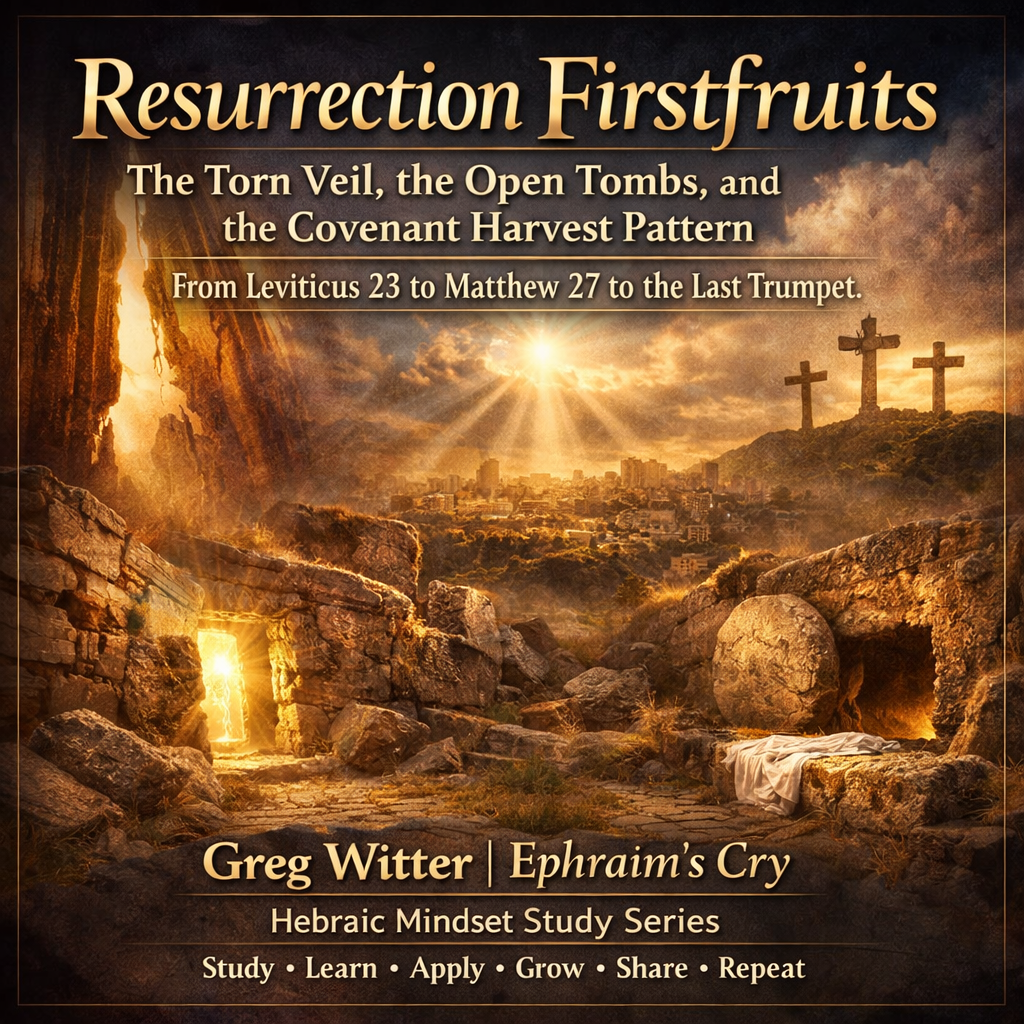
Resurrection Firstfruits: The Torn Veil, the Open Tombs, and the Covenant Harvest Pattern
From Leviticus 23 to Matthew 27 to the Last Trumpet
Messiah rose first—then the graves answered. Firstfruits is not poetry; it is covenant order.
Greg Witter | Ephraim’s Cry
Hebraic Mindset Study Series
Study Learn Apply Grow Share Repeat
The scene Matthew records at the execution and resurrection of Yahusha is not written like a devotional thought. It is written like a covenant courtroom exhibit. The veil tears from top to bottom. The earth shakes. Rocks split. Tombs open. And then—after His resurrection—set-apart ones are raised and appear to many in the set-apart city (Matthew 27:51–53). That sequence is not random. It is structured. And if we try to interpret it without the Torah calendar and covenant architecture that frames it, we will either overreach into speculation or reduce it into a strange footnote. The correct approach is covenant-first: Torah establishes patterns; prophets echo them; the apostolic writings show their fulfillment; Revelation closes the loop.
Matthew is describing a covenant turning point, not merely a supernatural anomaly. The tearing of the veil is a legal declaration: access, mediation, and covenant administration have shifted. The opening of tombs is a prophetic sign: death’s claim is being publicly contested. And the raising of “many” set-apart ones is not the full resurrection harvest; it is a firstfruits-proving sign that the harvest has begun in the Righteous One.
1) The Text Says More Than People Notice—And Less Than People Assume
Matthew 27:51–53 includes a detail that governs everything: the set-apart ones come out of the tombs after His resurrection. That matters because it establishes order. Yahusha is first. The saints follow. That is not a minor timeline note; it is theological architecture.
Many readers collapse the whole event into the moment of His death. Matthew does not. He records tombs opening at the death-event, but he ties the raising and the public appearing to the resurrection-event. In other words, the execution shook creation and opened graves; the resurrection released bodies.
This protects the text from two common errors:
The error of calling those saints “the main resurrection.”
The error of claiming Messiah was not first.
Paul will not allow either error. He explicitly declares Messiah as first in resurrection order (1 Corinthians 15:20–23). Matthew’s wording aligns with Paul’s order, not against it.
2) Firstfruits in Leviticus 23 Is the Key That Unlocks Matthew 27–28
Leviticus 23 is not merely a list of holy days. It is a covenant timeline. In that timeline, Firstfruits is not a celebration of spring sentiment. It is a legal-act offering that signals the start of harvest and guarantees the rest.
Yahuah commands Israel to bring the first sheaf (omer) of the harvest to the priest. The priest waves the sheaf “before Yahuah” so it is accepted “for you,” and this occurs “on the day after the Sabbath” during the Unleavened Bread week (Leviticus 23:9–11). The point is not the quantity. The point is representative headship: the first portion stands for the whole.
The covenant logic is simple and strong:
Firstfruits is the beginning, not the end.
Firstfruits is proof of harvest, not the completion of harvest.
Firstfruits guarantees what follows because Yahuah’s appointed times are not symbolic theater; they are covenant markers.
Now Paul says something that most believers quote but few interpret covenantally:
“Messiah has been raised from the dead, the firstfruits of those who have fallen asleep.” (1 Corinthians 15:20)
Paul is not inventing a metaphor. He is claiming that Yahusha’s resurrection is the covenant Firstfruits offering in reality. In other words, the Firstfruits sheaf was a shadow rehearsal. The resurrection is the substance.
Then Paul nails down the resurrection order:
“Each in his own order: Messiah the firstfruits, afterward those who belong to Messiah at His coming.” (1 Corinthians 15:23)
That one sentence keeps us honest. It tells you there is an already-and-not-yet structure. Firstfruits is already. Full harvest is not yet. Messiah rises now; the full resurrection of His people occurs at His coming.
So where do Matthew 27’s raised saints fit?
Exactly where Firstfruits demands they fit: as a covenant sign that the harvest has begun, not as the full harvest itself.
3) Why “Many” Saints, Not “All” Saints: Covenant Sign, Not Final Harvest
Matthew does not say all the righteous were raised. He says “many.” That alone tells you this is not the final resurrection event described elsewhere. If this were the full resurrection harvest, the text would not limit it to “many,” and the apostolic writings would not locate the general resurrection of the righteous at Messiah’s return (1 Thessalonians 4:16–17; 1 Corinthians 15:51–52; John 5:28–29; Daniel 12:2).
Instead, Matthew records a limited raising that functions as a witness.
That is how Yahuah often operates in covenant history: He gives a first sample, a down-payment sign, a preview that proves what He has decreed is now in motion.
The firstfruits sheaf proves harvest has begun.
A first cluster of resurrected set-apart ones proves resurrection harvest has begun.
This is not random supernatural spectacle. This is covenant testimony.
4) The Torn Veil and the Open Tombs Belong Together
Many people preach the torn veil as a standalone theme. Matthew refuses to let you separate it. He binds the torn veil to earthquake, rock-splitting, tomb-opening, and resurrection witness.
The veil tearing “from top to bottom” matters because it signals divine initiative, not human action. It is Yahuah declaring something has changed in covenant administration. The Dwelling Place veil represented restricted access, mediated approach, and the weight of holiness (Exodus 26; Leviticus 16). When the veil tears at the death of Yahusha, it testifies that the sacrificial work has reached a decisive turning point. The blood-work is not merely forgiveness language; it is covenant ratification language (Exodus 24:8; Jeremiah 31:31–34; Luke 22:20; Hebrews 9–10).
And then Matthew immediately shows the consequence: death’s prison doors are being forced open. That is not accidental sequencing. When the covenant barrier is breached by the righteous sacrifice and the resurrection victory, the authority of death is publicly challenged.
If the veil tearing is covenant access restored, the tombs opening is covenant curse being reversed in motion. Death entered through sin (Genesis 2:17; 3:19; Romans 5:12). Covenant restoration necessarily confronts death, because death is not merely biological; it is covenant consequence.
So Matthew is showing you: covenant breach repaired → death’s claim weakened.
5) “Scripture Is Silent About Their Continued Existence”—Yes, and That Silence Is a Boundary
Gladi’s question is honest: What happened to those raised saints afterward? Did they remain alive? Did they die again? Were they taken somewhere? The truth is: Matthew does not tell us. He tells us what matters for the witness—raised, entered the set-apart city, appeared to many—and then he moves on.
That means we must distinguish:
What the text establishes as doctrine
from
What the text leaves unrecorded
Where the text is silent, we must not speak with certainty. But we can still think covenantally and keep possibilities inside Scriptural boundaries.
There are two broad possibilities often discussed:
A) They were raised as a sign and later died again.
This is not “impossible” or “against covenant order.” Scripture already contains resurrections that do not result in immediate glorification (e.g., the widow’s son through Eliyahu, 1 Kings 17; the Shunammite’s son through Elisha, 2 Kings 4; and Lazarus raised by Yahusha, John 11). Lazarus plainly died again later, because he was raised back into mortal life, not into immortal glorified life. So “raised” does not automatically mean “incorruptible body.”
B) They were raised and later translated/removed from earthly life by Yahuah’s will.
Some connect this to language about Messiah’s ascension victory and the idea of a triumphal procession (Ephesians 4:8 is often brought into the discussion). But Scripture does not explicitly say these Matthew 27 saints ascended with Messiah. So this remains possible, but unproven.
Either way, the text’s main point stands: their raising served as a public covenant witness to Messiah’s victory over death, tied to His resurrection, consistent with firstfruits order.
6) The “They Cannot Die Twice” Argument Needs Correction
The claim “they died once and therefore cannot die a second death without Great White Throne judgment” sounds orderly, but it confuses categories.
Scripture uses “second death” in a specific way: it is the final judgment outcome—lake of fire—associated with ultimate condemnation (Revelation 20:14–15; 21:8). It is not a technical term for “dying physically a second time.”
A person can die, be raised back to mortal life, and later die again without that being “the second death” of Revelation. Lazarus is the simplest example: raised, then later died again—yet that does not place him under the “second death” category.
So we must not import a definition into “second death” that Scripture does not give. The “second death” is not “your second biological death.” It is the final judicial death—the irreversible judgment.
That alone removes a major stumbling block in the discussion.
7) Paradise, Eden, and “No One Has Ascended”: How to Hold These Texts Without Forcing Them
Gladi also asked about paradise and John 3:13.
Luke 23:43 records Yahusha telling the repentant criminal, “Truly, I say to you today, you shall be with Me in paradise.” There has been debate over punctuation in translations, but the core concept stands: Yahusha speaks of “paradise” as a real destination associated with blessedness and life.
Revelation 2:7 connects “paradise of Elohim” with the tree of life—Eden imagery restored.
But here is the boundary: Scripture does not plainly define paradise as a “holding realm for resurrected saints until the Great White Throne.” That is a model some propose, but it is not explicitly taught as a system.
John 3:13 says: “No one has ascended into heaven except He who came down from heaven—the Son of Adam.” This statement is made in a pre-resurrection context, as Yahusha is establishing His unique authority and origin. After the resurrection, He speaks of ascending (John 20:17), and the apostles bear witness of His ascension (Acts 1:9–11).
So John 3:13 should not be weaponized to deny everything Scripture later reveals. It is emphasizing His unique heavenly origin and authority, not constructing a full geography map of the unseen realm with every detail spelled out.
The responsible covenant reading is:
Yahusha uniquely descends from heaven and has unique authority.
Paradise language is real and tied to life and restoration.
But Scripture does not give enough detail to declare, with certainty, where the Matthew 27 saints remained afterward.
8) The Last Trumpet: The Full Harvest That Firstfruits Guarantees
Now bring it forward to the last trumpet, because this is where Firstfruits reaches completion.
Paul teaches that the full resurrection harvest occurs at Messiah’s coming:
“The Master Himself will descend from heaven with a shout… and with the trumpet of Elohim, and the dead in Messiah will rise first.” (1 Thessalonians 4:16)
“In a moment, in the twinkling of an eye, at the last trumpet… the dead will be raised incorruptible, and we shall be changed.” (1 Corinthians 15:52)
That is the harvest completion event: the incorruptible change, the gathering, the forever-with-Him reality. That is not what Matthew 27 is describing, because Matthew 27 is a firstfruits-linked sign, not the consummation.
So the covenant timeline is coherent:
Passover: the Lamb and the blood covenant pattern (Exodus 12; Luke 22:20).
Unleavened Bread: separation from corruption, the sinless One in the grave (Leviticus 23:6–8).
Firstfruits: resurrection begins, Messiah first, then a sign-witness of raised saints (Leviticus 23:9–14; Matthew 27:52–53; 1 Corinthians 15:20).
Shavuot: the Spirit poured out and the harvest of people begins (Acts 2; Leviticus 23:15–22).
Fall appointments: trumpet announcement, judgment themes, dwelling/kingdom completion patterns (Leviticus 23; Revelation’s kingdom proclamations).
Firstfruits is the covenant hinge that proves resurrection is not a vague hope. It is a scheduled covenant reality.
9) The Teaching Answer to Gladi’s Original Question
So, were those set-apart ones “part of the firstfruits with Messiah’s resurrection”?
Here is the clean, text-faithful answer:
Messiah Himself is the Firstfruits in the primary, governing sense (1 Corinthians 15:20). He is first in order and first in authority.
The raising of “many” saints after His resurrection in Matthew 27 functions as a firstfruits sign—a visible testimony that the resurrection harvest has begun because the Firstfruits has risen.
Scripture does not tell us their long-term state, so we should not declare certainty about whether they remained alive, died again, or were taken elsewhere. The text’s point is their witness, not their biography.
The “second death” category in Revelation is final judgment, not “dying a second time physically,” so it is not a valid argument against a temporary sign-resurrection.
Paradise is real and tied to restored Eden imagery, but Scripture does not explicitly identify it as the permanent location of those Matthew 27 saints or as the holding place for all resurrected saints until the Great White Throne.
If we hold to that, we stay inside Scripture, honor Torah patterns, and refuse speculation.
10) Why This Matters Right Now
This matters because it exposes a major modern blind spot: people want Messiah’s resurrection without Torah’s calendar, and they want “spiritual meaning” without covenant structure. But the apostles did not preach that way. The resurrection is not a floating miracle. It is the fulfillment of appointed times—covenant schedule—covenant order—covenant harvest.
Matthew 27:51–53 is not just strange. It is a warning and a promise.
The warning is that death is not neutral; it is covenant consequence, and the world is under a sentence it cannot overturn.
The promise is that the sentence has been challenged and broken in Yahusha, and the firstfruits guarantee stands: what began in Jerusalem will be completed at the last trumpet.
The graves opened once as a sign.
They will open again as a final harvest.
And that is why the people of Elohim must stop treating Torah as “old” and start treating it as what it is: the covenant constitution that explains the entire storyline from Genesis to Revelation.
#EphraimsCry #GregWitter #HebraicMindsetStudySeries #StudyLearnApplyGrowShareRepeat #Yahuah #Yahusha #Elohim #Torah #Covenant #Firstfruits #Leviticus23 #Matthew27 #Resurrection #Passover #UnleavenedBread #Shavuot #YomTeruah #LastTrumpet #KingdomOfElohim #GospelOfTheKingdom #PropheticPattern #ScriptureInterpretation #WholeCounsel #CovenantContinuity #Remnant #Watchman #Revelation
