
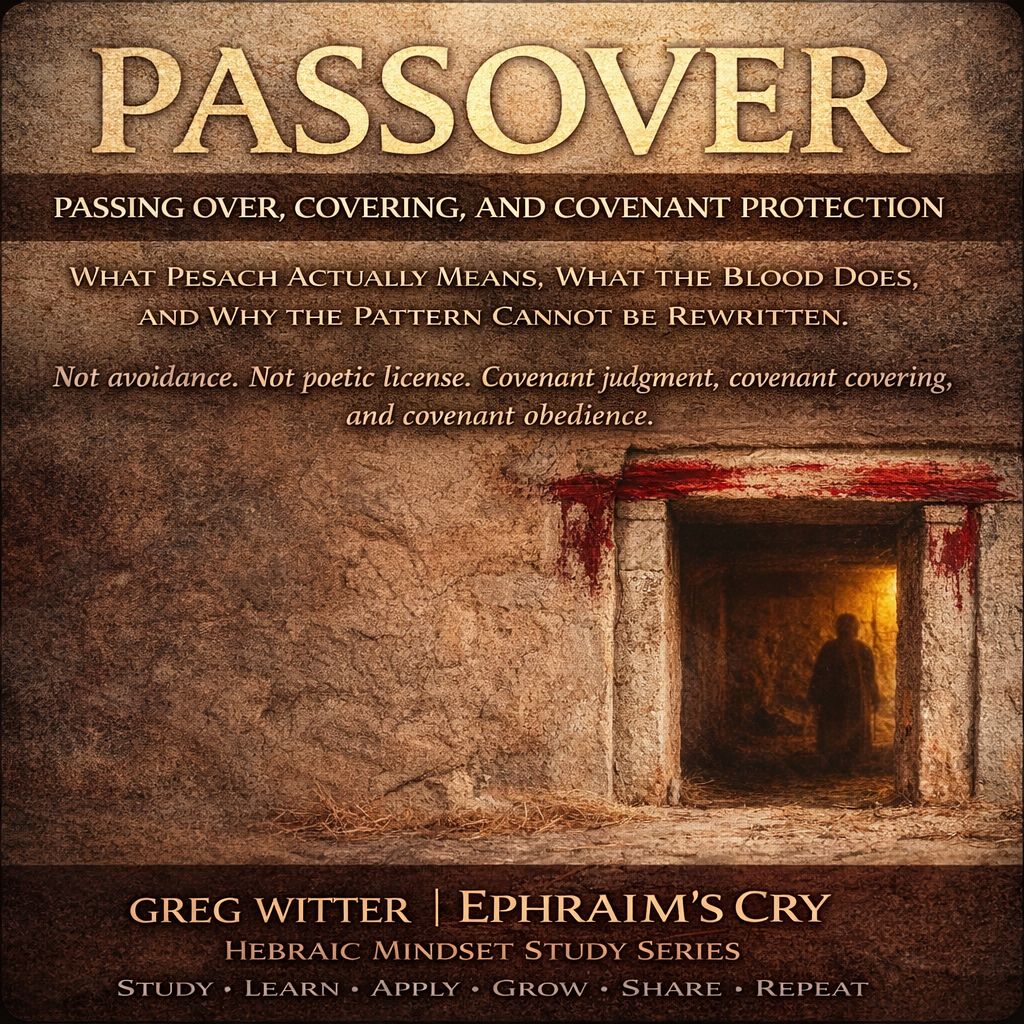
Passover: Passing Over, Covering, and Covenant Protection
What Pesach Actually Means, What the Blood Does, and Why the Pattern Cannot Be Rewritten
Not avoidance. Not poetic license. Covenant judgment, covenant covering, and covenant obedience.
Greg Witter | Ephraim’s Cry
Hebraic Mindset Study Series
Study Learn Apply Grow Share Repeat
Passover stands as one of the most mishandled, redefined, diluted, and reinterpreted events in all of Scripture. It is softened into symbolism, turned into sentiment, expanded into poetic language, or reshaped into something that sounds deeper but drifts away from what is actually written. The result is always the same: confusion. And confusion never comes from the text—it comes from departing from it (Isaiah 8:20).
So the only way to deal with Passover is to strip everything back. No assumptions. No overlays. No churchianity filters. No poetic insertions. No philosophical expansions. The text must define itself, and every claim must stand on what is written.
Exodus 12 is not vague. It is precise, structured, and legally defined.
Exodus 12:12–13 establishes the event clearly: Yahuah will pass through the land in judgment, striking the firstborn, and when He sees the blood, He will pass over, and the plague will not be upon that house. Exodus 12:23 clarifies further: Yahuah passes through to strike, and when He sees the blood, He passes over the door and does not allow the destroyer to enter the house to strike.
This establishes the structure without ambiguity. Judgment is real and active—Yahuah is moving through the land (Exodus 12:12; Exodus 11:4–5). The blood is the covenant marker—not emotion, not internal belief alone, but obedience expressed through visible action (Exodus 12:7, 13). Passing over is defined by the text itself: it is the prevention of destruction from entering, not a redefinition of the event into something else (Exodus 12:23). The protection is not abstract. It is covenantal, conditional, visible, and enforced by obedience.
Pesach carries the sense of sparing, shielding, and protecting, but Scripture defines exactly how that protection operates. Yahuah passes over. The destroyer is restrained. The house is spared. That is the pattern. You do not replace what is written with language that is not written. You do not improve the text by inserting ideas that are absent from it. The authority is in what is written, not what is imagined.
The blood is not symbolic decoration. Exodus 12:7 commands it to be placed on the lintel and the two doorposts. This is not optional. It is not internal. It is not metaphorical. It is obedience. The blood marks identity, alignment, and submission to instruction. Without the blood, there is no distinction (Exodus 11:7). Without obedience, there is no covering. The placement itself forms a visible threshold, a boundary between life and death. Inside that boundary is protection. Outside that boundary is exposure. This is reinforced by the command that no one is to go out of the house until morning (Exodus 12:22). Protection is location-based and obedience-dependent.
Passover establishes distinction. Exodus 11:7 declares that Yahuah makes a distinction between Egypt and Israel. Not everyone is covered. Not everyone is protected. Not everyone is spared. The difference is covenant obedience. That distinction is enforced through action, not claimed through words.
Passover also resets time itself. Exodus 12:2 declares that this month becomes the beginning of months. Deuteronomy 16:1 commands the guarding of the month of Aviv. Redemption is not emotional language—it restructures identity, time, and alignment. Passover is not placed inside the calendar; it defines it.
The structure of the household is central. Exodus 12:3–4 assigns responsibility at the household level. Each house takes a lamb. Leadership is required. Responsibility is required. This is not individualistic spirituality; it is covenant order expressed through the household structure.
The lamb must be without blemish (Exodus 12:5). This establishes purity, acceptability, and legal integrity. Nothing defective is brought into covenant sacrifice. The lamb is selected on the tenth day and held until the fourteenth (Exodus 12:3–6), establishing a four-day period of inspection, testing, and exposure. Nothing is sacrificed without examination.
The meal is participation, not observation. Exodus 12:8 commands that the lamb be eaten with unleavened bread and bitter herbs. Unleavened bread reflects the removal of corruption (Exodus 12:15; 1 Corinthians 5:6–8). Bitter herbs establish remembrance of bondage. Participation ties identity to the event.
The posture is urgency. Exodus 12:11 commands readiness: belt fastened, staff in hand, sandals on feet. This is not comfort. This is transition. Passover is movement from bondage to deliverance.
The structure of judgment reveals both authority and execution. Yahuah passes through in judgment (Exodus 12:12), and the destroyer is the agent not permitted to enter the marked house (Exodus 12:23), aligning with 2 Samuel 24:16 and 1 Chronicles 21:15. Judgment is authorized and executed with precision.
The blood placement forms covenant geometry. The lintel and doorposts create a threshold boundary—entry point, dividing line, legal separation between life and death. There is no middle ground.
The integrity of the lamb is reinforced: no bone is to be broken (Exodus 12:46; Numbers 9:12), confirmed in John 19:36.
Access is restricted by covenant identity. Exodus 12:43–48 establishes that participation requires covenant alignment. The mixed multitude (Exodus 12:38) reveals that proximity is not covenant faithfulness.
Leaven must be removed from the house (Exodus 12:15, 19), establishing jurisdictional cleansing. Corruption cannot remain within the covenant boundary (1 Corinthians 5:6–8).
The distinction between Passover and Unleavened Bread remains non-negotiable. The lamb is slain on the fourteenth (Leviticus 23:5; Numbers 28:16). Unleavened Bread begins on the fifteenth (Leviticus 23:6–8; Numbers 28:17). These are connected but distinct.
The night is commanded to be guarded (Exodus 12:42). The judgment is targeted at the firstborn (Exodus 12:29). The event is taught generationally (Exodus 12:26–27).
The pattern continues forward: “Messiah, our Passover” (1 Corinthians 5:7). “Not one of His bones shall be broken” (John 19:36). Fulfillment confirms the pattern, it does not erase it (Luke 24:44).
Passover is not a metaphor. It is a covenant act defined by instruction, obedience, boundary, judgment, protection, and separation. It functions exactly as written.
Now the structure must be reinforced and locked in plainly:
• Judgment is active and real — Yahuah passes through the land (Exodus 12:12; Exodus 11:4–5)
• The blood is the covenant marker — visible obedience, not internal claim (Exodus 12:7, 13)
• Passing over is defined — prevention of destruction entering the house (Exodus 12:23)
• Protection is conditional — tied directly to obedience (Exodus 12:22–23)
• Distinction is enforced — Yahuah separates between those covered and uncovered (Exodus 11:7)
• The boundary is physical and legal — inside vs outside determines outcome (Exodus 12:7, 22)
• The lamb must be without blemish — covenant acceptability (Exodus 12:5)
• Inspection precedes sacrifice — 10th to 14th day testing (Exodus 12:3–6)
• Participation is required — the meal is eaten, not observed (Exodus 12:8)
• Leaven must be removed — corruption cannot remain in the house (Exodus 12:15; 1 Corinthians 5:6–8)
• Household responsibility is central — covenant is administered at the house level (Exodus 12:3–4)
• Access is restricted — covenant alignment required (Exodus 12:43–48)
• The destroyer is restrained — judgment is controlled, not random (Exodus 12:23; 2 Samuel 24:16)
• No bone is broken — integrity of the offering (Exodus 12:46; John 19:36)
• The timeline matters — 14th vs 15th must not be collapsed (Leviticus 23:5–6)
• Passover resets time — beginning of months (Exodus 12:2; Deuteronomy 16:1)
• The night is guarded — this is not casual (Exodus 12:42)
• The firstborn judgment is targeted — authority structure is struck (Exodus 12:29)
• Covenant is taught generationally — instruction preserves identity (Exodus 12:26–27)
• Fulfillment confirms pattern — it does not erase it (1 Corinthians 5:7; Luke 24:44)
What must also be locked in, because it is consistently missing: the distinction between the fourteenth and fifteenth must remain (Leviticus 23:5–6); the separation between Passover and Unleavened Bread must not be collapsed (Numbers 28:16–17); the requirement of obedience before protection must remain central (Exodus 12:7, 22–23); the household model must be upheld (Exodus 12:3–4); the judgment context must not be removed (Exodus 12:12); and the covenant boundary of participation must be maintained (Exodus 12:43–48).
What must be rejected is equally clear: redefining terms beyond the text; replacing obedience with symbolism; collapsing distinctions Scripture maintains; inserting timelines that contradict the written sequence; and elevating emotional interpretation above covenant structure.
Passover stands complete as written. It is judgment and protection operating at the same time (Exodus 12:12–13). It is separation between those marked and those unmarked (Exodus 11:7).
It is life within the boundary and death outside of it (Exodus 12:22–23). It is commanded observance (Exodus 12:24–27). It is the beginning of months (Exodus 12:2). It is guarded in its time (Exodus 12:42). It is remembered across generations (Exodus 12:26–27). It is fulfilled in pattern, not abolished in meaning (1 Corinthians 5:7; John 19:36; Luke 24:44).
And it only functions as designed when it is kept exactly as written.
#Passover#Pesach#Covenant#Yahuah#Yahusha#Torah#Truth#BiblicalCalendar#HebraicMindset#EphraimsCry
#GregWitter#StudyLearnApplyGrowShareRepeat
