
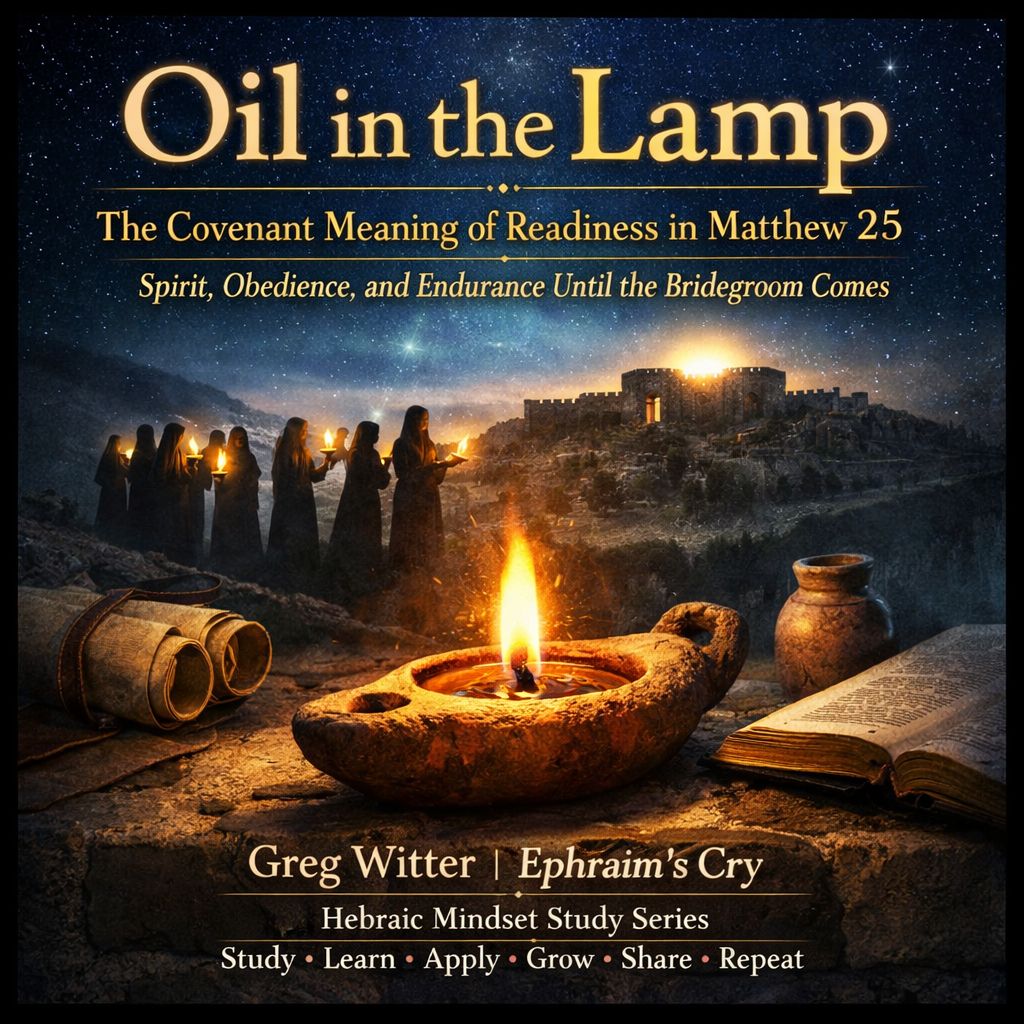
Oil in the Lamp
The Covenant Meaning of Readiness in Matthew 25
Spirit, Obedience, and Endurance Until the Bridegroom Comes
Greg Witter | Ephraim’s Cry
Hebraic Mindset Study Series
Study Learn Apply Grow Share Repeat
Introduction — The Question Behind the Oil
One of the most common questions surrounding Matthew 25 is this:
Does having oil in your lamp mean speaking in tongues?
Or does it mean walking faithfully in prayer and obedience?
That question exposes something deeper.
Many people are searching for a visible, measurable, emotional sign of readiness. They want a spiritual badge. A manifestation. A moment. A proof-text.
But Messiah did not give a badge in Matthew 25.
He gave a warning.
The parable of the ten virgins is not about gifting hierarchy. It is about covenant readiness when the Bridegroom delays.
And delay is the test.
This parable is not random. It is covenant language using a wedding framework Yahuah already established in Torah and the Prophets.
Yahuah repeatedly describes His relationship with His people in marriage covenant terms: He is the Husband; His people are the bride who must remain faithful (Isaiah 54:5; Jeremiah 31:32; Hosea 2:19–20). When Messiah speaks of a Bridegroom arriving, a bridal party waiting, and a door shutting, He is not merely teaching morality. He is describing covenant membership and covenant recognition.
This is why the parable is terrifying to casual religion.
It depicts covenant claimants who assume entrance… and are locked out.
I. The Structure of the Parable — What Actually Differentiates the Wise and the Foolish
Matthew 25:1–13 describes ten virgins.
All ten:
• Were waiting for the Bridegroom
• Had lamps
• Expected His coming
• Fell asleep during delay
The difference was not outward affiliation.
The difference was oil.
The foolish took lamps but no extra oil.
The wise took oil in their vessels with their lamps.
When the cry came at midnight, only those with oil were prepared.
This is critical:
The foolish were not pagans.
They were unprepared covenant claimants.
The separation happens at the moment of arrival.
And the door shuts.
That finality should sober anyone who treats readiness casually.
Matthew 25 does not stand alone. It continues the same warning Messiah gave in Matthew 24.
Matthew 24 ends with the question: “Who then is the trustworthy and wise servant?” (Matthew 24:45). Then Messiah warns about servants who say, “My master delays,” and begin to live lawlessly (Matthew 24:48–51).
Immediately after that, Messiah gives Matthew 25: ten virgins in a delay, then a sudden arrival, then a shut door.
So the theme is consistent: delay reveals who is faithful when no one is watching.
And notice the shared pattern:
• Delay
• Complacency
• Sudden arrival
• Separation
• Finality
Matthew 25 is not a charismatic parable.
It is an end-times covenant separation parable.
II. The Wedding Covenant Background — Why This Parable Carries Blood-Covenant Weight
In the Hebraic framework, marriage is covenant. Not sentiment. Not a party. Covenant.
The bridal pattern includes:
• Betrothal (set-apart commitment)
• Preparation and purification
• The bride waiting while the groom prepares
• A sudden arrival, often at night
• A shut door
• A wedding feast
Messiah directly invokes that expectation when He says the Bridegroom comes later, and not everyone enters.
This parallels what Messiah told His disciples:
“In My Father’s house are many staying places… I go to prepare a place for you… and I shall come again and receive you to Myself.” (John 14:2–3)
The bride does not live as if the groom is gone forever.
The bride lives as if the groom’s return is certain — and her preparedness will be tested.
That is why the virgins must be pure.
That is why the lamp must be burning.
That is why oil must be present.
Because the bridal waiting period is a covenant test.
This is also why the end of the parable is not “they missed out on blessing.”
It is “the door was shut” and “I do not know you.” (Matthew 25:10–12)
That is covenant language.
That is recognition language.
That is the language of who belongs in the household when the covenant is consummated.
III. What Is the Lamp?
Scripture defines its own symbols.
Psalm 119:105
“Your Word is a lamp to my feet and a light to my path.”
Proverbs 6:23
“For the commandment is a lamp, and the Torah a light.”
The lamp represents the revealed Word of Yahuah.
It represents covenant instruction.
It represents the path illuminated by obedience.
Every virgin had a lamp.
In modern language:
Every one of them had access to Scripture.
Every one of them identified with the covenant story.
But not all had sustaining oil.
Word without oil cannot burn.
Knowledge without Spirit cannot endure.
The lamp is also Temple language.
Yahuah commanded Israel to maintain light continually:
“Command the children of Israel that they bring you pure oil of pressed olives for the light, to cause the lamp to burn continually.” (Exodus 27:20)
The lamp in the set-apart place was not allowed to go out.
It was tied to priestly responsibility, covenant presence, and continual watchfulness.
That matters because Matthew 25 portrays virgins as attendants of the Bridegroom.
They function like a watchful priesthood in bridal form — assigned to be ready, to keep light, to meet the coming One.
So the lamp is not “my religious identity.”
It is the Word of Yahuah entrusted to covenant people — meant to be carried, guarded, and kept burning.
IV. What Is the Oil?
Throughout Scripture, oil is associated with:
• Anointing (1 Samuel 16:13)
• Consecration
• Divine enablement
• The Spirit of Yahuah
When David was anointed, “the Spirit of Yahuah came upon David from that day forward.”
Oil signifies the Spirit’s empowering presence.
But here is where many go wrong:
The Spirit is not reduced to one manifestation.
Nowhere in Matthew 25 does Messiah define oil as speaking in tongues.
That interpretation is imposed from outside the text.
Scripture defines the evidence of the Spirit in multiple ways:
Galatians 5:22–23
Love, joy, peace, patience, kindness, goodness, faithfulness, gentleness, self-control.
Ezekiel 36:27
“I shall put My Spirit within you and cause you to walk in My statutes.”
Romans 8:4
“The righteous requirement of the Torah might be fulfilled in us who do not walk according to the flesh but according to the Spirit.”
The Spirit produces obedience.
The Spirit sustains covenant faithfulness.
The Spirit empowers endurance.
Oil sustains flame.
The Spirit sustains obedience.
And the oil must be pure.
The menorah oil was not any oil. It had to be pure, pressed, and clean:
“Pure oil of pressed olives for the light.” (Exodus 27:20)
“He shall arrange the lamps on the clean lampstand before Yahuah continually.” (Leviticus 24:4)
So the question becomes: what contaminates oil?
Mixture contaminates oil.
False doctrine contaminates oil.
Lawlessness contaminates oil.
Compromise contaminates oil.
If your “spirituality” permits disobedience, your oil is not pure.
If your “spirit” contradicts Torah, your oil is not pure.
If your “grace” excuses rebellion, your oil is not pure.
The Spirit of Yahuah does not empower lawlessness.
The Spirit of Yahuah empowers covenant faithfulness.
V. Why Tongues Cannot Be the Defining Evidence of Oil
Tongues are mentioned in Acts and 1 Corinthians as one gift among many.
They are never described as the universal proof of readiness for Messiah’s return.
Messiah never said: “Blessed are those who speak in tongues.”
He did say:
“Why do you call Me ‘Master, Master,’ and do not do what I say?” (Luke 6:46)
And:
“Not everyone who says to Me, ‘Master, Master,’ shall enter… but he who does the desire of My Father.” (Matthew 7:21)
Matthew 7 and Matthew 25 must be read together.
Both describe people who expected acceptance.
Both describe people shocked at rejection.
Both describe the finality of separation.
In Matthew 7, they prophesied and performed miracles.
Yet Messiah says: “Depart from Me, you workers of lawlessness.”
Spiritual manifestation without covenant obedience is not oil.
It is deception.
If miracles cannot substitute for obedience in Matthew 7, then tongues cannot substitute for obedience in Matthew 25.
If someone claims, “My sign proves I am ready,” Messiah already answered:
The proof is whether you do what the Father says.
The proof is whether you live in covenant loyalty.
VI. The Delay — The True Test
The Bridegroom delayed.
All ten slept.
The issue was not momentary weakness.
The issue was sustained preparation.
Oil is not about a one-time experience.
It is about maintained readiness over time.
The foolish were not ready when the midnight cry came.
That is the warning for 2026 and beyond.
Delay produces drift.
Drift exposes who has oil and who does not.
This aligns with apostolic warning:
“The Master is not slow concerning the promise… but is patient… not wishing that any should perish…” (2 Peter 3:9)
The delay is mercy — but it is also testing.
Because delay reveals whether people love truth, or just love moments.
Whether people can endure, or only perform.
VII. The Midnight Cry — Prophetic Timing and Judgment Language
When the cry comes, it is “at midnight.” (Matthew 25:6)
Midnight is not random.
In Scripture, midnight repeatedly appears in judgment and deliverance patterns:
• Midnight judgment in Egypt (Exodus 12:29)
• Midnight deliverance language in Psalms (Psalm 119:62)
• Midnight prison deliverance (Acts 16:25–26)
• Midnight arrival and separation (Matthew 25:6)
Midnight is the hour when human sight fails, and only prepared light remains.
Midnight is when the unprepared panic.
Midnight is when separation becomes irreversible.
In other words: midnight exposes whether your faith is internal reality or external association.
VIII. The “Buy Oil” Problem — Why Oil Cannot Be Borrowed, Shared, or Transferred
The foolish said to the wise: “Give us some of your oil, for our lamps are going out.” (Matthew 25:8)
But the wise answered: “No… go rather to those who sell, and buy for yourselves.” (Matthew 25:9)
This exchange is massive and must not be skipped.
Oil cannot be borrowed because covenant readiness is not transferable.
You cannot borrow someone’s relationship with Yahuah.
You cannot borrow someone’s obedience.
You cannot borrow someone’s endurance.
You cannot borrow someone’s repentance.
You cannot borrow someone’s clean conscience.
You cannot outsource covenant faithfulness.
This destroys an entire false refuge people rely on:
“I’m connected to the right people.”
“I’m in the right group.”
“I’m around the right teachings.”
“I listen to the right teachers.”
“I attend the right gatherings.”
None of that is oil.
Oil is inward reality produced by the Spirit, proven through obedience over time.
That is why the wise cannot “share oil” at the last moment.
Because no one can repent for you.
No one can obey for you.
No one can endure for you.
No one can be faithful for you.
IX. Revelation’s Definition of the Ready Remnant
Revelation does not describe the end-time faithful as:
“Those who spoke in tongues.”
It describes them as:
“Those guarding the commandments of Elohim and holding to the testimony of Yahusha.” (Revelation 12:17)
“Those guarding the commandments of Elohim and the belief of Yahusha.” (Revelation 14:12)
Commandments + testimony.
Spirit + obedience.
Light + oil.
The Spirit of Yahuah never contradicts the Word of Yahuah.
If someone claims Spirit but rejects obedience, the oil is counterfeit.
X. The “I Do Not Know You” — Covenant Recognition, Not Information
When the foolish returned, the Bridegroom answered:
“I do not know you.” (Matthew 25:12)
This is not, “I don’t have information about you.”
This is covenant recognition language.
In Scripture, “know” is often tied to intimacy, covenant bond, and relational recognition.
Adam “knew” his wife (Genesis 4:1). That is not data. That is covenant union language.
So when Messiah says, “I do not know you,” He is declaring:
You were not recognized as Mine in covenant fidelity.
This aligns perfectly with Matthew 7:23:
“I never knew you; depart from Me, you workers of lawlessness.”
This is the same issue: covenant claim without covenant loyalty.
Not a lack of religious activity.
A lack of obedience — a life of lawlessness.
XI. Temple Oil, Continual Light, and the Priesthood of the Set-Apart Ones
The lamp imagery is also priesthood imagery.
In Torah, priests were responsible for continual light with pure oil:
“Outside the veil… Aaron and his sons shall arrange it from evening until morning before Yahuah continually.” (Exodus 27:21)
“He shall arrange the lamps on the lampstand of pure gold before Yahuah continually.” (Leviticus 24:4)
This maps onto the end-time identity of the faithful:
Yahuah makes His people a kingdom of priests (Exodus 19:6) — and Revelation echoes it (Revelation 1:6; 5:10).
Priests do not keep lamps for entertainment.
They keep lamps because the Presence matters.
Because covenant requires continual light.
Because darkness is dangerous.
The wise virgins behave like priests: they prepare beforehand, they carry reserve oil, they maintain readiness for the arrival.
The foolish behave like casual religion: they carry a lamp, but neglect the continual fuel.
XII. Proverbs 31 — The Bride Pattern and the Lamp That Does Not Go Out
Proverbs 31 says of the faithful woman:
“Her lamp does not go out at night.” (Proverbs 31:18)
That is bride imagery.
That is readiness imagery.
That is endurance imagery.
The lamp that does not go out is not powered by a one-time emotional experience.
It is sustained by disciplined faithfulness.
The wise woman prepares.
She stores.
She watches.
She builds in endurance.
The wise virgin does the same.
XIII. Creation Pattern — Light Before the Sun, and Why That Matters Here
In Genesis, light appears before the sun and moon are placed in the heavens (Genesis 1:3–5; 1:14–19).
That is a covenant pattern:
Revelation precedes structure.
Light precedes visible systems.
Truth precedes public confirmation.
Many want visible systems: crowds, platforms, manifestations, recognition.
But the test is whether the light is present when no one else can see it — during the dark.
Oil in the lamp is what keeps light when the external world is midnight.
XIV. The Closed Door — Finality, Not Debate
When the foolish returned, the door was shut. (Matthew 25:10)
This is finality language.
It means the season of preparation has ended.
There is a point where warnings stop.
There is a point where opportunity closes.
There is a point where the only thing left is judgment.
That is why Messiah ends with:
“Watch therefore, for you do not know the day nor the hour…” (Matthew 25:13)
Readiness is not a mood.
Readiness is a maintained covenant posture.
XV. What It Means to Have Oil Today
To have oil in your lamp means:
• The Spirit truly dwelling within
• Producing repentance
• Producing obedience
• Sustaining prayer
• Sustaining covenant loyalty
• Sustaining endurance during delay
It means denying flesh (Luke 9:23).
It means walking in statutes (Ezekiel 36:27).
It means guarding commandments (1 John 2:4).
It means loving truth more than comfort.
It means being prepared when no one is watching.
Oil is inward reality revealed through outward faithfulness.
XVI. Practical Diagnostic — How Do You Know If You Have Oil?
This is where people lie to themselves. So the test must be plain.
Do you have oil?
• Do you repent quickly when corrected by Scripture? (Psalm 51:10–12; 1 John 1:9)
• Do you guard commandments when it costs you comfort, approval, or convenience? (John 14:15; 1 John 2:4–6)
• Do you endure when the Bridegroom “delays” and life gets hard? (Matthew 24:13; Hebrews 10:36)
• Do you obey in private, not only in public? (Matthew 6:1–6)
• Do you love truth enough to reject mixture, even when mixture is popular? (Isaiah 8:20; 2 Thessalonians 2:10–12)
• Do you refuse lawlessness even if it comes wrapped in “grace-talk”? (Titus 2:11–14; Matthew 7:23)
• Does the Spirit produce fruit that can be seen over time — not hype, but character? (Galatians 5:22–23)
• Are you still faithful when you are tired, unrecognized, and unseen — during the delay? (Matthew 25:5–10)
Oil is not “I had an experience.”
Oil is “I stayed faithful.”
Conclusion — Are You Ready?
The question is not:
“Did I have a spiritual experience?”
The question is:
“Am I walking faithfully in covenant obedience empowered by the Spirit?”
The lamp is the Word.
The oil is the Spirit.
The flame is obedience sustained through delay.
When the midnight cry comes, it will not matter what gift you claimed.
It will matter whether you endured.
It will matter whether the Spirit was truly governing your life.
It will matter whether you guarded the commandments of Elohim and held the testimony of Yahusha.
Keep your lamp trimmed.
Keep oil in reserve.
Stay awake in heart even if the body grows tired.
The Bridegroom is coming.
If this teaching strengthens you, consider supporting the work for just 99 cents per month
here:https://www.facebook.com/greg.witter/subscribenow… Stand with the work if it has stood with you.
#GregWitter, #EphraimsCry, #HebraicMindset, #OilInTheLamp, #Matthew25, #CovenantReadiness,
#BridegroomComes, #LampAndOil, #TorahAndTestimony, #GuardHisCommandments, #SpiritAndObedience,
#EndureUntilTheEnd, #MidnightCry, #WeddingCovenant,
#MenorahLight, #PureOil, #WatchAndBeReady, #NarrowPath, #LastDaysDiscernment, #RemnantIdentity,
#FearOfYahuah, #RepentAndObey, #FruitNotHype, #CovenantFaithfulness, #NoMixture, #TruthOverComfort,
ShutDoorWarning, #BeReady,
