
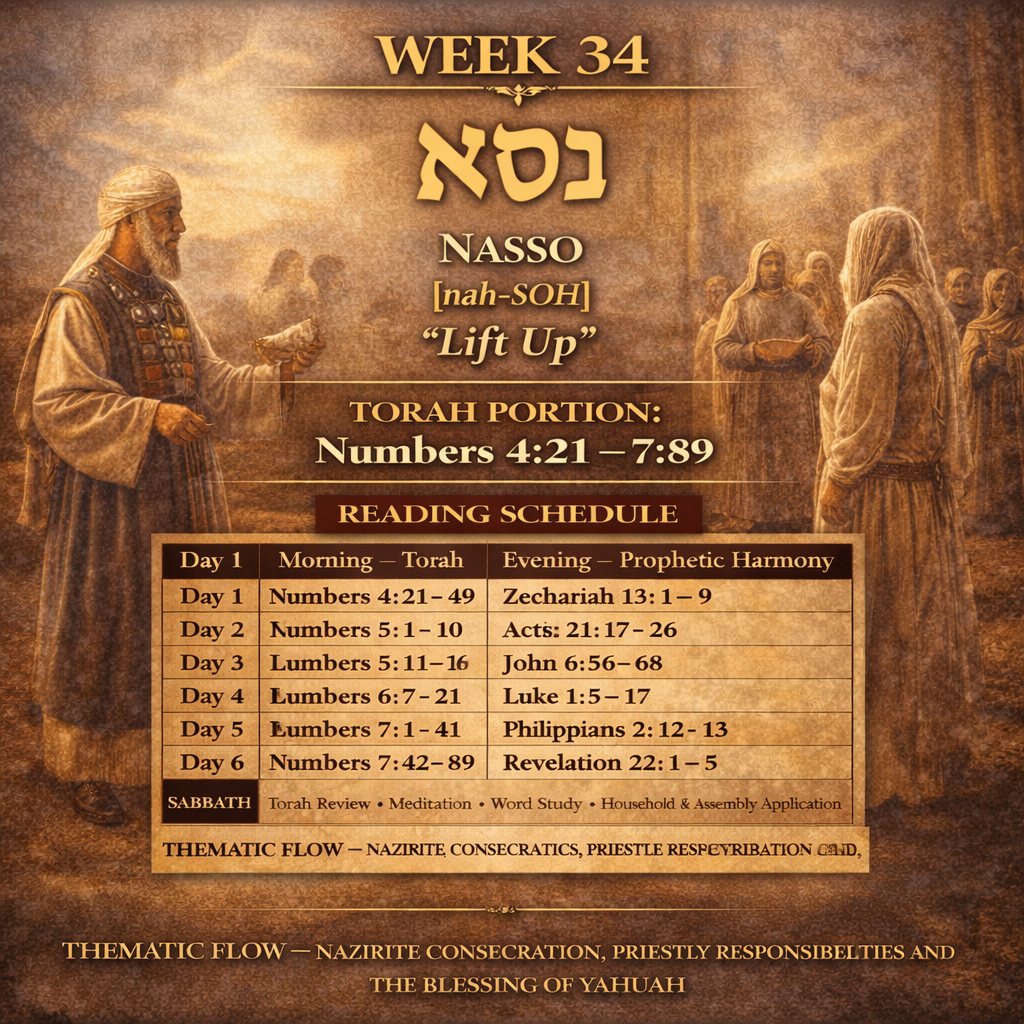
WEEK 34 — נָשֹׂא (Naso) [nah-SO] — “Lift Up / Take Up”
Torah Portion: Numbers 4:21 – 7:89
READING SCHEDULE
| Day | Morning — Torah | Evening — Prophetic Harmony |
| Day 1 | Numbers 4 : 21 – 49 | 1 Corinthians 12 : 1 – 27 |
| Day 2 | Numbers 5 : 1 – 10 | Psalm 15 |
| Day 3 | Numbers 5 : 11 – 31 | Hosea 2 : 14 – 23 |
| Day 4 | Numbers 6 : 1 – 21 | Acts 21 : 17 – 26 |
| Day 5 | Numbers 6 : 22 – 27 | John 17 : 1 – 26 |
| Day 6 | Numbers 7 : 1 – 89 | 2 Chronicles 7 : 1 – 10 |
| SABBATH | Torah Review · Meditation · Word Study | Household & Assembly Application |
THEMATIC FLOW — HOLINESS, CONSECRATION, AND BLESSING IN THE CAMP OF YAHUAH
Naso continues the organization of Israel’s wilderness encampment by assigning duties to the clans of the Levites. Each family — Gershon, Merari, Kohath — receives specific responsibilities for carrying, maintaining, and guarding the holy things. Holiness requires order, clarity, and reverence.
Numbers 5 extends this holiness outward into the camp itself. Those who are unclean must be set outside temporarily so the camp remains pure. Restitution laws affirm justice and integrity. The sotah (Numbers 5:11–31) reveals that Yahuah Himself judges hidden matters, protecting marriage and the purity of the community.
Numbers 6 introduces the Nazirite vow, a voluntary act of consecration that sets a man or woman apart for a period of devotion to Yahuah. Separation, restraint, and purity characterize this vow. The chapter culminates in the Priestly Blessing (6:22–27), one of the most profound declarations of covenant identity and divine favor.
Numbers 7 records the offerings of the tribal leaders for the dedication of the altar. Each tribe brings identical gifts, emphasizing unity, equality, and shared devotion. The portion concludes with Moshe entering the Tent of Meeting to hear Yahuah’s voice from above the mercy seat (7:89), anchoring the entire portion in divine communication.
Naso reveals that holiness governs individual responsibility, marital integrity, community purity, voluntary devotion, and corporate worship — all centered around Yahuah’s presence.
HEBREW WORD STUDY — נָשֹׂא (Naso)
Block: נשא Paleo: 𐤍𐤔𐤀 Root: נשא — “to lift,” “to carry,” “to bear,” “to take up”
| Letter | Symbol | Meaning | Prophetic Role |
| 𐤍 Nun | Seed | Life / continuation | Lifting up brings life and purpose |
| 𐤔 Shin | Teeth | Consume / press | Bearing responsibility with strength |
| 𐤀 Aleph | Ox | Strength / leader | Yahuah empowering those He calls |
Paleo Meaning:
“To lift up with strength and responsibility for covenant purpose.”
PROPHETIC PALEO-HEBREW WORD PICTURE
Naso signifies being lifted up into responsibility. Levites are lifted into service. Nazirites are lifted into consecration. Israel is lifted into blessing. The Paleo image shows life being carried with strength under divine authority — a picture of how Yahuah entrusts His people with holy assignments and sustains them as they bear His name.
SABBATH MEDITATION
Meditate on what it means to be “lifted up” by Yahuah — not for pride, but for purpose. Holiness requires purity, consecration, integrity, and unity. Naso invites us to walk in the blessing of Yahuah’s Name, to guard what is holy, and to embrace the responsibilities He gives.
REFLECTION AND DISCUSSION QUESTIONS
Heart (Individual)
- What responsibilities has Yahuah lifted me into in this season?
- Where do I need deeper consecration or purity?
- Do I carry His Name with reverence and integrity?
Household (Family)
- How can our home reflect the order, purity, and blessing found in Naso?
- Are we guarding holiness in our relationships and commitments?
Assembly (Corporate)
- Do we honor the distinct roles within the body of Messiah?
- Are we unified in our offerings, worship, and dedication?
PRAYER FOR SABBATH
Yahuah,
Lift us into the responsibilities You have chosen for us.
Make us a people of purity, devotion, and integrity.
Let Your blessing rest upon us —
Your protection, Your favor, and Your shalom.
Teach us to carry Your Name with holiness
as we walk in the order of Your covenant.
In Yahusha’s Name — Amein.
KEY THEMATIC INSIGHTS
Holiness Governs the Entire Camp
Numbers 5 shows that purity is not optional; the presence of Yahuah requires the camp to be guarded, disciplined, and cleansed.
Yahuah Judges Hidden Matters
The sotah procedure (Numbers 5:11–31) reveals that Yahuah protects marriage by exposing truth. Nothing hidden remains hidden before Him.
Consecration Is Voluntary but Weighty
The Nazirite vow (Numbers 6:1–21) calls individuals into deeper separation and devotion. Holiness requires restraint, purpose, and accountability.
The Priestly Blessing Establishes Identity
Numbers 6:22–27 declares Yahuah’s Name upon His people — blessing, protection, grace, and shalom are covenant gifts grounded in His presence.
Unified Offerings Reflect Corporate Devotion
The identical offerings of the tribal leaders (Numbers 7) demonstrate unity, equality, and shared dedication to the sanctuary.
FOOTNOTES
- Numbers 4 — duties of the Levite clans.
- Numbers 5 — purity in the camp and marital integrity.
- Numbers 6 — Nazirite vow and Priestly Blessing.
- Numbers 7 — offerings of the tribal leaders.
- Hosea 2 — restoration of covenant faithfulness.
