
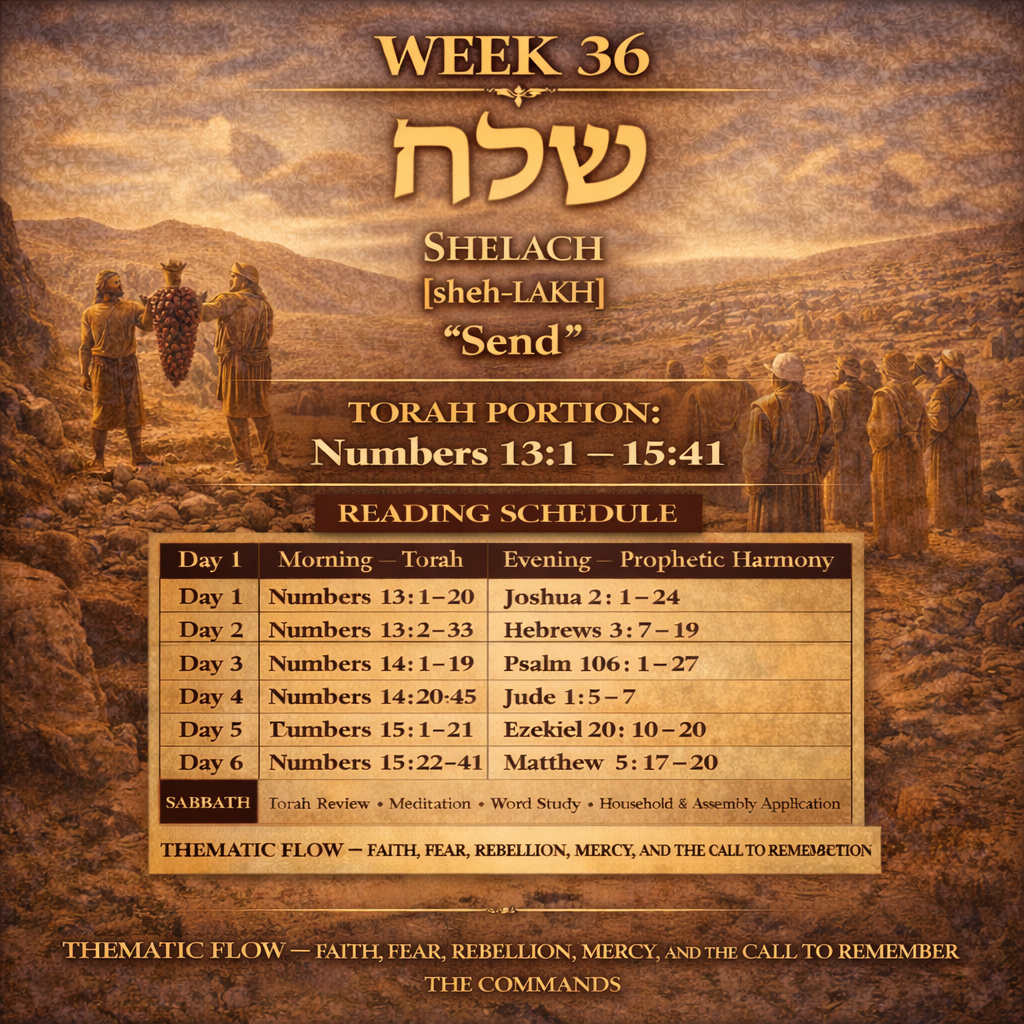
WEEK 36 — שְׁלַח (Shelach) [sheh-LAKH] — “Send”
Torah Portion: Numbers 13:1 – 15:41
READING SCHEDULE
| Day | Morning — Torah | Evening — Prophetic Harmony |
|---|---|---|
| Day 1 | Numbers 13 : 1 – 20 | Joshua 2 : 1 – 24 |
| Day 2 | Numbers 13 : 21 – 33 | Hebrews 3 : 7 – 19 |
| Day 3 | Numbers 14 : 1 – 19 | Psalm 106 : 1 – 27 |
| Day 4 | Numbers 14 : 20 – 45 | Jude 1 : 5 – 7 |
| Day 5 | Numbers 15 : 1 – 21 | Ezekiel 20 : 10 – 20 |
| Day 6 | Numbers 15 : 22 – 41 | Matthew 5 : 17 – 20 |
| SABBATH | Torah Review · Meditation · Word Study | Household & Assembly Application |
THEMATIC FLOW — FAITH, FEAR, REBELLION, MERCY, AND THE CALL TO REMEMBER THE COMMANDS
Shelach begins with Yahuah commanding Moshe to send twelve men — one from each tribe — to spy out the land of Kena’an. The mission is one of reconnaissance, confirmation, and encouragement, not doubt or fear. The land is indeed good, flowing with milk and honey.
But ten of the spies return with a report poisoned by fear, unbelief, and exaggeration. Their words spread discouragement, rebellion, and despair throughout the camp. Caleb and Yehoshua stand firm, urging Israel to trust Yahuah, but the nation chooses fear over faith.
Numbers 14 records the tragic consequences: Israel’s refusal to enter the land brings judgment. The generation of unbelief will wander forty years until they perish in the wilderness. Yet even in discipline, Yahuah shows mercy — He pardons Israel because of Moshe’s intercession.
Numbers 15 shifts from judgment to restoration. Offerings for unintentional sin, rules for native-born and sojourner alike, and the command regarding tzitziot (tassels) remind Israel to obey Yahuah’s commands, avoid following their own eyes, and remain a holy people. The case of the Sabbath-breaker shows that covenant boundaries must be honored.
Shelach reveals that faithlessness destroys destiny, rebellion delays promise, and obedience anchors identity. The portion ends with a call to remember — visually, continually — the commandments of Yahuah.
HEBREW WORD STUDY — שְׁלַח (Shelach)
Block: שלח Paleo: 𐤔𐤋𐤇 Root: שלח — “to send,” “to stretch out,” “to release”
| Letter | Symbol | Meaning | Prophetic Role |
|---|---|---|---|
| 𐤔 Shin | Teeth | Sharp / press | Testing and challenge |
| 𐤋 Lamed | Staff | Teach / guide | Divine direction in mission |
| 𐤇 Chet | Fence | Boundary / life | Protected purpose within covenant |
Paleo Meaning:
“A mission sent forth under divine authority with covenant boundaries.”
PROPHETIC PALEO-HEBREW WORD PICTURE
Shelach portrays a sending — a mission — intended to strengthen faith. The Paleo image reveals that being sent involves both testing (shin) and guidance (lamed) within covenant boundaries (chet). Israel’s failure lay not in the mission but in their response to it — choosing fear over faith and abandoning the boundaries of obedience.
SABBATH MEDITATION
Meditate on the contrast between the ten spies and Caleb/Yehoshua. Both saw the same land; only two believed Yahuah. The wilderness reveals whether we trust His promise or our perception. Shelach calls us to reject fear, remember covenant, and obey fully.
REFLECTION AND DISCUSSION QUESTIONS
Heart (Individual)
-
Am I responding to challenges with faith or fear?
-
Where has unbelief delayed what Yahuah intends for my life?
-
Do I remember His commandments or follow my own eyes?
Household (Family)
-
How can we cultivate a home of faith rather than fear?
-
Are we teaching the next generation to trust Yahuah’s promises?
Assembly (Corporate)
-
Does our community speak words of faith or words that discourage?
-
Are we submitting to Yahuah’s direction, even when the journey appears difficult?
PRAYER FOR SABBATH
Yahuah,
Teach us to walk by faith, not fear.
Guard our hearts from unbelief and rebellion.
Give us the spirit of Caleb and Yehoshua —
courageous, obedient, and confident in Your promise.
Help us remember Your commands
and walk in covenant faithfulness.
In Yahusha’s Name — Amein.
KEY THEMATIC INSIGHTS
Fear Rewrites Reality and Corrupts Destiny
Numbers 13 shows that the ten spies magnified the giants and minimized Yahuah. Fear distorts vision and destroys purpose.
Faithful Voices Are Often the Minority
Caleb and Yehoshua saw the same land but interpreted it through covenant confidence. Faith and fear cannot coexist.
Unbelief Brings Generational Consequences
Numbers 14 reveals that rebellion delays promises. The wilderness becomes the judgment for rejecting Yahuah’s word.
Yahuah’s Mercy Endures, Even in Discipline
Moshe’s intercession brings pardon, demonstrating that mercy exists even when consequences remain (Numbers 14:20).
Remembering the Commands Safeguards the Heart
The tzitziot command (Numbers 15:37–41) teaches Israel to avoid following their own eyes and to remain set-apart.
FOOTNOTES
-
Numbers 13 — spying out the land.
-
Numbers 14 — rebellion, judgment, and mercy.
-
Numbers 15 — offerings, Sabbath-boundaries, and tzitziot.
-
Joshua 2 — faithful reconnaissance contrasted.
-
Hebrews 3 — warning against unbelief.
