
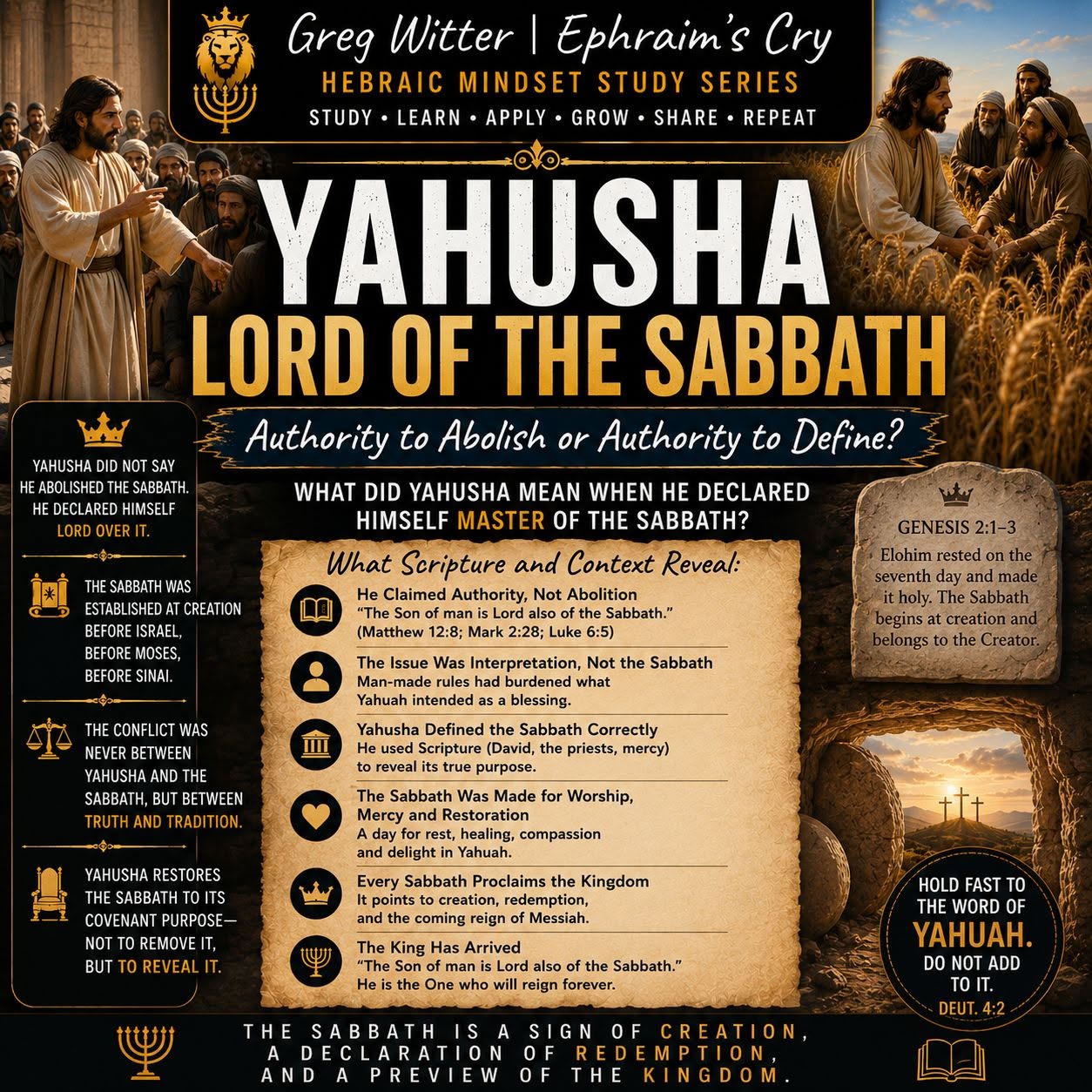
Lord of the Sabbath
Authority to Abolish or Authority to Define?
What Did Yahusha Mean When He Declared Himself Master of the Sabbath?
Greg Witter | Ephraim’s Cry
Hebraic Mindset Study Series
Study Learn Apply Grow Share Repeat
One of the most frequently quoted Sabbath passages in all of Scripture is Yahusha’s declaration that He is “Lord of the Sabbath.”
For many Christians, this statement has become proof that Yahusha abolished the Sabbath.
Others argue that because He is Lord of the Sabbath, He has the authority to change it.
Still others claim this statement proves believers are no longer required to observe it at all.
Yet none of those conclusions actually appear in the text.
The question is not what people assume Yahusha meant.
The question is what He actually said.
The statement appears in all three Synoptic Gospels.
Matthew 12:8:
“For the Son of man is Lord even of the Sabbath day.”
Mark 2:28:
“Therefore the Son of man is Lord also of the Sabbath.”
Luke 6:5:
“And he said unto them, That the Son of man is Lord also of the Sabbath.”
Notice what Yahusha does not say.
He does not say:
“I have abolished the Sabbath.”
He does not say:
“I will move the Sabbath.”
He does not say:
“The Sabbath no longer matters.”
He does not say:
“The Sabbath was temporary.”
Instead, He identifies Himself as Lord of it.
This raises an obvious question.
Can someone be Lord over something that no longer has value?
The statement itself assumes the continuing significance of the Sabbath.
A king rules a kingdom.
A master governs a household.
A shepherd oversees sheep.
A lord exercises authority over something that belongs under his administration.
Yahusha is not speaking against the Sabbath.
He is speaking about His authority concerning it.
The context is critical.
The statement comes immediately after the confrontation regarding grain plucking.
The Pharisees had accused the disciples of violating the Sabbath.
Yahusha responds by citing David.
He responds by citing the priests.
He responds by exposing their misunderstanding.
Then He declares Himself Lord of the Sabbath.
Why?
Because the issue is authority.
Who has the right to define proper Sabbath observance?
The Pharisees?
The traditions?
The schools of rabbinic interpretation?
Or the One through whom all things were made?
The confrontation is fundamentally about interpretation.
The religious leaders claimed authority to define the Sabbath through their traditions.
Yahusha claimed authority to define the Sabbath according to the intention of Yahuah.
That distinction changes everything.
The Sabbath was established long before Sinai.
Genesis 2:1-3 records:
“Thus the heavens and the earth were finished, and all the host of them. And on the seventh day Elohim ended his work which he had made;
and he rested on the seventh day from all his work which he had made. And Elohim blessed the seventh day, and sanctified it.”
The Sabbath begins at creation.
Before Israel.
Before Moses.
Before Sinai.
Before Judaism.
The Sabbath belongs to the Creator.
Therefore the One acting in complete submission to the Creator’s will possesses authority regarding its meaning and purpose.
Yahusha’s statement is therefore not a declaration of abolition.
It is a declaration of rightful authority.
This becomes even clearer when viewed alongside His other teachings.
Matthew 5:17 records:
“Think not that I am come to destroy the Torah, or the Prophets: I am not come to destroy, but to fulfill.”
The same Messiah who said He did not come to destroy Torah is the Messiah who declared Himself Lord of the Sabbath.
Those statements cannot be placed in opposition.
The authority of Messiah does not negate Torah.
The authority of Messiah correctly applies Torah.
This is exactly what we see throughout the Gospel accounts.
When Yahusha heals on the Sabbath, He is exercising lordship.
When Yahusha rebukes man-made restrictions, He is exercising lordship.
When Yahusha restores mercy, compassion, and covenant purpose to Sabbath observance, He is exercising lordship.
He is not destroying the institution.
He is cleansing it from corruption.
The irony is striking.
Many modern believers use “Lord of the Sabbath” as an argument against the Sabbath.
Yet in context it functions as an argument against false interpretations of the Sabbath.
The conflict was never between Yahusha and the Sabbath.
The conflict was between Yahusha and those who had distorted the Sabbath.
This pattern appears repeatedly throughout Scripture.
False religion often burdens what Yahuah intended to bless.
Human traditions often complicate what Yahuah made simple.
Religious systems often obscure what Yahuah intended to reveal.
The Sabbath was no exception.
Yahusha restores the Sabbath to its covenant purpose.
A day of worship.
A day of rest.
A day of mercy.
A day of healing.
A day of delight.
A day that points toward the coming Kingdom.
This prophetic dimension is often overlooked.
The Sabbath is not merely historical.
The Sabbath is prophetic.
Every seventh-day Sabbath proclaims a future reality.
Hebrews 4 connects Sabbath rest with the coming Kingdom rest.
The Sabbath points toward Messiah’s reign.
The Sabbath points toward restoration.
The Sabbath points toward the time when creation itself enters divine rest.
This helps explain why the Sabbath remains under attack.
The Sabbath testifies that Yahuah is Creator.
The Sabbath testifies that Messiah is King.
The Sabbath testifies that man’s kingdoms are temporary.
The Sabbath testifies that history is moving toward the Kingdom of Elohim.
Every Sabbath proclaims the future defeat of rebellion.
Every Sabbath proclaims the coming reign of the King.
The One who is Lord of the Sabbath is also the One who will reign over the Kingdom to which the Sabbath points.
Thus Yahusha’s statement is far greater than many realize.
It is not a declaration that the Sabbath is abolished.
It is a declaration that the King has arrived.
The One who established the purpose of the Sabbath now stands before them explaining it.
The issue was never whether the Sabbath should exist.
The issue was who had the authority to define it.
Yahusha’s answer was unmistakable:
“The Son of Man is Lord also of the Sabbath.”
That leads naturally into the next study:
The Sabbath Was Made for Man
What did Yahusha mean when He declared that man was not made for the Sabbath, but the Sabbath was made for man?
#Sabbath#Shabbat#LordOfTheSabbath#MasterOfTheSabbath#Yahusha#Torah#TorahStudy#HebraicMindset
#Matthew12#Mark2#Luke6#Genesis2#Hebrews4#KingdomRest#Creation#CovenantFaithfulness#WholeCounselOfElohim
#BiblicalSabbath#CommandmentsOfElohim#TraditionsOfMen#KingdomLiving#ReturnToCovenant#StudyScripture#WalkInTruth
#Yahuah#EphraimsCry#GregWitter#StudyLearnApplyGrowShareRepeat#KingdomOfYahuah#BiblicalTruth
