
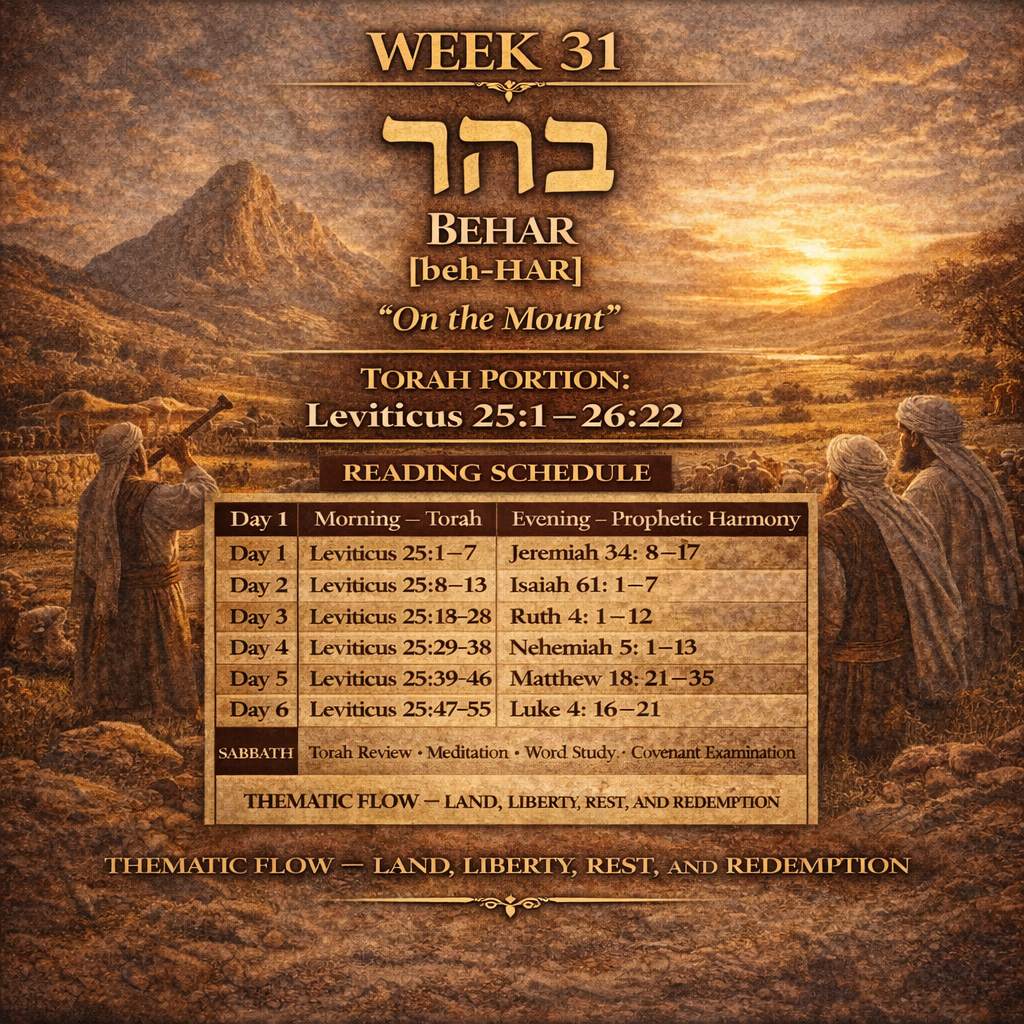
WEEK 31 — בְּהַר (Behar) [beh-HAR] — “On the Mount”
Torah Portion: Leviticus 25 : 1 – 26 : 2
READING SCHEDULE
| Day | Morning — Torah | Evening — Prophetic Harmony |
|---|---|---|
| Day 1 | Leviticus 25 : 1 – 7 | Jeremiah 34 : 8 – 17 |
| Day 2 | Leviticus 25 : 8 – 13 | Isaiah 61 : 1 – 7 |
| Day 3 | Leviticus 25 : 14 – 28 | Ruth 4 : 1 – 12 |
| Day 4 | Leviticus 25 : 29 – 38 | Nehemiah 5 : 1 – 13 |
| Day 5 | Leviticus 25 : 39 – 46 | Matthew 18 : 21 – 35 |
| Day 6 | Leviticus 25 : 47 – 55 | Luke 4 : 16 – 21 |
SABBATH | Torah Review · Meditation · Word Study | Household & Assembly Application
THEMATIC FLOW — SABBATH FOR THE LAND, JUBILEE, REDEMPTION, AND COVENANT FREEDOM
Behar opens with a deliberate reminder of authority: “And Yahuah spoke to Mosheh on Mount Sinai.” Though Israel is no longer physically at Sinai, the instruction given here is anchored in the same covenant authority as the Ten Words. This signals that the laws of land, debt, servitude, and release are not secondary ethics — they are foundational covenant commands.
The chapter introduces Shemitah, the Sabbath rest for the land. Just as mankind is commanded to rest on the seventh day, the land itself must rest in the seventh year. This establishes a radical covenant truth: the land belongs to Yahuah, not to its occupants. Israel is permitted to dwell in the land, but never to own it absolutely. Agricultural restraint becomes a test of trust — whether the people believe Yahuah will provide apart from endless production.
The Year of Jubilee (Yovel) intensifies this covenant rhythm. Every fiftieth year, land returns to its ancestral holders, debts are released, and Hebrew servants go free. This prevents permanent poverty, generational oppression, and economic tyranny. Jubilee reveals that covenant obedience actively restrains injustice and restores balance within the community.
Behar also establishes the legal framework for redemption (גְּאֻלָּה / ge’ullah). A close relative — the go’el — is given authority to redeem land or family members who have fallen into loss or servitude. This legal provision becomes one of the clearest Torah shadows of Yahusha, who redeems His people, restores inheritance, and proclaims liberty.
The portion ends by reaffirming covenant identity: “For the children of Yisra’el are My servants.” Israel cannot be enslaved permanently to men because they already belong to Yahuah. Any system — religious, political, or economic — that enslaves covenant people stands in opposition to Torah.
Behar teaches that holiness governs time, land, labor, debt, mercy, and trust. Covenant faith is not abstract belief; it is lived obedience that shapes an entire society.
HEBREW WORD STUDY — בְּהַר (Behar)
Block: בהר
Paleo: 𐤁 𐤄 𐤓
Root: הר (har) — mountain, elevated place
| Letter | Symbol | Meaning | Covenant Role |
|---|---|---|---|
| 𐤁 Bet | House | Dwelling | Covenant instruction belongs to Yahuah’s house |
| 𐤄 Hey | Breath | Revelation | Divine instruction revealed by Elohim |
| 𐤓 Resh | Head | Authority | Covenant authority flows from the Head |
Paleo Word Picture:
“From the house of Elohim, authoritative revelation is given.”
Prophetic Insight:
Behar reminds Israel that covenant law flows from divine authority, not human reasoning. Freedom, rest, and justice descend from above — they are not negotiated from below.
SABBATH MEDITATION
Sabbath confronts human fear. Behar asks whether Yahuah’s people truly trust His provision or whether they rely on constant production, accumulation, and control. The land’s rest exposes the heart. Jubilee challenges greed. Redemption confronts selfishness.
Sabbath becomes the weekly rehearsal of Jubilee — a declaration that Yahuah is Provider, Owner, and Redeemer. To refuse rest or release is to deny His sovereignty.
REFLECTION AND DISCUSSION QUESTIONS
Heart (Individual)
- Where does fear prevent me from resting or releasing control?
- Do I see myself as an owner or as a steward under Yahuah?
- Where is redemption needed in my life?
Household (Family)
4. Do we model trust, generosity, and release in our home?
5. How do we teach covenant freedom without entitlement?
Assembly (Corporate)
6. Does our assembly reflect covenant justice or worldly economics?
7. Are we proclaiming true liberty or enforcing dependence?
PRAYER / DECLARATION FOR SABBATH
Yahuah Elohim,
Owner of the land and Redeemer of Your people,
Teach us to trust You fully.
Break every form of bondage not established by You.
Restore what has been lost.
Write Jubilee into our hearts and lives.
We belong to You alone.
In Yahusha’s Name — Amein.
COVENANT MARKERS, JOTS & TITTLES & ALEPH–TAV
COVENANT MARKERS
Sabbath for the Land — Leviticus 25 : 2
Feature: Extension of Sabbath principle
Meaning: Creation order applied to land stewardship
Year of Jubilee — Leviticus 25 : 10
Word: יוֹבֵל
Meaning: Restoration, liberty, return
Redemption Clause — Leviticus 25 : 25
Word: גְּאֻלָּה
Meaning: Legal right of restoration
Servant Identity — Leviticus 25 : 55
Meaning: Israel belongs to Yahuah alone
JOTS & TITTLES
Numerical Structure — Leviticus 25 : 8–10
Seven cycles of seven years
Meaning: Covenant completeness leading to release
Repetition of “I am Yahuah” — Leviticus 25
Feature: Authority marker
Meaning: Law grounded in divine sovereignty
ALEPH–TAV MARKERS
Aleph–Tav — Leviticus 25 : 10
Marks liberty proclaimed throughout the land
Meaning: Covenant ownership of freedom
Aleph–Tav — Leviticus 25 : 38
Marks deliverance from Mitsrayim
Meaning: Redemption rooted in Exodus identity
Aleph–Tav — Leviticus 25 : 55
Marks Israel as covenant servants
Meaning: Eternal ownership by Yahuah
KEY THEMATIC INSIGHTS
The Land Belongs to Yahuah
Ownership is temporary; stewardship is covenant obligation.
Rest Is a Covenant Test
Shemitah exposes trust or fear in provision.
Jubilee Prevents Generational Oppression
Permanent loss is forbidden in covenant society.
Redemption Is Legal and Relational
The go’el restores inheritance by covenant right.
Freedom Is an Identity Issue
Israel is free because they belong to Yahuah.
WEEK SUMMARY
Week 31 (Leviticus 25 : 1 – 26 : 2) establishes covenant economics rooted in rest, trust, mercy, and restoration. Behar reveals that holiness governs land, time, labor, and freedom. Through Shemitah and Jubilee, Yahuah restrains oppression and restores inheritance. Redemption is revealed as a legal covenant act, foreshadowing Yahusha. This portion prepares Israel to face the covenant choice of obedience or consequence, fully unfolded in the following week.
FOOTNOTES
- The Sabbath principle extends beyond people to land.
- Jubilee interrupts unchecked accumulation and permanent loss.
- Redemption laws establish legal restoration within covenant.
- The go’el foreshadows Yahusha’s redemptive work.
- Israel’s servant identity forbids permanent enslavement.
- Trust in provision is a recurring covenant test.
- Liberty is proclaimed, not negotiated.
- Covenant economics differ from worldly systems.
- Exodus redemption remains the foundation of identity.
- Behar prepares the ground for Bechukotai’s covenant blessings and curses.
