
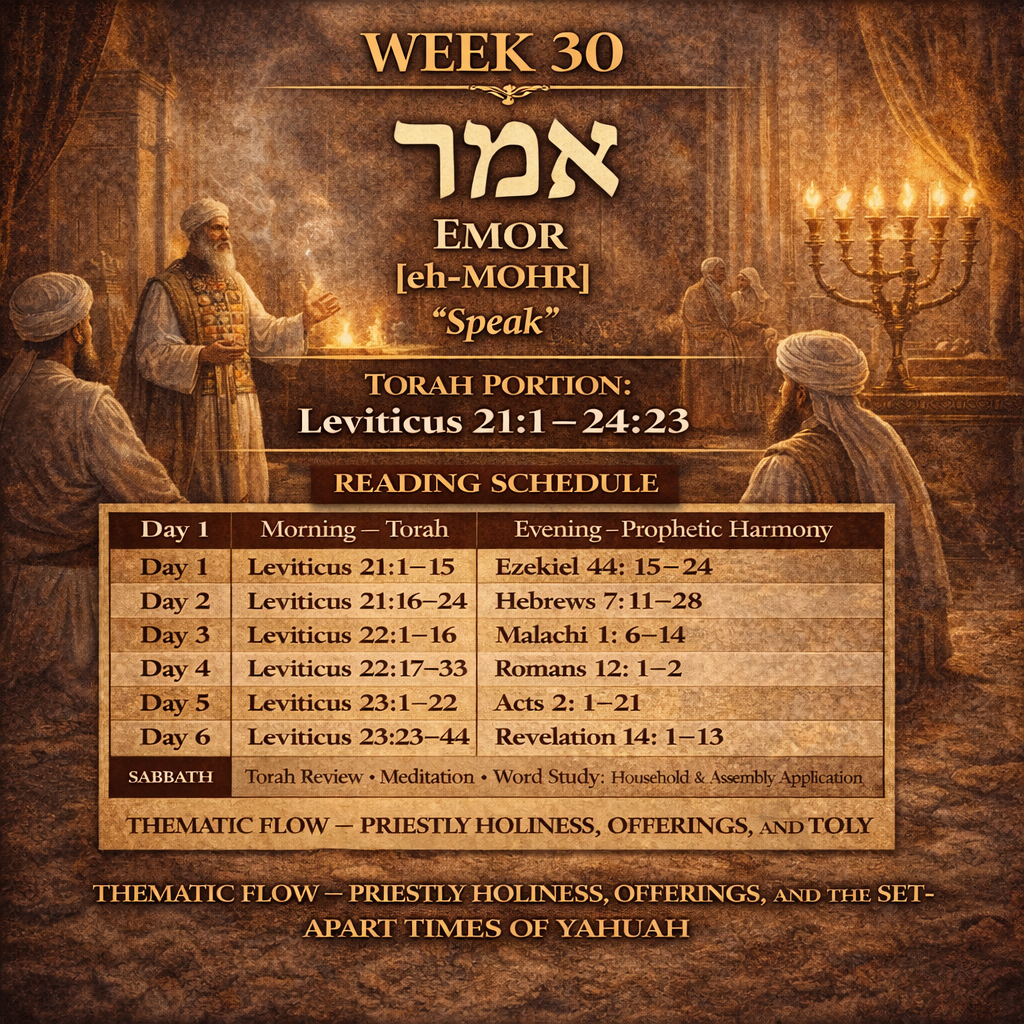
WEEK 30 — אֱמֹר (Emor) [eh-MOHR] — “Speak”
Torah Portion: Leviticus 21:1 – 24:23
READING SCHEDULE
| Day | Morning — Torah | Evening — Prophetic Harmony |
|---|---|---|
| Day 1 | Leviticus 21 : 1 – 15 | Ezekiel 44 : 15 – 24 |
| Day 2 | Leviticus 21 : 16 – 24 | Hebrews 7 : 11 – 28 |
| Day 3 | Leviticus 22 : 1 – 16 | Malachi 1 : 6 – 14 |
| Day 4 | Leviticus 22 : 17 – 33 | Romans 12 : 1 – 2 |
| Day 5 | Leviticus 23 : 1 – 22 | Acts 2 : 1 – 21 |
| Day 6 | Leviticus 23 : 23 – 44 | Revelation 14 : 1 – 13 |
| SABBATH | Torah Review · Meditation · Word Study | Household & Assembly Application |
THEMATIC FLOW — PRIESTLY HOLINESS, OFFERINGS, AND THE SET-APART TIMES OF YAHUAH
Emor focuses on three major themes: priestly holiness, acceptable offerings, and the appointed times. Leviticus 21–22 addresses the conduct of the priesthood, establishing boundaries for purity, marriage, mourning, and physical wholeness. The priests represent the people before Yahuah; therefore they must embody a higher standard of holiness.
Leviticus 22 clarifies which offerings are acceptable and under what conditions. Both the giver and the gift must meet covenant standards. Defective offerings dishonor Yahuah and undermine the meaning of sacrifice. Holiness in worship requires reverence, integrity, and obedience.
Leviticus 23 presents the Appointed Times — Yahuah’s calendar: Sabbath, Passover, Unleavened Bread, Firstfruits, Shavuot, Yom Teruah, Yom Kippur, and Sukkot. These moedim reveal Yahuah’s redemptive plan, structure Israel’s yearly rhythm, and call His people into covenant remembrance and prophetic anticipation.
Leviticus 24 addresses oil for the menorah, bread of the Presence, and the case of the blasphemer. Together, these elements show the ongoing responsibility to maintain the light, uphold covenant provision, guard holiness, and respond to rebellion with justice.
Emor reveals that holiness is expressed through leadership, worship, time, and community identity. Yahuah orders every dimension of life.
HEBREW WORD STUDY — אֱמֹר (Emor)
Block: אמר Paleo: 𐤀𐤌𐤓 Root: אמר — “to speak,” “to declare,” “to command”
| Letter | Symbol | Meaning | Prophetic Role |
|---|---|---|---|
| 𐤀 Aleph | Ox | Strength / leader | Yahuah as the source of the command |
| 𐤌 Mem | Water | Flow / nations | His word flowing into His people |
| 𐤓 Resh | Head | Person / authority | The authority to speak and live His word |
Paleo Meaning:
“The strong word of Yahuah flows forth with authority to shape His people.”
PROPHETIC PALEO-HEBREW WORD PICTURE
Emor begins with Yahuah saying, “Speak to the priests,” emphasizing that His word orders the life of those who draw near to Him. The Paleo picture shows strength moving through water to the head — a revelation of how Yahuah’s voice flows into His people, shaping their identity, worship, and obedience. Holiness begins with hearing and responding to His command.
SABBATH MEDITATION
Meditate on the fact that holiness begins with Yahuah’s spoken word. Emor calls us to listen, align, and live according to His instruction. The Appointed Times remind us that Yahuah governs time, redemption, and rhythm. The priestly call reminds us that those who draw near must reflect His character. Worship, offerings, and seasons all point to covenant order.
REFLECTION AND DISCUSSION QUESTIONS
Heart (Individual)
-
Am I living in alignment with the word Yahuah has spoken?
-
What areas of my life require greater purity or reverence?
-
Do I honor Yahuah’s Appointed Times as His calendar, not mine?
Household (Family)
-
How can our home observe and remember the moedim with purpose and joy?
-
Are we modeling the reverence and purity expected of those who draw near?
Assembly (Corporate)
-
Does our assembly teach and honor Yahuah’s Appointed Times?
-
Are we offering our best to Yahuah, or merely what is convenient?
PRAYER FOR SABBATH
Yahuah,
Speak to us,
and give us ears to hear Your word.
Make us a people who honor You in holiness,
in offerings,
and in the Appointed Times You have given.
Let Your light shine continually in our lives
as we walk in covenant obedience.
In Yahusha’s Name — Amein.
KEY THEMATIC INSIGHTS
Priestly Holiness as a Model for the Nation
Leviticus 21–22 establishes higher standards for the priesthood, teaching that those who draw nearest to Yahuah must embody purity, integrity, and reverence.
Acceptable Offerings Reflect the Heart of the Worshiper
Only unblemished offerings may be brought before Yahuah (Leviticus 22:17–25). The quality of the offering reflects the honor given to Yahuah.
The Appointed Times Reveal Yahuah’s Redemptive Order
Leviticus 23 outlines the moedim — Sabbath and the festivals — which structure Israel’s rhythm of worship and reveal the prophetic pattern of redemption.
The Lamp and the Bread Symbolize Continual Covenant Responsibility
Leviticus 24 commands perpetual light and continual bread before Yahuah, reminding Israel of their responsibility to maintain covenant fidelity and provision.
Holiness Commands a Response to Blasphemy and Rebellion
The judgment of the blasphemer (Leviticus 24:10–23) shows that Yahuah’s holiness demands justice and preserves the sanctity of His Name within the community.
FOOTNOTES
-
Leviticus 21 — standards for priestly conduct.
-
Leviticus 22 — acceptable offerings and covenant reverence.
-
Leviticus 23 — Yahuah’s Appointed Times.
-
Leviticus 24 — continual light, continual bread, and justice.
-
Ezekiel 44 — priestly distinctions and holiness.
