
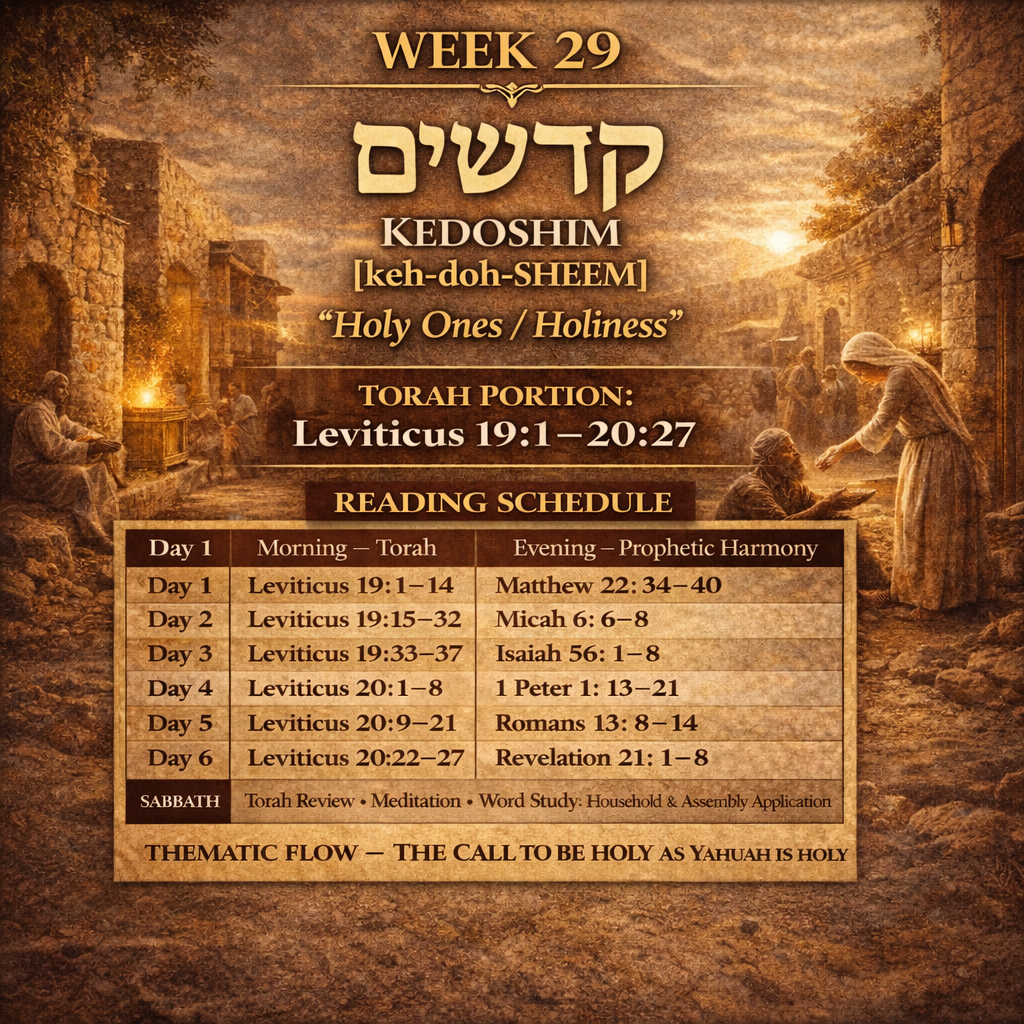
WEEK 29 — קְדֹשִׁים (Kedoshim) [keh-doh-SHEEM] — “Holy Ones / Holiness”
Torah Portion: Leviticus 19:1 – 20:27
READING SCHEDULE
| Day | Morning — Torah | Evening — Prophetic Harmony |
|---|---|---|
| Day 1 | Leviticus 19 : 1 – 14 | Matthew 22 : 34 – 40 |
| Day 2 | Leviticus 19 : 15 – 32 | Micah 6 : 6 – 8 |
| Day 3 | Leviticus 19 : 33 – 37 | Isaiah 56 : 1 – 8 |
| Day 4 | Leviticus 20 : 1 – 8 | 1 Peter 1 : 13 – 21 |
| Day 5 | Leviticus 20 : 9 – 21 | Romans 13 : 8 – 14 |
| Day 6 | Leviticus 20 : 22 – 27 | Revelation 21 : 1 – 8 |
| SABBATH | Torah Review · Meditation · Word Study | Household & Assembly Application |
THEMATIC FLOW — THE CALL TO BE HOLY AS YAHUAH IS HOLY
Kedoshim begins with the foundational command: “You shall be holy, for I Yahuah your Elohim am holy” (Leviticus 19:2). Holiness is not merely separation; it is reflection — Israel is called to reflect Yahuah’s character in daily life, relationships, worship, ethics, and community practice.
Leviticus 19 presents holiness through tangible actions: reverence for parents, Sabbath-keeping, rejecting idols, caring for the poor, honesty in judgment, integrity in speech, love for neighbor, and honoring Yahuah’s Name. Holiness is revealed in both worship and conduct, expressing the covenant identity of Yahuah’s people.
Leviticus 20 sets consequences for violating Yahuah’s boundaries. Idolatry, sorcery, sexual perversion, and covenant rebellion corrupt the land and the people. Israel is commanded to be distinct from the nations whose behaviors defile themselves and cause the land to expel its inhabitants. Holiness safeguards life and preserves covenant inheritance.
Kedoshim reveals that holiness reaches into the heart, the home, the community, the land, and every dimension of human experience. It is the lifestyle of a people set apart by Yahuah.
HEBREW WORD STUDY — קְדֹשִׁים (Kedoshim)
Block: קדשים Paleo: 𐤒𐤃𐤔𐤉𐤌 Root: קדש — “holy,” “set apart,” “consecrated”
| Letter | Symbol | Meaning | Prophetic Role |
|---|---|---|---|
| 𐤒 Qof | Back of head | Horizon / holiness | Set-apart distinction beyond the ordinary |
| 𐤃 Dalet | Door | Entry | The doorway into covenant identity |
| 𐤔 Shin | Tooth | Consume / fire | Refining fire of holiness |
| 𐤉 Yod | Hand | Work / action | Holiness expressed through deeds |
| 𐤌 Mem | Water | Flow / nations | Separation from nations through obedience |
Paleo Meaning:
“To enter the doorway into Yahuah’s refining presence, living set apart from the nations through obedient action.”
PROPHETIC PALEO-HEBREW WORD PICTURE
Kedoshim shows holiness beginning with entering the doorway into Yahuah’s presence, being refined by His fire, and walking in actions that distinguish His people from the nations. Holiness is not static; it flows outward, shaping life, conduct, and community.
SABBATH MEDITATION
Holiness is not optional — it is identity. Kedoshim challenges us to examine whether our lives reflect Yahuah’s character or cultural norms. Holiness is revealed in love, justice, purity, truthfulness, and obedience. The call is not simply to avoid impurity, but to pursue the character of Yahuah Himself.
REFLECTION AND DISCUSSION QUESTIONS
Heart (Individual)
-
Where is Yahuah calling me into deeper holiness?
-
Are my actions reflecting His character?
-
What boundaries must I restore in my personal walk?
Household (Family)
-
How can our home cultivate holiness in relationships, speech, and priorities?
-
Are we teaching and modeling holiness to the next generation?
Assembly (Corporate)
-
Is our community reflecting Yahuah’s holiness in practice and behavior?
-
Are we guarding the covenant boundaries Yahuah established?
PRAYER FOR SABBATH
Yahuah,
Make us holy as You are holy.
Refine our hearts, purify our actions,
and shape our lives to reflect Your character.
Teach us to walk in Your ways,
to honor Your Name,
and to guard the boundaries of covenant life.
In Yahusha’s Name — Amein.
KEY THEMATIC INSIGHTS
Holiness as Reflection of Yahuah’s Nature
The command, “You shall be holy, for I Yahuah your Elohim am holy” (Leviticus 19:2), establishes holiness as the identity of Yahuah’s people, rooted in His own nature.
Holiness Expressed Through Justice, Integrity, and Compassion
Commands concerning honest judgment, care for the poor, truthful speech, and love for neighbor (Leviticus 19:9–18) show holiness manifested in ethical action and relational righteousness.
Guarding the Sanctity of Worship and Identity
Prohibitions against idolatry, sorcery, and profaning Yahuah’s Name (Leviticus 19:26–31) protect Israel from practices that corrupt covenant identity.
Holiness in Relationships and Boundaries
Leviticus 20 outlines forbidden relationships and practices that defile individuals and community. Holiness safeguards family order, purity, and covenant continuity.
Holiness as Separation from the Nations
Israel is commanded not to imitate the nations whose abominations defile the land (Leviticus 20:22–26). Distinction preserves inheritance and covenant purpose.
FOOTNOTES
-
Leviticus 19 — practical holiness grounded in covenant identity.
-
Leviticus 20 — boundaries that safeguard purity and community life.
-
Micah 6 — justice, mercy, and humility as expressions of holiness.
-
1 Peter 1 — renewed call to holiness in Messiah.
-
Romans 1 — consequences of rejecting divine boundaries.
