
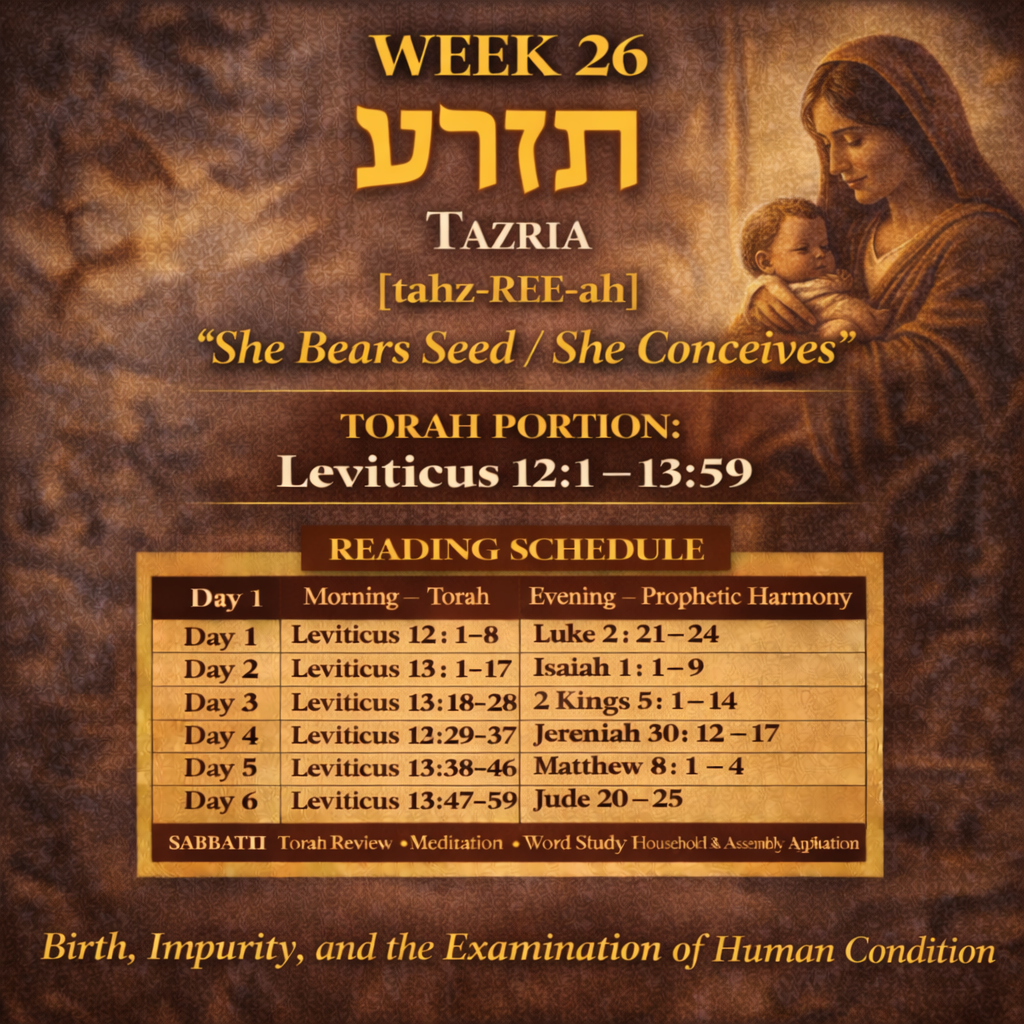
WEEK 26 — תַּזְרִיעַ (Tazria) [tahz-REE-ah] — “She Bears Seed / She Conceives”
Torah Portion: Leviticus 12:1 – 13:59
READING SCHEDULE
| Day | Morning — Torah | Evening — Prophetic Harmony |
|---|---|---|
| Day 1 | Leviticus 12 : 1 – 8 | Luke 2 : 21 – 24 |
| Day 2 | Leviticus 13 : 1 – 17 | Isaiah 1 : 1 – 9 |
| Day 3 | Leviticus 13 : 18 – 28 | 2 Kings 5 : 1 – 14 |
| Day 4 | Leviticus 13 : 29 – 37 | Jeremiah 30 : 12 – 17 |
| Day 5 | Leviticus 13 : 38 – 46 | Matthew 8 : 1 – 4 |
| Day 6 | Leviticus 13 : 47 – 59 | Jude 20 – 25 |
| SABBATH | Torah Review · Meditation · Word Study | Household & Assembly Application |
THEMATIC FLOW — BIRTH, IMPURITY, AND THE EXAMINATION OF HUMAN CONDITION
Tazria opens with the laws of childbirth (Leviticus 12), describing the periods of impurity following the birth of a male or female child. These laws are not punitive but covenantal, woven into the fabric of human life to teach Israel the distinction between the holy and the common, the clean and the unclean. Childbirth, though blessed, involves blood — and blood is linked to both life and the need for purification.
Leviticus 13 expands into the detailed laws of ṣaraʿat — commonly translated “leprosy,” though it encompasses a broader range of divinely diagnosed skin conditions, infections, and even afflictions of garments. The priest examines, discerns, isolates, and pronounces clean or unclean. This is not medical diagnosis; it is covenantal discernment. The condition symbolizes sin, decay, contagion, and the defilement that spreads when left unchecked.
Tazria reveals the deep truth about humanity: uncleanness can emerge from both natural processes (childbirth) and spiritual corruption (defiling conditions). Both require priestly oversight, humility, and obedience to Yahuah’s procedures for restoration. Nothing is left to self-diagnosis; the priest must observe, discern, and declare.
This portion underscores that holiness is not simply moral — it is embodied. It touches birth, skin, garments, and the rhythms of daily life. Israel learns that impurity cannot be ignored or hidden; it must be brought into the light, examined, and resolved according to Yahuah’s commands.
HEBREW WORD STUDY — תַּזְרִיעַ (Tazria)
Block: תזריע Paleo: 𐤕𐤆𐤓𐤉𐤏 Root: זרע — “seed,” “to sow,” “to conceive,” “to produce”
| Letter | Symbol | Meaning | Prophetic Role |
|---|---|---|---|
| 𐤕 Tav | Mark | Covenant / sign | The covenant mark placed on new life |
| 𐤆 Zayin | Weapon | Cut / separate | Separation of impurity from community |
| 𐤓 Resh | Head | Person / authority | Human condition examined under authority |
| 𐤉 Yod | Hand | Work / action | Priestly work of inspection and discernment |
| 𐤏 Ayin | Eye | Seeing / watching | Revelation of what is hidden beneath the surface |
Paleo Meaning:
“Through the covenant marking of new life, impurity must be cut away as the priest examines and reveals what lies beneath.”
PROPHETIC PALEO-HEBREW WORD PICTURE
Tazria speaks of sowing, birthing, and examining. Every life conceived bears the imprint of covenant, yet every life also encounters impurity that must be cleansed. The priest functions as the eye of Yahuah, discerning what lies beneath the surface, separating what must be removed from what may be restored. This portion foreshadows Yahusha, the true High Priest, who sees the hidden corruption of the heart and brings cleansing through truth and obedience.
SABBATH MEDITATION
Consider that impurity is not always the result of rebellion. Sometimes it emerges from simply living in a broken world. Tazria teaches that impurity must not be ignored, minimized, or self-managed. It must be acknowledged, examined, and restored through Yahuah’s appointed order. The path to holiness requires humility — a willingness to be inspected, corrected, and cleansed.
REFLECTION AND DISCUSSION QUESTIONS
Heart (Individual)
-
What impurities in my life need to be brought into the light?
-
Am I willing to submit to Yahuah’s process of examination and cleansing?
-
Where am I attempting to self-diagnose instead of seeking His discernment?
Household (Family)
-
How can our home cultivate practices of purity, honesty, and covenant distinction?
-
Are we teaching our household to address issues early rather than allowing them to grow?
Assembly (Corporate)
-
Do we create a culture where people can come forward for cleansing and restoration?
-
Are our leaders discerning and courageous enough to examine, separate, and restore according to Scripture?
PRAYER FOR SABBATH
Yahuah,
Examine us and reveal what lies beneath the surface.
Cleanse our hearts, our homes, and our assemblies.
Teach us to walk in purity and distinction
as we submit to Your appointed order.
Renew us in covenant life
and restore what impurity has touched.
In Yahusha’s Name — Amein.
KEY THEMATIC INSIGHTS
Birth and Covenant Identity
Childbirth introduces impurity not because life is sinful, but because blood and mortality intersect. Yahuah’s instructions teach Israel that every new life enters a world needing purification and covenant order (Leviticus 12:1–8).
Priestly Inspection and Discernment
The priest alone discerns between clean and unclean in cases of ṣaraʿat (Leviticus 13:2–17). This models the necessity of spiritual authority and divine procedure in diagnosing impurity.
Impurity as a Symbol of Hidden Corruption
The spreading of ṣaraʿat reflects how sin and defilement grow when not addressed. Israel learns that impurity is not merely external — it exposes deeper internal realities (Leviticus 13:18–28).
Isolation for Restoration
Yahuah commands periods of isolation not for punishment but for protection and restoration (Leviticus 13:4–6, 45–46). Separation preserves the community while giving space for healing.
Garments and the Contagion of Impurity
Even garments can bear ṣaraʿat (Leviticus 13:47–59), revealing that impurity can attach itself to one’s outer life — habits, environment, associations — requiring examination and cleansing.
FOOTNOTES
-
Leviticus 12 — purification after childbirth.
-
Leviticus 13 — priestly examination of skin afflictions.
-
Isaiah 1 — impurity as spiritual sickness.
-
2 Kings 5 — cleansing and humility in Na’aman’s healing.
-
Matthew 8 — Yahusha cleansing the leper and restoring community access.
