
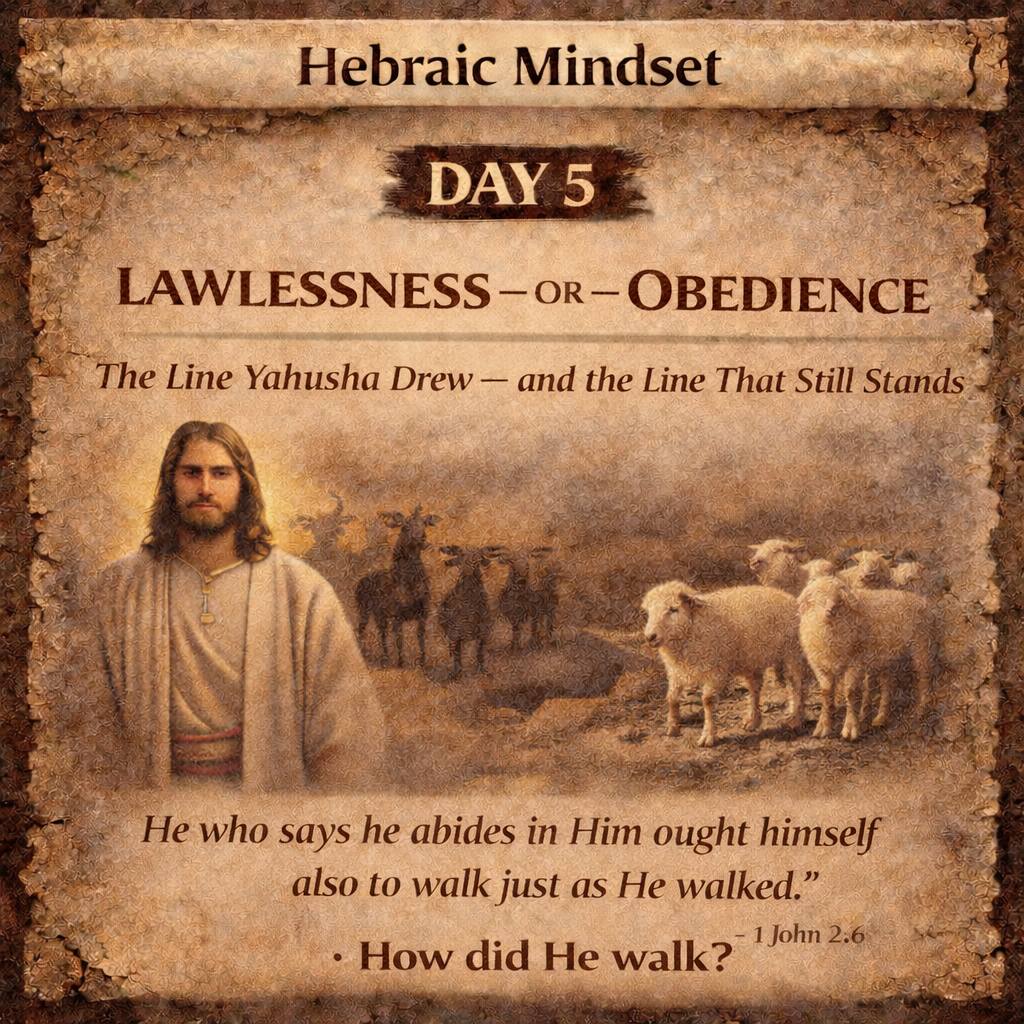
LAWLESSNESS OR OBEDIENCE
The Line Yahusha Drew — and the Line That Still Stands
Who truly belongs to Him
Greg Witter | Ephraim’s Cry
Hebraic Mindset Study Series
Study Learn Apply Grow Share Repeat
Orientation
Day One established the standard: all things must be tested by Torah and testimony.
Day Two exposed the failure: priesthood becomes corrupted when it departs from Torah.
Day Three revealed the consequence: rejected knowledge leads to rejection.
Day Four clarified the turning point: corrupted mediation judged, access restored through Yahusha.
Day Five now draws the final line—the line Yahusha Himself drew—and confronts the issue everything ultimately comes down to:
obedience versus lawlessness.
Scripture does not leave this undefined. Messiah did not leave it ambiguous. The modern confusion surrounding grace, faith, Spirit, and freedom exists because this line has been blurred. Today, Scripture restores it.
Messiah Defined the Problem Clearly
Matthew 7:21–23
“Not everyone who says to Me, ‘Lord, Lord,’ shall enter the kingdom of heaven, but the one who does the will of My Father who is in heaven…
And then I will declare to them, ‘I never knew you; depart from Me, you workers of lawlessness.’”
This passage is unavoidable.
Yahusha does not rebuke these people for:
lacking belief
lacking spiritual experiences
lacking religious language
They prophesied.
They cast out demons.
They performed works in His name.
Their condemnation rests on one charge: lawlessness.
The Greek term anomia means “without Torah.” Messiah identifies lawlessness—not ignorance—as the disqualifying issue.
Knowing Him Is Defined by Obedience
1 John 2:3–6
“By this we know that we know Him, if we keep His commandments.
The one who says, ‘I know Him,’ and does not keep His commandments, is a liar, and the truth is not in him.
The one who says he abides in Him ought himself also to walk just as He walked.”
John does not redefine knowing Elohim as emotion, confession, or affiliation. He defines it by obedience.
Three truths are made explicit:
Knowledge of Elohim is measurable
The measure is obedience to commandments
Walking as Yahusha walked is the expectation
This removes every subjective escape hatch.
Grace Trains Obedience — It Does Not Excuse Rebellion
Titus 2:11–14
Grace is often weaponized against obedience, but Scripture says the opposite:
“The grace of Elohim… teaches us to deny ungodliness and worldly lusts, and to live soberly, righteously, and set-apart in this present age… purifying for Himself a people zealous for good works.”
Grace is not permission.
Grace is training.
If grace does not produce obedience, it is not biblical grace.
The Spirit Writes Torah — He Does Not Replace It
Jeremiah 31:33; Ezekiel 36:26–27
The renewed covenant promise is explicit:
Torah is written on hearts
the Spirit causes obedience
The Spirit does not contradict Torah.
The Spirit internalizes it.
Any teaching that pits Spirit against Torah is false by definition.
The End-Time Definition of the Faithful
Revelation 12:17; Revelation 14:12
Scripture does not leave the identity of the faithful remnant vague:
“Those who keep the commandments of Elohim and hold to the testimony of Yahusha.”
This is the end-time standard.
Not faith alone.
Not works alone.
Covenant faithfulness.
Lawlessness Is Not a Small Error
Lawlessness is not a secondary issue. Scripture treats it as a covenant-breaking posture.
It nullifies repentance (Proverbs 28:13)
It corrupts worship (Isaiah 1:13–17)
It deceives the religious (Matthew 24:12)
It disqualifies the spiritually active (Matthew 7:23)
This is why Yahusha ends the discussion with departure, not debate.
The Final Covenant Question
Every teaching, every system, every life must answer one question:
Does this lead me to walk as Yahusha walked, or does it excuse what He never excused?
Scripture does not allow neutrality.
Faith without obedience is dead (James 2:17).
Love without commandments is false (1 John 5:3).
Spirit without truth leads to deception (John 4:24).
Watchman Conclusion
The torn veil restored access—but access increased accountability.
Yahuah removed corrupt mediation, not His instructions.
Yahusha fulfilled Torah, not erased it.
The Spirit empowers obedience, not independence.
The line still stands.
Those who belong to Yahusha:
hear His voice
keep His commandments
walk as He walked
Anything else is lawlessness—no matter how spiritual it sounds.
This series ends where Scripture ends the matter:
“Fear Elohim and keep His commandments, for this is the whole duty of man.”
— Ecclesiastes 12:13
#EphraimsCry #GregWitter #HebraicMindset #HebraicMindsetStudySeries #Obedience #Lawlessness #WalkAsHeWalked #Matthew723 #FirstJohn2 #Titus2 #Jeremiah31 #Ezekiel36 #Revelation1217 #Revelation1412 #CovenantFaithfulness #Watchman
