
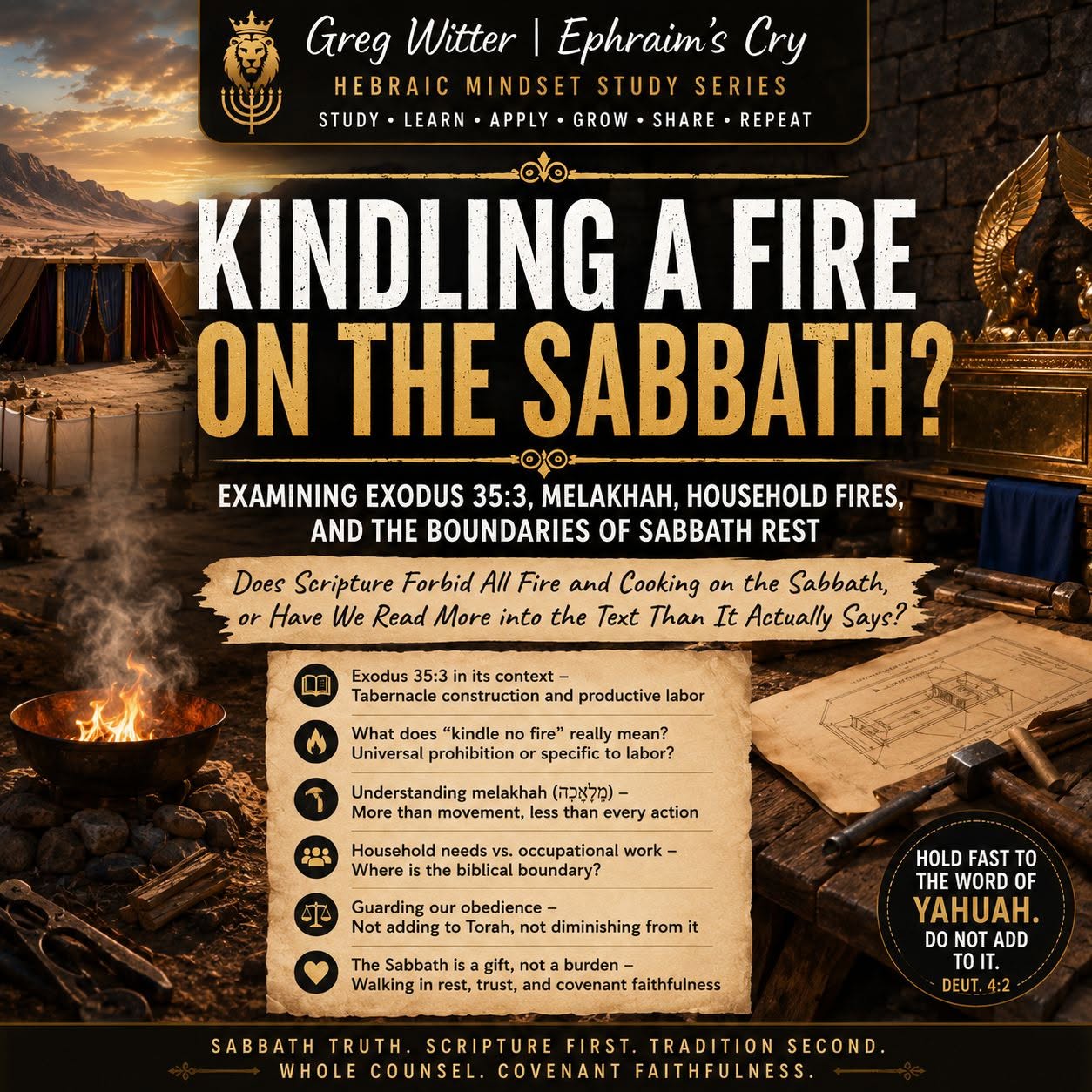
Kindling a Fire on the Sabbath?Examining Exodus 35:3, Melakhah, Household Fires, and the Boundaries of Sabbath Rest
Does Scripture Forbid All Fire and Cooking on the Sabbath, or Have We Read More into the Text Than It Actually Says?
Greg Witter | Ephraim’s Cry
Hebraic Mindset Study Series
Study Learn Apply Grow Share Repeat
If Exodus 16 is the primary text used to argue that all cooking is forbidden on the Sabbath, then Exodus 35:3 is usually the second passage brought into the discussion.
For many people, this verse appears to settle the matter immediately.
“You shall kindle no fire throughout your dwellings upon the Sabbath day.”
Exodus 35:3
At first glance the verse seems simple.
No fire.
No cooking.
Case closed.
Yet the moment we begin applying that interpretation consistently, significant problems emerge.
Does “no fire” mean no cooking fire?
Does it mean no heating fire?
Does it mean no lamp?
Does it mean no candle?
Does it mean no warmth during winter?
Does it mean no fire whatsoever under any circumstance?
If so, how did Israel survive in colder regions?
How did elderly people remain warm?
How did children remain protected?
How did anyone maintain light after sunset?
The fact that these questions arise should immediately tell us that the verse deserves deeper examination.
As always, context is king.
The danger in Bible study is not merely misunderstanding a verse.
The danger is isolating a verse from its context and then building an entire doctrine upon assumptions.
That is exactly what happens far too often in Sabbath discussions.
The first thing we must observe is where Exodus 35 appears.
The chapter opens with a restatement of Sabbath instructions.
Immediately afterward, Moses begins discussing the construction of the Tabernacle.
Exodus 35 is not a random collection of commandments.
It is a specific covenant context focused upon building the dwelling place of Elohim.
The people are preparing materials.
The people are gathering resources.
The people are contributing labor.
The people are bringing offerings.
The people are constructing sacred furnishings.
The entire surrounding context involves productive labor associated with building the Tabernacle.
This observation becomes extremely important because the Hebrew concept of melakhah consistently appears in contexts involving productive work, craftsmanship, construction, manufacturing, administration, and vocational activity.
The Torah repeatedly uses melakhah to describe purposeful work that produces, creates, builds, manages, or accomplishes an objective.
This is why understanding the Hebrew terminology is critical.
Many people define “work” according to modern assumptions.
Scripture defines work according to covenant context.
The Hebrew word most commonly associated with Sabbath prohibitions is melakhah (מְלָאכָה).
This word does not simply mean movement.
It does not mean effort.
It does not mean every physical action.
If it did, getting out of bed would violate the Sabbath.
Walking would violate the Sabbath.
Eating would violate the Sabbath.
Holding a child would violate the Sabbath.
The Torah never presents such a picture.
Rather, melakhah generally describes productive labor directed toward accomplishing a task, occupation, project, enterprise, or objective.
This becomes obvious throughout the Torah.
The craftsmen building the Tabernacle perform melakhah.
Administrators perform melakhah.
Builders perform melakhah.
Those engaged in productive vocational activity perform melakhah.
Therefore, when Exodus 35 prohibits kindling a fire, the immediate context strongly suggests that the fire is connected to productive labor occurring during Tabernacle construction.
Many ancient manufacturing activities required fire.
Metalworking required fire.
Tool production required fire.
Refining materials required fire.
Craftsmanship frequently required fire.
Construction projects frequently required fire.
The question therefore becomes:
Is Exodus 35:3 establishing a universal prohibition against every fire under all circumstances?
Or is it prohibiting fires associated with productive labor and construction activities during the Sabbath?
This is where honest students of Scripture must acknowledge that the text does not explicitly answer every question.
The verse itself is brief.
Interpretation requires examining the broader covenant framework.
What we can say with certainty is that the Torah repeatedly emphasizes cessation from ordinary productive labor.
What we cannot say with certainty is that Exodus 35 explicitly states:
“No food may ever be cooked on the Sabbath.”
Those exact words simply do not appear.
This does not automatically prove that cooking is unrestricted.
But neither does it prove that all cooking is prohibited.
The text simply does not say what many claim it says.
This distinction matters.
One of the greatest dangers in religious history has been the gradual elevation of interpretations into commandments.
Yahusha confronted this repeatedly.
Mark 7:7-9 records His rebuke:
“In vain do they worship me, teaching for doctrines the commandments of men.”
Notice what Yahusha condemned.
He did not condemn obedience.
He condemned replacing divine commandments with human traditions.
This creates an important balancing principle.
We must not loosen what Elohim has commanded.
But neither may we tighten what Elohim has not commanded.
Both errors distort covenant faithfulness.
One subtracts from Torah.
The other adds to Torah.
Both are dangerous.
This is why Sabbath discussions often become contentious.
One group fears becoming too permissive.
Another fears adding restrictions not found in Scripture.
Both concerns are legitimate.
The solution is not tradition.
The solution is careful textual study.
As we continue examining Sabbath observance, we must remember a foundational principle:
The burden of proof always belongs to the one claiming that something is commanded.
If Scripture explicitly commands it, we should obey it.
If Scripture explicitly forbids it, we should avoid it.
If Scripture does not explicitly address it, we should exercise caution before binding our personal conviction upon the entire body of believers.
The Sabbath is a gift.
The Sabbath is a delight.
The Sabbath is a covenant sign.
The Sabbath is not intended to become a burden of endless regulations that Scripture itself never imposed.
The next question therefore becomes even more important:
How did the prophets, Yahusha, and the Apostolic Witness define Sabbath violations?
What activities are actually identified as Sabbath-breaking throughout the rest of Scripture?
That is where our study must go next.
#Sabbath#Shabbat#Exodus35#KindlingAFire#Torah#HebraicMindset#Melakhah#BiblicalSabbath#SabbathRest
#TorahStudy#WholeCounselOfElohim#HebrewRoots#TraditionsOfMen#CommandmentsOfElohim#DoNotAddToTorah
#Exodus16#CovenantFaithfulness#KingdomLiving#BiblicalTruth#StudyScripture#ReturnToCovenant#AppointedTimes
#Moedim#Yahuah#Yahusha#EphraimsCry#GregWitter#StudyLearnApplyGrowShareRepeat#WalkInTruth#KingdomOfYahuah
